
When you hear someone mention “1st degree assault,” your mind probably jumps to a serious, intentional act of violence. You’re not wrong. In Georgia, this level of offense is typically prosecuted under the charge of aggravated assault, which is a felony that carries some heavy consequences. It’s a world away from a simple misunderstanding or a minor scuffle.
What a First Degree Assault Charge Means in Georgia

To really get a handle on the seriousness of a first-degree or aggravated assault allegation, it’s helpful to understand how it differs from lesser charges. Think of it this way: accidentally bumping into someone in a crowded hallway is one thing. Deliberately shoving them down a flight of stairs is something else entirely. The law sees it the same way, and the key factors that escalate a charge are almost always intent and the level of harm involved.
A simple assault might just be an action that makes someone fear they’re about to be hurt, while a simple battery involves actual, unwanted physical contact. But when an incident crosses a certain line, it jumps into serious felony territory.
To make this distinction clearer, let’s break down the different assault-related charges you might see in Georgia.
Georgia Assault Charges at a Glance
| Charge Type | Core Element | Typical Scenario Example |
|---|---|---|
| Simple Assault | Creating a reasonable fear of immediate violent injury in another person. No physical contact is required. | Shaking a fist in someone’s face during an argument and threatening to hit them. |
| Simple Battery | Intentionally making physical contact of an insulting or provoking nature, or causing physical harm to another. | Purposely shoving someone during a heated dispute at a sports game. |
| Aggravated Assault | Assault with a deadly weapon, with intent to murder/rape/rob, or by discharging a firearm from a vehicle. This is Georgia’s version of “first degree assault.” | Striking someone with a baseball bat, threatening someone with a knife during a robbery, or causing a permanent injury. |
As you can see, the jump to aggravated assault is significant and is defined by specific, dangerous circumstances.
Key Factors That Elevate an Assault Charge
The Georgia Code is very specific about what turns a standard assault or battery into the much more serious charge of aggravated assault. It usually boils down to one of these factors:
- Use of a Deadly Weapon: This is a big one. And a “deadly weapon” isn’t just a gun or a knife. It can be any object used in a way that’s likely to cause death or serious bodily harm—think a baseball bat, a heavy glass bottle, or even a car.
- Intent to Commit a Serious Crime: If an assault happens while someone is committing another felony, like a robbery or rape, it’s automatically treated as aggravated.
- Causing Serious Bodily Injury: The severity of the injury is a critical factor. An act that leads to disfigurement, the loss of a limb, or major impairment of a body part will almost certainly push the charge into the aggravated category.
- Discharging a Firearm from a Vehicle: The law specifically calls out firing a gun from a car toward another person as a form of aggravated assault.
This legal distinction is crucial because it separates minor altercations from acts the state views as a grave threat to public safety. The entire process following an arrest for such a charge is formal, confusing, and moves quickly. To get a better sense of what to expect right after an arrest, you can learn more about what happens when someone is arrested in our detailed guide.
An allegation of 1st degree assault, or aggravated assault, is a signal that the prosecutor believes the incident involved elements that are particularly dangerous, like a weapon, a specific criminal intent, or the infliction of major harm.
At the end of the day, this charge means the situation is serious. The sections that follow will break down the specific legal elements, potential penalties, and what comes next in more detail.
Breaking Down the Elements of the Offense
For a conviction for 1st degree assault—or what Georgia law actually calls aggravated assault—the prosecutor has to prove several key things. Think of it like a recipe. If the prosecution is missing even one of the main ingredients, known as “elements,” the whole case can fall apart.
A prosecutor has to establish each element beyond a reasonable doubt. For an aggravated assault charge, the core ingredients are usually an intentional act, the use of something like a deadly weapon, and the level of harm that was caused or intended. Let’s dig into what these terms actually mean when in a courtroom setting.
The Critical Role of Intent
Intent is all about what was going on in a person’s head. It’s the difference between accidentally tripping over someone’s foot and deliberately sticking a leg out to send them sprawling. But in assault cases, “intent” isn’t always so black and white.
It helps to think about the difference between specific intent and general intent.
- Specific Intent: This is like aiming a baseball directly at a neighbor’s prized picture window. A person has a very specific goal in mind: to shatter that exact window. In an assault case, this might mean an intent to cause a very specific, serious injury to someone.
- General Intent: This is more like swinging a baseball bat wildly in a packed room. The person might not be aiming for any one individual, but their actions are so reckless that they know it’s almost certain someone will get hurt. Here, the intent was simply to perform the reckless act itself.
For many aggravated assault charges, the prosecution just needs to prove an action was intentional and likely to cause harm, not that the specific result was planned out.
Defining a Deadly Weapon
When most people hear “deadly weapon,” their mind jumps to guns and knives. And while those definitely qualify, the legal definition in Georgia is far wider. Just about any object can be considered a deadly weapon, depending entirely on how it’s used.
A “deadly weapon” isn’t defined by what it is, but by how it is wielded. The focus is on the object’s capacity to produce death or serious bodily injury in the manner it was used.
Take a heavy glass beer mug, for example. On its own, it’s just something to drink out of. But if someone smashes it over another person’s head, it instantly becomes a deadly weapon in the eyes of the law. The same goes for:
- A baseball bat
- A steel-toed boot
- A heavy rock
- A car driven aggressively toward a person
The crucial question is always: in that specific situation, was the object capable of causing life-threatening harm or serious injury? This flexible definition means all sorts of everyday items can suddenly become the centerpiece of a 1st degree assault case.
This shows how the key elements of a 1st degree assault charge are connected.
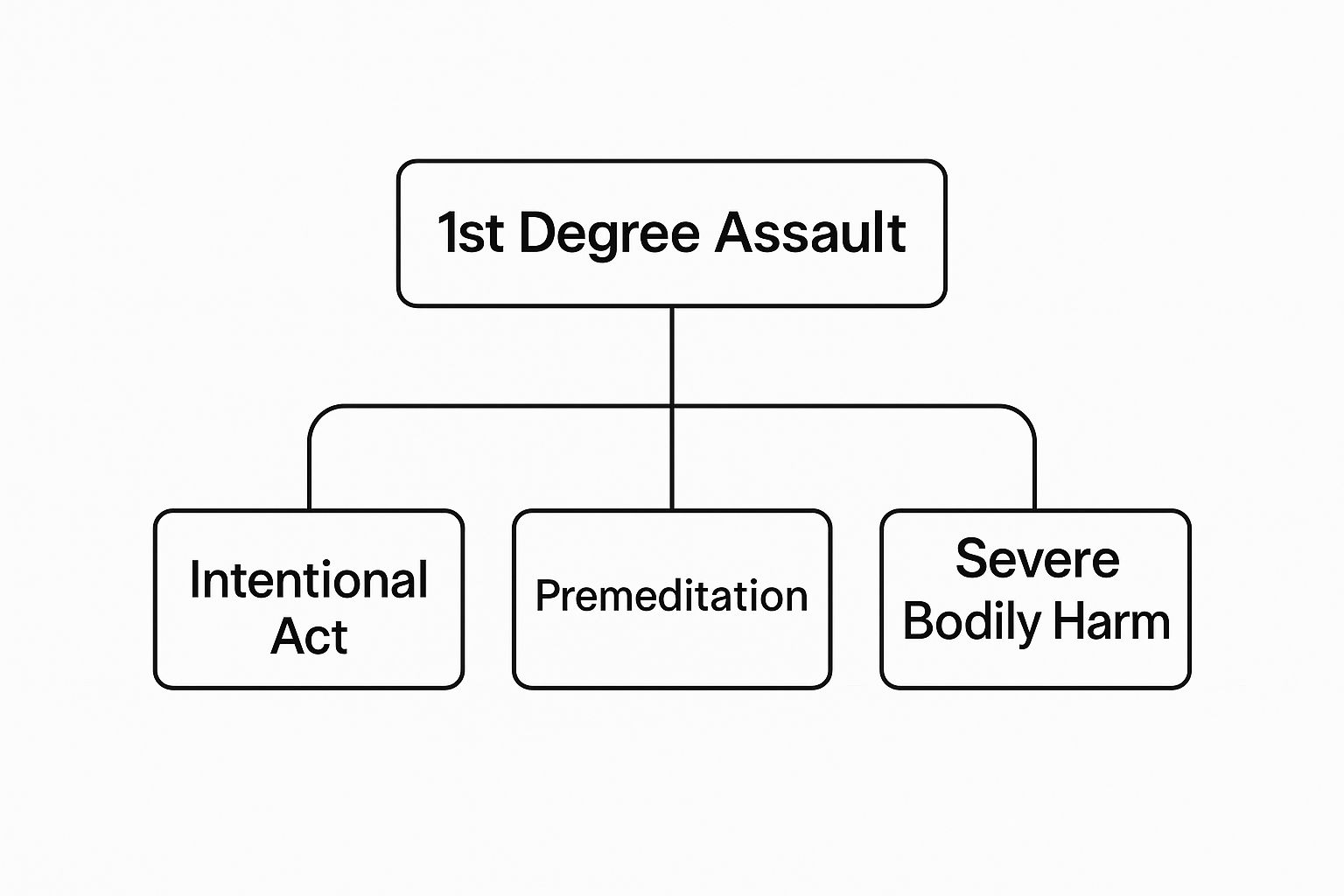
As you can see, the charge is built on the foundation of an intentional act, which is often combined with a weapon or results in severe harm.
Understanding Serious Bodily Injury
The last major piece of the puzzle is the level of harm. A minor bruise or a small scrape isn’t going to cut it for an aggravated assault charge. The law requires serious bodily injury, a legal standard that points to a much more severe outcome.
So, what counts as “serious”? While there isn’t a complete checklist, it generally includes any harm that:
- Creates a substantial risk of death.
- Causes permanent disfigurement.
- Leads to the loss or impairment of a bodily function or organ.
A broken arm, a deep gash requiring dozens of stitches, or an injury that causes blindness would almost certainly meet this standard. A punch that just leaves a temporary mark likely would not. This distinction is one of the clearest lines separating a simple misdemeanor battery from a life-altering felony aggravated assault charge.
All three of these elements—intent, the weapon, and the injury—are woven together. They create the story the prosecutor will try to tell the jury. Understanding each part is the first step in seeing how a situation can quickly escalate into a 1st degree assault allegation.
Real-World Scenarios Leading to Charges

It’s one thing to read legal definitions of intent, deadly weapons, and serious bodily injury. It’s another thing entirely to see how those concepts play out in the real world. A simple argument can spiral out of control faster than anyone expects, crossing the line from a minor disagreement into a serious felony charge for 1st degree assault—what Georgia law calls aggravated assault.
To connect the dots, let’s walk through a few examples. These hypothetical scenarios show just how quickly the legal landscape can shift based on a single action, like picking up an object or using too much force. They’re designed to show how the legal elements we’ve talked about come together in situations people might actually find themselves in.
The Bar Argument That Goes Too Far
Picture this: two guys, Alex and Ben, are arguing over a football game at a bar. It gets heated, and they take it to the parking lot. The shouting turns into shoving. At this point, it’s probably just a simple battery charge, a misdemeanor.
But then Alex, feeling backed into a corner, grabs an empty glass beer bottle. He swings it and hits Ben in the head. Ben goes down, bleeding from a deep cut and showing signs of a concussion. He needs an ambulance.
Right there, all the pieces for an aggravated assault charge fall into place. That glass bottle, when used to bash someone’s head, is absolutely a deadly weapon. Alex’s action was intentional, and it caused a serious bodily injury. The simple scuffle is now a felony investigation, and a 1st degree assault charge is almost certain.
Domestic Disputes and Escalated Harm
Sadly, many serious assault charges start at home. Imagine a married couple, Sarah and Tom, are in the middle of a bad argument. Tom, in a fit of rage, throws a heavy book across the room. It misses Sarah and just breaks a lamp. That alone probably isn’t aggravated assault.
But the fight continues. Tom then intentionally shoves Sarah hard, and she stumbles backward, falling over a coffee table and breaking her arm. A broken bone almost always qualifies as a serious bodily injury. Even if Tom swears he never meant to break her arm, his intentional act of shoving her is what caused the severe injury.
This is a critical point: the prosecutor doesn’t always have to prove the accused intended the specific injury. Proving they committed an intentional physical act that resulted in a serious injury is often enough to secure an aggravated assault conviction.
When a Vehicle Becomes a Weapon
We all drive cars every day, but the moment a driver uses one to threaten or harm someone, it legally becomes a deadly weapon. Let’s look at a road rage scenario. A driver, Kevin, cuts off another driver, Maria. Maria is furious and follows him into a shopping center parking lot.
Instead of getting out to yell, she floors it, ramming her car into the back of Kevin’s just as he’s stepping out. His leg is pinned between the vehicles, and the impact causes a severe fracture.
In this scenario, Maria used her 2,000-pound car as a weapon to inflict harm. Her intent is clear from the action, she used a deadly weapon (the car), and she caused a serious bodily injury. It’s a textbook example of how an ordinary object can be used to commit a 1st degree assault.
These aren’t just abstract examples. Real-life data shows how often these situations occur. For example, the National Intimate Partner and Sexual Violence Survey reported that in a single year, there were approximately 734,630 rapes in the U.S., many of which fall under the umbrella of 1st degree assault due to the violence involved.
Seeing how these complex situations have been handled in the past can offer valuable perspective. You can explore a variety of our informational case results to better understand the range of possible outcomes.
Understanding the Potential Consequences
When someone is facing a charge for 1st degree assault—what Georgia law calls aggravated assault—they’re up against more than just a court date. They are confronting penalties that can completely reshape a life. A conviction isn’t a single event; it creates a ripple effect that touches everything, from freedom and finances to future opportunities.
The fallout really splits into two parts. First, there are the immediate, court-ordered sentences. Then come the long-term, collateral consequences that can follow a person for years, long after any debt to society has been paid. It’s critical to understand both to see the whole picture.
Immediate Sentences Under Georgia Law
In Georgia, aggravated assault is a felony. That classification alone tells you it’s one of the most serious offenses on the books, and the penalties are designed to match.
The exact sentence will always depend on the specifics of the case, but the standard sentencing range for an aggravated assault conviction is anywhere from one to 20 years in prison. On top of that, courts can impose heavy fines, adding a significant financial blow.
But that’s not all. Certain factors can trigger mandatory minimum sentences, tying a judge’s hands and making prison time a certainty if a conviction occurs.
- Assaulting a police officer: This carries a mandatory minimum of five years behind bars.
- Assaulting a person over 65: The law requires a minimum sentence of three years.
- Using a firearm from a vehicle: If a firearm is discharged from a car at someone, the person is looking at a mandatory minimum of five years.
When a mandatory minimum is involved, there’s no room for negotiation on that portion of the sentence. It’s a hard floor that the court cannot go below.
A felony conviction is more than a punishment; it’s a permanent mark on a person’s record that fundamentally changes how society interacts with them. The consequences extend far beyond prison walls and court-ordered fines.
The Lasting Impact of a Felony Record
For many, the real challenges of an aggravated assault conviction begin after their official sentence is served. These are often called “collateral consequences”—the civil and social penalties that come with having a felony on a permanent record. The impact is staggering and can feel endless.
Probation is another major piece of the puzzle, often tacked on after a prison term. It comes with its own strict set of rules, and any violation can send a person right back to jail. To get a better handle on this, take a look at our guide on the differences between felony and misdemeanor probation in Georgia.
Here’s a breakdown of just some of the ways a felony conviction can follow someone.
Long-Term Impacts of a Felony Conviction
A felony conviction isn’t just a legal status; it’s a label that can close doors that were once wide open. The table below outlines some of the most common and difficult collateral consequences people face.
| Area of Impact | Potential Consequence | Explanation |
|---|---|---|
| Employment | Difficulty finding a job. | Most employers run background checks. A violent felony like aggravated assault can get an application tossed out immediately, regardless of qualifications. |
| Housing | Challenges securing housing. | Landlords also run background checks and are often hesitant to rent to someone with a felony record, making it incredibly hard to find a safe place to live. |
| Civil Rights | Loss of certain rights. | In Georgia, convicted felons lose the right to vote while serving their sentence (including probation/parole), the right to hold public office, and the right to own a firearm. |
| Social Stigma | Lasting social judgment. | The stigma of a felony can strain relationships with friends, family, and the community. It’s a heavy weight to carry every single day. |
These consequences create a constant uphill battle. Simple, everyday tasks like applying for an apartment or a new job become massive hurdles. It goes to show that even after a sentence is complete, the true “debt to society” can feel like it’s being paid for a lifetime.
Common Defenses Explained in Assault Cases

When someone is facing a charge as serious as 1st degree assault, it’s crucial to remember that an accusation is not a conviction. For educational purposes, we’ll walk through some of the common arguments that can be raised in response to these allegations. Each defense is built on a specific set of facts and a logical framework.
The success of any defense hinges entirely on the unique details of what happened. Think of these concepts as different ways to structure and present a counter-narrative to the prosecution’s story. This isn’t a substitute for specific guidance, but an overview to help understand the strategic thinking behind a strong defense.
The Principle of Self-Defense
One of the most intuitive defenses is self-defense. The core idea is simple: a person has a right to protect themselves from imminent harm. But this isn’t a free pass to use unlimited force. The key is proportionality—the force used must be reasonable in the face of the threat.
Imagine this scenario: Jane is walking to her car in a dark parking garage. Suddenly, a man jumps out, waving a knife and demanding her wallet. If Jane grabs a heavy object from her purse and strikes the attacker’s arm, making him drop the knife and run, her actions would almost certainly be seen as justified self-defense. She used a reasonable level of force to neutralize an immediate threat of serious injury.
When evaluating a self-defense claim, these elements are always under the microscope:
- Imminent Threat: Was the danger happening right now? Self-defense doesn’t apply to a threat that happened yesterday or might happen next week.
- Reasonable Fear: Did the person genuinely believe they were about to be harmed?
- Proportional Force: Was the response excessive? Using a level of force far beyond what was necessary to stop the threat can invalidate a self-defense claim.
Defense of Others and Property
The law also recognizes the right to protect other people from harm, not just oneself. This is known as defense of others, and it follows the same rules of immediacy and proportionality. If someone sees another person being attacked, they may be justified in using reasonable force to step in and stop it.
For example, a father who sees a stranger trying to pull his child into a van can use physical force to stop the abduction. His actions would be a clear-cut case of defending another person, as he reasonably believed his child was in immediate danger.
At the heart of both self-defense and defense of others is the concept of necessity. The argument is that the actions taken, while potentially causing harm, were necessary to prevent a greater, more immediate harm from occurring.
Challenging the Element of Intent
As we’ve covered, intent is a critical piece of a 1st degree assault charge. A powerful defense can be built by arguing that the person simply didn’t have the required criminal intent to cause serious harm. This doesn’t always mean it was a complete accident, but that the specific intention to commit an aggravated assault wasn’t there.
Think about two friends having a heated argument. One of them, gesturing wildly while holding a glass, accidentally hits the other, causing a cut. Yes, an injury occurred, but a strong case could be made that there was never any intent to use the glass as a weapon. The action was careless, not malicious in the way the law requires for a felony assault charge.
The Issue of Mistaken Identity
Sometimes, the most straightforward defense is the most effective: “It wasn’t me.” Mistaken identity argues that the police simply arrested the wrong person. This isn’t just a denial; it involves actively showing flaws in how the accused was identified.
This defense often comes into play when:
- The incident happened quickly or in poor lighting.
- An eyewitness description is vague or could match many people.
- There is no physical evidence like fingerprints or DNA to connect the accused to the crime.
If a victim picks an attacker out of a photo lineup, but the accused has a rock-solid alibi proving they were miles away, the case would center on mistaken identity. The focus shifts entirely from debating the assault to proving the accused couldn’t possibly have been the one who did it.
Commonly Asked Questions About First Degree Assault
When a person is looking into a serious charge, questions and confusion are completely normal. To help bring some clarity, here are answers to some of the most common questions about 1st-degree assault in Georgia—which the law officially calls aggravated assault.
What Is the Main Difference Between Simple and First Degree Assault?
The real difference between simple assault and first-degree (or aggravated) assault comes down to the level of danger and the specific circumstances. It’s like the difference between a verbal threat that makes someone feel unsafe versus an action that could genuinely end a life.
A simple assault in Georgia might be an act that makes someone reasonably believe they’re about to be hurt. But an aggravated assault charge is a whole different ballgame. It almost always involves one of these elements:
- Using a deadly weapon.
- The intent to commit another major felony, like a robbery.
- Causing a serious bodily injury to someone.
In short, the presence of a weapon or significant physical harm is what elevates a misdemeanor scare into a serious felony charge.
Can Someone Be Charged if the Other Person Was Not Actually Hurt?
Yes, absolutely. This surprises a lot of people, but a person can face an aggravated assault charge even if nobody was physically injured. The law cares just as much about the intent and the potential for severe harm as it does the final result.
For example, if someone fires a gun toward another person but misses, that act alone can still trigger a 1st-degree assault charge. The thinking is that the person showed a clear intent to cause violent injury and used a deadly weapon to do it. The attempt is often punished just as harshly as a successful attack because the potential for a deadly outcome was there.
The legal system recognizes that a failed attempt to cause serious harm can be just as dangerous as a successful one. The charge can hinge on what could have happened based on the defendant’s actions.
Does a Deadly Weapon Have to Be a Gun or a Knife?
No, and this is a critical point that trips many people up. While guns and knives are the classic examples, Georgia’s legal definition of a “deadly weapon” is much broader. Just about any object can be considered a deadly weapon depending entirely on how it is used.
The key question is whether the object, in the way it was handled, was likely to cause death or serious bodily harm. This means everyday items could easily qualify, such as:
- A baseball bat used to strike someone.
- A heavy glass bottle or a rock.
- A vehicle driven aggressively at a pedestrian.
- Steel-toed boots used to kick someone repeatedly.
The focus isn’t on what the object was designed for, but on its capability to inflict severe damage in that specific situation.
What Generally Happens After an Arrest for First Degree Assault?
Getting arrested for a felony like aggravated assault kicks off a formal, complicated process. This isn’t something that gets resolved informally or goes away overnight.
After an arrest, a fairly standard sequence of events begins:
- Booking: The person is taken to a law enforcement facility to be processed. This is where fingerprints and a mugshot are taken.
- First Appearance: Within 24 to 72 hours, the accused goes before a judge. In this hearing, the judge reads the charges and makes a decision about bond.
- Formal Charges: The prosecutor’s office will formally file the charges. For a felony, this often involves presenting the case to a grand jury to secure an indictment.
- Discovery: This is the pre-trial phase where both sides—the prosecution and the defense—exchange all the evidence they have. This includes police reports, witness statements, and anything else relevant to the case.
This whole process is governed by very strict legal rules and deadlines. It’s the official start of a criminal case that will move through the court system toward either a plea agreement or a trial. Every step matters and helps shape the direction the case will go.
Trying to make sense of a first-degree assault charge can feel like an uphill battle. If you or someone you care about is in this situation, having experienced legal guidance is not a luxury—it’s a necessity. At Brian Hansford Law, we’re committed to defending your rights and making sure your side of the story is heard. For a confidential talk about your case, visit us at https://challengemycharge.com.
Article created using Outrank
