
A second DUI arrest usually doesn't feel like a repeat of the first one. It feels heavier. You're thinking about jail, your license, your job, your family, and whether the court will assume the worst before your lawyer ever gets to speak.
For many people in Alpharetta, Roswell, Johns Creek, Milton, Cumming, Sandy Springs, Marietta, and Duluth, the panic starts the same night. The car is towed. Bond gets discussed. A court date appears. Then the actual problem sets in. A second DUI in Georgia can trigger mandatory penalties, fast-moving license consequences, and a prosecution strategy built around the idea that you've already had one warning.
The Shock of a Second DUI Arrest in Georgia
The second stop is different from the first. The officer usually treats it that way. The booking process feels less like a mistake and more like the start of a serious criminal case.

People charged in North Atlanta courts often tell me the same thing. They aren't only worried about the DUI itself. They're worried about missing work in Fulton County, getting to school drop-off in Forsyth County, or explaining a second arrest to a spouse who thought the first case was behind them.
That fear makes sense. Georgia treats repeat DUI allegations seriously because repeat offenders are overrepresented in fatal crashes, and the risk of an alcohol-related collision increases by about 20% with each subsequent conviction, according to this discussion of repeat offender crash risk. That policy choice affects everything that follows. Police, prosecutors, and judges tend to view a second arrest through a harsher lens.
Why early hours matter
The first decisions after arrest can help or hurt both parts of your case. What you say to police, what paperwork you ignore, and whether you act on your license deadlines all matter.
Practical rule: A second DUI is never just one case. It is a criminal prosecution and a license problem at the same time.
What usually goes wrong
A lot of damage happens before the first court date:
- People wait too long: They assume the court date is the only deadline that matters.
- They focus only on jail: In reality, losing the ability to drive can disrupt work and family faster than the criminal case.
- They talk too freely: Statements made to police, pretrial officers, or even in text messages can become evidence.
If you're searching for a DUI lawyer in Alpharetta, a DUI attorney in Roswell, or same-day legal help near you, the immediate goal is simple. Slow the situation down, preserve options, and stop avoidable mistakes.
How Georgia Defines a Second DUI Offense
Before you can judge the risk, you need to know whether Georgia legally treats your case as a second offense. That answer turns on timing.

Georgia uses a 10-year look-back period for repeat DUI treatment. This functions as a rolling calendar. The court looks backward from the current case and asks whether a prior DUI falls inside that window. If it does, the new case can be prosecuted and sentenced as a second DUI.
The five-year line changes the sentence
Inside that larger 10-year window, there's a smaller and more dangerous one. If two DUI convictions occur within five years, judges must impose a mandatory minimum of 10 days in jail, with at least 48 hours served consecutively, as explained in this Georgia second DUI look-back overview.
That's why the dates matter so much. A few months can change the mandatory sentencing floor.
The first thing a defense lawyer should verify is the timeline. Not the client's memory of the timeline. The actual arrest and conviction records.
What to check immediately
If you've been arrested for DUI in Alpharetta, Cumming, Marietta, or elsewhere in North Atlanta, these are the facts that need to be nailed down early:
Date of the prior arrest
Old paperwork is often incomplete, and people misremember dates.Date of the prior conviction or final disposition
The sequence matters when the state tries to label the case a second offense.Whether an out-of-state DUI may count
Interstate prior offenses can become a serious issue in repeat-offender analysis.Whether the state's records are accurate
Clerical mistakes happen more often than clients expect.
Why the distinction matters in practice
The look-back rule isn't academic. It shapes negotiations, sentencing exposure, and how aggressively the state pushes the case. A DUI attorney in Forsyth County or Cobb County will usually start by pulling certified records and mapping the dates before making any big strategic decisions.
If the state is wrong about the prior, the whole case posture changes. If the state is right, the defense has to plan around mandatory consequences and look harder for suppression issues, evidentiary problems, or plea alternatives.
The Mandatory Criminal Penalties You Will Face
A second DUI case gets serious fast because Georgia law limits how much room the court has once the state proves a qualifying prior conviction. In practice, clients now begin to see the true exposure. Jail is possible. The fine is higher. Probation conditions get stricter. The court can also require treatment-related steps that affect how the criminal case is presented and how quickly a person can put life back together.
Georgia 2nd DUI Penalties Within 10 Years
| Penalty Category | Mandatory Minimums & Requirements |
|---|---|
| Jail | If the qualifying convictions fall within five years, the judge must impose 10 days in jail, with at least 48 hours served consecutively |
| Fine | $1,000 to $2,000 |
| License impact | 12-month license suspension, with possible reinstatement after 120 days upon completion of required conditions |
| Required programs | Completion of a DUI education program and clinical substance abuse evaluation |
Those baseline penalties come from Georgia's DUI statute and related sentencing requirements. They are only the starting point.
The facts around the arrest still matter. A wreck, a refusal, a very high breath result, a child in the car, or a difficult interaction with the officer can make prosecutors in Alpharetta, Roswell, Cumming, and Marietta less willing to negotiate. Judges see those facts too, especially in courts that handle repeat DUI cases regularly.
Jail is usually the first concern
For many people, the hardest part to process is the mandatory jail exposure. The immediate question is practical. Can you keep your job, protect a professional license, or avoid a custody problem if a sentence includes time to serve?
If the prior and current cases fall within the five-year window, the court must impose at least 10 days, and 48 hours must be served consecutively. A sentencing presentation can still help on the balance of the case, but it does not erase a mandatory minimum. That is why defense work has to start with the evidence, the stop, the arrest procedure, the testing, and the state's proof of the prior conviction.
The fine is only one part of the cost
The statutory fine is significant, but it is rarely the full financial hit. Court surcharges, probation fees, classes, evaluation costs, treatment recommendations, missed work, and transportation problems often matter just as much.
That gap becomes clear when people compare a second DUI to first offense DUI penalties in Georgia. The jump is substantial, and the margin for error is much smaller.
Treatment requirements can help or hurt, depending on timing
A second DUI conviction commonly brings a DUI program and a clinical substance abuse evaluation. Those requirements may sound administrative, but they can affect case strategy.
Sometimes early enrollment helps show the court that the client is taking the case seriously. Sometimes it creates statements, records, or treatment themes that the prosecution can use if the criminal case is still being contested. That is one of the central problems in a second DUI. You are handling the criminal prosecution while also trying to protect your ability to drive and meet reinstatement conditions. The timing of each step matters.
I tell clients the same thing in every North Fulton, Cobb, and Forsyth County repeat DUI case. Do not assume every "good step" is a good step at every stage.
What actually helps
Some decisions improve the defense position early:
- Helpful: Pulling certified copies of the prior case and confirming the state can prove it correctly.
- Helpful: Reviewing body camera, dash camera, implied consent issues, and testing procedure before discussing plea terms.
- Helpful: Preparing for sentencing early if the evidence is strong, especially where local courts expect treatment planning and structured mitigation.
- Usually unhelpful: Rushing into classes, evaluations, or admissions without a plan for how they affect both the court case and the license case.
- Usually unhelpful: Assuming the judge can waive the mandatory parts of a second DUI sentence.
A second DUI is not a matter to handle casually. The criminal penalties are serious on their own, and every move should be made with the separate license suspension fight in mind.
Protecting Your Driving Privileges from Suspension
On a second DUI arrest, many drivers focus on the criminal court date and miss the separate deadline that can take away the right to drive before the court case is resolved.
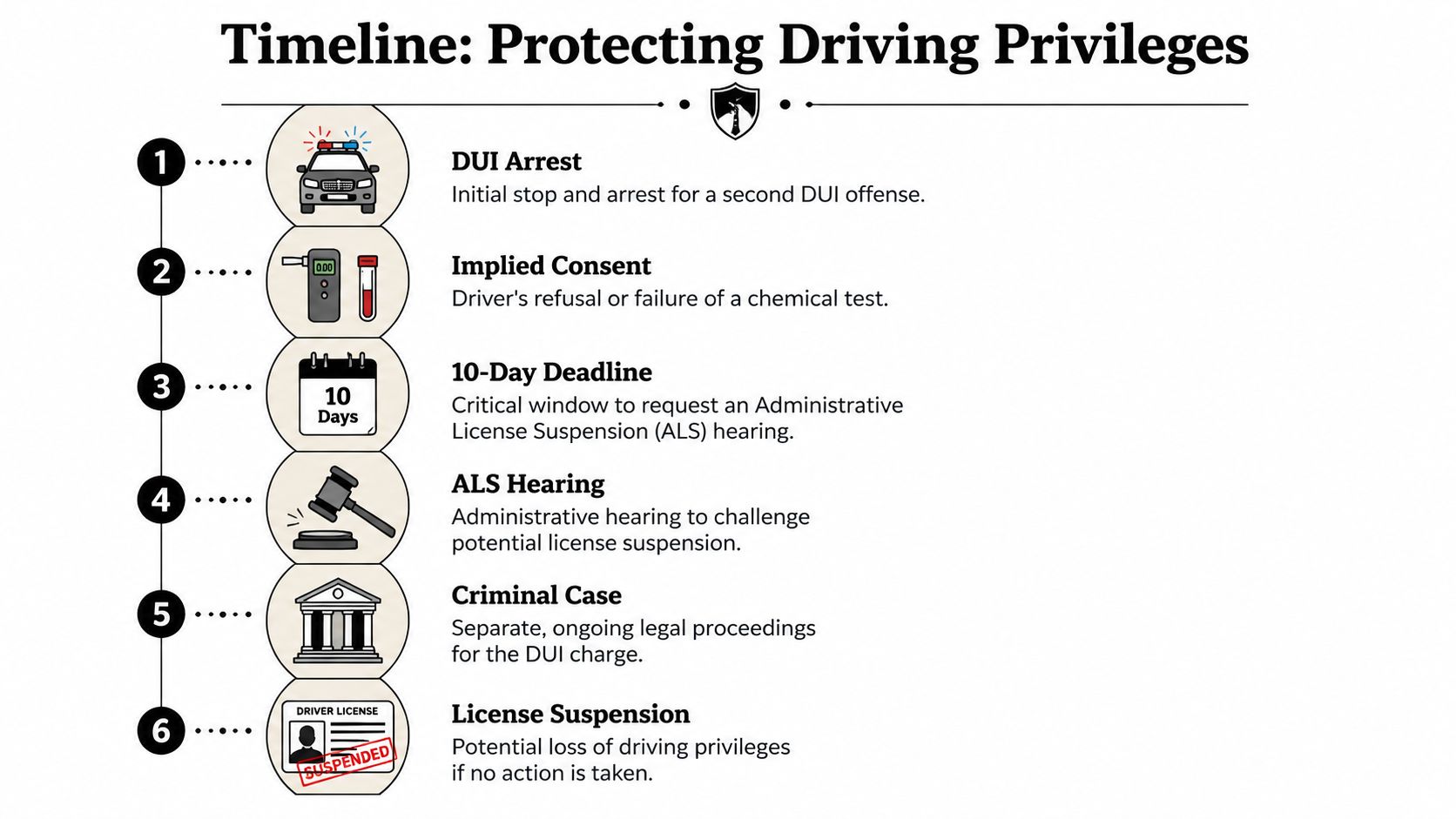
That mistake shows up often in Alpharetta, Roswell, Cumming, and Marietta. The officer hands over paperwork, the bond conditions take over, and the criminal charge gets all the attention. Meanwhile, the administrative side keeps moving.
Two cases begin at the same time
A Georgia DUI arrest can trigger an administrative license suspension through DDS that is separate from the criminal prosecution. You have to handle both. They involve different deadlines, different decision points, and different risks.
For many people, the license issue becomes the immediate pressure point. If you cannot drive, getting to work, getting children to school, making treatment appointments, or complying with court settings becomes much harder. Insurance costs can also rise sharply after a DUI conviction or suspension, so the driving issue is not just about convenience.
The first license decision comes fast
Early in the case, the question is usually whether to challenge the suspension, seek another available driving option, or avoid making a move that hurts the criminal defense. The right answer depends on the stop, the testing evidence, your prior record, and what paperwork the officer filed.
A separate guide on license suspension after DUI in Georgia explains the DDS process in more detail. The practical point is simple. Waiting can shut off options that were available in the first days after arrest.
Strategy has to account for both tracks
At this stage, second DUI cases often get mishandled. A step that looks helpful for keeping you on the road can create problems in court if it locks in facts, reveals the defense too early, or leads to statements the prosecutor can later use.
I look at these cases as two connected fights:
- Administrative fight: Is there a basis to challenge, delay, or limit the suspension?
- Criminal fight: Does the position taken on the license issue affect suppression arguments, plea posture, or trial strategy?
- Practical fight: Can the client keep driving legally enough to hold a job and meet family obligations while the case is pending?
In North Fulton, Cobb, and Forsyth County courts, local practice matters here. A case in Alpharetta Municipal Court, Roswell Municipal Court, Cumming Municipal Court, or State Court in Marietta may move differently in timing and expectations, but the same rule applies. The license side should be addressed early and with the criminal case in mind.
Do not treat the license issue like paperwork. It affects your ability to work, comply with the case, and keep daily life stable.
What to do first
If you were arrested in Fulton County, Forsyth County, Cobb County, Cherokee County, or Gwinnett County, start here:
- Gather every document: Keep the citation, DDS forms, temporary permit, bond papers, and any notice the officer gave you.
- Write out the timeline: Note where the stop happened, what the officer said, whether roadside tests were given, and whether a breath or blood test was requested.
- Protect the deadline: Fast review gives your lawyer a better chance to preserve license options and defense issues.
- Do not explain the case casually: Texts, calls, and social media posts often create admissions that hurt both the DDS matter and the court case.
A second DUI requires a coordinated response from the start. If the license fight is ignored, the damage can arrive before the criminal case is even underway.
When a Second DUI Becomes a Felony Charge
Most second DUI cases in Georgia are prosecuted as serious misdemeanors, not felonies. But that doesn't mean the felony risk is remote. Certain facts can change the case dramatically.
The aggravating facts that raise the stakes
A second DUI can move into felony territory when the state alleges additional criminal conduct tied to the incident. The most common examples include serious injury, death, child endangerment allegations, or a record severe enough to trigger felony-level treatment under Georgia law.
That distinction matters because the defense changes immediately. A standard DUI defense focuses on stop validity, impairment proof, chemical testing, and sentencing mitigation. A felony-level case adds exposure that can reshape bond conditions, plea posture, and trial risk.
Interstate comparisons can mislead people
Clients sometimes assume another state's prior diversion or repeat-offender rule will protect them in Georgia. That assumption is dangerous. A Pennsylvania-focused analysis discusses a 2025 Pennsylvania Supreme Court decision holding that ARD for a first DUI does not count as a prior conviction there, but that kind of leniency is not available in Georgia for repeat offenders.
What works in Pennsylvania does not control a Georgia prosecution in Alpharetta, Roswell, or Marietta.
One strategic goal is keeping the case from getting worse
When aggravating facts are alleged, early defense work often centers on limiting escalation.
- Challenge the factual basis: Was there a child-endangerment fact pattern? Was the claimed injury legally attributable to the DUI event?
- Test the state's proof: Felony add-ons usually depend on records, witness accounts, and causation evidence that can be disputed.
- Assess charging influence: In some cases, the strongest defense result is preventing a high-stakes allegation from hardening into the final charge.
If your case raises questions about felony exposure, it helps to review how Georgia decides when a DUI becomes a felony before making any plea decision.
Building Your Defense and Exploring Alternatives
A second DUI arrest is not the same as a second DUI conviction. That gap matters. It's where the defense lives.

The state still has to prove the stop was lawful, the investigation was handled correctly, and the testing evidence is reliable. In many cases, one weak link alters the negotiating position or trial posture.
What defense lawyers actually look for
The strongest DUI defenses are usually fact-specific, not generic. In a second-offense case, attorneys often start with the record created in the first few minutes.
Reason for the stop
If the officer lacked a legal basis to stop the car, everything that followed may be vulnerable.Field sobriety testing
These tests are often presented as objective, but their value depends on administration, instruction, environment, and interpretation.Breath or blood evidence
Maintenance records, timing, chain-of-custody issues, and medical explanations can all matter.Video compared with the report Police reports sometimes sound stronger than the footage looks.
A second DUI defense often turns on detail. Not broad arguments. A few seconds of body camera footage can matter more than pages of assumptions.
Alternatives short of a DUI conviction
Not every case should be tried, and not every case should be pled as charged. Sometimes the right result is a negotiated resolution that avoids the mandatory consequences tied to a second DUI conviction. Depending on the facts, a reduction to a non-DUI offense such as reckless driving may be worth pursuing.
That's where local court knowledge matters. Prosecutors in one North Atlanta court may evaluate weaknesses differently than prosecutors in another. A reckless driving lawyer in one courtroom and a DUI attorney in another may take different paths to the same goal, which is reducing damage.
Evidence outside the traffic stop can matter too
Clients often forget that the case may involve more than breath results and roadside video. Phone records, surveillance footage, receipts, passenger statements, and digital communications may all become relevant. If you're wondering whether text messages hold up in court, the answer is that they can, depending on authentication and context, which is exactly why clients should stop discussing the facts casually after arrest.
For people seeking same-day help, Brian Hansford Law handles DUI and criminal defense matters in North Atlanta, including cases involving repeat DUI allegations, license issues, and related misdemeanor or felony exposure.
What tends to help the defense
- Fast evidence review: Body cam, dash cam, dispatch records, and test documents should be requested early.
- A disciplined client: Staying off social media and not “explaining” the case to anyone except counsel avoids preventable harm.
- A realistic negotiation posture: Strong cases may call for trial preparation. Flawed cases may support a reduction. Both require honest assessment.
What doesn't work is hoping the second charge will be treated like a ticket. It won't.
Take Action Now to Defend Your Future
If you've been arrested for a second DUI in Georgia, delay works against you. Deadlines pass. Video gets harder to obtain. Administrative license issues move forward whether you feel ready or not.
The right response is immediate, focused action. That means getting the timeline reviewed, preserving evidence, analyzing the stop, and treating the license suspension and criminal case as connected but separate fights. If you're looking for a DUI lawyer in Alpharetta, a DUI attorney in Roswell, court representation in Cumming, or a license suspension lawyer in Marietta, local court knowledge matters because the practical path through one courthouse may look different from the next.
A second DUI can threaten your freedom, your mobility, and your ability to keep life stable at home. But it can still be defended. The charge has to be examined, the evidence has to be tested, and every available alternative has to be considered before you make a decision that follows you for years.
If you're facing a second DUI in Alpharetta, Roswell, Johns Creek, Milton, Cumming, Marietta, or anywhere in North Atlanta, contact Brian Hansford Law for a free, confidential consultation. Fast action can help protect your license, your court position, and your future.
