
If you’ve heard the term “3rd degree assault,” you might think it has a clear, fixed definition. The truth is, here in Georgia, our laws don't actually use that specific phrase. Instead, the kinds of actions that other states might label as "3rd degree" are typically classified as either simple assault, battery, or more often, aggravated assault, all depending on what happened.
Getting this distinction right is the very first step to making sense of the charges you or a loved one might be facing.
Decoding Assault Charges in Georgia
The phrase "3rd degree assault" causes a lot of confusion for people in places like Cumming, Johns Creek, and Forsyth County because it’s simply not part of Georgia's terminology. Think of it as a regional slang term—while people might say it, the official language of the state statutes describes these offenses in a different way. The key isn't the unofficial label, but the specific actions involved in the incident.
In Georgia, an assault charge isn't a single offense. It's a spectrum, and where a case falls on that spectrum depends on a few critical factors. This is where understanding the difference between a simple assault and an aggravated one becomes so important.
The Building Blocks of an Assault Case
So, what does a prosecutor need to build an assault case? Think of the elements of the crime like the ingredients for a recipe. To even bring an assault-related charge, the state has to prove specific components exist. Just like a chef needs flour, water, and yeast to make bread, a prosecutor needs to prove certain facts to build their case.
Before we dive into the specifics, let's look at the basic building blocks prosecutors need to establish for any assault charge in Georgia. This table breaks down what they must prove.
Key Elements of Assault Charges In Georgia
| Legal Element | Simple Explanation | Common Example |
|---|---|---|
| Intent | Did the person mean to cause harm or make someone fear they were about to be harmed? | Intentionally swinging a fist at someone, even if it doesn't connect. |
| Action | Did an act happen that could be seen as an attempt to injure or that put someone in reasonable fear? | Threatening someone with a raised fist or making a credible threat of violence. |
| Injury Level | Did the incident result in only minor physical contact, or did it cause serious bodily injury? | A slap would be minor, while a broken bone would be considered a serious injury. |
| Use of a Weapon | Was a deadly weapon or any object used in a way that could cause serious harm? | Using a knife, a gun, or even a heavy object like a baseball bat during an altercation. |
The combination of these "ingredients" is what determines the final charge. A heated verbal threat is one thing. But bringing a weapon into the mix or causing a significant injury changes the entire situation, often elevating a simple charge into a serious felony. You can learn more about the fundamental differences in our detailed guide on what constitutes assault and battery.
National Context and Local Impact
These charges are treated with incredible seriousness, not just in Georgia but across the country. In 2023, the U.S. saw a shocking total of over 800,000 reported cases of aggravated assault—a charge that often lines up with what many people think of as "third-degree assault" involving serious injury or weapons.
This trend highlights just how severely these charges can derail lives in our own communities, from Alpharetta to Forsyth County. Here, local courts treat aggravated assault as a felony, carrying potential prison time of 3 to 20 years, depending on the specifics of the case.
Facing an assault allegation can feel like being caught in a storm. The language is unfamiliar, the process is intimidating, and the stakes are incredibly high. The goal is to first understand the landscape before trying to navigate it.
Ultimately, grasping what "3rd degree assault" really means in Georgia is about translating a common phrase into the specific concepts used by our local courts in Roswell, Marietta, and throughout Cobb County. It's not about the name of the charge—it's about the substance of the allegations.
How Georgia Law Classifies Different Assault Charges
To really get a handle on a term like "3rd degree assault," you first have to understand how Georgia’s system organizes these offenses. Think of it like a ladder—each rung you climb represents a more serious act with much heavier consequences. What starts at the bottom can escalate quickly depending on a few key details.
The very foundation of this ladder is simple assault. This is where most cases begin, and it's important to know that it doesn’t even require physical contact. Imagine a tense argument over a parking spot in Roswell where one person lunges toward another, making them believe they’re about to get hit. That alone could be simple assault. The critical element here is creating a reasonable fear of immediate harm.
The Escalation to Battery
Take a step up that ladder, and you get to battery. This is where actual physical contact comes into play. If that same argument in Roswell goes from a lunge to an actual shove, the charge can easily become simple battery. This offense involves intentionally making physical contact of an insulting or provoking nature, or causing physical harm to someone else.
In many Georgia cases, it’s that jump from a threat to a touch that separates assault from battery. While both are usually misdemeanors in their simplest forms, bringing physical contact into the mix changes the dynamic completely.
Reaching Aggravated Assault
The highest rungs on the ladder are for aggravated offenses, which is where a charge like "3rd degree assault" would most likely fit in Georgia. An act becomes aggravated assault when certain specific factors—I call them accelerators—are present. These accelerators can turn what might have been a misdemeanor into a very serious felony.
The most common accelerators include:
- Use of a Deadly Weapon: This isn't just a gun or a knife. It can be any object that, when used offensively, is likely to cause serious bodily injury. In places like Forsyth County, we’ve seen cases where even a car or a heavy tool qualifies.
- Intent to Commit a Serious Felony: If the assault happens while someone is trying to commit murder, rape, or robbery, it's automatically bumped up to an aggravated charge.
- Serious Bodily Injury: When the act causes significant harm—think broken bones, disfigurement, or knocking someone unconscious—the charge escalates from simple to aggravated.
A single action can be interpreted in vastly different ways under the law. The line between a simple misunderstanding and a felony charge can be razor-thin, often depending on intent, the presence of a weapon, or the severity of an injury.
This hierarchy shows exactly how different assault-related charges are structured here in Georgia. The infographic below gives you a clear visual breakdown.
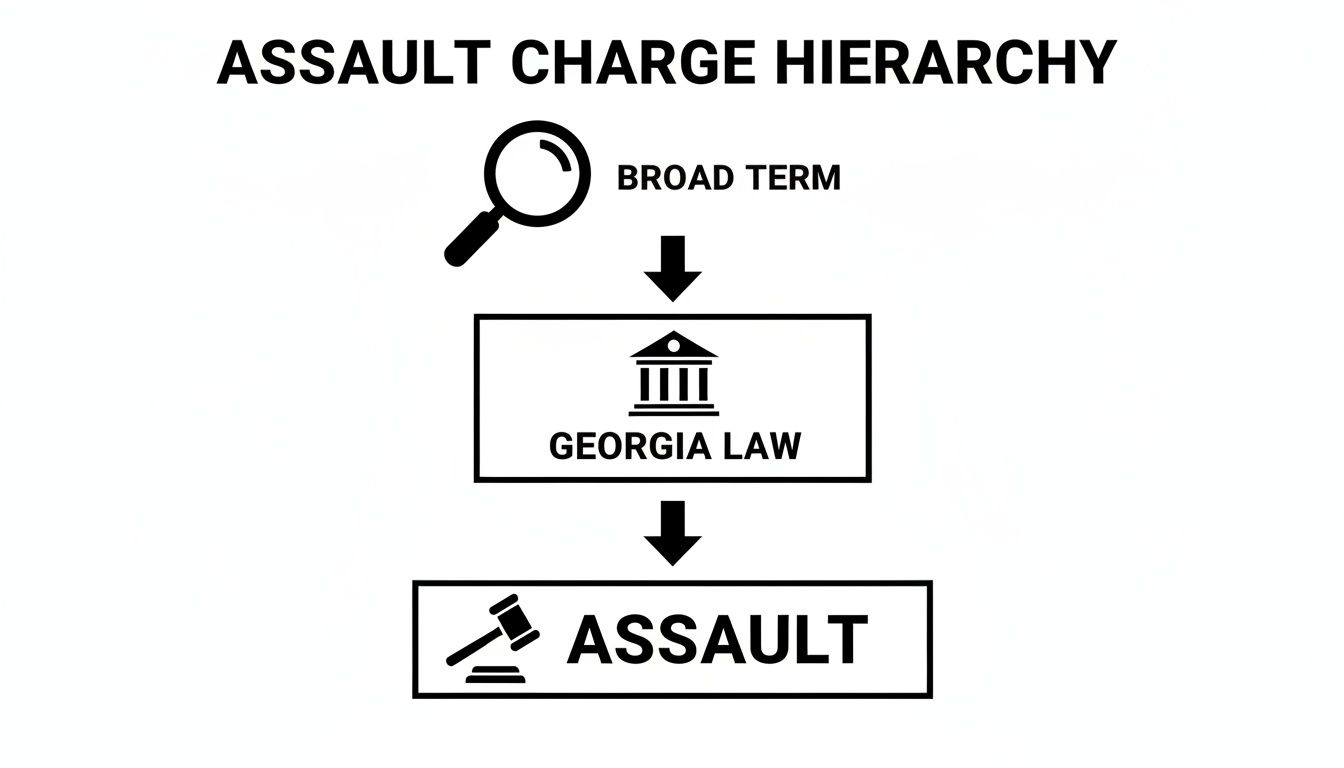
This visual really helps illustrate how the broad idea of "assault" gets filtered through Georgia's specific definitions, ultimately resulting in a precise charge. It shows just how structured the state's approach is.
The Impact of Assault Charges
These distinctions aren't just technicalities; they have huge real-world consequences, and you can see it in national crime data. The National Crime Victimization Survey recently reported 1,019,490 aggravated assault victimizations, contributing to an overall assault figure that tops 5 million every year. In urban areas similar to those around Cobb County and Marietta, violent victimization jumped to 29.6 per 100,000 in 2023, a noticeable increase. These numbers really underscore how seriously these offenses are taken. You can dig deeper into these trends in the full victimization survey report.
Understanding this classification system is the first step toward making sense of an assault charge in North Georgia, whether it happened in Marietta, Alpharetta, or Milton.
Potential Penalties For An Assault Conviction
If you’re convicted of assault in North Georgia, the consequences reach far beyond just a courtroom fine. The penalties aren't a one-size-fits-all punishment; they fall on a spectrum, and a judge in Forsyth County or Cobb County will look at the unique facts of a case before handing down a sentence.
The outcome really hinges on how the charge is classified. A simple assault or simple battery is typically a misdemeanor and will carry a very different set of penalties than an aggravated assault, which is a serious felony. That distinction is what truly defines the severity of the consequences you'll face.
The Spectrum Of Court-Ordered Penalties
When someone is convicted, the court has a whole range of sentencing options. These penalties are meant to match the seriousness of the crime, which is why felony convictions bring much harsher punishments than misdemeanors. The presence of what the law calls "aggravating factors" can dramatically ratchet up the severity of the sentence.
For example, a conviction for simple assault or simple battery in places like Cumming or Alpharetta usually falls under misdemeanor penalties. This can include:
- Jail Time: Up to 12 months in the county jail.
- Fines: Up to $1,000, not including court costs and other fees.
- Probation: A supervised release period, often for 12 months, that comes with strict conditions one must follow.
But if the charge is bumped up to a felony like aggravated assault—which is where a charge people often think of as "3rd degree assault" lands—the potential penalties jump significantly. The consequences can be life-changing and may include:
- Prison Time: A long sentence in a state prison, usually from one to 20 years.
- Hefty Fines: Financial penalties that can easily climb into the tens of thousands of dollars.
- Felony Probation: An extended, intensive period of supervision after release from prison.
The difference between walking away with a misdemeanor versus a felony conviction is night and day. One might mean probation and fines, while the other can lock you away for years and strip you of certain civil rights forever.
To make it clearer, here’s a quick comparison of how the penalties stack up based on the charge.
Assault Penalties Comparison In Georgia
This table gives a comparative look at the potential penalties for different assault charges in Georgia, from misdemeanors all the way up to serious felonies.
| Charge Type | Classification | Potential Jail/Prison Time | Potential Fines |
|---|---|---|---|
| Simple Assault | Misdemeanor | Up to 12 months in jail | Up to $1,000 |
| Simple Battery | Misdemeanor | Up to 12 months in jail | Up to $1,000 |
| Aggravated Assault | Felony | 1 to 20 years in prison | Substantial fines |
| Aggravated Battery | Felony | 1 to 20 years in prison | Substantial fines |
As you can see, the stakes get incredibly high once you cross the line from a misdemeanor to a felony.
Factors That Influence Sentencing
A judge doesn’t just look at the charge on paper; they dig into all the surrounding circumstances. Several key factors can push a sentence toward the lighter or harsher end of that spectrum.
The biggest influences are usually the defendant's prior criminal record, how badly the victim was injured, and whether a weapon was part of the incident. An altercation in Marietta that ends with minor bruising will be treated very differently than one in Roswell that involves a dangerous weapon and sends the victim to the hospital.
The Lasting Collateral Consequences
Perhaps the most damaging penalties are the ones that stick with an individual long after they’ve served their time. These are often called collateral consequences, and they can bleed into nearly every area of a person's life.
A felony assault conviction can put up lifelong roadblocks, such as:
- Loss of Firearm Rights: In Georgia, convicted felons are permanently banned from owning or even possessing a firearm.
- Employment Difficulties: Many employers will think twice about hiring someone with a violent crime on their record.
- Housing Challenges: Landlords can—and often do—deny rental applications based on a criminal background check.
- Permanent Criminal Record: A felony conviction is a public record that can follow a person around forever, impacting their reputation and future opportunities.
These "hidden" penalties are what really show the true weight of a conviction for a serious charge like aggravated assault.
Common Defense Strategies Against Assault Allegations
When someone is accused of something like 3rd degree assault, it's critical to remember that an accusation is just one side of the story. The prosecution will present their version of events, but that's just the starting point. Here in Georgia, there are several recognized defense strategies that can challenge assault allegations by painting a much more complete picture of what really happened.
These strategies aren't about making things up. They're about meticulously examining the evidence, questioning the prosecutor's narrative, and pointing out inconsistencies or alternative explanations. Think about a chaotic scene in a downtown Roswell bar or a poorly lit event in Marietta—details get fuzzy, and things can easily be misinterpreted. A solid defense is built by digging into every piece of information to make sure the full context is understood.
Self-Defense And Defense Of Others
One of the most common and powerful strategies is a claim of self-defense or the defense of another person. This approach doesn't deny that an action occurred; instead, it argues the action was completely justified to prevent someone from getting hurt.
Under Georgia law, a person is generally justified in using force when they reasonably believe it's necessary to protect themselves or someone else from another person's imminent use of unlawful force.
For this defense to hold up, three key things typically must be shown:
- Reasonable Belief of Threat: The person must have genuinely believed they or someone else was in immediate danger.
- Proportional Force: The force used must have been reasonable and proportionate to the threat they faced. An individual can't respond to a minor shove with overwhelming force.
- No Instigation: The person claiming self-defense cannot have been the one who started the fight.
This entire defense often comes down to what a "reasonable person" would have done if they were in the same shoes.
Questioning The Element Of Intent
Not every physical encounter comes from a malicious place. An assault charge in Georgia requires the prosecution to prove that an individual acted with a specific state of mind—either with the intent to injure someone or in a criminally negligent or reckless manner. A strong defense can be built around showing that this required intent simply wasn't there.
This could involve situations where an injury was a pure accident. For example, if someone stumbles in a crowded space in Johns Creek and accidentally causes another person to fall and get hurt, there was no criminal intent. Proving a lack of intent can knock the legs out from under the prosecution's case.
The prosecution must prove every single element of their case beyond a reasonable doubt. If a key component like intent cannot be proven, the entire foundation of the assault charge can crumble.
The Problem Of Mistaken Identity
Eyewitness testimony feels powerful in a courtroom, but it's also notoriously unreliable, especially in confusing or fast-moving situations. A defense of mistaken identity argues that the police simply arrested the wrong person. This is especially relevant in cases where there's very little physical evidence connecting an individual to the incident.
This defense involves a deep dive into factors like:
- Poor lighting at the scene.
- Distractions that could have messed with a witness's memory.
- How far away the witness was from the actual event.
- Similarities in appearance between the accused and another person who was present.
Building a mistaken identity case requires scrutinizing everything from security footage to witness interviews to show that the identification isn't as certain as the prosecution wants the judge or jury to believe.
Many assault cases, especially those rooted in domestic situations, are incredibly complex. Domestic violence fuels a significant number of assault allegations, and statistics show just how common these issues are in communities like East Cobb and Cobb County. Over 35.6% of U.S. women and 28.5% of men have experienced physical violence from an intimate partner. You can find more details by exploring data on domestic violence trends.
Ultimately, exploring all possible defenses is a crucial part of the process. If you want to understand more about how these cases can play out, you might find our guide on how assault charges might be dropped helpful. Each strategy provides a path to challenge the prosecutor’s story and ensure all the facts come to light.
What To Do The Moment You're Arrested
The minutes right after an arrest are a blur. It's confusing, stressful, and a person is under immense pressure. But what a person does—and doesn't do—in this critical window can make a huge difference down the road. It’s vital to think clearly, even when feeling completely overwhelmed.

The most important thing an individual can do? Exercise the right to remain silent. It’s human nature to want to explain oneself or tell one's side of the story. Resist that urge. Speaking to law enforcement without an attorney is like walking through a minefield blindfolded—it's impossible to know where the traps are.
Politely tell the officers that you are invoking your right to remain silent and that you want to speak with an attorney. This is not an admission of guilt. It's a fundamental right designed for protection.
Secure Your Rights Immediately
As soon as it's clear you’re staying silent, the next move is to get experienced professional help on the phone. The clock starts ticking the second someone is in custody, and having a professional in your corner from the very beginning is absolutely essential.
Here’s a simple, strategic plan:
- Contact a Defense Attorney: The first call should be to a criminal defense lawyer. They can start protecting an individual right away, sometimes even before formal charges are filed.
- Notify a Trusted Contact: Make a second call to a reliable family member or friend. Let them know where you are and the name of the attorney called. Do not get into the details of the arrest over a recorded jail phone line.
- Document Everything Remembered: The moment there's a chance, write down every single detail that can be recalled about the arrest. What time was it? Where did it happen? What did the officers say? Who else was there? Memories fade fast under stress, and this written record will be invaluable.
These first few actions lay the groundwork for a defense. By controlling the conversation and getting a lawyer involved, common mistakes that can seriously complicate things are sidestepped. To get a better picture of the entire process, check out our guide on what happens when you get arrested.
Critical Mistakes You Must Avoid
Just as important as knowing what to do is knowing what not to do. In a high-stress situation like an arrest in Alpharetta or Johns Creek, it's easy to make mistakes that have lasting consequences.
The single biggest mistake is talking about the case with anyone who isn't an attorney. That includes cellmates, friends, and especially family over the phone—those calls are recorded. Anything said can and will be used against an individual.
In the aftermath of an arrest, silence is your strongest shield. Every word spoken can become a piece of the prosecution’s puzzle. Protect your future by letting an attorney do the talking.
Also, get off social media. Don't post about the arrest, the incident, or any feelings about it. Prosecutors can and do use social media posts to build their case. Even something intended to be harmless can be twisted and taken completely out of context. The best move is to deactivate social accounts for a while and focus on building a defense strategy with a lawyer.
How An Experienced Defense Attorney Can Make A Difference
Trying to face a criminal charge like 3rd degree assault alone is like trying to find your way through a maze blindfolded. The criminal justice system is notoriously complex, and everything is on the line. An experienced defense attorney is both a guide and an advocate, fighting to protect an individual's rights every step of the way.

From the moment a case is taken on, the job is to pick apart the prosecution's story. It all starts with a deep, independent investigation. A legal team will pour over police reports, look for holes in witness statements, and scrutinize every single piece of evidence the state plans to use.
This isn't just about reviewing files. It's about finding the weak spots in their case. Every inconsistency, every procedural mistake, becomes a tool that can be used to build a powerful defense.
Building A Strategic Defense
A skilled attorney doesn't just play defense; they build a proactive strategy from day one, all geared toward getting the best possible result for their client. This is about so much more than just showing up in court. It means handling every phone call and meeting with prosecutors and police so a client doesn't accidentally say something that hurts their case.
Having a former prosecutor on your side gives a massive advantage. They know the playbook inside and out—how cases are built, the evidence valued most, and the negotiation tactics used. This insider knowledge allows them to anticipate moves and counter them effectively.
An experienced defense attorney does more than represent someone in court; they manage the entire process, allowing a person to focus on their life while they work to protect the future.
Working Toward The Best Possible Outcome
The end goal is always to secure the most favorable outcome possible. What that looks like is different for every case. Every single option available will be explored, which often includes:
- Seeking a Case Dismissal: If an investigation uncovers a lack of evidence or finds that someone's rights were violated, the first move is always to get the charges thrown out completely.
- Negotiating Reduced Charges: When a full dismissal isn't on the table, it is often possible to negotiate with the prosecutor to get a serious charge reduced to something less severe, with lighter penalties.
- Exploring Alternative Sentencing: Local courts in places like Cumming, Milton, and Forsyth County sometimes offer diversionary programs. These can be a path to avoiding jail time and keeping a conviction off a permanent record.
At the end of the day, having a dedicated professional in your corner means you have a strategist who gets the system and is committed to fighting for you. They handle the complex matters so you don't have to, working tirelessly to shield you from the harsh consequences of a 3rd degree assault conviction.
Frequently Asked Questions About Georgia Assault Charges
When facing an assault charge in North Georgia, a person's head is probably swimming with questions. It's a stressful, confusing time. Below are some straightforward answers to the questions we hear most often from people who find themselves in this exact situation.
Can I Be Charged With Assault If I Never Touched Anyone?
Yes, absolutely. Under Georgia law, simple assault doesn't require any physical contact at all. The charge can stem from an attempt to cause a violent injury or any act that puts someone in reasonable fear of getting hurt right then and there.
Think about it this way: a heated argument in a parking lot in Cumming that ends with a person lunging toward someone could be enough. Even if you stop short and never lay a hand on them, that aggressive act could be enough for an assault charge. The key isn't whether they were touched, but whether they had a legitimate reason to believe they were about to be harmed.
What Is The Difference Between Assault And Battery In Georgia?
This is a very common point of confusion. The easiest way to remember it is that assault is typically the threat or attempt, while battery is the actual physical contact.
- Simple Assault is trying to hurt someone or making them believe they are in immediate danger of being harmed.
- Simple Battery is when actual physical contact is made, whether it's intentionally insulting or provoking (like a shove) or directly causing physical harm.
These charges often get tangled together. When a weapon gets involved, or the injuries are particularly nasty, the charges can be elevated to aggravated offenses—which is often where a charge like 3rd degree assault might fit in, depending on the specific circumstances.
Will An Assault Charge Permanently Affect My Future?
A conviction for assault can definitely throw up long-term roadblocks. It can affect a person's ability to get a job, rent an apartment, and even own a firearm.
But here’s the most important thing to remember: a charge is not a conviction. There's a whole process that has to play out first. A skilled defense attorney can dig into the details of your case, looking for every possible angle. This could mean negotiating for lesser charges, fighting for a complete dismissal, or taking your case to trial.
Down the road, it might even be possible to have the record restricted (what many people call expungement), which can significantly minimize the lasting impact on a person's life.
Facing the complexities of the system on your own is a daunting task. You don't have to. The team at Brian Hansford Law has the experience to guide you through this difficult time and fight to protect your future. For a confidential consultation to discuss your case, contact us online.
