
A burglary charge usually enters your life fast. A phone call from jail. A detective asking you to “come clear a few things up.” A warrant you didn’t know existed. Or a family member in Alpharetta, Roswell, Marietta, or Cumming suddenly trying to figure out bond, court dates, and whether this is “just a misunderstanding” or a felony that can change everything.
If you're dealing with what people often call 3rd degree burglary, the first thing to know is simple. In Georgia, this is serious, but it is also defendable. Panic leads people to make bad statements, consent to searches they should question, or assume the case is hopeless because the police sounded confident. None of that helps.
Georgia burglary cases often turn on specific facts. Why was the person there? Did they enter without authority? Can the state prove intent to commit a theft or felony inside? Those questions decide cases in Fulton County, Forsyth County, and Cobb County every week. A former prosecutor sees the pressure points quickly because prosecutors tend to build these cases the same way. They rely on assumptions about motive, shaky inferences from entry, and statements made before the accused understands the stakes.
What a Georgia Burglary Charge Really Means for You
The first few days after an arrest are usually the worst. Families are trying to piece together what happened. The accused person is worried about jail, work, school, and whether a felony charge will follow them for years. In many cases, the police report makes the case sound cleaner than it really is.
A burglary accusation in North Atlanta often starts with a claim that someone entered a building, garage, business, or other structure without permission and planned to steal something or commit another crime once inside. That sounds straightforward. In court, it rarely is.
Georgia treats burglary charges seriously because unlawful entry cases affect homes, businesses, and community safety. In Georgia, the 2022 burglary rate was 217.8 per 100,000 residents, which was below the national average but still shows burglary remains a real issue in suburban areas including places like Forsyth and Cobb County, according to reported burglary rate data compiled by Statista.
What clients often get wrong at the start
Many people assume one of three things:
- “No one got hurt, so this isn't that serious.” Burglary can still be charged as a felony even when there was no confrontation.
- “The door was not locked, so it can't be burglary.” An unsecured door doesn't end the analysis. Prosecutors focus on authority to enter and alleged intent.
- “If nothing was taken, the case should go away.” The state may still prosecute if it claims the person entered with criminal intent.
Practical rule: The worst time to explain yourself is when you're stressed, unrepresented, and speaking to investigators who are building the case.
The right response is to slow the process down. Get the charging documents. Protect your right to remain silent. Preserve texts, location data, surveillance leads, and witness names before they disappear. Burglary cases are often won early, before assumptions harden into the state's theory.
Why local court experience matters
A burglary case in Fulton County won't always move the same way it does in Forsyth or Cobb. Bond practices differ. Prosecutors differ. Judicial expectations differ. That matters if you're deciding whether to push for a quick evidentiary challenge, negotiate from strength, or prepare for trial from day one.
People searching for a burglary lawyer in Alpharetta, felony defense lawyer in Roswell, or criminal defense attorney near me are usually looking for one thing. Someone who can tell them what matters next. That's the right focus.
Understanding Georgia's Burglary Law O.C.G.A. § 16-7-1
Georgia law doesn't use “degrees” for burglary the way some other states do. So when someone says 3rd degree burglary in Georgia, they're usually using a label borrowed from other jurisdictions or a shorthand description for a burglary-style accusation. In Georgia, the actual charge is governed by O.C.G.A. § 16-7-1.
That distinction matters because a defense has to match the statute you're charged under, not a label someone used online or during booking.

The two elements prosecutors must prove
The state generally has to prove two core ideas:
- Entry or remaining without authority in a building or structure
- Intent to commit a felony or theft inside
That second part is where many cases become defensible. Intent usually isn't captured neatly on video. It gets inferred from circumstances. Tools, time of day, movement inside the property, statements, prior relationships with the location, and what the person did before or after entry all become part of the argument.
A useful comparison helps. If someone walks into the wrong garage by mistake while looking for a friend's house, that may raise trespass issues. If someone enters a structure carrying items the state claims were meant to assist a theft, the prosecution will argue burglary because it believes it can prove criminal intent at the moment of entry.
Burglary is not the same as robbery
People mix these charges up all the time. Robbery involves taking property from a person, typically by force, intimidation, or threat. Burglary focuses on unlawful entry into a place with criminal intent.
If you need a clean side-by-side explanation, this guide on burglary vs robbery lays out the difference in plain language.
Why intent becomes the battlefield
Prosecutors rarely get a confession that says, “I entered to commit a theft.” They build the case from indirect proof. That may include:
- Surveillance footage: Often incomplete, grainy, or missing what happened before entry.
- Witness assumptions: A witness may believe someone intended to steal, but belief isn't proof.
- Objects found nearby: Gloves, bags, or tools can look suspicious, but context matters.
- Statements made after arrest: People say damaging things when they think they can “talk their way out of it.”
The entry itself is only half the case. If the state can't prove what the person intended to do inside, the burglary theory weakens fast.
What works and what doesn't
What works is a fact-driven defense. That means isolating the exact point where the state jumps from “presence” to “criminal intent.” What usually doesn't work is broad denial without supporting evidence. Judges and prosecutors hear that every day.
A stronger approach asks narrower questions. Did the accused have permission to be there before? Was there a family dispute, business dispute, or property access misunderstanding? Does the video show entry? Does the timeline make the state's story unlikely? Those are the issues that move a burglary case.
The Penalties and Lifelong Consequences of a Conviction
A lot of people call my office after the arrest and focus on one question: "Am I going to jail?" That matters. But in a Georgia burglary case, the sentence is only part of the problem. The conviction can keep showing up long after probation ends and fines are paid.

The immediate legal consequences
Burglary is a felony in Georgia. A conviction can bring prison exposure, lengthy probation, fines, restitution, reporting requirements, and strict conditions on travel, work, and contact with other people involved in the case. In North Atlanta courts, judges also look closely at prior record, the location involved, and whether the facts suggest planning, damage, or a dispute that got out of hand.
The pressure starts before any conviction. A pending felony can lead to job suspension, loss of security clearance, school discipline, bond conditions that limit movement, and problems in custody or immigration matters. If you have never been through the system before, read this plain-English guide on what happens after an arrest in Georgia. Timing matters early, especially in Forsyth, Cobb, and Fulton, where prosecutors often make initial decisions before the defense has had a fair chance to frame the facts.
The consequences outside the courtroom
The record often does more lasting harm than the sentence.
Employers see a burglary conviction as a dishonesty and trust issue. Landlords read it the same way. Licensing boards in healthcare, education, finance, real estate, and government work may treat it as a character problem, not just a criminal one. A felony record can also affect firearm rights and shift how judges, guardians ad litem, school administrators, and immigration authorities assess your credibility.
That is why plea decisions need to be made with a longer view. A quick result is not always a good result.
Record restriction is limited, and many people find that out too late
People often assume the case can be cleaned up later. Georgia law does allow record restriction in some situations under O.C.G.A. § 35-3-37, but eligibility is narrow and highly fact-specific. A burglary conviction is often far harder to clear than people expect.
The practical lesson is simple. Treat the defense of the original case as the best chance to protect your record. Post-case relief is not something to count on.
The real trade-off in plea decisions
As a former prosecutor, I can tell you where people get hurt. They accept an offer because it removes the immediate fear of jail, then learn months later that the disposition blocks a job, a housing application, or a professional license. The better question is not whether an offer ends the case fast. The better question is what the offer leaves behind.
Here is the framework I use with clients:
| Decision point | What to ask |
|---|---|
| Plea offer | Does it reduce the charge in a way that protects employment, housing, and licensing opportunities? |
| First offender or diversion option | Does successful completion lead to dismissal or discharge, and how will the record appear on a background check? |
| Trial risk | Can the state actually prove unlawful entry and criminal intent, or is the file stronger in appearance than in evidence? |
| Sentencing exposure | What is the realistic outcome in this county, with this judge, and with these facts? |
| Later cleanup | Is there any realistic path to record restriction or relief if this resolves today? |
County practice matters here. Fulton may approach negotiations differently than Forsyth. Cobb may evaluate property crimes differently depending on the facts, prior record, and the alleged location. Those differences affect strategy.
If your case may be heading toward a contested hearing or trial, it helps to understand how to prepare for trial. The strongest position usually comes from building the defense early, before the state locks in its theory and before a bad plea decision follows you for years.
Navigating the Court Process in Forsyth, Cobb, and Fulton Counties
Individuals don't need a lecture on “the justice system.” They need to know what happens next, how fast it moves, and where mistakes get made.
A Georgia burglary case usually unfolds in stages. The order is familiar, but the pressure points differ by county. A person arrested in Johns Creek, Milton, Marietta, or Sandy Springs may enter the system through a municipal or county process before the felony case settles into Superior Court handling.
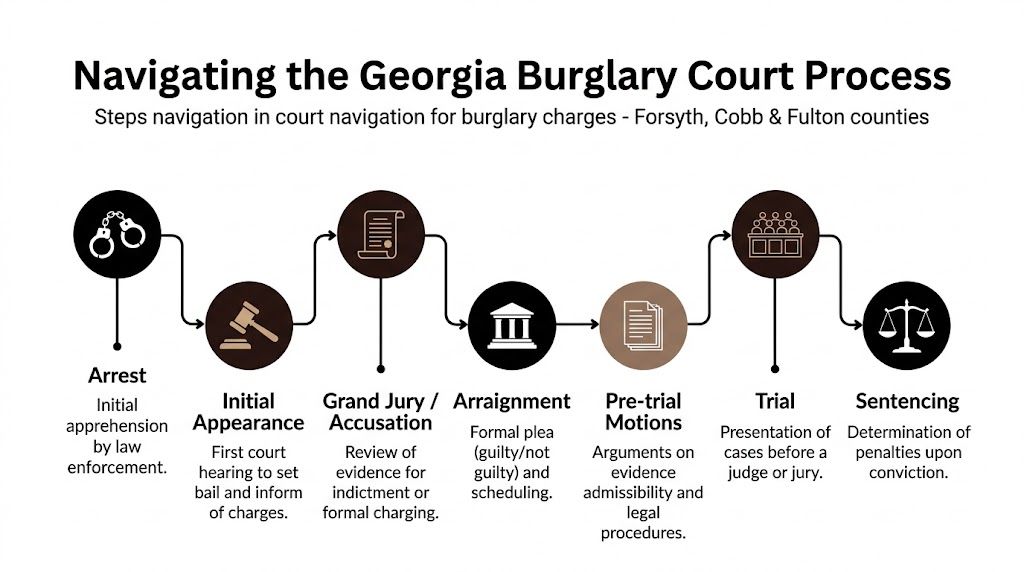
Arrest and first appearance
The case starts with the arrest, citation history, warrant execution, or surrender. Booking follows. Property is logged. Statements may be taken. Phones may become evidence issues if officers seek access or a warrant.
Then comes the first appearance. That hearing addresses the charge, the accused's rights, and bond questions. For many families, this is the first chance to influence whether the person stays in jail or fights the case from home.
If you want a plain-English overview of the first stage, this guide on what happens when you get arrested is useful.
Charging and arraignment
After arrest, prosecutors decide how to formally proceed. In a felony case, that can involve indictment or another charging mechanism depending on the posture of the case. During this period, weak cases sometimes get narrowed, strengthened, or overcharged.
At arraignment, the accused enters a plea, usually not guilty at that stage, and the court sets the schedule. That sounds routine. It isn't. Waiving appearances, preserving objections, and identifying immediate motion issues can shape the entire case.
Where local strategy matters most
In Forsyth, Cobb, and Fulton, the same legal issue can play differently based on courtroom expectations and prosecutor habits. Local knowledge matters in at least four places:
- Bond advocacy: The argument that works in one county may fall flat in another if it ignores local concerns.
- Discovery pressure: Some prosecutors produce key material promptly. Others need persistent follow-up.
- Motion practice: Illegal search issues, statement suppression, and identification challenges have to be raised correctly and on time.
- Negotiation timing: Pushing too early can lose advantage. Waiting too long can harden positions.
Good defense work starts before trial. It starts when someone secures bond conditions, preserves evidence, and blocks the state from turning assumptions into uncontested facts.
Pretrial motions and trial preparation
This stage is where real defense lawyering happens. Counsel reviews body cam, surveillance, dispatch logs, witness statements, forensic submissions, and any alleged statements by the accused. Then the legal work begins. Suppression motions, evidentiary challenges, witness interviews, and targeted negotiations all grow out of that review.
For clients who may ultimately need a contested hearing or jury trial, preparation becomes practical and personal. Witness order, exhibits, timeline reconstruction, and how the accused presents under questioning all matter. This resource on how to prepare for trial gives a useful outside perspective on organizing facts and testimony without turning preparation into panic.
The process in one view
Arrest and booking
Law enforcement takes the person into custody or executes a warrant.Initial appearance and bond
The court addresses release conditions and formal notice of the accusation.Formal charging
Prosecutors review evidence and decide how to proceed.Arraignment
A plea is entered and deadlines begin to matter.Motions and negotiations
The defense challenges evidence, presses weaknesses, and evaluates resolution options.Trial or negotiated outcome
The case is either resolved by plea, diversion, dismissal, or presented to a judge or jury.
What hurts defendants most is delay. Missed deadlines, casual statements, and poor early decisions often create problems that are harder to fix later.
Common Defenses Against Georgia Burglary Charges
A burglary case often looks settled on paper long before it is proven in court. I have seen police reports from Cobb, Fulton, and Forsyth read like a conviction, then fall apart once the defense tested consent, intent, identification, and the way evidence was collected.
That is the practical reality in North Atlanta burglary cases. The state still has to prove each element, and one weak point can change the value of the case, the plea posture, or the trial strategy.

Challenging intent
Intent is often the battleground. In many burglary prosecutions, nobody heard the accused announce a plan to steal or commit another crime inside. Prosecutors usually ask the judge or jury to infer intent from surrounding facts such as the time of entry, movement of property, prior conflict, possession of tools, flight, or inconsistent statements.
That inference is not automatic.
A strong defense forces the state to show more than suspicion. Entering a building without permission may be trespass. It does not become burglary unless the state can prove the required criminal intent at the time of entry or unlawful remaining. In practice, that distinction matters a great deal.
Facts that often support an intent defense include:
- Property disputes: Former tenants, relatives, employees, or former partners may have believed they still had a right to enter.
- Retrieving personal belongings: Taking back clothing, documents, work tools, or other personal items raises a different issue than entering to steal.
- Confusion, intoxication, or mistake: Bad judgment can still fall short of proof that the person intended a theft or felony inside.
- No conduct inside the property that matches the alleged plan: If nothing was searched, gathered, damaged, or targeted, the state's theory may be weaker than the accusation suggests.
Arguing there was authority or consent
Burglary requires unlawful entry or unlawful remaining. Consent, apparent consent, or a pattern of prior access can undercut that element fast.
This issue comes up regularly in domestic disputes, roommate conflicts, shared businesses, family property matters, and storage unit cases. A person may still have a key. They may know the alarm code. They may have been told they could come by earlier that week. Police often hear one side first and write the report from that perspective. The defense has to rebuild the full relationship history.
The proof is usually ordinary and powerful. Text messages. Call logs. Doorbell camera footage. Prior visits. Witnesses who know the arrangement. Those details can create reasonable doubt even when the report says the entry was unauthorized.
Attacking the state's evidence
Many burglary cases are won by testing how the evidence was gathered, not by arguing abstract legal definitions.
Start with identification. Grainy video, a quick eyewitness observation, or an assumption based on clothing and location is not always enough. Continue with the search. If officers pulled evidence from a phone, car, house, or bag without a lawful basis, the defense may have a suppression issue. This explanation of when police can search your house without a warrant is useful background on the kinds of search problems that can affect a felony case.
A serious review also looks at:
- Chain of custody: Can the state prove an item recovered is the same item tied to the scene?
- Statement admissibility: Were Miranda rights handled properly, and was any statement voluntary?
- Video completeness: Does the footage show entry, or only presence nearby?
- Witness bias or limited perception: Did the witness have a clear view, enough time, and a reason to be accurate?
As a former prosecutor, I can say this plainly. Cases get overcharged when early assumptions go untested.
Young adult cases and first-offender strategy
For younger clients, defense strategy is not limited to contesting the accusation. It also has to address the long-term consequences of a felony record in school, employment, professional licensing, housing, and future sentencing exposure.
That is especially true in North Atlanta courts, where many defendants are in college, working their first serious job, or trying to protect a clean record. In the right case, the defense presentation should show more than the allegation itself. Judges and prosecutors often want context. Lack of sophistication, no violence, limited or no criminal history, steady work, family support, restitution options, and immediate corrective steps can all matter in resolution talks.
That does not mean every case should end in a plea. It means the strategy should account for both tracks at once: prepare to beat the charge if the facts support it, while also positioning the client for the best possible outcome if negotiation becomes the smarter path. If you are weighing cost at the same time, a neutral explanation of a lawyer consultation fee can help you plan that first meeting.
What usually helps, and what usually does not
General denial rarely carries much weight by itself. “Nothing was taken” is also incomplete, because burglary does not require a completed theft. Those arguments can be part of a defense, but they are rarely enough on their own.
Specific facts move these cases. A message showing permission to enter. GPS data that challenges the timeline. Video that stops short of proving entry. A witness with motive to exaggerate. A search that should never have happened. In Forsyth, Cobb, and Fulton County courtrooms, those are the details that change outcomes.
Take the First Step to Protect Your Future Today
If you're facing a burglary accusation in North Atlanta, waiting usually makes things worse. Evidence hardens. Witnesses become harder to reach. Prosecutors get more comfortable with their theory of the case. Early action gives the defense room to challenge intent, address bond conditions, preserve favorable facts, and negotiate from a stronger position.
The biggest mistake people make is treating burglary like a charge that can be “worked out” later without a plan. It can't. Sentencing for burglary in Georgia can vary widely, and that variability makes experienced negotiation critical when the goal is probation, diversion, or a reduced outcome, as discussed in this review of burglary sentencing ranges and defense strategy.
The right next move
Your next step should be practical:
- Get legal advice quickly: Before speaking further with police or investigators.
- Preserve evidence: Save texts, location history, camera footage leads, and names of witnesses.
- Learn your deadlines: Bond conditions, court dates, and no-contact rules can affect the case immediately.
- Ask smart consultation questions: Case strategy matters more than generic reassurance.
If cost is part of your hesitation, reading a neutral explanation of a lawyer consultation fee can help you understand what firms typically charge and what you should ask before hiring counsel.
A burglary charge doesn't define the outcome. Your response in the first days often does.
Frequently Asked Questions About Georgia Burglary Charges
A deputy shows up at your door, or a detective leaves a voicemail asking you to come in and “clear something up” about a break-in at a house, business, or storage building. By the time people call my office, they usually have the same questions: Is this really burglary, does the lack of forced entry matter, and is there still a way to keep a felony off their record?
Here are the answers I give in real Georgia cases, especially in Forsyth, Cobb, and Fulton courts, where local practice can affect charging decisions, bond terms, and plea options.
Quick answers to common questions
| Question | Short answer |
|---|---|
| Is 3rd degree burglary a real charge in Georgia? | No. Georgia does not label burglary by degree the way some other states do. |
| Is burglary always a felony? | Georgia burglary charges are prosecuted as serious felony cases. |
| Can a burglary charge be reduced? | Sometimes. The answer depends on proof of intent, authority to enter, and the weaknesses in the state's case. |
| If the door was unlocked, is it still burglary? | Yes, it can be. Forced entry is not required. |
| What if nothing was stolen? | The state can still pursue burglary if it claims there was criminal intent at the time of entry. |
| Should I talk to police to explain myself? | Not without a lawyer. Explanations often fill gaps in the state's case. |
Is “3rd degree burglary” an actual Georgia charge
Georgia burglary law does not use first, second, or third degree labels the way some states do. People use that phrase because they have seen it online or heard it from someone outside Georgia, but the court will focus on the actual charge filed under Georgia law.
That matters because defense strategy depends on the specific accusation, not the search term. A case involving an alleged entry into a home raises different issues than one involving a business, shed, or other structure.
Can the charge be reduced to trespass
Yes, in the right case.
The pressure point is usually intent. If the prosecution cannot prove that the person entered with the intent to commit a theft or felony, the case may be better suited for criminal trespass or another lesser outcome. I have seen that issue come up in domestic disputes, property access disagreements, former roommate situations, and cases where the accused had some prior connection to the location.
In North Atlanta courts, reductions usually come from facts the defense develops early, not from broad arguments about fairness.
Does an unlocked door help the defense
Sometimes. It does not defeat the charge by itself.
An unsecured door can support a better defense theme if it fits the rest of the evidence. It may help show a misunderstanding, prior permission, routine access, or weak proof that the entry was unauthorized. In other cases, it changes very little because the prosecutor is relying on statements, surveillance, or property recovery instead.
The question is not whether the door was locked. The question is whether the state can prove unlawful entry and criminal intent beyond a reasonable doubt.
What if the accused is a young adult with no record
That can make a real difference in how the case should be handled. A clean record may improve the chances of first offender treatment, a negotiated reduction, or another result designed to limit long-term damage to employment, licensing, housing, and school opportunities.
That said, no prosecutor in Fulton, Cobb, or Forsyth dismisses a burglary case just because someone is young or has never been arrested before. The defense still needs a concrete plan. Mitigation works best when it is paired with weaknesses in the evidence, favorable background information, and a strategy specific to the court handling the case.
How fast should I hire a lawyer
Immediately, if possible.
Early representation can affect whether you make a damaging statement, whether defense evidence is preserved, how bond conditions are addressed, and how the case is framed before the prosecutor settles into a theory. As a former prosecutor, I can tell you that timing matters. The earlier the defense starts working, the more options usually exist.
Can a burglary charge affect driving, tickets, or other pending cases
Yes. A pending felony charge can influence how another judge or prosecutor views you, especially if you are already dealing with probation, a license issue, or a separate misdemeanor case.
I tell clients to treat all open cases as connected until proven otherwise. One court date missed in a traffic or probation matter can create avoidable problems in the burglary case, and vice versa.
What should I bring to a consultation
Bring the documents and information that let a lawyer assess the case quickly:
- Arrest warrants, citations, charging papers, or bond paperwork
- Your next court date
- Any police reports or screening documents you were given
- Texts, call logs, emails, or social media messages tied to the accusation
- Names and contact information for witnesses
- Photos, video, or leads on surveillance footage
- A written timeline of what happened before, during, and after the alleged incident
A strong consultation is built on facts, dates, and documents. That is how a defense lawyer spots issues with intent, identity, consent, and proof.
If you or a loved one is facing a burglary charge in Alpharetta, Roswell, Johns Creek, Milton, Cumming, Marietta, or anywhere in North Atlanta, Brian Hansford Law offers experienced, confidential criminal defense backed by more than 25 years of legal experience and former prosecutor insight. Get help quickly, protect your rights early, and schedule a free consultation to discuss your options.
