
A late-night call from jail. A bond amount you didn’t expect. A charge description that sounds severe but also confusing. That’s how many people first encounter the phrase 5th degree felony.
If you’re searching for answers in Alpharetta, Roswell, Johns Creek, Milton, Cumming, Sandy Springs, Marietta, or Duluth, the first thing to know is simple. Georgia doesn’t use the “5th degree felony” label. That term usually comes from other states. But the fear behind it is real, because Georgia does prosecute many low-level felonies that can carry jail exposure, probation, a permanent record, and damage to your job, license, and future.
People often find generic articles online, assume they apply everywhere, and make bad decisions early. That’s a mistake. A felony case in Fulton County, Forsyth County, Cobb County, Cherokee County, or Gwinnett County turns on local procedure, charging choices, evidence issues, and how quickly the defense gets involved.
What a 5th Degree Felony Charge Really Means
When someone says they were arrested for a 5th degree felony, they usually mean the lowest felony tier in a state that uses numbered felony degrees. It’s still a felony. It’s still serious. But it’s often the category where smart lawyering can make the biggest difference.

In Georgia, the more important question isn’t, “Is this a 5th degree felony?” It’s, “What exact offense am I charged with, and what does Georgia law allow the prosecutor and judge to do with it?” A low-level felony here might involve drugs, theft, property damage, or an offense that started as a traffic stop and became more serious after a search, an injury allegation, or a prior record issue.
Why the wording causes confusion
Georgia charges crimes by specific offense, not by a numbered degree system. So if you were arrested in North Atlanta and someone used out-of-state terminology, don’t assume the internet definition fits your case.
A person charged after a traffic stop in Roswell may need a traffic ticket attorney and a felony defense lawyer. A person arrested after a domestic dispute in Johns Creek may need court representation focused on intent, witness credibility, and bond conditions. A driver facing a DUI-related injury allegation in Marietta may need a DUI lawyer and immediate action to protect a license.
Practical rule: The label matters less than the exact accusation, the court, and the evidence the state thinks it has.
What you should focus on first
Start with three questions:
- What is the exact charge on the paperwork
- Which court is handling the case
- Has any statement, search, or seizure issue already damaged the defense
If you’re still trying to sort out whether your case is a misdemeanor or a felony, this explanation of the difference between a felony and misdemeanor is a useful starting point.
A felony arrest doesn’t mean the state can prove the case. It means the potential consequences are significant enough that early mistakes can weaken your position later.
How Georgia Classifies Felonies Compared to Other States
The biggest misunderstanding in these cases comes from assuming every state uses the same felony structure. They don’t.
Some states rank felonies by degree. Georgia generally does not. That difference changes how lawyers analyze risk, negotiate, and plan for court.
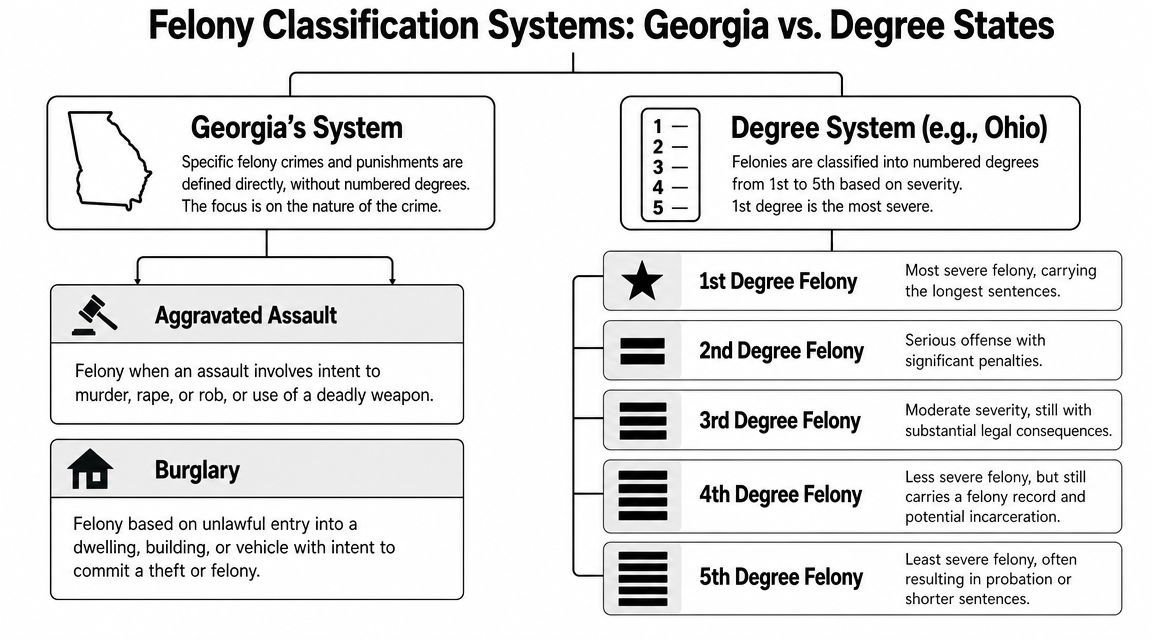
How degree states work
Ohio is a clear example. There, a fifth-degree felony is the least serious felony level. Under Ohio law, fifth-degree felonies carry 6 to 12 months in prison with discretionary fines up to $2,500, and courts may order community control instead of incarceration for some first-time offenders, as explained in this discussion of Ohio fifth-degree felony sentencing.
That kind of system gives lawyers a numbered ladder. They can talk in terms of moving a case from a fourth-degree felony to a fifth-degree felony, or from a felony to a misdemeanor, with fairly defined sentencing bands.
Here’s the simplest comparison:
| System | How crimes are categorized | What lawyers focus on |
|---|---|---|
| Degree states | Felonies are grouped by numbered severity levels | Degree, range of punishment, reduction leverage |
| Georgia | Specific crimes carry their own felony treatment and penalty rules | Exact statute, facts, enhancements, local court practice |
How Georgia works in practice
Georgia prosecutors don’t usually ask whether your charge is “5th degree.” They ask what the statute allows, whether aggravating facts are present, whether there’s a prior record, and whether the evidence supports the most serious version of the accusation.
That’s why generic felony articles can mislead people in North Atlanta. A low-level felony in Alpharetta may look negotiable on paper, but the actual negotiating power depends on search issues, witness problems, restitution, digital evidence, medical records, or whether the stop itself was lawful.
Georgia law rewards precision. The defense has to attack the actual charge, not the nickname someone gave it.
If you want a local overview of Georgia criminal categories and procedure, this Georgia criminal defense resource gives a better foundation than out-of-state summaries.
Why local analysis beats generic advice
A person searching “5th degree felony lawyer near me” is usually trying to answer a more urgent question. Can this be reduced, diverted, dismissed, or kept from wrecking my record?
That answer depends on local realities. A prosecutor in Fulton County may view a theft case differently than a prosecutor in Forsyth County. A judge in Cobb County may expect different preparation on bond, treatment, restitution, or compliance. The legal framework starts with the statute. The outcome often turns on the facts and the court.
Common Low-Level Felony Charges in North Georgia
In North Georgia, the cases that feel like the equivalent of a “5th degree felony” often start small and get serious fast. A routine stop becomes a drug case. A retail accusation becomes a felony theft allegation. A bad night out turns into a DUI-related injury prosecution.
Drug cases after a stop or search
A common pattern in Alpharetta, Johns Creek, and Cumming starts with a traffic stop. An officer says there was an odor, suspicious movement, consent, plain view, or probable cause to search. Then the case shifts from traffic court territory into felony exposure.
That’s when people start searching for a drug possession lawyer, a license suspension lawyer, or even a DUI attorney near me, because the same stop can create multiple problems at once.
Low-level felony drug cases often rise or fall on details such as:
- The stop itself: Was there a valid reason to pull the driver over?
- The search: Did the officer have legal authority to search?
- The substance identification: Has the state properly tested and identified what was seized?
- Possession issues: Was it yours, or merely near you?
Theft and property cases
In Roswell, Marietta, and East Cobb, many low-level felony cases involve accusations tied to stores, homes, vehicles, or workplaces. Shoplifting, receiving stolen property, and property-entry allegations often carry more complexity than people expect.
Sometimes the state overcharges early. Sometimes a witness makes assumptions that don’t hold up once video, receipts, timelines, and messages are reviewed. In some cases, the better defense is not “it didn’t happen,” but “the state can’t prove felony intent.”
For related situations involving entry onto property or accusations that begin as a trespass-style case, this page on criminal trespassing charges may help frame the issue.
DUI-related felony exposure
DUI is commonly considered a misdemeanor. Sometimes it is. But an impaired driving case can become a felony-level crisis when there’s an injury allegation, a prior-history problem, or another charge attached to the stop.
That’s why someone in Sandy Springs or Duluth may need more than a DUI lawyer. They may also need a felony defense lawyer who knows how to challenge blood work, field sobriety evidence, causation claims, and statements made at roadside or at the hospital.
A lot of “low-level” felony cases don’t begin with a person planning to commit a felony. They begin with a stop, an argument, a misunderstanding, or a bad decision that prosecutors later frame in the harshest available way.
The True Cost of a Felony Conviction Beyond Jail Time
People usually focus on jail first. That makes sense. But the deeper damage often starts before the case is over.
A low-level felony can interfere with work, school, housing, family stability, professional licensing, and your standing in court if you’re ever charged again. Even when a judge doesn’t impose the harshest sentence, the record itself can keep punishing you.
What changes right away
The practical consequences start early:
- Employment pressure: Some employers suspend, reassign, or terminate workers after an arrest.
- Professional risk: Licensing boards may ask questions long before a criminal case reaches final resolution.
- Housing instability: Applications become harder, especially when background checks are routine.
- Family stress: Bond conditions, travel restrictions, and no-contact terms can disrupt childcare and daily life.
One reported data point tied to F5-equivalent charges states that 25% of defendants lose employment even before trial concludes, and that low-level felony convictions can trigger professional licensing problems. The same source also states that in Georgia, the First Offender Act can lead to expunged records for up to 70% of eligible low-level cases in qualifying circumstances, according to this discussion of employment loss and Georgia First Offender outcomes.
The hidden penalties clients underestimate
A felony record changes how people evaluate you. Employers do it. Schools do it. Landlords do it. In some fields, one conviction can derail years of training.
That’s especially important for nurses, teachers, commercial drivers, young adults applying to graduate programs, and anyone who holds a license or clearance. A person may avoid a long jail sentence and still suffer a career hit that lasts much longer.
The charge itself creates urgency. The conviction creates consequences that follow you into rooms the criminal court never sees.
Why “just plead and move on” can backfire
People under pressure often want the fastest ending. That instinct can be dangerous. A quick plea may solve the anxiety of the court date while creating a record problem that keeps resurfacing.
Consider the trade-off:
| Short-term choice | Possible immediate benefit | Long-term risk |
|---|---|---|
| Plead quickly | Case ends faster | Permanent criminal record consequences |
| Fight the evidence | More work and delay | Better chance to reduce or avoid a conviction |
| Seek diversion or First Offender treatment | More conditions up front | Better path to protect future opportunities |
When clients ask whether a low-level felony is “really that bad,” the honest answer is yes. Not because every case ends in prison, but because even a modest sentence can come with serious collateral damage.
Building Your Defense Strategy
A felony arrest is not proof. It’s the start of a contest over facts, law, and advantage. Strong defense work usually begins by slowing the case down and forcing the state to prove each part of it.

Attack the foundation of the case
Many low-level felony prosecutions look stronger at arrest than they do after review. Police reports often leave out uncertainty, conflicting witness accounts, body-camera problems, chain-of-custody gaps, and search issues.
A defense strategy often starts with questions like these:
Was the stop lawful
In traffic-related cases, an invalid stop can affect everything that came after it.Was the search legal
Consent, probable cause, warrant scope, and vehicle-search exceptions matter.Can the state prove possession or intent
Being near contraband isn’t always the same as knowingly possessing it.Are the witnesses reliable
Angry, frightened, intoxicated, or biased witnesses can change the strength of the case.
Challenge classification and charging decisions
Drug cases are a good example of why precision matters. One source notes that Ohio classifies possession of less than five grams of cocaine as a fifth-degree felony, while other states use different thresholds, and that this kind of variation creates opportunities to challenge how a case is classified when the quantity sits near a legal boundary, as discussed in this article on state-by-state 5th degree drug possession rules.
That specific Ohio rule doesn’t control Georgia. What it does show is the larger defense principle. Classification matters. If the state overreaches on amount, intent, or the relationship between the evidence and the statute, the defense should force that issue.
Good defense work doesn’t accept the charging document at face value. It tests whether the charge actually fits the facts.
Use negotiation intelligently
Not every solid defense ends in a trial. Sometimes the best result comes from exposing weaknesses early enough that the prosecutor rethinks the case.
What works in negotiation:
- Early mitigation: Treatment records, employment history, school status, counseling, or restitution can help.
- Targeted legal pressure: A focused suppression issue often carries more weight than emotional arguments.
- Specific alternatives: Misdemeanor reductions, diversion-style resolutions, treatment court options, and First Offender requests are stronger when backed by facts.
What usually doesn’t work:
- Unprepared apology tours: Talking too much before reviewing discovery can lock in harmful statements.
- Assuming first offense means automatic leniency: Some prosecutors still push hard, especially where injury, drugs, or repeat conduct is alleged.
- Waiting until the last court date: By then, much of the bargaining power may already be gone.
Protect the record, not just the sentence
A smart defense asks two separate questions. How do we reduce immediate punishment? How do we protect the client’s future record?
Those aren’t always the same thing. In many North Georgia cases, the best outcome involves some combination of evidence challenges, strategic negotiation, and a disposition that avoids a formal conviction if legally available.
What to Do Immediately After a Felony Arrest in Cobb Forsyth or Fulton County
The first forty-eight hours matter. So do the next few court dates. People do the most damage to their own case when they talk too much, text too much, or assume they can explain everything later.
The first moves that protect you
If you were arrested in Cobb County, Forsyth County, or Fulton County, keep it simple:
- Stay silent about the facts: Don’t try to “clear things up” with police after the arrest.
- Stop discussing the case by phone or text: Friends, relatives, and co-workers can become witnesses.
- Preserve documents and names: Save bond papers, court dates, receipts, and contact information for witnesses.
- Get local court representation quickly: Early appearances affect bond, conditions of release, and case positioning.
A lawyer who regularly handles felony, DUI, reckless driving, and drug possession matters in North Atlanta courts can often identify issues before they harden into problems. That’s especially important where the case began with a traffic stop, because license consequences, criminal exposure, and court deadlines can overlap.
Why timing matters
In structured sentencing systems, even low-level felony categories can widen dramatically when aggravating facts are alleged. For example, in Colorado, a Class 5 felony carries a presumptive range of 1 to 3 years in prison, but aggravating factors can increase that to 2 to 6 years, as described in this overview of Colorado Class 5 felony sentencing ranges. Georgia uses a different framework, but the core lesson is the same. Early legal work matters because charging posture and sentencing exposure can shift fast.
If you’ve been arrested, your next statement should be to your lawyer, not to the officer, not to the other person involved, and not on social media.
Local cases move on local calendars
A felony arrest in Cumming, Marietta, Alpharetta, or Sandy Springs doesn’t unfold in the abstract. It moves through a specific courthouse, with specific prosecutors, judges, clerks, and scheduling practices. Missing a deadline, violating a bond condition, or walking into a first appearance unprepared can make a hard case worse.
Why Brian Hansford Law is the Right Choice for Your Defense
A felony accusation demands more than general legal knowledge. It requires courtroom judgment, local familiarity, and the ability to spot weaknesses in the state’s case before those weaknesses disappear under pressure to plead.
Brian Hansford Law serves clients across Alpharetta, Roswell, Johns Creek, Milton, Cumming, Marietta, East Cobb, and the surrounding North Atlanta area in cases involving DUI, reckless driving, traffic offenses, license suspension issues, drug possession, misdemeanor charges, and felony defense. Brian Hansford brings over 25 years of experience and a background as a former prosecutor, which matters when the defense needs to anticipate how the state evaluates evidence, factors influencing a plea, and trial risk.
That experience is especially important in a criminal environment that has become more challenging. Nationally, felonies comprise about 23.4% of all criminal charges, and in Colorado, violent crime rates increased by 61% between 2013 and 2022, according to The Sentencing Project’s criminal justice data. Those figures don’t define any one Georgia case, but they do reflect a broader reality. Criminal prosecution is serious, technical, and increasingly unforgiving of mistakes.
Clients who need a DUI lawyer in Alpharetta, a reckless driving lawyer in Roswell, a speeding ticket lawyer in Johns Creek, a drug possession lawyer in Cumming, or a felony defense lawyer in Marietta usually need the same thing underneath the search term. They need immediate, informed, strategic help.
If you're facing a felony, DUI, drug, theft, or traffic-related charge in North Atlanta, contact Brian Hansford Law for a free, confidential consultation. Fast action can protect your license, your record, and your future.
