
A car shows up in your driveway, apartment lot, retail center, or office parking area and then just stays there. At first it looks like a parking problem. By the time neighbors start asking questions, tenants complain, or the car gathers dust and flat tires, it becomes a legal problem.
That's where people get into trouble in North Atlanta. A homeowner in Milton wants the car gone. A landlord in Roswell is tired of losing a space. A business owner in Alpharetta thinks a tow truck can solve it in an hour. Sometimes it can. Sometimes that shortcut creates a claim for wrongful towing, property damage, or even a theft accusation.
An abandoned vehicle on private property sits at the edge of civil procedure and criminal risk. If you own the property, the wrong move can expose you to liability. If it's your car that disappeared, the facts matter just as much. In Fulton County, Forsyth County, Cobb County, Gwinnett County, and Cherokee County, the safest approach is the same. Slow down, document everything, and follow the legal process instead of improvising.
An Unwanted Car Has Appeared What Are Your Rights
A familiar version of this starts with an ordinary day. A homeowner in Johns Creek comes outside and sees an unfamiliar sedan blocking part of the drive. A property manager in Marietta notices the same SUV in the back corner of the lot for several days. A retail tenant in Sandy Springs calls the landlord because a disabled vehicle is taking up customer parking.
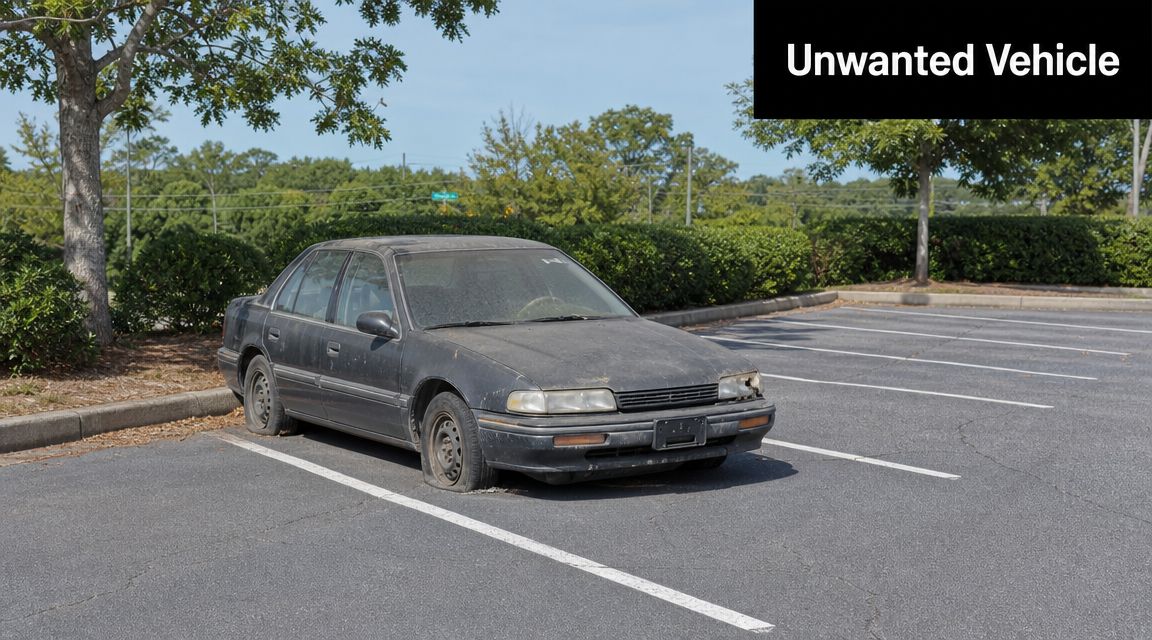
The first instinct is usually simple. Call a tow company, move it yourself, or ask a friend with a truck to drag it somewhere else. That instinct is exactly what creates avoidable legal exposure.
The property owner has rights, but not unlimited ones
If a vehicle is unauthorized, the property owner has a legitimate interest in clearing the space and protecting the property. That matters for homeowners, HOAs, apartment complexes, shopping centers, and small businesses across Alpharetta, Cumming, and East Cobb.
But ownership of the land doesn't automatically give you the right to seize someone else's vehicle in whatever way seems convenient. Cars are expensive property. A rushed decision can trigger claims for wrongful tow, conversion, trespass to chattels, or damage to the vehicle.
Practical rule: The fact that a car is annoying, suspicious, or inconvenient doesn't automatically mean it is legally abandoned.
The vehicle owner also has rights
People also forget the other side of the dispute. A car may look deserted and still belong to someone dealing with a breakdown, hospitalization, family emergency, arrest, or license issue. In some cases, a relative or friend parked it without telling the actual owner. In others, the vehicle became part of a police encounter, which is why related issues about DUI on private property in Georgia can overlap with what looks like a simple parking dispute.
That's why the law focuses so heavily on notice, timing, and process. The question is not just whether the car has been sitting there. The question is whether you can prove you handled the situation lawfully.
What raises the stakes fast
A private property vehicle dispute can expand quickly when any of these are present:
- Blocked access that affects a driveway, fire lane, delivery area, or tenant parking
- Visible damage or inoperability suggesting the vehicle may have been dumped
- No communication from the person who left it there
- Police involvement after a complaint, confrontation, or tow
- Owner anger after removal when the vehicle disappears or returns damaged
For both sides, the main issue is control. The property owner wants control of the space back. The vehicle owner wants control of the car, the fees, and the legal narrative. The process you choose often determines who ends up defending themselves later.
What Legally Defines an Abandoned Vehicle in Georgia
People often use the word abandoned loosely. In law, that word matters. A vehicle isn't legally abandoned just because it has not moved, looks rough, or has overstayed its welcome.
Unattended is not the same as abandoned
The easiest way to think about it is this. An unwanted guest isn't always a trespasser. Sometimes the person stayed too long. Sometimes they were never invited. The law treats those situations differently.
The same is true for a car. A vehicle may be unattended without yet meeting the legal standard for abandonment. That distinction matters because towing too early can create liability for the property owner and the towing company.
A proper abandonment analysis usually turns on facts like permission, how long the vehicle has remained, the condition of the vehicle, location, and whether the owner can be identified and notified.
Why timelines matter so much
Georgia has its own statutes, and local practice matters, but it helps to see how sharply states can define this issue. In Texas, a vehicle may be treated as abandoned on private property after 48 hours if it is left there without consent, according to a legal summary of the Texas rules published at Texas stored abandoned and junked vehicle guidance. That comparison shows why guessing is dangerous. A short statutory window in one state tells you how aggressive abandoned vehicle enforcement can be, but it also shows why you must know the exact rule that applies where the car is sitting.
A vehicle can be a nuisance long before it becomes legally abandoned.
Facts that strengthen an abandonment argument
Certain facts usually make the situation more serious and easier to document:
- The vehicle appears inoperable because of flat tires, broken glass, or obvious disrepair
- Major identifying details are missing such as plates or registration stickers
- The location makes permission unlikely such as a private driveway, reserved apartment stall, or gated lot
- No one responds after reasonable efforts to identify or contact the owner
That still doesn't make self-help a good idea. It means the case for formal removal gets stronger.
The safest working approach
If you're dealing with an abandoned vehicle on private property in Alpharetta, Roswell, Johns Creek, or Cumming, use this mindset before you do anything else:
- Treat the car as someone else's property until the legal process says otherwise.
- Separate frustration from legal status.
- Build a file before you build a plan.
That file should include photos, dates, plate information if visible, where the car is parked, and any communication with tenants, neighbors, or the suspected owner. In practice, that documentation often decides whether the matter stays administrative or turns into a dispute.
Property Owner's Guide to Legal Vehicle Removal
Once you have reason to believe the vehicle qualifies for removal, the priority changes. The issue is no longer just getting the car off your property. The issue is creating a record that shows you handled the matter lawfully from start to finish.
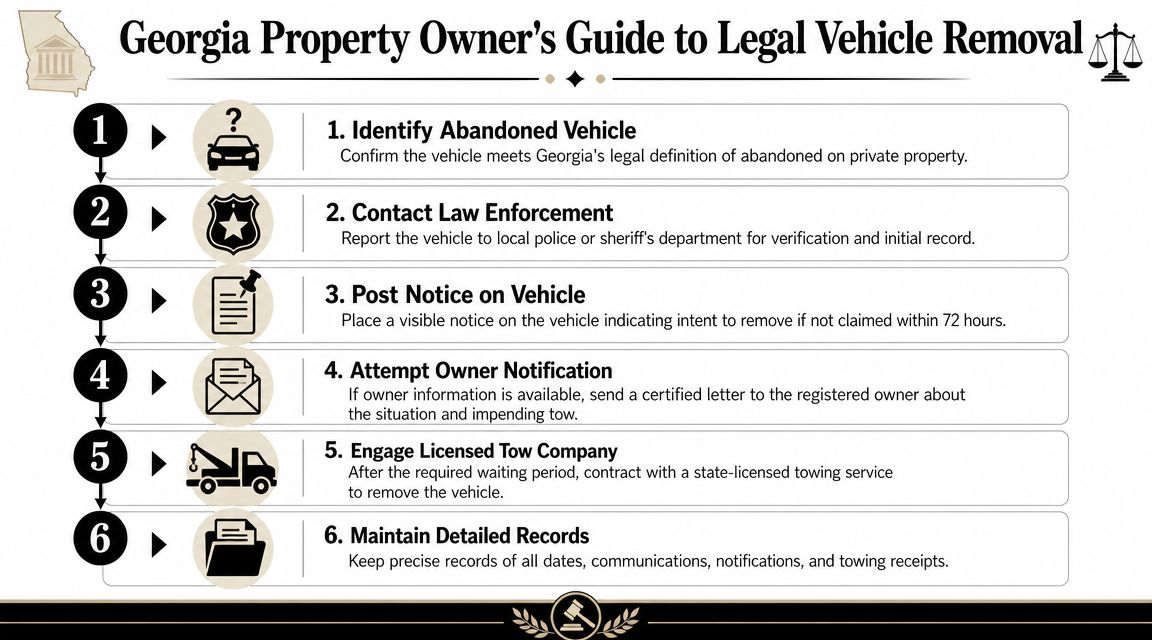
Start with evidence, not assumptions
Before any tow is requested, collect the details you may need later.
- Photograph the vehicle from multiple angles, including the space it occupies, any damage you can already see, and any posted parking signs nearby.
- Record the basics such as plate number, VIN if visible through the windshield, make, model, color, and the date you first noticed it.
- Note the location precisely because "back of lot" is weak, while "space 14 beside Building B" is useful.
If a dispute lands in court, the side with the cleaner file usually has the stronger position.
Report it through the proper channels
In many real-world situations, the next smart move is to involve local law enforcement or the appropriate municipal process before arranging removal. That creates a neutral record and reduces the chance that the vehicle is stolen, linked to another case, or already subject to some other hold.
If you manage private parking regularly, it also helps to review operational best practices for documentation for parking enforcement tows. The value there isn't marketing. It's the reminder that photos, logs, timestamps, and notice records often matter more than anyone expects.
Notice is where many cases go wrong
Property owners frequently get tripped up on notice. They assume that because the vehicle is unauthorized, formal notice is optional. It isn't.
In states with detailed rules, notice is the backbone of a valid tow process. Texas provides a useful example. Once a storage facility takes possession, the first notice must be mailed no later than day 5 for Texas-registered vehicles and day 14 for out-of-state vehicles, according to the Texas law library guide on abandoned vehicle notices. That source also explains that notice timing affects redemption rights, lien enforcement, and auction eligibility. Georgia property owners should take the same lesson even when working under Georgia procedures. Deadlines and proof of notice are not paperwork trivia. They are the case.
If you can't prove notice, you may not be able to prove the tow was lawful.
Use licensed professionals and preserve the paper trail
A lawful removal usually depends on the right vendor, the right sequence, and the right records.
Here's the practical checklist I'd want any property owner to follow:
Confirm authority to act
Make sure you control the property or have written authority from the owner, manager, landlord, or HOA.Review posted signs and lot rules
If your lot relies on signage, inspect it before the tow, not after the complaint.Attempt owner identification
If information is available, document your effort to reach the owner.Use a state-licensed towing and storage provider
Avoid informal arrangements. A buddy with a rollback is not legal strategy.Keep every document
Save call logs, emails, tow requests, intake forms, receipts, mailing records, and photos.
What doesn't work
Some methods are almost guaranteed to create risk:
- Pushing the car into the street so the city will deal with it
- Removing parts to pressure the owner to respond
- Accepting cash from a scrap buyer before title or custody issues are resolved
- Using threats instead of notice
- Relying on memory instead of written records
Property owners in Roswell, Milton, Duluth, and Marietta often think the legal issue ends once the car leaves the property. It doesn't. The legal issue often begins at the moment of removal.
Navigating Local Towing Ordinances in North Atlanta
State law sets the framework, but local practice changes the way these cases unfold. That's especially true in North Atlanta, where private lots, mixed-use developments, apartment complexes, and HOA communities all operate differently.
A towing issue in Alpharetta may involve city police procedures and private parking enforcement expectations. A similar issue in unincorporated Forsyth County may move through a different local process. The safest answer is always the same. Check the city or county rule that applies to the exact address, then confirm how local law enforcement wants the matter documented.
Local rules can differ in practical ways
The biggest local differences usually involve three things:
- Signage expectations at entrances and throughout the lot
- Notice practices before a nonconsensual private property tow
- Police notification before or immediately after removal
For apartment owners, retail centers, and HOAs, these are not technicalities. They are what make the tow defensible.
North Atlanta Private Property Towing Ordinance Comparison 2026
| Jurisdiction | Required Signage at Entrance? | Specific Notice Period | Police Notification Required Before Tow? |
|---|---|---|---|
| Alpharetta | Check current local code and police practice | Check current local rule or property-specific basis for tow | Confirm with local enforcement and tow provider |
| Roswell | Check current local code and police practice | Check current local rule or posted lot policy | Confirm with local enforcement and tow provider |
| Johns Creek | Check current local code and police practice | Check current local rule or property-specific basis for tow | Confirm with local enforcement and tow provider |
| Milton | Check current local code and police practice | Check current local rule or posted lot policy | Confirm with local enforcement and tow provider |
| Cumming | Check current local code and police practice | Check current local rule or property-specific basis for tow | Confirm with local enforcement and tow provider |
| Marietta | Check current local code and police practice | Check current local rule or posted lot policy | Confirm with local enforcement and tow provider |
| Sandy Springs | Check current local code and police practice | Check current local rule or property-specific basis for tow | Confirm with local enforcement and tow provider |
| Unincorporated Fulton County | Check county rule and local enforcement protocol | Check current rule for private property removal | Confirm with sheriff or appropriate agency |
| Unincorporated Forsyth County | Check county rule and local enforcement protocol | Check current rule for private property removal | Confirm with sheriff or appropriate agency |
| Unincorporated Cobb County | Check county rule and local enforcement protocol | Check current rule for private property removal | Confirm with sheriff or appropriate agency |
| Unincorporated Gwinnett County | Check county rule and local enforcement protocol | Check current rule for private property removal | Confirm with sheriff or appropriate agency |
| Unincorporated Cherokee County | Check county rule and local enforcement protocol | Check current rule for private property removal | Confirm with sheriff or appropriate agency |
Why this table is qualitative
I'm keeping this comparison qualitative for a reason. Local ordinances change, police practices vary, and a city code summary can be misleading if applied to the wrong property type or towing scenario. A private apartment lot, a retail center, and a single-family driveway may all be governed differently in practice.
That's also why people searching for a traffic ticket attorney in Roswell, a reckless driving lawyer in Alpharetta, or a criminal defense attorney near me often need the same thing in towing disputes. They need someone who understands how local enforcement handles these issues on the ground.
The right question is not "Can I tow this car?" The right question is "What process does this location require before I tow this car?"
A practical local checklist
Before a tow in North Atlanta, confirm all of the following:
- Which jurisdiction controls the address
- Whether the lot has compliant signage
- Whether your lease, HOA rules, or parking agreement adds requirements
- Whether police must be notified before or after the tow
- Whether the towing company follows the local reporting process
That extra call or document check can prevent a much larger fight later.
Your Rights if Your Car Was Towed from Private Property
If you walk outside in Alpharetta, Johns Creek, or Marietta and your car is gone, start with one assumption. It may have been towed, not stolen. That distinction matters because your next steps need to be fast and focused.
First, find the vehicle and gather records
Call local law enforcement and ask whether the vehicle was reported as towed from private property. Then contact the towing company and ask for the legal basis for the tow, the location of the vehicle, what paperwork they have, and what you need to retrieve it.
Write down names, times, and exactly what you're told. If the company claims the car was unauthorized or abandoned, ask what notice was given and who authorized removal.
Illegal tows often come down to procedure
Many private property tow disputes aren't really about whether the car was welcome. They're about whether the tow followed the required procedure.
California offers a sharp example of how exact these rules can be. On private property, a posted sign at each entrance must be at least 17” x 22” with lettering at least one inch high, and failure to comply can expose the property owner or manager to damages of two to four times the towing or storage charges under the circumstances summarized by California private property tow requirements. That's California, not Georgia, but the lesson applies everywhere. Procedural defects strengthen the vehicle owner's position.
Questions that can expose a bad tow
Use these questions immediately:
- Was the car on private property where the person ordering the tow had authority?
- Was the required signage present and visible?
- Was notice required and, if so, was it given?
- Was the vehicle unauthorized or abandoned, or just temporarily parked?
- Was the car damaged during removal or storage?
If police searched the vehicle, impounded it, or used the tow as part of a broader investigation, related search issues may matter too. That's why many vehicle owners also need to understand when police can search your car in Georgia.
A bad tow case often turns on small facts. Missing signage, wrong lot, poor records, or weak notice can change everything.
What to do next if you plan to challenge the tow
Don't rely on memory alone. Build your own file.
- Photograph the lot where the vehicle was parked, especially entrances, signs, curb markings, and space numbers
- Collect receipts and notices from the towing company
- Preserve communications with the property owner, apartment office, landlord, or HOA
- Inspect the vehicle carefully when you recover it and document new damage immediately
A wrongful private property tow can start as a fee dispute and end as a civil claim. The sooner the facts are preserved, the better your position usually is.
When a Civil Issue Becomes a Criminal Charge
This is the part most online guides skip. People assume an abandoned vehicle on private property is a civil headache, not a criminal case. That assumption causes real damage.
Self-help is where people get burned
A frustrated property owner decides to handle the problem alone. They move the car with a chain. They take it to another lot. They strip parts because the owner "obviously abandoned it." They sell it to a scrapyard because they think nobody will come back for it.
That's where the risk shifts. A dispute over parking or towing can become an accusation of theft, criminal trespass, false reporting, or property damage.
Pennsylvania's state guidance captures the gap well. It explains procedures for dealing with abandoned vehicles, but the larger lesson is the one many people miss. The wrong self-help step can turn a vehicle dispute into accusations of theft-like conduct or property damage, as described in Pennsylvania abandoned vehicle guidance discussing owner and landowner procedures.
Common criminal exposure points
Here are the situations I see create the most danger:
- Moving the car without lawful authority and then denying it
- Selling or scrapping the vehicle before title and notice issues are resolved
- Removing property from inside the vehicle
- Damaging the vehicle during an improvised removal
- Making a false stolen vehicle report after a dispute over towing or possession
A person who thought they were "just dealing with junk" can suddenly need a misdemeanor defense attorney in Alpharetta, a felony defense lawyer in Roswell, or immediate court representation in Fulton or Forsyth County.
The criminal case often turns on intent and documentation
Criminal exposure doesn't always come from a dramatic act. Sometimes it comes from a bad explanation. If police ask why you moved a car, sold parts, entered the vehicle, or called in a theft report, your answer matters. Your records matter even more.
That's also why cases involving vehicle disputes can overlap with other property-related offenses, including criminal trespassing charges in Georgia. Once police are involved, the conversation stops being about neighbor frustration and starts being about legal authority.
If your plan depends on "I'll explain it later," it is probably not a safe plan.
The better approach
If you own the property, use the legal process. If you own the vehicle, challenge the tow or removal through records and procedure. If the situation has already escalated into a police report, demand for payment, or accusation, treat it like a criminal risk issue immediately.
That is especially important in North Atlanta courts, where a minor-looking dispute can produce a charging decision faster than people expect.
Get Help Now from an Experienced North Atlanta Attorney
An abandoned vehicle dispute can look minor right up until someone gets a tow bill, a demand letter, a court date, or a call from police. That's why these cases need careful handling from the start. The underlying issue usually isn't just the car. It's the risk created by the way the car was removed, reported, stored, or challenged.

If you're dealing with a towing dispute, threat of charges, license concerns tied to the incident, or a broader criminal investigation in Alpharetta, Roswell, Johns Creek, Milton, Cumming, Sandy Springs, Marietta, or the surrounding counties, get advice before you make the next move. That applies whether you're the property owner trying to do things right or the vehicle owner trying to undo a bad tow.
Quick legal guidance can help protect your record, your property, and your position in court.
If you need immediate help with a vehicle-related dispute, criminal allegation, DUI issue, traffic case, or court appearance in North Atlanta, contact Brian Hansford Law. The firm serves clients in Alpharetta, Roswell, Johns Creek, Milton, Cumming, Marietta, and throughout Fulton, Forsyth, Cobb, Gwinnett, and Cherokee County, with focused defense for high-stakes situations where the next step matters.
