
Sometimes, the legal system can be used improperly. This is the heart of what's known as an abuse of process. It occurs when someone takes a standard legal procedure—like filing a lawsuit or issuing a subpoena—and uses it for a malicious or improper reason that has nothing to do with the case itself.
This isn't about filing a totally baseless case from the start. It’s about twisting a valid process within a lawsuit to harass, intimidate, or financially drain the other side.
Understanding the Core Concept of Legal Misuse

Think of the legal system as a toolbox. Every tool, from a lawsuit to an arrest warrant, has a specific, legitimate purpose. An abuse of process is like grabbing a hammer not to build something, but to smash a window out of spite. The initial action might even look justified on the surface, but the corrupt intent behind it is what crosses a line.
The whole concept boils down to one thing: an "ulterior motive." The person isn't using the courts to genuinely seek a resolution. Instead, they're using the power and expense of the legal process to achieve some other goal.
The Misuse of Legitimate Actions
What makes this tricky is that the procedure being used is often perfectly valid. The problem isn't the filing of the motion itself, but the hidden agenda driving that action. It's like pulling a fire alarm—a legitimate safety device—not because there's a fire, but just to disrupt a competitor's business meeting next door. The alarm works, but the reason for using it is completely improper.
A few real-world examples can make this clearer:
- Filing a lawsuit just to bury a business rival in legal fees, hoping they'll run out of money and fold.
- Initiating an arrest on a minor charge not for public safety, but to intimidate someone in a separate civil dispute.
- Sending mountains of irrelevant and burdensome discovery requests simply to harass the other party and drive their legal costs through the roof.
The Intent is What Matters
Ultimately, a court will look at the purpose behind the action. Was the legal step taken to honestly advance a claim? Or was it just a strategic play to coerce, bully, or harm the other person outside the actual scope of the lawsuit? When misused, even a standard procedure can become a powerful weapon.
The essence of an abuse of process claim is the misuse of legal proceedings for a purpose other than that which they were designed to accomplish. It is the malicious and deliberate misuse of a regularly issued judicial process that is not justified by the underlying legal action.
This kind of behavior can strike at the integrity of the justice system. Even a seemingly small procedural step can cause immense damage when driven by malice. To better understand this, it helps to know how these processes are supposed to work. For those curious about the very beginning of a criminal case, you can learn more about what happens when someone is arrested. Knowing the proper function of these procedures makes it easier to see how they can be twisted.
The Two Core Elements of an Abuse of Process Claim

To successfully show an abuse of process, it is often necessary to establish two key things happened. Think of them as two sides of the same coin; together, they show how a perfectly normal legal tool was twisted for an improper reason. It’s not enough to just feel like a lawsuit is unfair—a claim must be built on these two specific pillars.
The first piece of the puzzle is the existence of an ulterior purpose or motive. This is the hidden agenda, the real reason for the legal action, which has nothing to do with what the lawsuit is officially about. The court process isn't being used to find a just resolution but to bully, harass, or gain leverage in a completely separate matter.
This ulterior purpose is the "why" behind the misuse. It’s the secret motivation driving someone to use the legal system as a weapon.
Uncovering the Ulterior Purpose
What to look for here is a goal that's completely unrelated to the legitimate outcome of the case. The person filing is trying to achieve something on the side—a benefit the legal system was never meant to provide. To show this, one has to get to the heart of the filer's true intentions.
Here are a few scenarios that paint a clear picture of an ulterior purpose:
- Financial Pressure: Imagine a massive corporation suing a small startup competitor. Their goal isn't really to win the case but to drain the smaller company's resources with endless legal fees, hoping to drive them out of business.
- Coercion in an Unrelated Dispute: Someone files a minor but very public lawsuit against a former business partner. The real goal? To pressure that partner into selling their shares in a different, privately owned company they co-own.
- Personal Harassment: During a messy divorce, one ex-spouse repeatedly files pointless motions and demands sensitive, irrelevant personal information through subpoenas, all with the sole intent of causing emotional distress and invading the other's privacy.
In every one of these examples, the legal tool being used is legitimate on its face, but the mission behind it is corrupt. The objective isn't justice in this case, but a win in a battle happening outside the courtroom.
The Willful Act of Misusing the Process
The second essential element is a willful act where the process is used improperly in the regular course of the legal proceedings. This is the "how." It’s the specific, concrete action someone takes to push their hidden agenda forward.
This element is critical because it takes the claim from a bad thought to an actual bad deed. It’s not just about wanting to misuse the system; it’s about actively doing something to make it happen. This act is a clear step taken to weaponize some part of the legal process.
An abuse of process isn't defined by the wrongfulness of the case itself, but by the improper use of procedural tools within it. The focus is on the perversion of a specific action after the case has begun.
This misuse goes far beyond just filing the initial lawsuit. It involves exploiting a specific legal procedure along the way. For example, placing a lien on a property is a standard legal tool. But if that lien is filed not to secure a debt related to the lawsuit but to stop the owner from selling the property to force them into an unrelated settlement, that becomes a willful act of misuse.
Proving this requires evidence showing exactly how a standard procedure was twisted. This is where the burden of proof comes into play. If you want to dive deeper into this concept, our guide on what the burden of proof is explains how it works. Understanding this helps clarify what's needed to back up an abuse of process claim—the person making the claim has to show the action was a deliberate perversion of the process.
Contrasting Abuse of Process and Malicious Prosecution
While they often get tangled together in conversation, abuse of process and malicious prosecution are two very different legal concepts. Understanding what sets them apart is crucial because, while both involve misusing the legal system, they happen at completely different stages of a case.
Think of it this way: malicious prosecution is like building a house on a toxic, unstable foundation. The entire project is corrupt from the very start because there was never a legitimate reason to build it.
Abuse of process, on the other hand, is like building a perfectly sound house but then intentionally using the plumbing system to flood a neighbor's yard. The initial structure was valid, but a specific tool within it was weaponized for an improper goal.
This core difference—whether the problem lies with the entire case or a specific action within it—is what really sets them apart.
The Point of Origin
The biggest distinction between the two is their starting point. A claim for malicious prosecution attacks the very beginning of a legal action. It argues the whole lawsuit was filed without probable cause and with malicious intent. In simple terms, there was never a good reason to bring someone to court in the first place.
Conversely, an abuse of process claim doesn’t necessarily challenge the original lawsuit. A case can be perfectly valid and based on real facts, yet still involve abuse of process. The wrongdoing happens after the case has already started, when one party misuses a specific legal procedure—like a subpoena, a deposition, or a lien—for a reason it was never intended for.
This infographic highlights some key outcomes tied to this kind of procedural misuse.
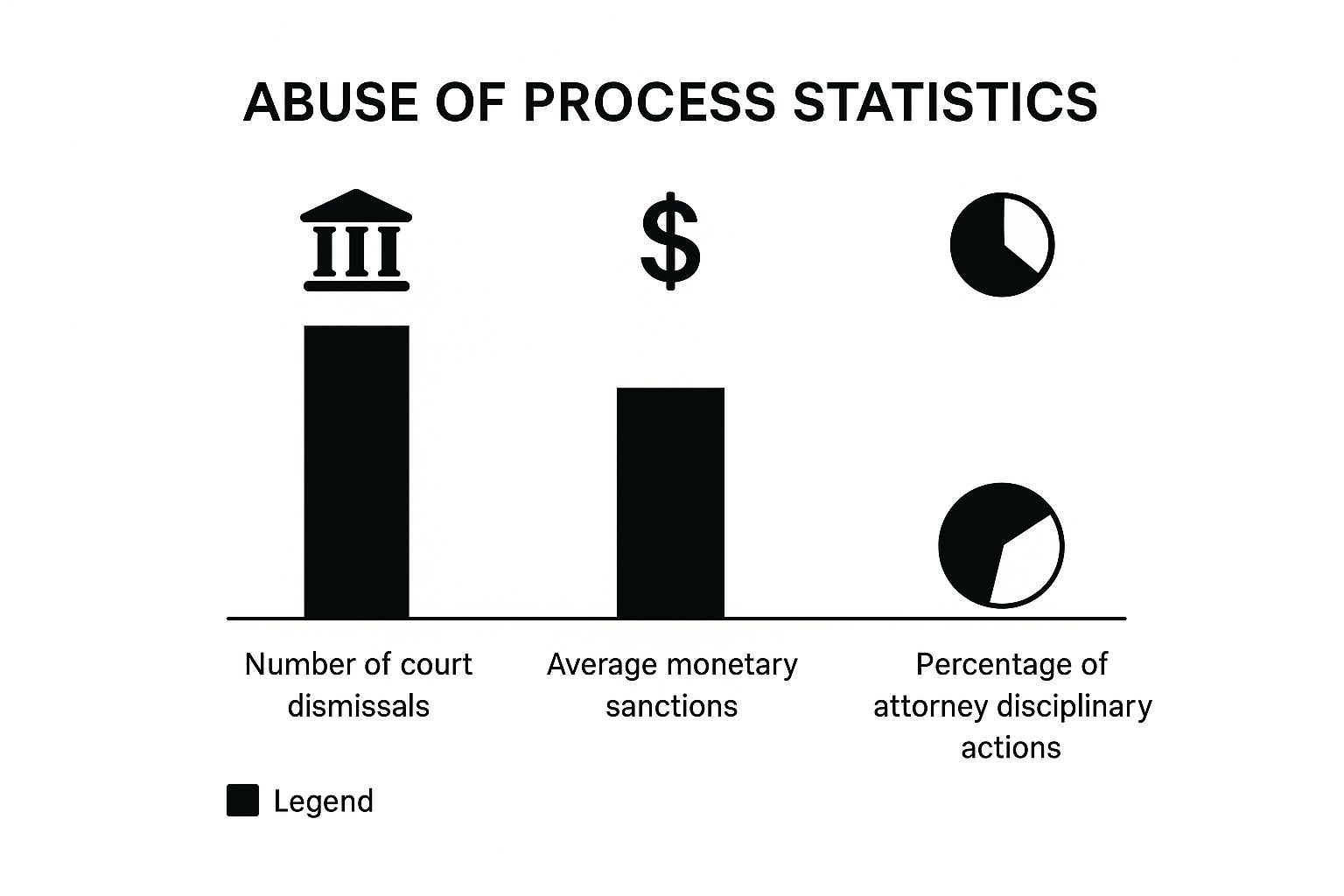
The data shows a clear link between procedural misconduct and serious consequences, including case dismissals, monetary sanctions, and even professional discipline for the attorneys involved.
Focus of the Wrongdoing
The central focus of the wrongdoing also differs sharply.
- Malicious Prosecution: The harm is being wrongfully brought into court. The entire judicial proceeding is the problem because it lacks any legitimate justification from day one.
- Abuse of Process: The harm comes from the improper use of a specific procedural tool within an otherwise legitimate case. The focus isn't the lawsuit as a whole, but the misuse of a particular process.
For example, suing someone for breach of contract when you know no contract ever existed could be malicious prosecution. But suing that same person for a legitimate contract breach and then filing excessive, harassing document requests to bully them into a separate, unrelated deal? That would be an abuse of process.
The key question for malicious prosecution is, "Should this case have ever been started?" For abuse of process, the question is, "Was this specific legal tool used for its intended purpose?"
It’s important to understand these differences, as they can pop up in both civil and criminal matters. For more on that, our overview on the differences between civil vs criminal cases can add more clarity.
Abuse of Process vs Malicious Prosecution Key Differences
To make the distinction even clearer, this table breaks down the essential components of each concept. It compares the fundamental characteristics of abuse of process and malicious prosecution to clarify their distinct legal natures.
| Aspect | Abuse of Process | Malicious Prosecution |
|---|---|---|
| Timing of Wrongdoing | Occurs after legal proceedings have started. | Occurs at the very initiation of legal proceedings. |
| Core Wrongful Act | Misusing a specific legal tool (e.g., subpoena, motion) for an ulterior purpose. | Starting a legal action without probable cause and with malicious intent. |
| State of the Case | The underlying lawsuit may be completely valid and have merit. | The underlying lawsuit is baseless and lacks legal justification from the start. |
| Primary Proof Needed | Must show an ulterior motive and a specific act of misuse. | Must show a lack of probable cause, malice, and a favorable termination of the original case. |
Ultimately, malicious prosecution is about a wrongful beginning, while abuse of process is about a wrongful action along the way. Both represent a serious misuse of our justice system, but they are identified and proven in fundamentally different ways based on when and how the misconduct happens.
How Procedural Misuse Impacts Global Legal Systems

The idea of abuse of process is much bigger than a simple disagreement between two people or companies. When someone intentionally misuses the rules of the legal system, the damage sends ripples through the foundation of justice itself. This isn't just a personal problem—it’s a threat to the whole system, draining court resources, destroying public trust, and even complicating international relationships.
Think about it. Every time a legal procedure is twisted for an ulterior motive, it eats up precious court time and money that should have gone to legitimate cases. This creates a logjam, delaying justice for everyone and making the courts less effective. Over time, people start to lose faith in the system's ability to deliver a fair outcome.
The problem is so widespread that even major global institutions have had to write specific rules to stop people from misusing their internal justice systems. They know that to be credible, they have to protect the integrity of their own procedures.
Upholding Integrity in Global Institutions
International organizations are just as vulnerable to these kinds of manipulations. In fact, with the stakes so high in global disputes, the temptation to bend the rules can be overwhelming. Recognizing this, bodies like the United Nations have put strong systems in place to catch and penalize anyone who abuses their internal legal processes.
A prime example comes from the United Nations Dispute Tribunal (UNDT) and United Nations Appeals Tribunal (UNAT), where misconduct is taken very seriously. In one case, an applicant filed a completely frivolous claim and then lied repeatedly for six months to try and keep a lump sum payment he wasn't entitled to. The UNAT ultimately found he had "manifestly abused the judicial process" by using forged documents and lying, and they reversed the initial decision. You can read more about how the UN works to uphold integrity within its internal judicial mechanisms.
This shows a critical principle in action: for any legal system to command respect, it has to be able to protect itself from being corrupted from the inside.
A Case Study in Fabricated Evidence
The real-world damage from procedural misuse becomes crystal clear when you look at a case involving fabricated evidence. Imagine a company in a high-stakes patent lawsuit knowingly submits altered lab reports to make it look like a competitor stole their invention.
This one dishonest act sets off a disastrous chain reaction:
- Wasted Judicial Resources: The court and its staff now have to spend hundreds of hours analyzing evidence that is a complete sham.
- Financial Drain: The competitor who was falsely accused is forced to spend a fortune on experts and legal fees just to prove the claims are based on lies.
- Delayed Justice: The entire case gets sidetracked. Instead of focusing on the actual patent issue, everyone is now trying to untangle a web of deceit, pushing a final resolution further and further away.
Even if the fraud is discovered and the guilty party faces severe penalties, the damage has been done. Each time something like this happens, it chips away at the public’s belief that our courts deliver outcomes based on the truth.
"The fairness of the process is as important as the outcome itself. When the process is corrupted, any outcome becomes suspect, undermining the credibility of the entire legal system."
At the end of the day, procedural fairness isn't just some lofty ideal. It’s a practical necessity for any justice system—local or international—to work. Without everyone sticking to the rules and real consequences for those who don't, the entire framework of justice is at risk.
The Economic Ripple Effect of Legal System Exploitation
When the legal system gets twisted and used for the wrong reasons, the damage isn't just contained to the courtroom. The fallout creates a very real economic ripple effect that touches businesses, their customers, and the economy as a whole. This is what an abuse of process can look like in the real world: the justice system gets turned into a tool for financial pressure instead of a place for fair resolution.
Think about strategic lawsuits filed not to win on the facts, but simply to bleed a competitor dry. The astronomical cost of fighting a long, drawn-out legal battle can force even a healthy company to make an impossible choice: pay a settlement on a claim that has no merit or risk going bankrupt just to prove a point. This is how the threat of a lawsuit becomes a powerful weapon.
The Rise of Nuclear Verdicts and Insurance Pressures
This problem has only been made worse by the rise of "nuclear verdicts"—jury awards so massive they can run into the tens or even hundreds of millions of dollars. Even if the chance of getting hit with one is small, the mere possibility is enough to scare defendants and their insurance carriers into settling. The fear of one catastrophic loss at trial often becomes a much bigger motivator than the desire to fight an unjust case.
This has a direct and costly impact on the insurance industry. The United States sees roughly 40 million lawsuits filed every year, creating a perfect storm for this kind of exploitation. As these "nuclear verdicts" became more common in the late 2010s, insurers had to scramble to protect themselves. For example, it wasn't uncommon for a commercial insurance policy to have a $50 million limit. Now, those limits are often slashed to between $10 million and $25 million as a defense against these massive, unpredictable awards. You can find more details on how insurers are responding to these economic pressures from industry experts.
The systemic exploitation of legal procedures doesn't just harm individual defendants; it introduces a level of unpredictability and risk that destabilizes entire markets, driving up costs for everyone.
This change in coverage has serious consequences. With lower policy limits, businesses are far more exposed to financial ruin from a single large judgment. To make up for the increased risk, insurance premiums have shot up across the board in industries like trucking, construction, and healthcare.
Broader Economic Consequences of Defensive Practices
The economic pain doesn't stop at higher insurance bills. To lower their risk of being sued, businesses are often forced to change how they operate, adopting more defensive—and more expensive—practices.
These shifts show up in a few key ways:
- Increased Consumer Costs: Businesses don't just absorb these new costs. They pass their higher insurance and legal expenses on to you and me through higher prices for goods and services.
- Stifled Innovation: Why take a risk? Companies may think twice about developing a new product or expanding into a new market out of fear that they'll be targeted by an opportunistic lawsuit.
- Reduced Competitiveness: Small and mid-sized businesses are hit the hardest. They don't have the deep pockets to fight endless legal battles and can be pushed out of the market by bigger competitors who use litigation as a business strategy.
At the end of the day, exploiting the legal system acts like a drag on the entire economy. It takes money that could have been used for productive things—like research, creating new jobs, and growing a business—and funnels it into pointless legal fights. A systemic abuse of process isn't some abstract legal theory; it's a real-world cost that we all end up paying for.
When a legal fight crosses international borders, the idea of an abuse of process gets a whole lot more complicated. Suddenly, you’re not just dealing with a simple contract or local laws. Instead, the dispute often falls under the authority of massive treaties between entire nations, opening the door for a different kind of legal gamesmanship.
It’s an environment where the rules themselves can become a weapon. If parties are from different countries, one might be tempted to "forum shop"—filing the same claim in multiple international courts, hoping to find one that will give them a better outcome. This isn't just a clever strategy; it’s often a deliberate ploy to wear down an opponent, forcing them to fight the same battle on multiple fronts. That’s a classic abuse of the system.
The Role of Treaties in Global Disputes
Unlike a typical lawsuit, international arbitration often revolves around claims based on bilateral or multilateral investment treaties. The concept of abuse of process, which is rooted in public international law, has become a critical tool for tribunals to police the misuse of these legal frameworks.
To give you a sense of how common this is, the International Centre for Settlement of Investment Disputes (ICSID) revealed that a whopping 83.2% of its cases in 2016 were based on these kinds of treaties. In major disputes like the Lauder/CME case against the Czech Republic, the government argued the claimant was abusing its rights by filing for the same remedy more than once. This raised serious questions about whether traditional legal doctrines were enough to stop this kind of behavior. You can find a deeper dive into the abuse of process doctrine in international arbitration from Squire Patton Boggs.
This heavy reliance on treaties creates a tangled web of overlapping jurisdictions and rules—a perfect situation for someone to exploit. A party might start a case under one treaty and, if things start looking bad, launch a new case under a different treaty, just hoping for a second bite at the apple.
In international arbitration, the principle of good faith is everything. Using treaty loopholes to create parallel cases or re-litigate issues that have already been decided isn't seen as smart lawyering. It's viewed as a direct attack on the integrity of the entire global dispute resolution system.
This kind of maneuvering drains everyone's resources, leads to conflicting court rulings, and ultimately undermines the legitimacy of international tribunals.
Safeguarding the Integrity of International Arbitration
Thankfully, international tribunals are getting better at spotting and stopping this kind of procedural abuse. They understand their job is to provide a fair and efficient place to resolve real disputes, not to be a playground for legal trickery.
Tribunals are on the lookout for specific red flags that point to an abuse of process, such as:
- Parallel Proceedings: Launching multiple claims about the same core issue in different courts without a good reason.
- Re-litigation: Trying to bring back a claim that has already been decided or settled somewhere else.
- Improper Motives: Using the arbitration process not to get a legitimate remedy, but to harass a country or gain an unfair advantage in other negotiations or even bankruptcy proceedings.
When a tribunal determines that a party is misusing its procedures, it won't hesitate to take strong action, like throwing the claim out entirely. These are necessary safeguards to protect the credibility of international law and make sure that access to justice isn’t hijacked by those looking to game the system for their own gain.
Common Questions About Abuse of Process
It's natural to have questions when you're caught in the middle of a complex legal fight. When the term abuse of process gets thrown around, it can create a lot of confusion about what it actually means on the ground. Let's clear up a few of the most common questions.
A big one that comes up is: if someone files a lawsuit and loses, can the other side turn around and sue for abuse of process? Generally, the answer is no. Our justice system is built on the idea that people have the right to bring a case, and losing is just a part of that process. An abuse of process claim isn't about whether a case was won or lost; it's about why a specific legal tool was used in the first place.
Clarifying Key Distinctions
People also wonder if aggressive legal tactics automatically count as abuse. While it’s true that some approaches can be overly aggressive, making things frustrating and expensive, that alone doesn't usually cross the line. The real test is whether an action serves a legitimate purpose within the lawsuit, however aggressive it may seem. The problem arises when a legal tool is used specifically to harass, drain someone's finances, or force an outcome in a completely separate issue.
Here are a few common situations:
- What if someone uses the legal process just to delay things? If the delay is for a legitimate strategic reason—like needing more time to gather evidence—it’s probably fine. But if the only reason is to make the other party run out of money and give up, that could definitely be seen as an improper ulterior motive.
- Does this only apply to civil cases? Not at all. The concept applies to criminal cases, too. For instance, if someone files a baseless criminal charge not to seek justice but to pressure an ex-spouse into giving up assets in a divorce, that's a classic example of abuse of process.
At its heart, an abuse of process claim is not about the strength of a case but the integrity of the actions taken within it. The law is looking at the misuse of a specific legal tool for a purpose it was never meant to serve.
Ultimately, figuring out if an abuse of process has occurred means looking past the surface of a legal action to uncover the true intent driving it.
If you are facing complex legal challenges, having experienced guidance is essential. At Brian Hansford Law, we are dedicated to protecting your rights and providing a strong defense. For a detailed review of your situation, visit us at https://challengemycharge.com.
