
When you're arrested for a DUI in Georgia, you’re suddenly facing two separate challenges. One is the criminal charge everyone knows about. The other is a separate, fast-moving civil case that puts your driver's license on the line immediately. This second battle is the administrative license suspension hearing, and it operates completely independently of what happens in criminal court.
Understanding The Georgia Administrative License Suspension
It's easy to get tunnel vision after a DUI arrest and focus only on the criminal side of things. But while you're worrying about that, another clock starts ticking on your right to drive. This isn't a criminal matter—it's an administrative one handled by the Georgia Department of Driver Services (DDS).
Think of it this way: the criminal court wants to know if you broke the law. The DDS only cares about one thing: your privilege to hold a Georgia driver's license. These two processes run on parallel tracks. Winning, losing, or pleading in one case doesn't automatically dictate the outcome of the other.
This administrative action is called an Administrative License Suspension, or ALS for short. It's triggered automatically in certain situations right at the time of your arrest.
Triggers for an Administrative License Suspension
An officer will start an ALS proceeding against your license for one of two reasons:
- Refusing a Chemical Test: You refuse the state-administered chemical test (breath, blood, or urine) after being lawfully arrested.
- Testing Over the Legal Limit: You take the test and your Blood Alcohol Concentration (BAC) is 0.08% or higher. For drivers under 21, the limit is 0.02%, and for commercial drivers, it's 0.04%.
If either of these happens, the officer will likely confiscate your plastic license on the spot. They'll hand you a DDS 1205 form, which serves as both a temporary driving permit and the official notice that your license suspension is about to begin.
The Critical 30-Day Window
Here is the most important takeaway: there is an extremely short window to respond. From the day of your arrest, you have only 30 calendar days to request an ALS hearing and appeal the suspension. If this deadline is missed, the license is suspended automatically. No exceptions.
This isn't a rare occurrence. In 2023 alone, Georgia saw over 30,000 DUI arrests, and a huge number of those triggered these administrative actions. This shows just how common this secondary fight is for drivers across our state.
To help you keep these critical deadlines straight, here is a quick summary of the actions to consider immediately after a DUI arrest.
Key Timelines And Actions After A Georgia DUI Arrest
This table breaks down the critical deadlines and choices a driver faces to prevent an automatic license suspension.
| Action Required | Deadline | Potential Outcome If Deadline Is Missed |
|---|---|---|
| Appeal the Suspension (Request an ALS Hearing) | Within 30 calendar days of your arrest date. | Automatic "hard" suspension of your driving privileges. |
| Install an Ignition Interlock Device (As an alternative to ALS) | Within 30 calendar days of your arrest date. | You waive your right to an ALS hearing and accept a limited driving permit. |
| Do Nothing | The 30-day window passes. | Your license will be automatically suspended without any chance to appeal. |
Failing to act within these 30 days is a common mistake, and it has immediate, serious consequences.
The ALS hearing is not about proving guilt or innocence on the DUI charge. It's a civil hearing to determine if the officer followed proper procedure and if the state has the right to suspend your license.
Understanding this distinction is the first and most critical step. The choices made—or not made—in that first month will directly impact your ability to get to work, take care of your family, and live your life. To see what a suspension looks like in practice, you can learn more about what a license suspension after a DUI actually entails.
Your Critical 30-Day Decision After A DUI Arrest
The moment you’re arrested for a DUI in Georgia, a clock starts ticking. You have exactly 30 calendar days to make a choice that will have a direct and immediate impact on your ability to drive. This isn't a deadline you can put off or ignore—missing it means automatic, and often severe, consequences for your driver's license.
In this very short window, you’re standing at a fork in the road. You have two options, and each one comes with its own set of costs, rules, and potential outcomes. Getting a handle on these two paths is the first real step toward taking back control.
Many people don't realize that a single DUI arrest actually triggers two separate processes. One is the criminal case that goes through the court system. The other is an administrative action against your license handled by the Department of Driver Services. They run on parallel tracks.
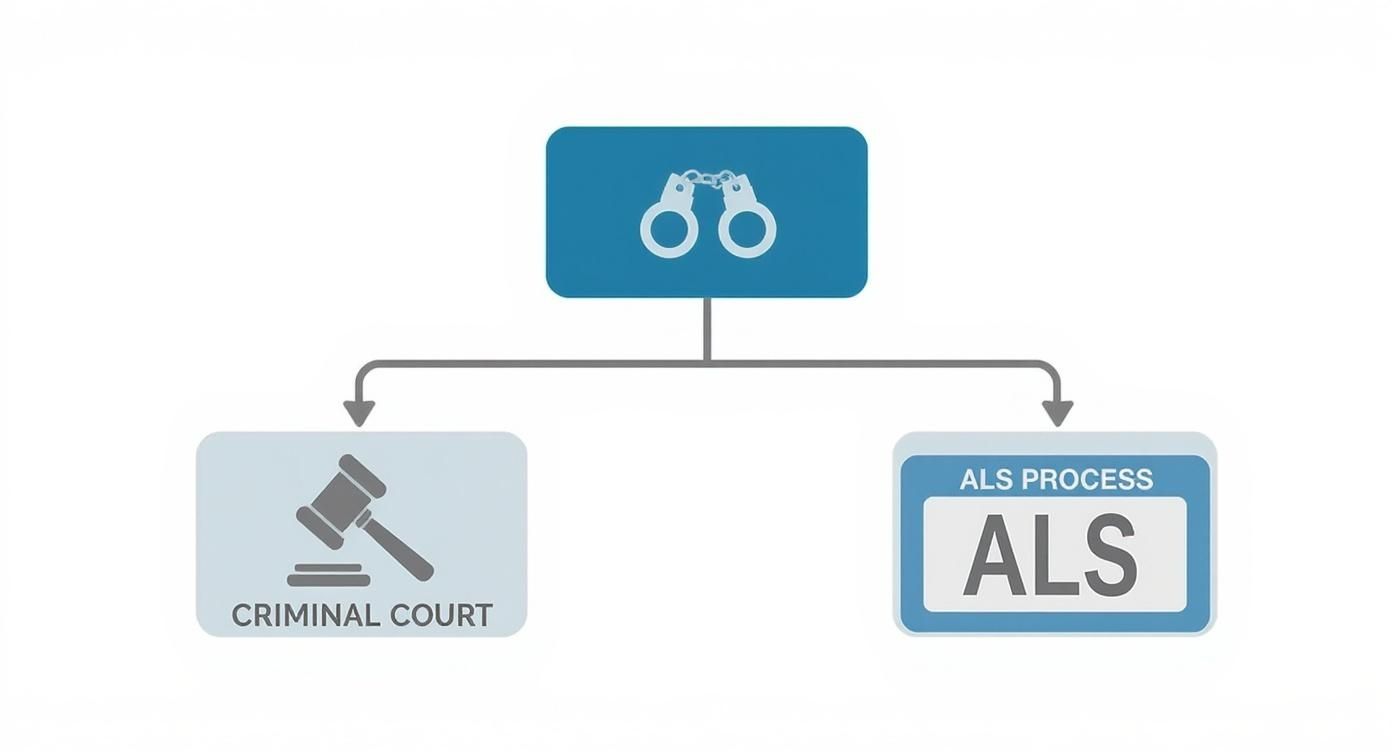
This diagram shows how the administrative process is completely separate from your criminal court proceedings, but they both stem from the same arrest.
Path One: Request An ALS Hearing
The first choice is to fight the automatic license suspension head-on. This is done by officially filing an appeal and requesting an administrative license suspension (ALS) hearing with the Georgia Department of Driver Services (DDS). This request, commonly known as a "30-day letter," must be sent along with a $150 filing fee. Critically, it has to be received by the DDS before that 30-day clock runs out.
Taking this path puts a temporary pause on the suspension. You’ll be able to keep driving on the temporary permit you were given (the DDS 1205 form) until your hearing is held. The hearing isn't a criminal trial about guilt or innocence; its sole focus is to determine if the arresting officer followed all the proper legal procedures during the arrest.
Requesting a hearing is the only way to preserve your right to challenge the administrative suspension. It’s the one and only shot to argue the case and potentially stop your license from being suspended on these administrative grounds.
This option gives you a fighting chance to keep your full driving privileges while the criminal case moves forward. But it's not a sure thing. If the hearing is lost, the suspension kicks in immediately.
Path Two: Waive The Hearing And Install An Interlock Device
The second path is to give up, or waive, your right to an ALS hearing. Instead, an application can be made for an Ignition Interlock Device Limited Driving Permit (IIDLP). This choice must also be made within that same tight 30-day window after your arrest.
When going this route, you are essentially accepting the administrative suspension but getting a way to drive under very specific restrictions. It requires you to have an ignition interlock device—a small breathalyzer wired into your car's ignition—installed by a certified professional, and you foot the bill.
Keep a few things in mind with this option:
- Costs: You're on the hook for the installation fee, monthly monitoring fees, and the eventual removal fee for the device.
- Driving Limitations: The permit doesn't let you drive just anywhere. It's limited to essential travel like work, school, medical appointments, and court-ordered substance abuse treatment.
- Duration: The device has to stay on your vehicle for a legally required amount of time, which is usually a full year for a first-offense refusal.
While this path definitely comes with costs and hassles, it offers a guaranteed way to keep driving legally. For anyone who absolutely cannot afford a "hard suspension" with zero driving privileges, this can be the most practical choice. It’s important to see how this fits into the overall strategy.
Deciding between these two paths isn’t a one-size-fits-all situation. The best choice depends entirely on the unique facts of the case—things like your driving history, the specific details of the traffic stop, and how critical it is for you to be on the road all come into play.
What To Expect At The ALS Hearing
Walking into any kind of hearing can be nerve-wracking. The good news is, an administrative license suspension hearing in Georgia isn't the high-drama criminal trial you see in movies. It's a much more low-key, formal administrative proceeding with a very specific, narrow purpose.
The whole thing happens in front of an Administrative Law Judge (ALJ). Forget about a jury of your peers; there isn't one here. The ALJ acts as a neutral referee, listens to the evidence, and makes a call based strictly on the letter of administrative law. The focus is not on whether you're guilty of a DUI—that's a separate fight for the criminal courts.
Key Participants In The Room
When you walk in, you'll see a few key players, and each one has a distinct role. Besides you and the judge, the arresting officer and an attorney for the Department of Driver Services (DDS) will be there.
- You (The Driver): The person who requested the hearing, so you are the petitioner.
- The Administrative Law Judge (ALJ): This is the official who runs the show, hears testimony, and makes the final decision on your license.
- The Arresting Officer: They are the state's main witness and will testify about the traffic stop and everything that followed.
- The DDS Attorney: This lawyer is there to represent the state's interest in suspending your driver's license.
During these hearings, getting everything down on paper is crucial. An official record often relies on a detailed legal court transcription to ensure every word is captured exactly as it was spoken.
The Scope Of The Hearing
The big question at an ALS hearing is surprisingly simple: did the officer do everything by the book? The hearing is designed to look at just a few key issues, and the conversation will not stray from them.
The scope of the hearing is strictly limited to four main issues: the legality of the traffic stop, the grounds for the DUI arrest, the proper reading of the Georgia Implied Consent Notice, and the results of (or refusal of) the chemical test.
The ALJ isn't there to listen to arguments about what a good person you are or how much you need your license for work. The focus stays locked on the police procedure during and after your arrest. Think of it as a technical review of the "how," not a trial to determine guilt.
The Odds And Importance Of Representation
It’s important to be realistic. The odds for drivers at Georgia ALS hearings can be tough, especially for anyone trying to go it alone. When a driver requests a hearing without an experienced lawyer, the DDS usually wins—some estimates put their success rate between 70% to 85% in those situations.
The hearing is all about very specific legal questions and procedures. Having an attorney in your corner who lives and breathes these nuances can completely change the dynamic in the room.
Common Defense Arguments In ALS Hearings
An administrative license suspension hearing isn't about whether you're guilty of a DUI. It’s not a criminal trial. Instead, the focus is squarely on whether the arresting officer followed the correct procedures down to the letter. Think of it less as looking for a loophole and more as ensuring every single procedural safeguard was properly met.
These arguments dive deep into the technical side of the arrest. A winning challenge often comes down to details that might seem small on the surface but carry significant legal weight. That’s why a complete, step-by-step review of the entire process is so critical.
Every ALS hearing is unique, but the defense arguments often zero in on a few key areas where procedural mistakes are most likely to happen.
Challenging The Initial Traffic Stop
Everything that leads to a DUI arrest begins with the traffic stop. For that stop to be legal, the officer must have had a legitimate reason to pull you over. The legal standard for this is called reasonable articulable suspicion.
This just means an officer can't pull you over based on a hunch or for no reason at all. They have to be able to point to a specific, observable fact, such as:
- A traffic violation, like speeding, failing to stay in your lane, or rolling through a stop sign.
- Erratic driving, like weaving back and forth or hitting the brakes for no reason, which might suggest impairment.
- An equipment problem, like a burned-out taillight or an expired tag.
If it can be demonstrated that the officer didn't have a valid reason for the initial stop, then everything that came after it—the DUI investigation, the arrest, and the request for a chemical test—could be thrown out. This type of challenge attacks the very foundation of the state's case to suspend your license.
Scrutinizing The Implied Consent Notice
After a DUI arrest in Georgia, the officer is legally required to read you the Georgia Implied Consent Notice. This notice is meant to inform you that you must submit to a state-administered chemical test (like a breath or blood test) and what happens if you refuse. The exact wording here is incredibly important.
An officer must read the correct version of the implied consent notice based on your age and the type of license you hold. Reading the wrong one is a critical procedural mistake.
For instance, Georgia has different notices for drivers over 21, drivers under 21, and commercial (CDL) drivers. If an officer reads the over-21 warning to a 19-year-old driver, that error can become the centerpiece of the defense. The law demands that the notice be read correctly, and any failure to do so is a powerful basis for challenging the license suspension. To explore this topic further, you can find a detailed breakdown of Georgia’s Implied Consent Law and what happens if you refuse a chemical test in our related guide.
Examining Breath Test Procedures And Maintenance
If you took a breath test, those results are only considered valid if both the machine and the officer who used it met strict state-mandated requirements. This opens up another major area for a detailed defense.
The focus here includes:
- Machine Calibration and Maintenance: Breathalyzer devices, like the Intoxilyzer 9000 used across Georgia, have to be inspected and calibrated on a regular schedule. The maintenance logs can be pulled to see if the machine was even working properly on the day you were tested.
- Officer Certification: The officer who gave you the breath test must have a current, valid certification to operate that specific machine. If their certification has expired, the test results can be invalidated for the ALS hearing.
- Proper Observation Period: Before having you blow into the machine, the officer is supposed to watch you for a continuous period (usually 20 minutes) to make sure you don’t eat, drink, smoke, or put anything in your mouth that could contaminate the results.
Any slip-up in these strict protocols can be brought up at the hearing. The core argument is simple: if the state can't prove the test was done correctly with a properly maintained machine, then those results have no business being used to suspend your driver's license. Each of these arguments shows just how technical an administrative license suspension hearing in Georgia is and why a detailed review is absolutely essential.
Understanding The Potential Outcomes Of Your Hearing
Once your administrative license suspension hearing wraps up, the Administrative Law Judge (ALJ) will issue a decision. This ruling is a big deal—it directly impacts your ability to drive, and it’s completely separate from what happens in your criminal DUI case. To figure out what comes next, you need to understand what each potential outcome really means for you.
There are three main ways an ALS hearing can go, and each one sends you down a different path. Knowing what could happen beforehand helps you get ready for the next steps, no matter which way the judge rules.

Outcome 1: Suspension Is Upheld
If the judge finds the arresting officer did everything by the book, your license suspension will be upheld. Frankly, this is a very common result, especially if there are no significant procedural mistakes to challenge. What this suspension looks like depends entirely on the specifics of your arrest.
- If you refused the test: You’re looking at a 12-month "hard" suspension. That means no driving, period. You won't be eligible for any kind of limited permit to get to work or school.
- If your test was over the legal limit: Your license will be suspended for 30 days. After that initial month, you may be able to apply for a limited driving permit.
When the suspension period is over, your license doesn't just reappear. You have to actively work to get it back by completing reinstatement requirements, which almost always include paying a fee and finishing a DUI Alcohol or Drug Use Risk Reduction Program.
Outcome 2: Suspension Is Rescinded
A much better outcome is having the suspension rescinded, which is sometimes called being "set aside." This happens when the ALJ agrees that the state just didn't meet its burden of proof. Maybe the officer didn't have a legitimate reason to pull you over in the first place, or perhaps they botched the Implied Consent Notice reading.
When a suspension is rescinded, it's a huge win on the administrative side. It means your license is safe from any administrative suspension, and you can keep your full driving privileges while the criminal case moves forward.
Getting the suspension rescinded effectively kills the administrative case against your license. But remember, this doesn't make your criminal DUI charge go away. The two cases are on completely separate tracks, and you still have to fight the charges in criminal court.
Outcome 3: Case Is Negotiated Or Dismissed
Sometimes, the issue can be resolved without ever having a full-blown hearing. The DDS attorney might agree to rescind the suspension if you agree to plead to a lesser charge in your criminal case, like reckless driving. It’s a strategic move that can save everyone the time and risk of a hearing.
A case can also get dismissed for practical reasons. One of the most frequent is the arresting officer simply not showing up. Without their key witness, the state can't make its case, and the judge will almost always dismiss the action and rescind the suspension.
No matter the result, the end of your administrative license suspension hearing in Georgia is a critical point. It gives you a clear answer on your immediate driving status and lets you turn your full attention to the separate battle of your criminal case. Every outcome has its own set of next steps, from applying for reinstatement to gearing up for your defense in court.
Frequently Asked Questions About Georgia ALS Hearings
After a DUI arrest, you’re suddenly thrown into a confusing process, and a million questions start running through your mind. Let’s clear up some of the most common ones about the Administrative License Suspension (ALS) hearing in Georgia to give you a better handle on what’s ahead.
If I Win My ALS Hearing Does That Mean My DUI Case Is Dismissed
No, it doesn't. This is a critical point to understand: the ALS hearing and your criminal DUI case are two completely separate battles fought on different fronts.
The ALS hearing is a civil proceeding. It’s handled by the Department of Driver Services, and the only thing at stake is your privilege to drive. The Administrative Law Judge is there to decide one thing: whether the arresting officer followed the rules when they initiated the suspension of your license.
Your DUI charge, on the other hand, is a criminal matter that will be decided in a separate court. While winning the ALS hearing is a huge victory for keeping your license, you still have to fight the criminal charges. That said, the testimony an officer gives at the ALS hearing can sometimes provide a strategic advantage in the criminal case.
What Happens If The Arresting Officer Does Not Show Up
This is one of the best-case scenarios. If the arresting officer is the state's main witness and they don't appear for the hearing, the DDS usually can't prove its case against you.
Without the officer’s testimony, the state can't meet its burden of proof. In almost every situation like this, the Administrative Law Judge will have to dismiss the proposed suspension.
When that happens, the suspension is "rescinded," and you get your license back without any administrative penalty. An officer's failure to show up is a common reason drivers win these hearings.
Can I Get A Work Permit After An ALS Suspension
Whether you can get a limited driving permit—often called a work permit—depends entirely on why your license was suspended. The rules are extremely specific.
- Suspension for Refusal: If your license is being suspended because you refused to take the state's chemical test (breath, blood, or urine), you are not eligible for any kind of permit. You will face a one-year "hard suspension" with no driving whatsoever.
- Suspension for a BAC Result: If the suspension is because your BAC was over the legal limit, you may be able to get a limited permit. However, this is only after serving an initial 30-day suspension where you cannot drive at all. After that, the permit lets you drive for essential reasons like work, school, and medical appointments.
Be warned: the terms of a limited permit are ironclad. If you're caught driving outside of its strict limitations, you'll face even tougher penalties, including a longer suspension.
How Much Does It Cost To File For A Hearing
To request an administrative license suspension hearing in Georgia, you have to send an appeal letter to the Georgia DDS.
Along with that letter, you must include a $150 filing fee. This needs to be a check or money order made out to the Georgia Department of Driver Services.
This is the most important part: both the letter and the fee must be in their hands within 30 calendar days of your arrest. If you miss that deadline by even a day, you automatically forfeit your right to a hearing, and the license suspension goes into effect. For legal professionals addressing specific regional concerns like administrative license suspension hearings in Georgia, effective local SEO strategies for law firms can be essential for connecting with individuals who need timely information in areas like Forsyth County and Cobb County.
Is The ALS Hearing The Same As My Criminal Court Date
Absolutely not. It's easy to get them confused, but they are two completely different events.
The ALS hearing is an administrative process with an Administrative Law Judge, usually at a DDS office or held over video. Its only purpose is to address your driver's license.
Your criminal court date is for the DUI charge itself. It takes place in a criminal court—like State, Superior, or Municipal Court—and involves a prosecutor and a criminal judge. These will be on different days, at different times, and in different locations. They must be treated as two separate obligations.
Navigating an administrative license suspension hearing is the first step, but it’s a process filled with procedural traps. With over 25 years of experience, including years as a prosecutor, Brian Hansford Law knows how to scrutinize every detail of your arrest. If you're facing a DUI in Alpharetta, Cumming, Roswell, or anywhere in Forsyth and Cobb Counties, contact us for a consultation to protect your license and your future. Visit us at https://challengemycharge.com.
