
An arrest in Alpharetta, Roswell, Cumming, or Marietta can make the case feel over before it starts. You may have blown into a machine, answered questions you now regret, handed over your phone, or watched an officer pull something from your car that the State will try to label as the whole story.
That feeling is common. It’s also often wrong.
In Georgia criminal defense, one of the most important fights happens before a jury ever hears a word of the evidence. The issue is admissibility of evidence. That means whether the prosecution can legally use a piece of evidence at all. A failed breath test, a bag pulled from a console, a text message screenshot, a bodycam clip, or a lab report may look powerful on paper. But if the police collected it unlawfully, handled it badly, or can’t prove it’s reliable, a judge can keep it out.
That is where a former prosecutor’s perspective matters. A lawyer who has built cases for the State knows where officers cut corners, where reports are drafted to patch weaknesses, and where prosecutors tend to overstate what their evidence can prove. In North Atlanta courts, that insight matters in DUI cases, drug possession cases, reckless driving charges, theft allegations, and felony prosecutions.
If you’re searching for a DUI lawyer in Alpharetta, a traffic ticket attorney in Roswell, a drug possession lawyer in Johns Creek, or a felony defense lawyer near me, this is the practical part of the defense that can change everything. Not every charge is beaten by arguing innocence alone. Many are won by forcing the State to play by the rules.
Your Guide to Challenging Evidence in a Georgia Criminal Case
A lot of clients call after a long night and say the same thing. “They have me on camera.” “I failed the breath test.” “They found it in my car.” “The officer says my phone data proves it.”
Those facts may matter. But they don’t end the case.
In Georgia courtrooms, evidence only matters if the judge allows it in. That’s the difference between what the police found and what the prosecution can use. For someone facing a DUI in Forsyth County, a drug charge in Fulton County, or a theft case in Cobb County, that distinction is often the center of the defense.
Why this issue changes cases
The State doesn’t get a free pass just because an officer wrote it into a report. Prosecutors still have to clear legal hurdles before a judge lets a jury hear the evidence.
That usually means asking hard questions like these:
- Was the stop lawful: If the traffic stop itself was invalid, later evidence may be vulnerable.
- Was the search proper: If police searched without legal authority, the result can be suppression.
- Was the evidence handled correctly: Chain of custody problems can damage drug, blood, and digital evidence.
- Can the State prove reliability: Lab results and technical testing don’t come in automatically.
- Can the State authenticate it: Digital evidence often fails on basic foundation.
Practical rule: A criminal case is not just about what happened. It’s about what the government can prove with admissible evidence.
In Alpharetta Municipal Court, Cumming courts, Marietta courts, and throughout North Atlanta, that fight often starts early. A strong defense does not wait for trial and hope the prosecutor’s case falls apart on its own. It forces the issue with targeted motions, hearings, and cross-examination.
What clients need to know right away
If you’ve been arrested or cited, time matters. Surveillance footage disappears. bodycam must be requested. Dashcam files get overwritten. Witness memories change. Court deadlines arrive fast, especially in DUI and license suspension matters.
The best early move is simple. Preserve the evidence, stop talking about the case, and have the file reviewed with admissibility in mind from day one.
What Is the Admissibility of Evidence in Georgia
Admissibility of evidence is the judge’s gatekeeping function. Before evidence can influence a judge or jury, it has to pass through legal rules that screen out material that is irrelevant, unreliable, unlawfully obtained, or unfairly prejudicial.
In plain terms, the courthouse has a gate. Not everything gets through.
The judge acts as the gatekeeper
A prosecutor may want to use a statement, a lab result, a cell phone extraction, or a roadside observation. The defense asks whether that item meets the legal rules for entry.
Three basic questions usually drive that decision:
- Is it relevant: Does it help prove or disprove a fact that matters?
- Is it reliable: Can the court trust the method, handling, or source?
- Was it obtained lawfully: If police violated constitutional protections, the evidence may be excluded.
This sounds technical, but it becomes concrete quickly. If an officer in Johns Creek stops a car without a legal basis and then finds drugs in the console, the defense may challenge not just the stop but everything that came after it.
The exclusionary rule
The exclusionary rule is the remedy courts use when police obtain evidence in violation of constitutional rights. If the government broke the rules to get the evidence, the court can keep that evidence out.
That rule is one of the strongest protections a defendant has. It matters in traffic stops, home entries, phone searches, vehicle searches, and statements made during custodial questioning.
Fruit of the poisonous tree
The next layer is the fruit of the poisonous tree doctrine. If the original search or seizure was unlawful, later evidence discovered because of that illegality may also be suppressed. The rule traces back to cases including Mapp v. Ohio (1961), and its application is more nuanced than many people realize, as discussed in Justia’s overview of admissibility of evidence and suppression doctrine.
Here is the practical version. If police unlawfully search your car in Milton and find a phone, then use that phone to uncover messages, photos, or location data, the defense may argue that the later digital evidence is tainted by the original illegal search.
But there is a limit. Suppression usually applies only if your own rights were violated, not someone else’s. Local trends in Fulton County show that a notable percentage of suppression motions succeed primarily on direct constitutional violations against the defendant, which is why a focused, fact-specific motion matters.
A weak suppression argument wastes credibility. A targeted one can change the case.
What this means in real life
Clients often assume “evidence is evidence.” Courts don’t work that way.
A prosecutor still has to answer questions like:
- Why was the stop legal?
- What justified the search?
- Who handled the evidence?
- Can the witness lay the proper foundation?
- Does the probative value outweigh the unfair prejudice?
Those are not minor details. In many DUI, drug, reckless driving, and theft cases in North Atlanta, they are the defense.
The Legal Standards Governing Evidence in Georgia Courts
Evidence challenges become tougher when the prosecution relies on science or technology. Breath testing, toxicology, digital extraction, accident reconstruction, and telematics all sound impressive in court. But the label “scientific” doesn’t make them automatically admissible.
Georgia courts look closely at the legal standard behind that evidence.
Frye explains the older framework
For decades, courts relied on the Frye standard. It came from the 1923 case Frye v. United States and required novel scientific methods to gain general acceptance before admission. As summarized in this explanation of the Frye standard and admissibility of evidence, Frye governed about 75% of U.S. jurisdictions before newer standards took over.
That history still matters because it explains a basic truth. Courts have long recognized that juries can be overawed by technical evidence. A machine printout can look decisive even when the underlying process is flawed.
The current focus is reliability
Today, Georgia courts evaluating forensic and technical proof focus on reliability principles that mirror Daubert and related evidentiary rules. The State must do more than hand over a report and say “trust the science.”
The pertinent questions are narrower:
- Was the method tested: A lawyer should ask how the method was validated.
- Is there a known error framework: Reliability is not assumed.
- Was it applied correctly in this case: Even a sound method can be misused.
- Can the witness explain the foundation: A result without foundation is vulnerable.
For a DUI attorney in Cumming or a drug possession lawyer in Milton, important work happens at this stage. Breath testing records, blood draw procedures, machine maintenance, analyst notes, and custody logs all matter. If the State can’t build the scientific foundation, the evidence should be challenged.
The record matters more than people think
Judges don’t decide these issues in a vacuum. They rely on motions, testimony, exhibits, transcripts, and hearing records. That’s one reason accurate documentation matters so much. When a hearing turns on a disputed statement by an officer or analyst, clean records can shape the ruling and preserve issues for appeal. For lawyers and firms that need dependable records from hearings, interviews, or trial prep, legal transcription services can be a practical support tool.
A related concept also matters in constitutional challenges. The exclusionary rule definition and application helps explain why even strong-looking evidence can be kept out when the government crossed the line getting it.
What usually works and what doesn’t
What works is a specific attack on method, foundation, or application. What usually fails is a broad complaint that the evidence “doesn’t seem fair.”
A court is more likely to engage when the defense can point to a precise defect such as:
| Issue | Why it matters |
|---|---|
| Missing calibration records | Undermines confidence in machine output |
| Weak chain of custody | Raises questions about contamination or mix-up |
| Incomplete expert foundation | Leaves the judge without a basis to admit the opinion |
| Poorly documented extraction process | Makes digital evidence harder to trust |
That’s the pressure point. The State bears the burden of getting the evidence through the gate.
Common Evidence We Challenge in North Atlanta Courtrooms
Most evidence fights in Georgia criminal court are not abstract debates about legal theory. They arise from ordinary police work. A roadside DUI stop in Sandy Springs. A car search after a traffic stop in Marietta. A phone dump in a drug case from Johns Creek. A witness identification made after officers used a suggestive process.
Those are the cases where admissibility arguments do real work.
DUI test results
In North Atlanta DUI cases, prosecutors often build the file around field sobriety testing, officer observations, breath testing, and sometimes blood analysis. Clients tend to focus on the number from the machine. The defense should focus on the foundation under it.
In Georgia DUI and drug cases, admissibility of forensic evidence such as breathalyzer results or toxicology reports depends on reliability standards similar to FRE 702. The verified data also states that 55% of challenges succeed against flawed forensics, and that under O.C.G.A. § 40-6-392, certification failures lead to suppression in up to 37% of cases in Forsyth County Superior Court, as described in PharmChek’s discussion of forensic admissibility and defensibility.
That means a DUI lawyer in Alpharetta or a DUI attorney in Roswell should be looking at details like:
- Machine certification: Was the device maintained and certified the way the law requires?
- Operator compliance: Did the officer follow the required procedure?
- Observation period issues: Was the pre-test process documented cleanly?
- Blood draw handling: Was the sample stored, labeled, and transferred correctly?
A bad breath test is not unbeatable evidence. Sometimes the machine result survives. Sometimes it doesn’t. What matters is whether the State can prove the testing process was legally and scientifically sound.
Drug evidence
Drug cases often look simple from the prosecutor’s side. Police say they found the substance. A lab says it tested positive. End of story.
That version skips over the fragile parts of the chain.
In a Marietta possession case, for example, the primary fight may not be whether police recovered an item. The fight may be whether the State can show the item tested at the lab is the same item seized from the car, pocket, or home. If a property log is sloppy, if labels don’t match, or if the transfer trail has gaps, the court may question admissibility or weight.
Drug cases also raise search issues. If the stop or search was unlawful, the defense may attack the seizure first and the substance identification second. Both fronts matter.
In possession cases, the prosecution often assumes the lab result will carry the day. It won’t if the path from seizure to courtroom is broken.
Eyewitness identification
Jurors often give eyewitnesses too much confidence credit. In real practice, identifications can be shaky.
A witness may have seen the suspect only briefly. Lighting may have been poor. Stress may have been high. Officers may have shaped the process by the way they presented a photo lineup or asked follow-up questions.
These cases come up in theft, assault, robbery, and even traffic-related allegations where identity is disputed. In Roswell or Duluth, for example, a witness may identify the “driver” based on a few seconds at an intersection or parking lot.
The defense challenge is usually built around fairness and reliability:
- Suggestive lineup procedures
- Officer comments that influenced the witness
- Weak viewing opportunity
- Delayed identification
- Inconsistencies between the original description and the accused
Eyewitness problems don’t always lead to outright exclusion, but they can significantly weaken the prosecution’s ability to present the identification with confidence.
Digital evidence
This is one of the fastest-growing areas of admissibility litigation. Cell phone records, extracted text messages, call logs, dashcam footage, security video, GPS data, and social media screenshots appear in cases across Fulton, Forsyth, Cobb, and Gwinnett Counties.
The legal issue is usually not just relevance. It is authentication.
A prosecutor has to show the digital item is what the State claims it is. That may require testimony about who created it, how it was stored, whether metadata stayed intact, and whether the file changed during collection or transfer. If you want a plain-language explanation of out-of-court statements and why they can trigger additional evidentiary problems, this overview of examples of hearsay is useful.
Practical digital evidence challenges often focus on:
| Digital item | Common challenge |
|---|---|
| Text screenshots | No proof of authorship or completeness |
| Phone extraction reports | Weak chain of custody or altered data during handling |
| Dashcam clips | Missing metadata or incomplete segment |
| Social media posts | Poor authentication and identity disputes |
A former prosecutor learns quickly that digital evidence gets oversold. A screenshot is not self-proving. A phone report is not magic. A video clip with missing context can create as many questions as answers.
Traffic and reckless driving evidence
A speeding ticket lawyer or reckless driving lawyer in North Atlanta often deals with a different kind of evidence problem. Radar or lidar readings, pacing testimony, bodycam, and officer notes all have foundation issues that can matter.
Sometimes the challenge is technical. Sometimes it is observational. Sometimes the officer’s memory months later doesn’t line up with the citation, video, or road conditions. For a client trying to protect a license, avoid points, or keep a CDL clean, those details can be the difference between paying a ticket and fighting it effectively.
Confession evidence
Statements are evidence too. In DUI, traffic, drug, and felony cases, officers often rely on what a client allegedly said at the roadside or in custody.
The defense looks at timing, custody status, voluntariness, Miranda compliance where applicable, and whether the statement was accurately recorded. A statement that looks harmful in the report can become much less useful to the State when the recording, context, and questioning method are examined closely.
How to Formally Challenge the Prosecution's Evidence
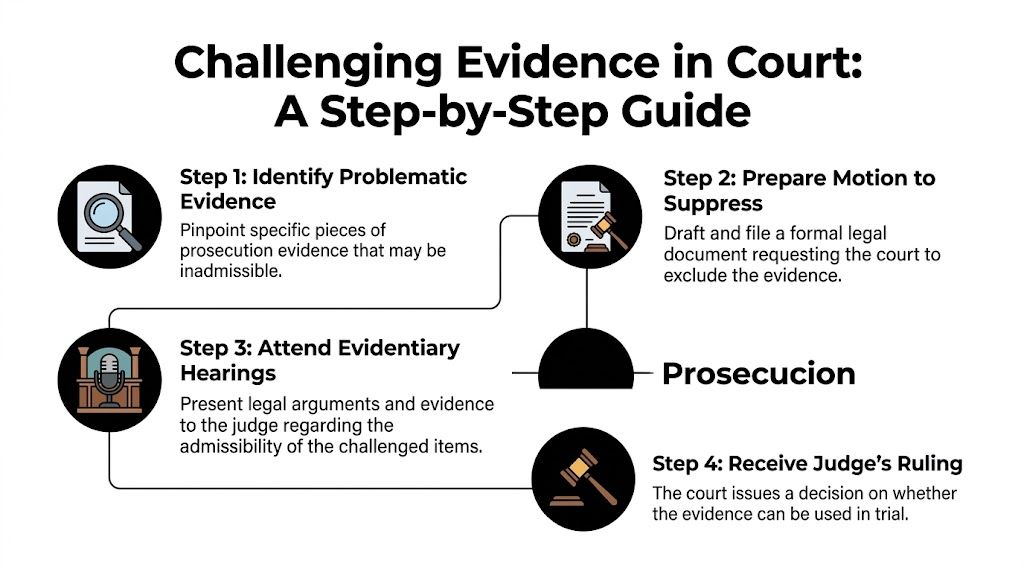
Challenging evidence is not an informal objection tossed out at the last minute. In many cases, it starts with written motions filed before trial, then moves into a hearing where witnesses testify and the judge decides what the prosecution may use.
That process is where preparation shows.
Motion to suppress
A motion to suppress asks the court to exclude evidence because the government obtained it unlawfully. That usually applies to searches, seizures, statements, identifications, and other constitutional issues.
The motion should identify the evidence, state the legal basis for exclusion, and tie the law to the specific facts. If you want a direct explanation of that filing, this page on what is a motion to suppress evidence lays out the basic concept.
Common examples include:
- Illegal stop cases: No valid basis for the original traffic stop.
- Warrantless search cases: Police searched beyond the lawful scope.
- Statement challenges: The defendant’s words were taken in violation of constitutional protections.
- Phone search disputes: Officers accessed digital material without proper legal authority.
Motion in limine
A motion in limine is different. It asks the judge to keep specific evidence out of trial because it lacks foundation, is unfairly prejudicial, or violates evidentiary rules even if there was no constitutional violation.
This tool is especially useful for digital evidence.
The verified data states that digital evidence such as cell phone data must be authenticated under rules similar to FRE 901, and that courts reject 68% of unauthenticated digital exhibits. It also states that using forensic tools to verify authentication can boost successful suppression rates by 42% in DUI and criminal defenses, according to HaystackID’s analysis of ESI admissibility standards.
That means a motion in limine may be the right vehicle when the prosecution wants to offer:
- Unverified phone records
- Screenshots with no authenticating witness
- Dashcam or surveillance files with gaps
- Extracted data with weak metadata support
What the hearing looks like
A suppression or evidentiary hearing is often where the defense gains an advantage. Officers testify. Cross-examination exposes gaps. Judges ask questions they may never ask at trial. Prosecutors have to defend the process, not just repeat the accusation.
The sequence usually looks like this:
- Defense identifies the target evidence
- Written motion is filed
- The State responds
- The court hears testimony and argument
- The judge rules
A strong hearing is built long before the hearing date. Reports, videos, certifications, dispatch records, and chain-of-custody materials should be requested and analyzed early.
What works in practice
The best motions are narrow, supported, and fact-driven. Judges respond better to “the officer extended the stop without legal grounds” than to “the arrest felt unfair.”
Useful preparation may include:
| Task | Why it matters |
|---|---|
| Reviewing bodycam and dashcam | Tests whether the report matches the video |
| Comparing certifications and logs | Exposes gaps in technical foundation |
| Mapping the search timeline | Shows when the stop or detention became unlawful |
| Isolating statements by phase | Helps analyze custody and voluntariness |
Preserve the issue even if the judge denies it
Not every motion wins. But that doesn’t make the hearing pointless.
A properly raised and argued issue can be preserved for appeal. That matters when the trial court admits evidence that should have been excluded. Good defense practice does not stop at “we lost the motion.” It makes a record that can still protect the client later.
The Game-Changing Impact of a Successful Suppression Motion
When a judge suppresses evidence, the ruling doesn’t just tidy up the file. It shifts the advantage.
In some cases, it changes everything.
Dismissal becomes possible
If the suppressed evidence is the core of the prosecution’s case, the State may not be able to proceed. That often happens in possession cases where the drugs, gun, or digital records were the central proof and the court keeps them out.
Without the critical exhibit, the accusation may still exist in a report. But the proof may be gone.
Reduced charges become realistic
Sometimes suppression doesn’t end the case, but it strips away the prosecutor’s strongest piece of proof. In a DUI case, losing a key test result can change negotiations. In a felony traffic or drug case, suppression can push the State toward a lesser charge.
That matters for people trying to avoid jail, protect a professional license, save a driver’s license, or keep a conviction from damaging employment and school opportunities.
Trial looks very different
Even when a case still goes to trial, suppression can force the State to try a weaker version of the case. Prosecutors prefer clean, simple stories backed by documents, tests, and recordings. When those pieces disappear, jurors see more uncertainty.
That changes how the trial is tried:
- Witnesses become more exposed on cross-examination
- The police report matters less if the underlying evidence is gone
- The prosecution has less room to argue certainty
- The defense has more room to argue doubt
A suppression motion is not paperwork for its own sake. It is one of the few tools that can remove evidence before the jury ever hears it.
It also affects collateral consequences
For many clients, the case is not just about guilt or innocence. It is about the license suspension hearing, the job application, the insurance impact, the school discipline process, or the immigration concern that may follow.
A successful evidence challenge can improve those downstream consequences because it weakens the basis for the charge itself. In practical terms, that can create options that did not exist when the case first arrived.
Why a Former Prosecutor's Insight Is Your Advantage
Evidence fights are strategic. A lawyer has to know the rule, the local practice, and the argument the prosecutor is about to make before it’s made.
That is where former prosecutor experience matters.
Knowing how the State builds the file
Prosecutors rely on police reports, officer testimony, lab paperwork, certifications, and digital records. A former prosecutor knows which parts of that file are usually solid and which parts are often patched together after the fact.
That perspective helps in several ways:
- Spotting report language that was written to justify a weak stop
- Recognizing when a chain-of-custody narrative is thinner than it looks
- Anticipating how the State will defend a search or statement
- Finding the technical issue the prosecutor hopes nobody notices
In local courts in Forsyth County, Cobb County, Fulton County, and surrounding North Atlanta jurisdictions, those patterns repeat. The names and facts change. The methods often don’t.
The science gap is real
A verified 2025 Science & Justice study reports ongoing judicial resistance to excluding unreliable forensic evidence despite scientific criticism, and notes that by 2026 there were still no federal mandates forcing change. That makes a lawyer’s ability to argue reliability standards in local courts a real differentiator, especially in DUI and juvenile-related cases, as reflected in the PubMed listing for the Science & Justice study on forensic evidence and judicial resistance.
That gap matters because not every judge starts from scientific skepticism. Some technical evidence still gets admitted more easily than it should. A defense lawyer who knows how to challenge the method, the language, and the assumptions behind it has a better chance of breaking through.
Local credibility matters too
Judges notice which lawyers file generic motions and which lawyers bring focused arguments tied to the record. Prosecutors notice it too.
That’s one reason experience in the courtroom matters more than polished marketing. Firms can invest in visibility, and some legal teams study resources on SEO for law firms to improve how clients find them online. Once the case is in court, though, visibility is no substitute for knowing how to dismantle the State’s evidence one piece at a time.
A former prosecutor is not valuable because of a title. The value is practical. It’s knowing the other side’s habits, assumptions, and pressure points before the hearing starts.
Frequently Asked Questions About Evidence in Criminal Cases
Can evidence be thrown out even if I was arrested
Yes. Arrest and admissibility are different issues. Police may arrest first and leave the legal fight for later. If the stop, search, seizure, statement, or testing process violated the rules, a judge can still exclude the evidence.
Can the State use evidence if it violated someone else’s rights but not mine
Usually, no suppression for you unless your rights were violated. Standing matters. In shared-home, roommate, passenger, and family-car situations, that issue can be more complicated than people expect.
Does a confession end the case
Not always. The court still looks at whether the statement was voluntary, whether custody rules applied, and whether the statement was accurately documented. Confession evidence is often challenged on timing, context, and legality.
If the evidence is suppressed, is the case automatically dismissed
Not always. Sometimes the prosecution still has enough to continue. Sometimes it does not. The answer depends on how central the excluded evidence was to the case.
Is digital evidence easier for prosecutors to use because it looks technical
No. Digital proof often creates foundation problems. Screenshots, extraction reports, messages, and video clips all require authentication and context. Courts do not treat a screenshot as self-proving.
What’s the difference between a motion to suppress and a motion in limine
A motion to suppress usually targets evidence obtained unlawfully, often on constitutional grounds. A motion in limine usually targets trial evidence that should be excluded under evidentiary rules because it lacks foundation, is unreliable, or is unfairly prejudicial.
How fast should I talk to a lawyer after a DUI or arrest
Immediately. Early review matters because evidence can disappear, deadlines can pass, and the defense may need to request records before they are lost.
Can a speeding ticket lawyer or traffic ticket attorney challenge evidence too
Yes. Traffic cases still rely on evidence. Radar readings, pacing testimony, officer observations, bodycam, and citation details can all be challenged depending on the facts.
What should I bring to the first meeting
Bring everything you have. That usually includes citations, bond papers, court notices, license suspension paperwork, tow records, videos, screenshots, and the names of any witnesses.
What kinds of evidence are challenged most often
Here is a practical summary.
| Evidence Type | Common Reason for Challenge | Legal Basis |
|---|---|---|
| Breath test results | Certification or procedure problems | Reliability and statutory compliance |
| Drug evidence | Search issues or broken chain of custody | Constitutional challenge and foundation |
| Phone data | Weak authentication | Evidentiary foundation |
| Statements to police | Custody or voluntariness issues | Constitutional protections |
| Eyewitness identification | Suggestive process or unreliability | Due process and fairness |
| Radar or traffic evidence | Foundation or observational weakness | Reliability and evidentiary support |
If you’re facing a DUI in Alpharetta, a reckless driving charge in Roswell, a drug case in Johns Creek, or a felony prosecution in Marietta, the right question is not just “What evidence do they have?” It’s “Can they use it?” Brian Hansford Law reviews stops, searches, statements, test records, and digital evidence with that question in mind, then builds the defense around the weakest points in the State’s case. If you need fast help with court deadlines, license concerns, or a same-day case review, start with Brian Hansford Law.
