
If you or a loved one was recently arrested in Alpharetta, the immediate financial panic can be just as stressful as the charge itself. Court fees, filing costs, and the expense of hiring an attorney add up fast. The Affidavit of Indigency is a crucial legal form that provides a path for financial relief by formally telling the court you cannot afford your own defense or the required costs. For those facing charges in Alpharetta or anywhere in Fulton County, filing this document is often the very first step toward protecting your constitutional rights when you simply don't have the money to fight back.
When you are facing the justice system, you should not have to face it alone. As an experienced Alpharetta criminal defense attorney, I am here to help you understand all your options. Call Brian Hansford Law today for a confidential case review.
Why This Matters in Alpharetta
An Affidavit of Indigency is a sworn, written statement you give to the court that lays out your financial situation. It’s your proof that you lack the funds for both court costs and a private lawyer.
Think of it as your official request for two critical forms of help:
- Waiving court fees, like the initial filing costs required by the Alpharetta Municipal Court or Fulton County State Court.
- Appointing a public defender to represent you.
This document is your formal way of telling a judge in a North Fulton courtroom, "I need help because I cannot afford to defend myself properly." The entire process is designed to ensure that your financial status does not prevent you from having legal representation.
How the Alpharetta Courts Use This Affidavit

In the world of criminal defense, this affidavit can be a total game-changer for people facing charges in places like Alpharetta, Cumming, Johns Creek, Milton, and Roswell. As a general rule, you might qualify as indigent if your income is at or below 200% of the federal poverty level.
Across Georgia, courts rely on this document as the standard for deciding who gets state-funded legal aid. You can even review the legal basis for indigency affidavits from official sources to understand its importance.
Crucial Warning: This is a sworn statement made under oath. Any intentional lies or leaving out important financial details is considered perjury. That's a serious felony in Georgia that could add devastating new charges to your case. Honesty is not optional here, and Fulton County prosecutors will investigate inaccuracies.
Who Should Consider Filing in Alpharetta?
This form is for anyone facing criminal charges in North Fulton—from a DUI or theft to more serious felonies—who genuinely can't cover the high costs of a legal defense. Whether you live in Sandy Springs, Dunwoody, or East Cobb, if your case is in a Fulton County court and money is tight, this is an avenue you need to explore. Understanding your options is the first step, but remember that every case has its own unique facts and deadlines. The Fulton County court system moves quickly. Your first and most important step should always be to speak with an experienced Alpharetta criminal defense attorney who can explain all your options.
Breaking Down Eligibility in Alpharetta and Fulton County
Qualifying for indigency status in Georgia is about much more than just having a low income. When you file an affidavit of indigency, a judge in Fulton County will need to see the full context of your financial life to determine if you truly lack the money for a defense.
While the Federal Poverty Level can be a starting point, judges in courts like the Alpharetta Municipal Court or Fulton County State Court look at a much bigger picture. They scrutinize your entire financial situation before making a decision.
Key Factors in the Indigency Assessment
Your eligibility isn't decided by a single number. Instead, the court evaluates a combination of your income, what you own, what you owe, and who depends on you.
- Income and Employment: This includes your wages, salary, unemployment benefits, and any other money coming in. The court will want to see proof, like recent pay stubs.
- Assets: This is anything of value you own. That means cash on hand, money in bank accounts, vehicles, and any real estate. Even if an asset isn't easy to sell, it must be disclosed.
- Liabilities and Debts: The court also has to consider what you owe. This includes credit card debt, medical bills, student loans, and car, mortgage, or rent payments.
- Household and Dependents: The number of people who rely on your income is a critical factor. Supporting a family on the same income as a single person is a completely different financial reality, and the court knows that.
For instance, a professional from Milton with significant debt might qualify, while a Roswell resident with a lower income but no dependents or major debts may not. The court’s goal is to get a true and accurate picture of your real ability to pay for a private defense attorney near you.
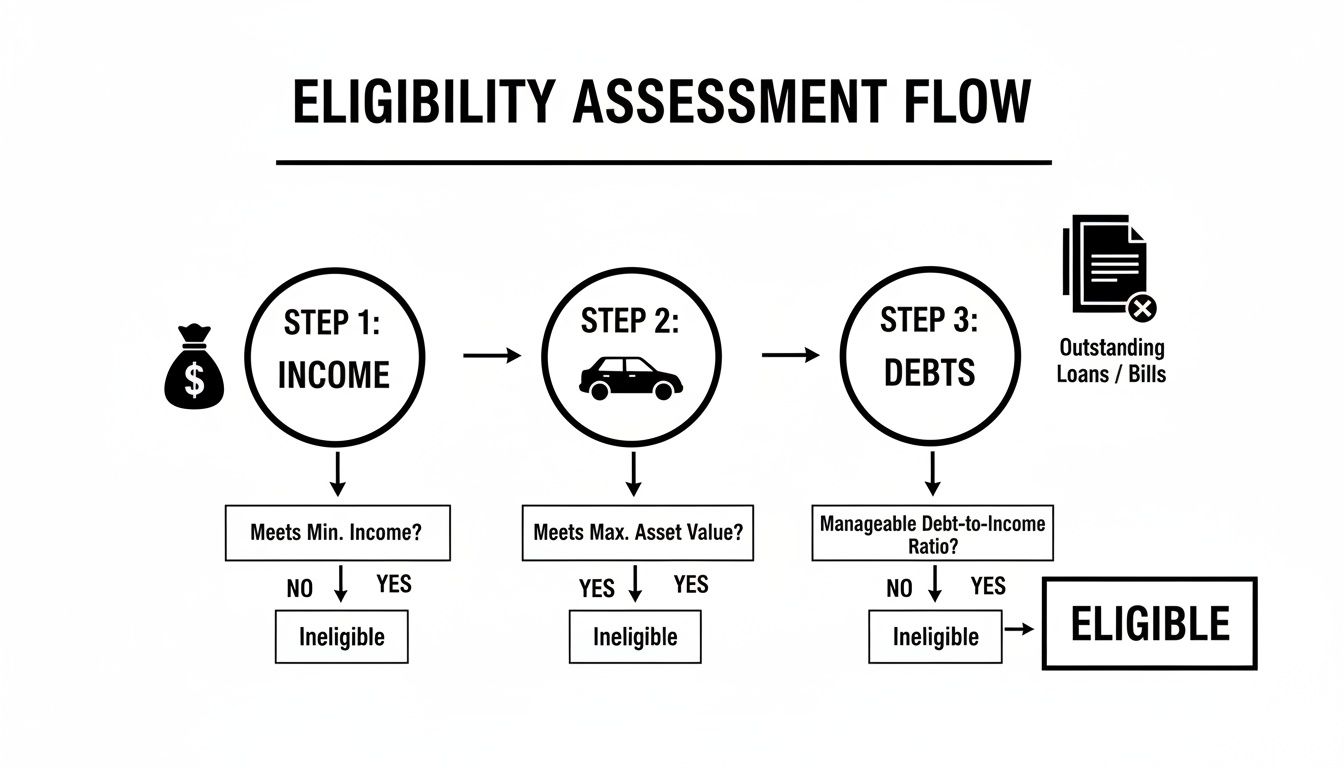
While the process of determining indigency can vary, the core ideas are similar everywhere. Some states have tried to create more uniform standards to make the process consistent. You can learn more about how different states have structured their rules for these affidavits. A 2017 report on another state’s system found that many courts used personal knowledge of local attorney fees in their decisions, showing how both formal rules and a judge's local experience play a role. You can explore the full report on indigency standards.
A Crucial Point on Partial Indigency: In some cases, a Fulton County judge might find that you are "partially indigent." This means the court believes you can pay for some, but not all, of your legal costs. If this happens, you may be ordered to contribute a certain amount toward your defense.
Ultimately, the decision rests entirely with the judge handling your case. They have the final say based on the information you provide in your affidavit of indigency.
Your Defense Strategy: Filing the Affidavit in Alpharetta and Fulton County
Filing your Affidavit of Indigency is a formal legal step that demands complete accuracy and honesty. Getting this right from the start is absolutely critical. Any error or omission could cause a judge to deny your request for a court-appointed attorney and waiver of fees, leaving you in a very tough spot.
The process itself isn't complicated, but you have to know where to go. The specific court you file with depends entirely on where your charge originated. For instance, a traffic ticket or a city ordinance violation inside Alpharetta city limits will be handled by the Alpharetta Municipal Court. But for more serious charges, even if the arrest happened in Alpharetta, the case moves up to the Fulton County court system.
Step-By-Step Filing Guide for North Fulton Defendants
Navigating the local court system can feel overwhelming, but filing this affidavit follows a clear path. Follow these steps carefully to make sure your application gets submitted the right way.
- Get the Right Form. You must get the official Affidavit of Indigency form directly from the clerk of the court that is handling your case. Don't just download a generic version you find online; each North Fulton court often has its own specific form.
- Fill It Out With Total Honesty. This form is a deep dive into your finances. You will have to list every source of income, all your assets (like cash, money in the bank, and vehicles), and all your debts (rent, car payments, credit card bills). Be precise—use exact numbers. Do not guess.
- Sign the Document Under Oath. When you sign this affidavit, you are making a sworn statement. Legally, it's the same as testifying in court under oath. You are swearing that every piece of information is true and accurate.
- Submit the Form to the Clerk. Take the completed and signed form back to the clerk’s office where you got it. The clerk will add it to your case file, and a judge will then review it to decide if you qualify.
It’s crucial to understand that this is a legal declaration. Intentionally lying or leaving things out is considered perjury. That’s a serious felony in Georgia that can pile devastating new charges on top of what you’re already facing.
The Court Process in Fulton County
Knowing where you need to go is half the battle. If your arrest was in Alpharetta or nearby areas like Roswell, Johns Creek, or Sandy Springs, your case will most likely be in one of the courts listed below.
Here is a quick reference table to help you find the right location for filing your affidavit.
| Court Name | Handles These Types of Cases | Filing Location |
|---|---|---|
| Alpharetta Municipal Court | Misdemeanors, city ordinance violations, and traffic offenses within Alpharetta city limits. | 12624 Broad St, Alpharetta, GA 30004 |
| Fulton County State Court | County-wide misdemeanors like DUI, theft, and domestic violence from Alpharetta, Roswell, etc. | 160 Pryor St SW, Atlanta, GA 30303 |
| Fulton County Superior Court | All felony charges originating in Fulton County, including drug trafficking and aggravated assault. | 136 Pryor St SW, Atlanta, GA 30303 |
A Note on Financial Verification: Don't think for a second that the court will just take your word for it. From my experience, judges and prosecutors in Fulton County can, and often do, ask for proof. This might include bank statements, recent pay stubs, or tax returns to verify what you’ve written down. Be ready to back up every single number on that form.
Filing this form correctly is a critical first step. But remember, it’s a procedural move—it is not a defense strategy. The deadlines in a criminal case move fast, and protecting your rights requires immediate action from an experienced lawyer who knows how to fight for you. If you're dealing with other stressful parts of the arrest process, you might find our other guides useful, like how to understand how to post bail in Georgia.
Why Choose Brian Hansford in Alpharetta

Even if you go through the process of filing an affidavit of indigency and the court agrees you qualify for a public defender, that doesn't mean it's the best choice for your case. When your career, freedom, and reputation are on the line, your defense is no place to cut corners.
For a professional living in Johns Creek or Sandy Springs, a conviction for something like a DUI or a drug offense can mean losing a professional license and seeing a career implode. For a local college student, that same charge could lead to expulsion and the loss of scholarships. This is where the real-world value of hiring a private criminal defense attorney near you becomes crystal clear.
The Reality of Caseloads in Fulton County
Public defenders are dedicated, capable lawyers. But they operate under the harsh reality of staggering caseloads, especially in the busy Fulton County court system. It’s not uncommon for them to be juggling hundreds of cases at once, which makes it nearly impossible to give your case the singular focus it truly needs.
Hiring private counsel is an investment in time, resources, and strategy dedicated solely to your case. It is the difference between being one of hundreds and being the only one that matters.
A private attorney has the bandwidth to dig into every detail, file strategic motions, and build a defense specifically tailored to the judges and prosecutors you’ll face in the Alpharetta Municipal Court or Fulton County State Court. They are there to answer your calls and explain every step of the process.
A Proactive Defense Built for You in North Fulton
Your case deserves more than just a standard defense; it demands a proactive strategy from day one. As a former prosecutor, I have firsthand knowledge of how the other side puts a case together. This insight is critical for spotting weaknesses in the prosecution's arguments and protecting your rights from the very beginning.
When you choose private counsel, you're not just hiring a lawyer—you're getting a dedicated partner committed to protecting your record and your future. While the public defender system provides an essential service, the difference in approach and resources is stark. You can learn more in our detailed guide on the differences between a public defender vs. a private attorney.
Whether you're in Roswell, Milton, or Cumming, a criminal charge is a serious event with life-altering consequences. Don't let your defense be limited by an overburdened system. An investment in a dedicated private attorney is an investment in yourself.
FAQ: Indigency in Alpharetta, GA
Q: What happens if my Affidavit of Indigency is denied in Fulton County?
A: If a Fulton County judge denies your Affidavit of Indigency, you immediately become responsible for all court costs and fees. The court will not appoint a public defender, and the case deadlines will not stop. You will need to hire a private defense attorney right away to ensure your rights are protected.
Q: Can I file an Affidavit of Indigency for a traffic ticket in Alpharetta?
A: Yes, but only for more serious traffic offenses that require a mandatory appearance in Alpharetta Municipal Court, such as DUI, reckless driving, or driving on a suspended license. An approved affidavit can waive some court fees, but it does not serve as a legal defense to protect your driving record.
Q: Is information on my Affidavit of Indigency public record in Georgia?
A: Yes. Once your affidavit is filed with the court, it becomes part of the public case file in Georgia. This means anyone can access the financial details you provided. This is why complete honesty is non-negotiable, as any falsehoods could be used against you by North Fulton prosecutors.
Q: Does being declared indigent mean I won't have to pay any fines?
A: No. This is a common and costly misunderstanding. Being declared indigent in an Alpharetta court covers administrative costs and grants you a public defender. It does not eliminate criminal fines, mandatory fees, or restitution you may be ordered to pay if you are convicted.
Q: What happens if I make a mistake on my Affidavit of Indigency?
A: Mistakes, even unintentional ones, can cause a judge in Alpharetta Municipal Court or Fulton County State Court to deny your request. Intentional lies or omissions are considered perjury, a serious felony in Georgia. It is critical to review your form for complete accuracy before submitting it to the court clerk.
If you are facing criminal charges in Alpharetta, do not leave your future to chance. At Brian Hansford Law, we build the strategic, personalized defense you need to protect your rights and your record. Do not speak to police without representation. Deadlines in Fulton County move quickly, and your first court date matters.
Call now for a consultation at https://challengemycharge.com and protect your record.
