
You leave Gulf Shores, Tuscaloosa, or Mobile thinking the trip is over once you cross back toward Roswell, Cumming, or Marietta. Then a routine stop in Alabama turns into something else. An officer sees a cup, an empty can, or a bottle with a broken seal in the vehicle, and suddenly you're dealing with more than a roadside inconvenience.
That surprises a lot of Georgia drivers. They assume an open container ticket is basically a traffic citation. In Alabama, it can be a criminal misdemeanor, even when nobody is drunk, even when the driver isn't drinking, and even when the container is empty.
For North Atlanta drivers, the risk isn't just the fine. It's the out-of-state court date, the record issue, the possibility that the stop expands into a DUI investigation, and the mistake of paying the ticket too quickly. If you live in Alpharetta, Johns Creek, Milton, Sandy Springs, Duluth, or East Cobb, you need to treat this like a criminal defense problem, not an ordinary travel hassle.
A Georgia Driver's Guide to Alabama's Open Container Law
A common version of this case is simple. You get stopped in Alabama for speeding, lane usage, or another minor driving issue on the way back to Georgia. The officer looks into the car and finds an empty beer can in the backseat, a mixed drink in a passenger's hand, or a restaurant cup from a downtown entertainment area. You may have been completely sober. That often doesn't matter.
The alabama open container law reaches conduct many Georgia drivers don't expect. It can apply to passengers, not just drivers. It can apply even if the container is empty, as long as the seal has been broken. It can also create problems for a driver who had no intention of drinking and thought the issue was just a leftover container from earlier in the day.
Most out-of-state drivers get in trouble because they misread the situation. They think, "I'm not DUI, so this isn't a serious case." That's the wrong starting point.
For someone from Forsyth County or Cobb County, the practical questions usually come fast:
- Do I have to go back to Alabama court
- Will this show up on a background check
- Can this affect a Georgia license issue later
- Should I just pay it and move on
- What if the container belonged to my passenger
Those are the right questions. The wrong move is assuming the answer is obvious.
Why Georgia residents get caught off guard
Georgia drivers are used to thinking in terms of points, insurance, and moving violations. An Alabama open container charge sits in a different category. It's handled as a criminal matter, and that changes how you should respond.
That matters if you're searching for a DUI lawyer in Alpharetta, a traffic ticket attorney in Cumming, or a misdemeanor defense attorney in Marietta after an Alabama stop. The legal issue may have started on the highway, but the consequences follow you home.
The practical goal
If you've been charged, the objective isn't to explain the situation away informally. It's to identify what the state can prove, where the container was located, who had access to it, whether the officer expanded the stop lawfully, and whether the charge should be challenged instead of paid.
That's how these cases should be handled. Start with the statute. Then look at the facts with precision.
The Core Rule What Alabama Law Actually Prohibits
Alabama's vehicle open container rule is stricter than many travelers expect.
Alabama's open container law, codified under §32-5A-330, prohibits passengers from consuming alcohol in vehicles and bans possession of open alcohol containers in the passenger area of a motor vehicle on public roadways. Violations are a Class C misdemeanor with a maximum fine of $25, with no jail time or driver's license impact, as summarized by World Population Review's discussion of legal open container states.
The short version is this. If an alcoholic beverage container is open and it's in the wrong part of the vehicle while the vehicle is on a public roadway, Alabama can charge it.
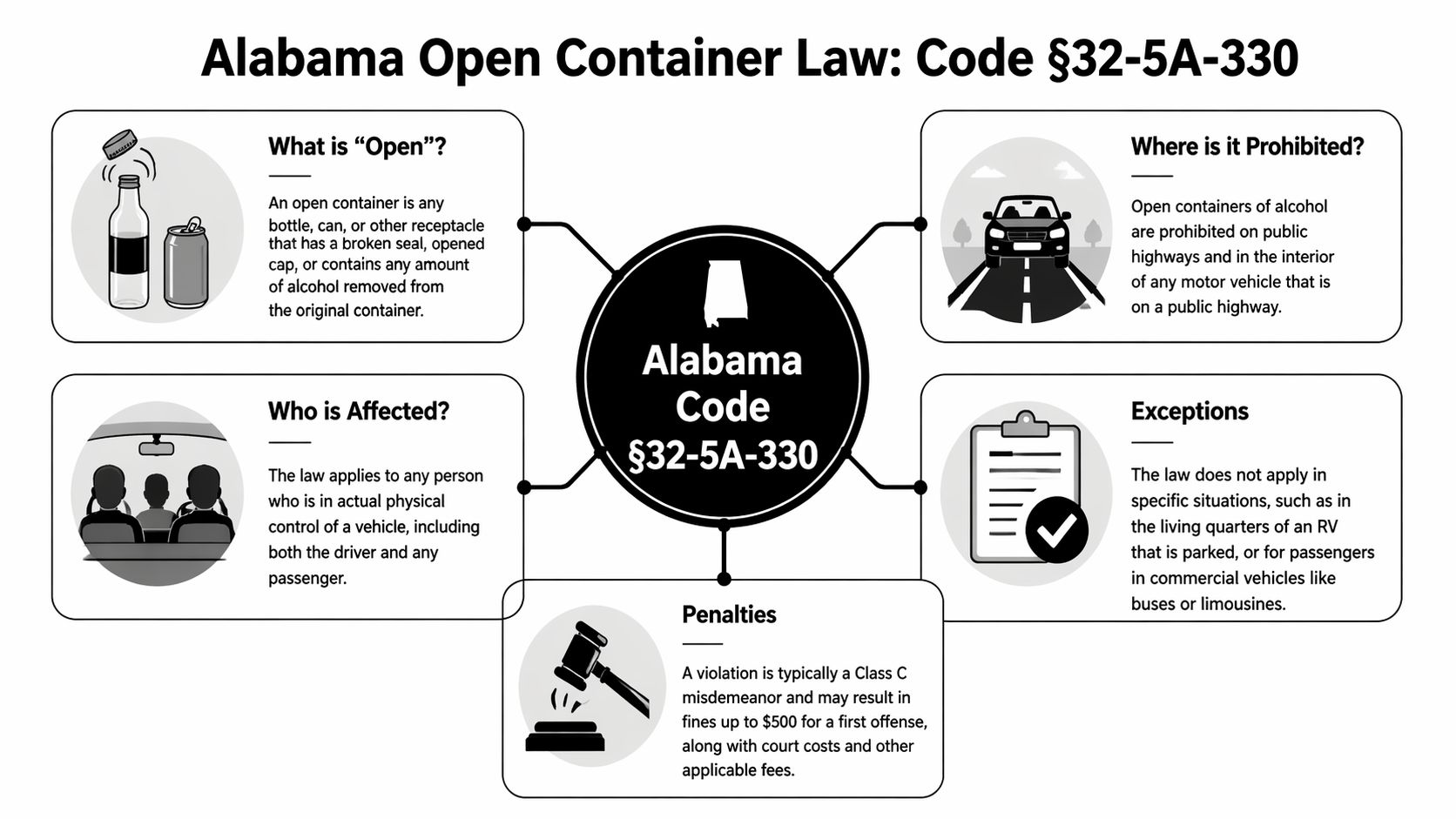
What counts as an open container
A lot of people think "open" means half-full. That's too narrow.
Under the descriptions tied to Alabama's statute, an open container is any alcohol container that is not in the manufacturer's sealed condition. That includes a broken-seal bottle, a cup with alcohol in it, and even an empty container with a broken seal. So the can your friend finished earlier can still create a charge if it's in the passenger area.
That point matters because the prosecutor doesn't need a dramatic fact pattern. They don't need slurred speech, bad driving, or proof that someone was actively drinking at the moment of the stop to pursue the open container offense.
What Alabama means by passenger area
The second term that controls these cases is passenger area.
The law focuses on the part of the vehicle readily accessible to the people riding in it. In plain terms, that usually means the seats, floorboards, console, door pockets, cupholders, and similar spaces inside the cabin.
A simple comparison helps:
| Location of container | Likely treatment under Alabama law |
|---|---|
| Cupholder or center console | Usually prohibited |
| Backseat floorboard | Usually prohibited |
| Passenger's hand | Usually prohibited |
| Trunk | Typically outside passenger area |
| Locked glove compartment | Typically outside passenger area |
| Area behind the last upright seat in a vehicle without a trunk | May fall within an exemption depending on configuration |
The most important exceptions
Not every open container in or around a vehicle creates liability. The statutory framework recognizes some vehicle-layout exceptions and special situations.
- Trunk storage: A container stored in the trunk is generally treated differently from one left in the cabin.
- Locked compartments: A locked glove compartment or similar locked area can matter because accessibility is central to the statute.
- Certain vehicle types: Some for-hire vehicles and motorhome living quarters are treated differently.
- Driver knowledge issues: In some circumstances, whether the driver knew about the container can become a live defense issue.
Practical rule: If alcohol is traveling in the car, put it where nobody in the cabin can reach it. "I thought the backseat was good enough" is one of the weakest explanations in these cases.
For a Georgia resident, defense begins, not with apology. Not with assumptions. With the exact condition of the container and the exact place where the officer found it.
Beyond the Fine The Real Penalties of an Alabama Conviction
A lot of Georgia drivers from Alpharetta, Cumming, and Marietta make the same mistake after an Alabama stop. They look at the amount on the ticket, decide it is cheaper to pay it, and move on. In practice, paying can be the step that creates the longer problem because it can amount to closing the case with a conviction on the record.
A Class C misdemeanor still matters. Employers, licensing boards, graduate programs, military screenings, and some landlords often focus less on the amount of the fine and more on the fact that a criminal offense appears in a background check. For a Georgia resident who crosses state lines for work, school, or family travel, that can turn a weekend traffic stop into a months-long explanation.

Why paying the ticket can cost more later
People regularly assume an open container case is too small to fight. I have seen the opposite. The cheap option up front can become the expensive option once a job application, professional renewal, security review, or custody dispute puts the record under a microscope.
That cross-state problem hits North Atlanta drivers harder than they expect. The case is filed in Alabama, but the consequences follow them home to Forsyth County, Fulton County, Cobb County, and beyond. The officer goes back to work. The driver keeps dealing with the record.
Another practical issue is evidence. Before deciding whether to resolve the charge, it makes sense to examine how the stop developed, what the officer saw, and whether the vehicle search was lawful. A good starting point is understanding when a police officer can search your car, because many open container cases rise or fall on that sequence.
Cannabis creates a different level of risk
Drivers also need to separate alcohol cases from cannabis cases. They are not the same exposure, and treating them as if they are can be a serious error.
If the substance is cannabis or another controlled substance, the case can move beyond a simple open alcohol container issue and into drug possession territory, paraphernalia issues, or disputed search questions. That usually raises the stakes fast. It can also affect bond conditions, probation terms, and how a prosecutor values the case.
For a Georgia driver used to one set of assumptions at home, Alabama can be an expensive place to guess wrong.
What matters in the long run
The practical risk usually looks like this:
- Immediate cost: fine, court costs, and travel back to Alabama if the case is not handled properly
- Record exposure: a misdemeanor conviction that may appear in background checks
- Professional fallout: trouble with licensing, hiring, internships, school discipline, or security-sensitive work
- Case escalation: added scrutiny if officers also claim impairment, marijuana possession, or another offense
The right question is not whether the ticket looked minor on the roadside. The right question is whether the case can be reduced, dismissed, or kept off your record before you plead it out.
For Georgia residents searching for help after an Alabama charge, the practical takeaway is simple. Do not judge the case by the fine alone. Judge it by the record risk, the stop, the search, and the chance to keep a small charge from becoming a lasting problem.
Common Scenarios How Georgia Drivers Get Charged
You leave Orange Beach, Tuscaloosa, or Mobile, cross back roads toward I-65, and get stopped for something minor. The officer sees a cup, a cooler, or a half-empty can within reach of a passenger. For a driver from Alpharetta, Cumming, or Marietta, that is where a routine trip can turn into an Alabama criminal citation.

The backseat cooler after a lake, beach, or game weekend
This is one of the most common fact patterns I see with out-of-state drivers. Someone cleans out the rental, truck, or SUV in a hurry, drops beer cans or mixed-drink cups into a cooler, and leaves that cooler on the backseat or rear floorboard instead of locking it away in the trunk.
The driver may not have touched alcohol at all. That often does not stop the charge.
For Georgia families and friend groups traveling in SUVs, Jeeps, and pickups, this is a real trap because there may be no separate trunk. Officers focus on whether the container was in the passenger area and whether someone in the vehicle could reach it. A driver who thought, "it's behind me, so it's fine," can end up explaining that assumption to an Alabama judge.
The passenger drinking while the driver stays sober
Georgia drivers regularly assume the main issue is impaired driving. In Alabama, a sober driver does not make an open container issue disappear if a passenger is holding or storing alcohol in the passenger compartment.
That misunderstanding shows up all the time with college-age passengers, concert trips, SEC football weekends, and rides back from the beach. One person keeps a drink in hand because the driver is designated sober. Then a speeding stop turns into separate questions about who was drinking, where the alcohol came from, and whether there is more in the car.
The practical mistake is treating Alabama like the officer only cares about the driver. In these cases, the officer often starts with the passenger and works outward.
The entertainment district mistake
This one catches careful people.
A traveler buys a legal to-go drink in an Alabama entertainment district and assumes the cup stays legal once everyone gets in the car. It does not. Local district rules may allow open alcohol while you are walking in a designated area, but that does not override the statewide rule for a vehicle.
NBC 15's report on downtown Mobile entertainment district drink rules explains how those districts use container limits and branding requirements. The problem for Georgia visitors is simple. A drink that was lawful on the sidewalk can become evidence the moment it enters the passenger area of a vehicle.
The rideshare, carpool, and tailgate carryout problem
The charge is not limited to the person who bought the alcohol. I have seen cases start because nobody wanted to spill a drink, nobody wanted to leave expensive alcohol behind, or nobody thought the short drive back to the hotel mattered.
That is how a cup holder, door pocket, or center console becomes the officer's first point of attention.
North Atlanta drivers run into this after Atlanta-to-Alabama weekend trips because habits that feel harmless in a parking lot carry over into the car. A leftover stadium cup, a plastic mixed-drink container, or a half-finished seltzer in the rear cup holder is enough to create a problem if the officer can place it inside the passenger area.
The search issue nobody thinks about early enough
Once an officer sees, or says he sees, a container, the stop can widen fast. The officer may ask everyone to identify the drink, explain who consumed it, or step out of the vehicle. In the wrong case, that leads to a broader look for other alcohol, marijuana, pills, or anything else that creates a second charge.
If you want to understand where that line is, read this guide on when a police officer can search your car.
In practice, many open container cases are won or lost on the details officers claim to have observed inside the vehicle, where the item was located, and whether the stop should have expanded at all.
For Georgia residents, the defense value in these scenarios is obvious. The closer the facts are to a rushed cleanup, a mistaken assumption about passenger drinking, or a lawful sidewalk drink carried into a car, the more room there may be to challenge knowledge, access, identification of the container, or the scope of the officer's investigation.
Open Container and DUI How One Charge Can Lead to Another
You leave Birmingham after dinner, head back toward Georgia, and get stopped near the state line for a lane issue. The officer spots a cup, bottle, or can in the cabin. What looked minor a minute earlier now becomes the reason for questions about where you drank, how much, and whether you are safe to drive.
For drivers from Alpharetta, Cumming, and Marietta, this is one of the easiest cross-state traps to underestimate. In Georgia, people often focus on the ticket in front of them. In Alabama, the container often becomes the fact that pushes the stop into a DUI investigation.
Why an open container allegation changes the stop
Officers treat the container as a clue about recent alcohol use. If the driver has bloodshot eyes, an odor of alcohol, slowed responses, or inconsistent answers, the open container allegation gives the officer more reason to keep digging. That usually means roadside questioning, a request to exit the vehicle, field sobriety exercises, and sometimes a breath test request.
The legal risk is not just the extra charge.
It is the sequence. Once the officer writes in the report that alcohol was present and accessible inside the vehicle, prosecutors may use that fact to support the DUI case even if the driving pattern was mild or the test result is being challenged. I see that issue often in travel cases. A weak DUI file can look stronger on paper when the report also claims there was an open container within reach.
Why Georgia drivers get caught by this
North Atlanta drivers make this trip all the time for concerts, college weekends, lake trips, and football travel. The common mistake is assuming a passenger's drink stays a passenger problem. In Alabama, that same fact can shift attention directly onto the driver, especially if no one gives a clear answer about who was drinking from what.
That creates real trade-offs at roadside. Drivers want to explain. Passengers want to help. Those explanations often lock everyone into facts that are incomplete, inconsistent, or wrong.
A coordinated defense matters
If both charges are on the table, the defense has to examine the stop in order and attack the points where the case expanded:
- The stated reason for the traffic stop
- The officer's basis for claiming a container was open and in the passenger area
- The observations used to justify a DUI investigation
- Any statements made by the driver or passengers
- The reliability of field sobriety testing and chemical testing
- Whether the report overstates what the officer saw
That overlap is why I do not treat the open container count as background noise. In the right case, beating or weakening that allegation can undercut the officer's basis for escalating the encounter and can change how the DUI charge is negotiated or tried.
For a broader look at the DUI side of that defense, this guide on how to beat DUI charges explains the pressure points that matter once a stop turns into an impairment investigation.
The practical mistake is fighting the DUI and ignoring the container. In Alabama travel cases, those facts usually rise or fall together.
If you were stopped in Alabama while driving back to Forsyth County, Alpharetta, or Cobb, get the report, the ticket, and any body-cam request moving early. Those cases are often defended best by challenging how the stop grew from a container allegation into a DUI case at all.
Building Your Defense How to Fight an Alabama Open Container Ticket
Paying the ticket may feel efficient. From a defense standpoint, it's often the wrong instinct. A contested open container case gives your lawyer room to work with the facts, the stop, the officer's observations, and the statute's technical limits.
The strongest defense is rarely a speech about being a good person. It's a targeted attack on proof.
Start with the exact location of the container
One of the best defense themes in these cases is the meaning of passenger area. The verified data states that Alabama law recognizes exemptions for trunks, locked glove compartments, and the area behind the last upright seat in a vehicle without a trunk, and that motions challenging ambiguity in "passenger area" have success rates of 70-80% in aggregated misdemeanor dismissal data, as discussed in DrivingLaws' summary of Alabama open container penalties and defenses.
That matters because these cases often turn on inches, compartments, seat configuration, or whether the officer described the location loosely instead of precisely.
A defense lawyer will want to know:
- Was the item in the cabin or in a separate storage area?
- Was the glove box locked?
- In an SUV or hatchback, was the item behind the last upright seat?
- Did the officer photograph the location?
- Did the report use legal conclusions instead of factual detail?
Then examine who knew what
Knowledge can matter, especially when the driver and passenger are not the same person and the container is tied to somebody else. If a passenger left an item in the car or concealed it in a bag, the state may still have to prove the right person's awareness and control.
This is one reason group travel cases deserve careful review. Cars returning from the beach, football weekends, concerts, or family trips create messy fact patterns. Ownership, access, and knowledge are not always obvious.
Defense focus: The state doesn't win because an officer uses the phrase "open container." The state wins only if the evidence fits the statute and ties the right person to the prohibited conduct.
Challenge the stop and expansion of the investigation
A defense isn't limited to the container itself. It can also target how the officer got there.
Was the original stop lawful? Did the officer have a valid basis to prolong it? Did questioning drift into a criminal investigation without adequate justification? Did the search go beyond what the circumstances allowed?
Those issues often lead to suppression arguments. If you want a plain-English overview of that process, review this explanation of what a motion to suppress evidence is.
What tends to work and what usually doesn't
Some approaches help. Some don't.
| Approach | Practical value |
|---|---|
| Precise mapping of container location | Often strong |
| Photos of trunk, cargo area, or locked compartment | Often strong |
| Challenging vague use of "passenger area" | Often strong |
| Separating driver knowledge from passenger conduct | Can be strong |
| "Nobody was drunk" | Usually weak by itself |
| "It was only empty" | Usually weak by itself |
| "The officer seemed unfair" | Not enough without legal support |
The best open container defenses are technical, documented, and disciplined. They don't depend on emotion. They depend on forcing the state to prove each required point with reliable facts.
For drivers in Cobb County, Gwinnett County, Fulton County, and North Atlanta generally, that's the takeaway. These charges are often more defensible than they first appear. But only if somebody treats the case like a criminal case instead of a travel annoyance.
Charged in Alabama A Call to Action for Georgia Residents
If you live in Alpharetta, Roswell, Johns Creek, Milton, Cumming, Marietta, or elsewhere in North Atlanta, an Alabama open container charge should move to the top of your priority list right away. Waiting usually doesn't improve anything. It narrows options.
The usual bad first reaction is to minimize it. People say it's just a small fine, just a cup, just an out-of-state ticket, just something a passenger did. Those explanations don't protect your record. They also don't address the practical problems that come next, including court handling, background concerns, and the possibility that the stop generated other evidence.
What to do now
Take these steps immediately:
- Save every document: Keep the citation, bond paperwork, court notice, and any receipt or towing paperwork together.
- Write down the facts: Note where the container was found, who was in the vehicle, what the officer said, and whether any search occurred.
- Preserve photos: If you have pictures of the vehicle interior, trunk area, or cup involved, keep them.
- Don't make admissions casually: What you tell friends, post online, or say in a call can become part of the problem.
- Talk to defense counsel quickly: Fast review matters in out-of-state cases.
Why local Georgia counsel still matters
A Georgia resident doesn't just need someone who can read the Alabama statute. You need a lawyer who understands how North Atlanta clients experience these cases in real life. That includes work schedules, family pressure, professional licensing concerns, court anxiety, and the overlap with Georgia DUI, traffic, and criminal defense issues.
That is especially true if your Alabama stop happened while traveling back into Fulton County, Forsyth County, Cobb County, Cherokee County, or Gwinnett County. A person searching for a reckless driving lawyer near me, a speeding ticket lawyer in Cumming, or a court representation attorney in Marietta often discovers too late that the "small" Alabama citation belongs in the same serious category of decisions.
If you're charged, don't let the low-dollar fine make the strategy decision for you. The record consequence is the real issue.
The right mindset
Treat the case like a misdemeanor defense matter from day one. Get the facts organized. Assume nothing. Don't rely on the officer's roadside summary of your options. And don't plead out of convenience if the facts support a challenge.
For many Georgia residents, the best result comes from acting early, before missed deadlines, rushed payments, or loose statements make the case harder to fix.
If you were charged under the alabama open container law while traveling from or back to North Atlanta, Brian Hansford Law can help you assess the risk quickly and respond strategically. Brian Hansford brings over 25 years of legal experience, including work as a former prosecutor, and represents clients facing DUI, misdemeanor, traffic, and drug-related charges. If you're in Alpharetta, Roswell, Cumming, Johns Creek, Milton, Marietta, or the surrounding area, reach out for a free, confidential consultation before you make a decision that could affect your record.
