
Ankle monitor costs in Georgia typically run $5 to $25 per day, plus setup fees, and those costs are almost always paid by the defendant. That means a release condition that sounds better than jail can still create a serious financial burden within days.
If you're standing in a courtroom in Alpharetta, Cumming, Marietta, or elsewhere in North Atlanta and the judge says electronic monitoring is required, your first reaction is usually relief. Your second is confusion. Then the bills start. For many people facing a DUI, drug possession charge, reckless driving case, probation issue, or another criminal matter, the stated ankle monitor cost is only the beginning.
The problem isn't just the daily charge. It's the chain reaction. A setup fee. Ongoing maintenance. Missed work because of appointments or charging problems. Restrictions that make it harder to keep a job. Pressure to pay for supervision even before your case is resolved. In practice, electronic monitoring can operate like a private tax on staying out of jail.
Your Guide to Ankle Monitoring in North Georgia
A common scene plays out in Fulton County, Forsyth County, and Cobb County courtrooms. Someone appears after an arrest for DUI, a drug offense, theft, or a probation violation. The judge agrees to release them, but only with an ankle monitor. Family members hear "better than jail" and assume the hard part is over.
It usually isn't.
The first issue is money. In Georgia, monitor fees often start immediately, and the person wearing the device is usually expected to pay. That can hit hard if the arrest already caused missed work, towing fees, bond costs, or license problems. For people looking for a DUI lawyer in Alpharetta, a reckless driving lawyer in Roswell, or a drug possession lawyer near me, this is one of the first financial shocks after the case begins.
What people usually learn too late
The court may present monitoring as a reasonable compromise. From the court's perspective, it is. From the defendant's perspective, it can be a moving target with terms that affect work, family obligations, transportation, and privacy.
Three practical points matter right away:
- Daily fees add up fast: Even a "manageable" daily rate can become a monthly bill that competes with rent, groceries, and car payments.
- The device affects daily life: Charging schedules, location restrictions, and reporting rules can interfere with employment and parenting.
- The condition may be negotiable: A skilled defense lawyer can sometimes challenge the need for the monitor, the type of monitor, or the fee structure.
The question isn't just whether monitoring is better than jail. It's whether the terms are realistic enough for you to comply without losing your job or falling into debt.
If you're trying to choose counsel quickly, this guide on how to find a criminal lawyer in North Georgia is a useful starting point. In these cases, speed matters. A same-day response can make a difference before release conditions harden into something much harder to change.
What Is Ankle Monitoring and Why Do Courts Order It
Electronic monitoring is a supervision tool. The court uses it to track where a person is, whether that person stays home during required hours, or whether the person complies with restrictions tied to a DUI, probation, pretrial release, or bond condition.
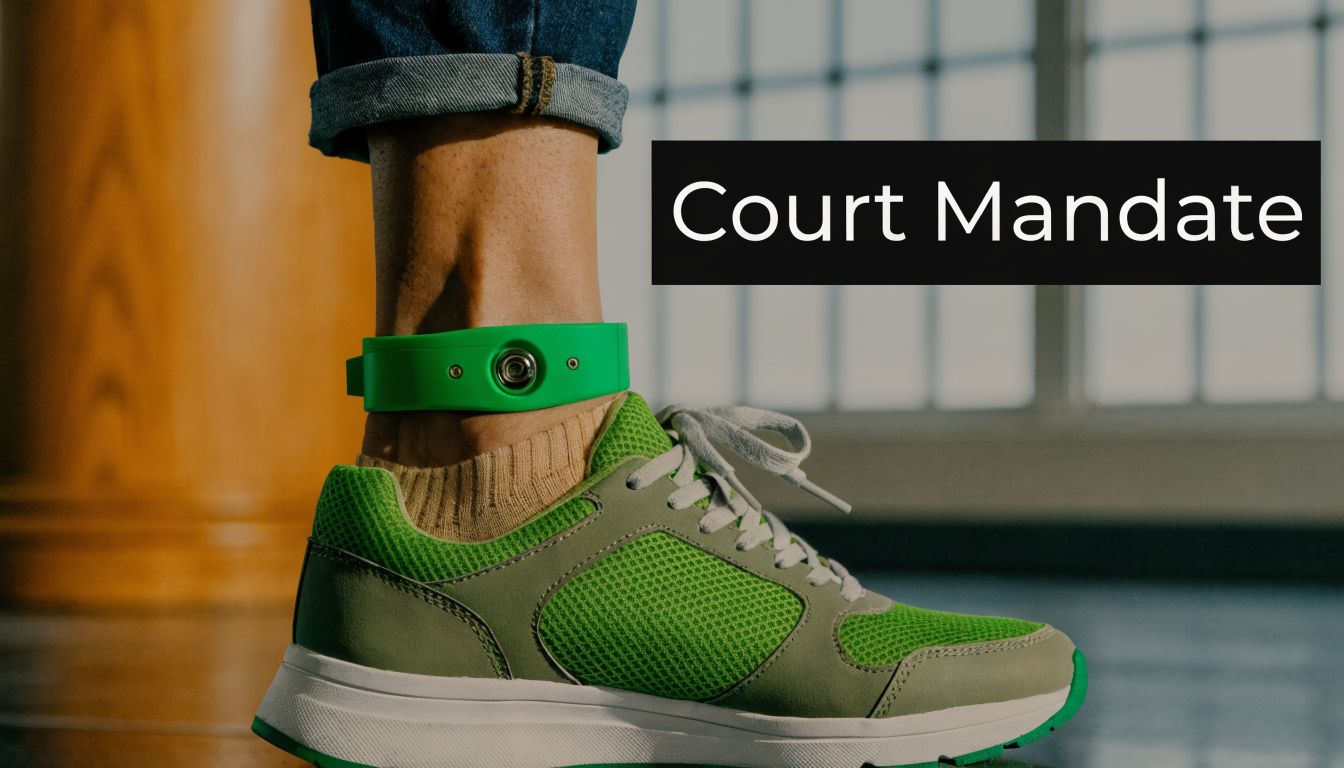
Judges in places like Roswell, Johns Creek, Milton, and Sandy Springs often see monitoring as a middle option. It isn't full freedom, but it isn't jail. For someone charged with DUI, a felony, a repeat traffic offense, or a probation matter, the court may believe monitoring protects the public while still allowing the person to live at home and appear for court.
How courts think about it
From the court's side, ankle monitoring serves a few clear purposes:
- Court appearance control: The judge wants assurance that you'll return to court.
- Movement limits: The device can support curfews, exclusion zones, or home confinement.
- Risk management: In a DUI or alcohol-related case, the court may want closer supervision while the case is pending.
- An alternative to incarceration: Monitoring lets the court impose restrictions without putting someone in a jail bed.
That last point matters most. Courts and agencies view electronic monitoring as a practical substitute for detention because it gives them oversight while avoiding the cost and logistics of holding someone in custody.
What that means for defendants
The legal logic makes sense on paper. In real life, it can be rough.
A monitor can tell a judge, prosecutor, or probation officer that you are where you're supposed to be. But it doesn't solve the daily burdens that come with wearing it. If you work construction in Cherokee County, drive all day in Gwinnett County, or manage a shift job in Marietta or Duluth, the restrictions may fit poorly with the realities of your life.
Courts order monitors because they want control, structure, and accountability. Defendants experience them as surveillance, expense, and risk.
That difference in perspective is where many legal fights begin. A good defense strategy doesn't just ask whether monitoring is available. It asks whether this particular form of monitoring is necessary, fair, and workable for this particular person.
The True Ankle Monitor Cost A Detailed Breakdown
The advertised ankle monitor cost rarely tells the whole story. You need to look at the daily rate, the enrollment charge, and the surrounding terms that determine what you'll pay over time.
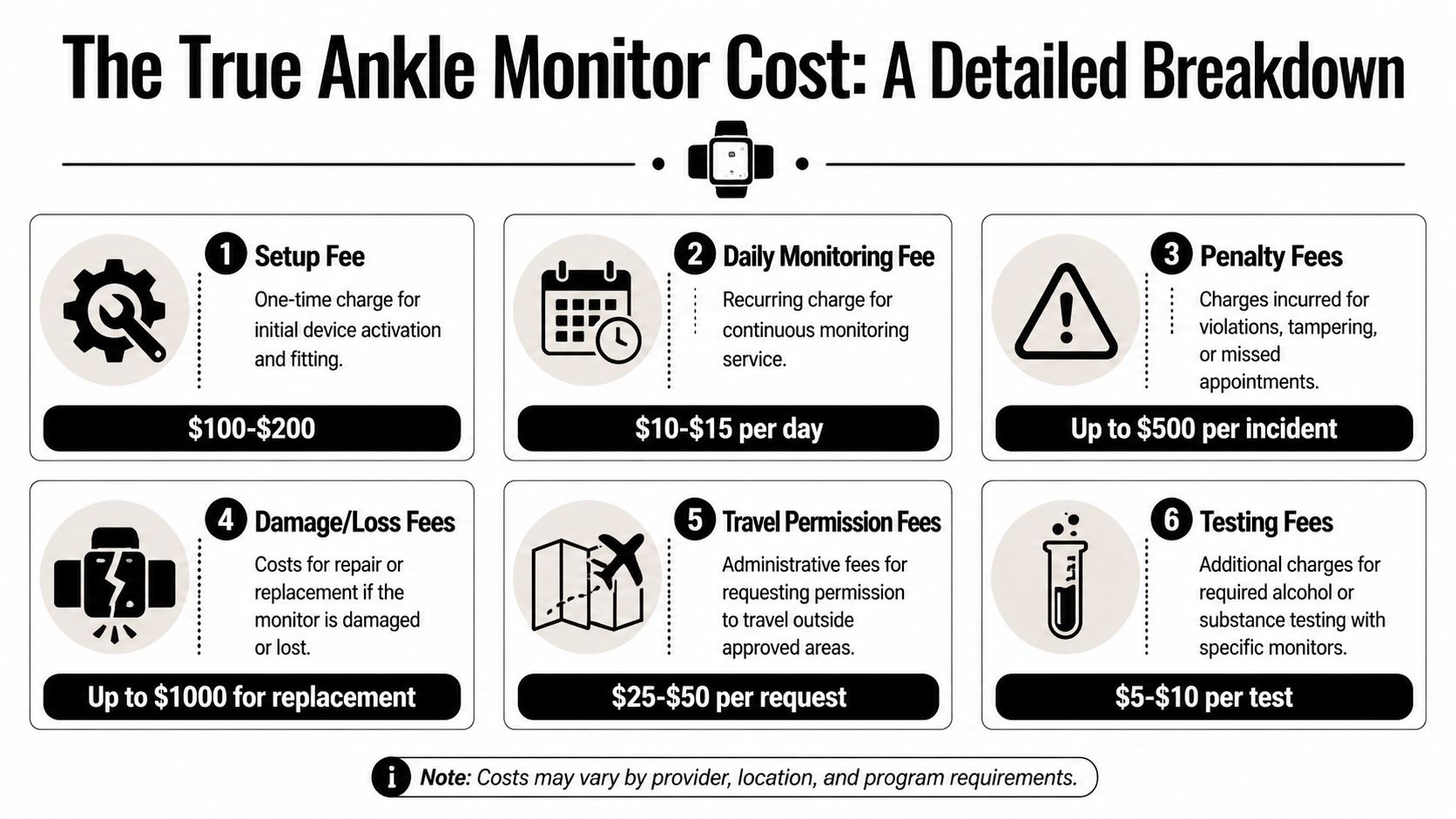
According to this 2026 ankle monitor cost breakdown for agencies and courts, active GPS supervision typically runs $3 to $15 per day, while some statutes and programs push charges as high as $13 to $25 daily or $400 monthly plus a $150 enrollment fee. The same source notes that offenders in at least 26 states, including Georgia, are charged directly for these costs.
What usually appears on the bill
Individuals often focus on the daily number because that's what they hear first. That misses the structure of the expense.
Here is the practical breakdown:
| Cost item | What it means |
|---|---|
| Daily monitoring fee | The recurring charge for GPS or other active supervision |
| Enrollment or setup fee | A one-time fee to place and activate the device |
| Maintenance or administration | Charges tied to ongoing supervision and program handling |
| Monthly billing structure | Some programs package daily costs into a monthly total |
The same cost guide explains why these programs are attractive to courts and counties. A standard prison bed is around $83 per day, while active GPS supervision is far lower on a per-day basis. That price difference is one reason electronic monitoring has expanded.
Why cheap on paper can become expensive in practice
The daily number doesn't tell you how the system operates. Some programs may look inexpensive at first glance but involve more staffing, more vendor oversight, or more conditions that produce indirect costs for the person wearing the device.
The same source also notes that some "cheap per diem" options can become more expensive long term once total cost of ownership is considered, including labor, replacements, and network costs. From a defense perspective, that matters because it shows the court should not assume the simplest sounding option is always the fairest or most efficient.
Practical rule: When a court proposes monitoring, ask exactly what is included in the fee, what is billed separately, and what happens if you fall behind.
For clients facing a DUI in Johns Creek, a misdemeanor charge in Cumming, or a felony case in Cobb County, the key issue is this: the court may see a cheaper alternative to jail, but you're the one expected to finance it.
GPS vs SCRAM vs Alcohol Monitors Explained
Not every monitor works the same way. The device ordered in your case depends on the charge, the judge, the probation terms, and what the court wants to track.
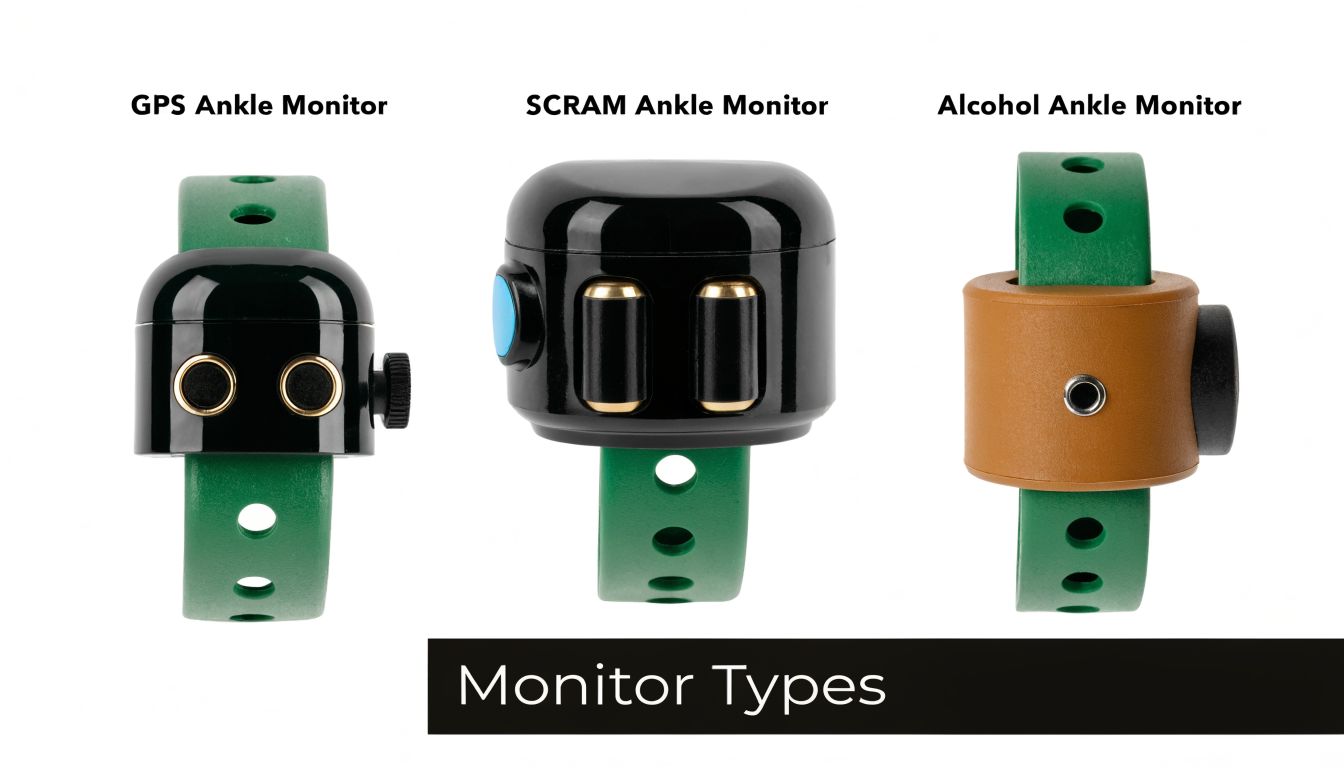
If you're dealing with a DUI case in Alpharetta, Roswell, or Milton, the type of monitor matters because each one creates a different level of intrusion. It also changes how hard it is to work, travel, and stay compliant.
GPS monitoring
GPS is the most common device people imagine. It tracks location actively and can be used for exclusion zones, movement history, or strict reporting conditions.
This technical overview of leading GPS ankle monitors describes devices with 2-second GPS update intervals, IP68 waterproofing, 50 to 60 hour battery life, and 2.0m positioning accuracy. The same source states this technology can reduce false positive alerts by 40 to 60% compared with older RF tethers, but it also places daily monitoring in the $10 to $15 range with $50 to $100 installation fees.
RF home curfew systems
RF systems are more limited. They are commonly used to confirm whether a person is home during required hours rather than providing constant location tracking throughout the day.
They tend to be less intrusive than GPS. In practical terms, that can make them a better fit for some defendants with stable housing, predictable schedules, and lower-risk allegations. They are often used when the court mainly cares about curfew compliance, not full movement tracking.
SCRAM and alcohol monitoring
SCRAM and similar alcohol-monitoring devices are most relevant in DUI and alcohol-related cases. These devices are tied to sobriety enforcement, not just location.
If the court believes alcohol use is the central concern, it may prefer alcohol monitoring over broad GPS surveillance. But that doesn't automatically make it easier. These programs can be more restrictive in daily life because they affect routines, testing expectations, and how the court interprets any alert.
In a DUI case, the best monitor isn't the harshest one. It's the least restrictive device that still answers the judge's stated concern.
If you're trying to understand the defense side of an alcohol-related case before your next court date, this guide on how to beat DUI charges gives helpful background. The important legal point is that the technology should match the actual risk. Courts sometimes impose a broader condition than the facts justify.
Who Pays The Ankle Monitor Debt Trap
In Georgia, the person wearing the monitor usually pays for it. That is the rule that changes the entire conversation.

This report on ankle monitoring and debt burdens states that in Georgia, electronic monitoring can cost $5.25 per day and GPS can cost $8.75 per day. When those charges are combined with a $50 setup fee and daily maintenance, defendants can accumulate over $470 per month in non-recoverable costs, even if they are later acquitted. The same report states that every state except Hawaii requires defendants to pay at least part of the cost.
Why this becomes a debt trap
A person who can post bond and absorb the monitor bill keeps working and stays home. A person who can't afford the fees may face violations, new pressure from the court, or a return to custody. That isn't a theory. It's how these cases unfold.
The debt trap works because the obligation starts early and doesn't wait for a final outcome. If your case is still pending in Fulton County or Forsyth County, you may already be paying hundreds of dollars to remain out of jail. If money is already tight, that can quickly spill into credit problems, unpaid utilities, and wage issues. For families already under pressure, information about how to stop wage garnishment in Georgia can become relevant fast.
What to do if you can't afford it
Do not assume you have to accept the fee structure without objection.
Start with these steps:
- Document your finances: Gather proof of income, expenses, dependents, and missed work.
- Raise hardship early: Courts are more likely to consider a fee argument before arrears pile up.
- Ask about indigency: If your finances are strained, review this resource on filing an affidavit of indigency.
- Treat payment trouble as a legal issue: Don't let it become a compliance issue first.
A monitor can function like a second bond. You pay to stay out, and if you can't pay, your freedom becomes unstable again.
That is why the ankle monitor cost question can't be reduced to a daily rate. The core question is whether the court is imposing a condition you can realistically survive.
Challenging Monitoring Fees in Forsyth and Fulton County Courts
Monitoring conditions are not untouchable. Judges can modify them, narrow them, or replace them when the facts and the defendant's circumstances support a better option.
In Forsyth County and Fulton County, the strongest arguments usually connect the legal issue to a practical outcome. Courts respond better when you show exactly why the current condition interferes with lawful work, treatment, caregiving, transportation, or compliance itself. A general complaint that the monitor is expensive won't do much. A documented argument that the monitor is pushing the defendant toward job loss, missed treatment, or default is different.
Arguments that can work
A focused defense lawyer may press several points at once:
- Lack of necessity: If the alleged conduct doesn't justify full GPS tracking, ask for a less restrictive condition.
- Financial hardship: Show why the fee structure is unrealistic based on income and fixed expenses.
- Employment disruption: Explain how the device or reporting terms interfere with work and make payment harder.
- Case-specific tailoring: Ask the court to match the condition to the actual concern, such as alcohol abstinence, curfew compliance, or court appearance assurance.
This EJI article discussing the burden of monitor fees cites a National Institute of Justice survey finding that 22% of people on electronic monitors were fired or asked to leave their jobs because of the device. In court, that matters. A monitor that destroys employment can undermine stability rather than support it.
Better alternatives to request
Not every challenge is an all-or-nothing fight. Sometimes the best result is a narrower condition.
A lawyer may ask for:
- A switch from GPS to home curfew monitoring.
- Removal of unnecessary travel restrictions for verified work.
- A fee reduction or waiver based on documented inability to pay.
- A different supervision structure tied to treatment, check-ins, or other targeted conditions.
Judges are more likely to modify a condition when the defense offers a workable substitute instead of a simple objection.
This is especially important for people charged with DUI, reckless driving, drug possession, or misdemeanor offenses in Alpharetta, Sandy Springs, Milton, and surrounding courts. If your release terms make lawful employment less likely, the court should hear that clearly and early.
How A Former Prosecutor Defends Your Rights and Finances
The strongest ankle monitor defense isn't just about arguing that the fees are unfair. It is about understanding how the court, prosecutor, probation office, and vendor will frame the issue, then building a response that answers each concern directly.
A former prosecutor brings a practical advantage to that task. Prosecutors tend to focus on control, appearance in court, public safety, and risk management. If your lawyer understands that mindset from the inside, the argument can be structured around what the judge is most likely to care about. That often means presenting a narrower, more credible alternative rather than rejecting supervision altogether.
Where experience matters most
In North Atlanta courts, local knowledge changes strategy. A lawyer handling a DUI in Roswell, a felony matter in Cumming, a traffic case in Marietta, or a license suspension issue in Fulton County needs to know how that court typically handles release conditions, probation violations, and hardship arguments.
That experience helps in several ways:
- Early bond advocacy: The best time to fight an unnecessary monitor is before it becomes routine.
- Accurate framing: Judges want facts, employment records, treatment plans, and workable alternatives.
- Cost-based arguments: When the defense can show the condition is excessive or ill-suited, modification becomes more realistic.
- Protection beyond the case: Good advocacy looks at your job, your family, your license, and your long-term record, not just the next hearing.
Why the financial side matters in strategy
This 2026 total cost of ownership guide for GPS ankle monitors states that total cost of ownership can range from $1,500 to $4,500 over a 3-year contract, driven largely by daily monitoring fees. That kind of information matters because it gives the defense a grounded way to argue that some monitoring structures are prohibitively expensive and that less costly, equally effective alternatives may exist.
A seasoned defense attorney doesn't treat ankle monitoring as a side issue. It affects plea negotiations, bond conditions, probation terms, work stability, and your ability to pay for every other part of your defense.
If you're searching for a DUI attorney near me, a speeding ticket lawyer in Alpharetta, a traffic ticket attorney in Roswell, or a drug possession lawyer in North Atlanta, the right question isn't just whether a lawyer can appear in court. It's whether that lawyer knows how to protect both your freedom and your finances from the start.
If you're dealing with a DUI, traffic offense, drug charge, misdemeanor, felony case, or a court order involving electronic monitoring in Alpharetta, Roswell, Johns Creek, Milton, Cumming, Marietta, or the surrounding North Atlanta area, Brian Hansford Law is available to help. Brian Hansford is a former prosecutor with more than 25 years of legal experience, and the firm offers free consultations for people who need fast, practical defense strategy now. If you're facing court deadlines, license risk, or ankle monitor costs that you can't realistically manage, contact the firm as soon as possible to protect your rights, your record, and your future.
