
An arrest warrant in Georgia is, at its core, a document signed by a judge giving police the authority to arrest someone. It’s not just a suggestion; it's an official order. A warrant gets issued when there’s probable cause—a reasonable, fact-based belief—that a specific person has committed a crime. This order doesn't expire; it stays active until the person is in custody or the warrant is formally cleared.
What an Arrest Warrant Means in Georgia
Finding out there might be one of the various arrest warrants in GA with your name on it can be a genuinely nerve-wracking experience. This isn't just a piece of paper; it’s a formal command from the court system that empowers police officers across the state to take you into custody.
This kind of authority isn't handed out casually. Before a warrant is ever issued, a police officer has to go before a judge or magistrate and lay out their evidence.
That evidence has to be strong enough to establish what is known as "probable cause." This is a key standard. It means there are enough facts and circumstances for a reasonable person to believe that a crime was committed, and that the person named in the warrant is the one who did it. Without clearing this hurdle, a warrant simply cannot be issued, whether in Forsyth County, Cobb County, or anywhere else in Georgia.
The Two Main Paths to a Warrant
Warrants in Georgia typically come about in one of two ways. It's helpful to understand the difference, as one involves a new criminal allegation and the other is about failing to follow a court's instructions.
- Warrants for New Allegations: This is what most people think of when they hear "arrest warrant." A police investigation takes place, evidence is collected, and law enforcement presents their case to a judge to get permission to make an arrest. This could be for anything from a misdemeanor shoplifting charge in Roswell to a serious felony in Marietta.
- Bench Warrants: These warrants are issued directly by a judge from "the bench," so to speak. The most common reason for a bench warrant is a Failure to Appear (FTA). This happens when you miss a mandatory court date for a traffic citation, a hearing, or any other required appearance.
It's a huge misconception that a minor slip-up, like forgetting a traffic court date in Alpharetta or Johns Creek, will just go away on its own. The reality is that this often triggers a bench warrant, which gives police the same power to arrest you as a warrant for a brand-new crime.
Knowing the type of warrant is important because it frames the entire situation. A warrant for a new allegation means you're a suspect in an active investigation. A bench warrant, on the other hand, means you’ve failed to comply with a direct order from the court, which is treated as its own separate issue.
Both are serious and can lead to an arrest at an inconvenient time—during a routine traffic stop, at home, or even at your job. To get a better handle on what happens next, take a look at our guide on what happens when you get arrested.
The Different Types of Warrants Issued in Georgia
Not all warrants are the same. While any active warrant can lead to an arrest, it’s useful to understand which type has been issued because they all come from very different situations. Knowing the difference between an arrest warrant, a bench warrant, and a search warrant is the first step in figuring out what you or a family member is up against.
Each one has a different origin and purpose, and knowing which one is in play in places like Cumming, Milton, or Johns Creek will shape the entire situation that follows.
Standard Arrest Warrants
This is what most people think of when they hear the word "warrant." A standard arrest warrant is always the result of a criminal investigation. When law enforcement in Forsyth County or Roswell believes they have enough evidence linking someone to a crime, they can't just go out and make an arrest whenever they want.
An officer first has to take their evidence—witness statements, security footage, lab results—and present it to a neutral judge. If that judge agrees there’s probable cause to believe the person committed the crime, they’ll sign the warrant. This document gives police the authority to find and arrest the individual.
Example: Roswell detectives are investigating a string of burglaries. After piecing together evidence from security cameras and talking to witnesses, they identify a solid suspect. They package this evidence, take it to a judge, and get an arrest warrant, which allows them to lawfully take that person into custody to be charged.
Bench Warrants and Failure to Appear
A bench warrant is a completely different animal. It’s issued directly by a judge from "the bench" when someone violates a direct court order—it has nothing to do with a new criminal investigation. The number one reason a bench warrant gets issued is for a Failure to Appear (FTA).
An FTA warrant is exactly what it sounds like: it’s issued when you miss a mandatory court date. It doesn't matter if it was for a serious felony hearing in Marietta or a simple traffic ticket in Alpharetta. The court system depends on people showing up. When they don't, a bench warrant is the tool a judge uses to compel them to appear.
A lot of people make the mistake of thinking a missed court date for something minor will just go away. The reality is that it almost always turns into a bench warrant, which has the same power of arrest as a warrant for a major crime.
Example: Someone gets a speeding ticket in East Cobb and is assigned a court date. Life gets busy, they forget about it, and the date comes and goes. The judge in their case will then issue a bench warrant for their failure to appear. The next time they get pulled over, even for a broken taillight, they’ll be arrested on the spot.
Search Warrants: A Different Category
While it’s good to know about them, it's important to understand that search warrants are not arrest warrants. A search warrant does not give police the power to take a person into custody. Its only purpose is to give law enforcement the authority to search a specific place (like a home, car, or storage unit) for specific evidence of a crime.
Like an arrest warrant, an officer has to prove probable cause to a judge to get a search warrant. They must be very specific about what they’re looking for and where they expect to find it. The distinction is simple but crucial: an arrest warrant targets a person, while a search warrant targets a place.
Comparing Common Warrants in Georgia
To keep these documents straight, here's a quick reference guide that breaks down the key differences between the most common warrants issued across Georgia.
| Warrant Type | Reason for Issuance | Common Example Scenario |
|---|---|---|
| Arrest Warrant | Probable cause that a person committed a specific crime. | Police investigate a theft in Johns Creek and present evidence to a judge, who then authorizes an arrest. |
| Bench Warrant | A person has violated a direct court order, usually by failing to appear. | Someone misses their scheduled traffic court date in Milton, and the judge issues a warrant for their arrest. |
| Search Warrant | Probable cause that evidence of a crime is located at a specific property. | Officers suspect stolen goods are being kept in a storage unit in Cumming and get a warrant to search it. |
Each of these serves a very specific function in the justice system. The first step toward handling the situation is identifying which type of warrant has been issued so you can understand what to expect next.
How to Check for an Active Warrant in Georgia

The stress of not knowing if you have an outstanding warrant is immense. Fortunately, you don't have to live with that uncertainty. There are a few straightforward ways to find out if one of the various arrest warrants in GA has your name on it. Getting a clear answer is the first, most important step you can take.
You do need to be careful, though. Each method has its pros and cons, and the best choice really depends on your situation. Whether you're in Cumming, Johns Creek, or Milton, the goal is to get reliable information so you can decide what to do next.
Using Online Warrant Search Portals
Many sheriff's offices across Georgia now have online databases where you can look up active warrants. This is usually the easiest and most private place to start. You can typically find these search tools on the official websites for county law enforcement, like the Forsyth County Sheriff's Office or the Cobb County Sheriff's Office.
Most of these online systems just need a first and last name to run a search. Some might ask for a date of birth to help narrow down the results.
- Pros: It’s fast, private, and you can do it from anywhere. You get answers right away without having to talk to anyone in law enforcement.
- Cons: Not every county offers this service. Also, these databases aren't always updated instantly, so a brand-new warrant might not show up yet.
Contacting the Clerk of Court
Another good option is to get in touch with the Clerk of Court's office in the county where you think the warrant might be. The clerk's office handles all the official court records, including warrants. You can almost always find their contact information on the county government's website.
If you call, have your full name and date of birth ready. The staff can search their records and tell you if there’s an active warrant. This is a common way people check in places like Alpharetta, Roswell, and Marietta.
It’s a good idea to be polite and to the point when you speak with the clerk's office. They are there to provide public information from court records. They aren't law enforcement and can't arrest you over the phone.
This approach gives you official confirmation straight from the source. Just remember that it does create a record that you asked.
Checking in Person at the Courthouse
For the most absolute, undeniable answer, you can go to the local courthouse yourself. By walking up to the Clerk of Court's window, you can ask them to search your name for any outstanding warrants. This cuts out any guesswork because you're right there at the source.
However, this method comes with a huge, obvious risk. If you do have an active warrant, you could be arrested on the spot. Because of this, many people choose to have a clear plan in place before considering this option.
The Foundation of Georgia's Warrant System
The ability to search for arrest warrants in GA today is the result of a system that began decades ago. Georgia’s criminal justice network has come a long way since its early days. Back in February 1971, Governor Jimmy Carter set up a committee to create a Master Plan for a Criminal Justice Information System, realizing that police needed better, faster information to do their jobs.
That early work laid the foundation for the modern, interconnected warrant systems we use today across Forsyth County, Cobb County, and the entire state. This history helps explain how Georgia's arrest records became so accessible. You can learn more about the history of how Georgia's crime information systems were developed.
The Potential Consequences of an Outstanding Warrant
An outstanding warrant is more than just a piece of paper in a court file; it's a ticking clock that can throw your life into chaos at the worst possible moment. The most obvious risk is getting arrested. This isn't always a dramatic event—it can happen during a simple traffic stop, at your home in front of your family, or even at your job, turning a private matter into a very public and humiliating experience.
But the real impact of arrest warrants in GA goes way beyond just the arrest itself. An unresolved warrant is a constant weight, creating a snowball effect of problems that can seep into nearly every part of your personal and professional life. Simply ignoring it won't make it disappear; in fact, it just lets the potential consequences get worse over time.
Beyond the Risk of Immediate Arrest
The fallout from an outstanding warrant creates ripples you might not even see coming. Everyday activities suddenly become risky, and doors to new opportunities can slam shut without warning. The existence of that warrant becomes a major roadblock to moving forward with your life.
Here are just a few of the long-term problems you could be up against:
- Employment Issues: Almost every serious job application involves a background check. An active warrant will pop up instantly, and most employers will pull a job offer without a second thought.
- Housing Applications: Thinking of renting a new apartment? Landlords and property managers run background checks as standard practice. A warrant is often grounds for an automatic denial, making it tough to find a place to live.
- Professional Licensing: Many careers, from nursing to cosmetology to real estate, require a state license to practice. A warrant can put your ability to get or renew that license in serious jeopardy, threatening the career you've worked hard to build.
These aren't small headaches. They are significant obstacles that can stop your life in its tracks and create a cycle of instability that’s hard to break.
Georgia's Interconnected Law Enforcement Network
It’s critical to understand that a warrant issued in one city, like Marietta or East Cobb, isn't just a local problem. Law enforcement agencies across Georgia are all plugged into powerful, statewide databases, sharing information in real-time.
An outstanding warrant is like a digital flag on your name, visible to nearly every law enforcement officer in the state and beyond. It’s a problem that follows you wherever you go, just waiting for the right moment to surface.
The Georgia Computerized Criminal History (CCH) system is a perfect example of how this works. It keeps a running tab on warrants and offender data, making it instantly available to local police in every corner of the state through the CJIS network. This system, along with tools like the Offender Based Tracking System (OBTS), ensures a warrant from Alpharetta or Cumming is logged and tracked across state and even federal databases, thanks to integration with the FBI's National Crime Information Center (NCIC).
What this all means is that there's really no hiding from an active warrant. Whether you're in Johns Creek, Milton, or clear across the country, any routine interaction with an officer can bring that warrant to light. The seriousness of this situation is why it’s so important to deal with it head-on. To better understand your rights and what to do next, you can learn more about criminal defense in Georgia. Doing nothing is not a strategy when you're up against a system built for such widespread information sharing.
Navigating the Process After Finding a Warrant
That sinking feeling you get when you discover there’s a warrant out for your arrest is something else. But taking a deep breath and figuring out the next steps is a common reaction. Choosing to be proactive is often better than just waiting for the inevitable. It's about taking back some control instead of living in fear of a sudden, public arrest.
Instead of waiting for a routine traffic stop to turn into a trip to jail, you can approach this head-on. This means understanding what a voluntary surrender is and getting ready for what comes after, like dealing with bond.
It's amazing how an old warrant can pop up at the worst possible times.
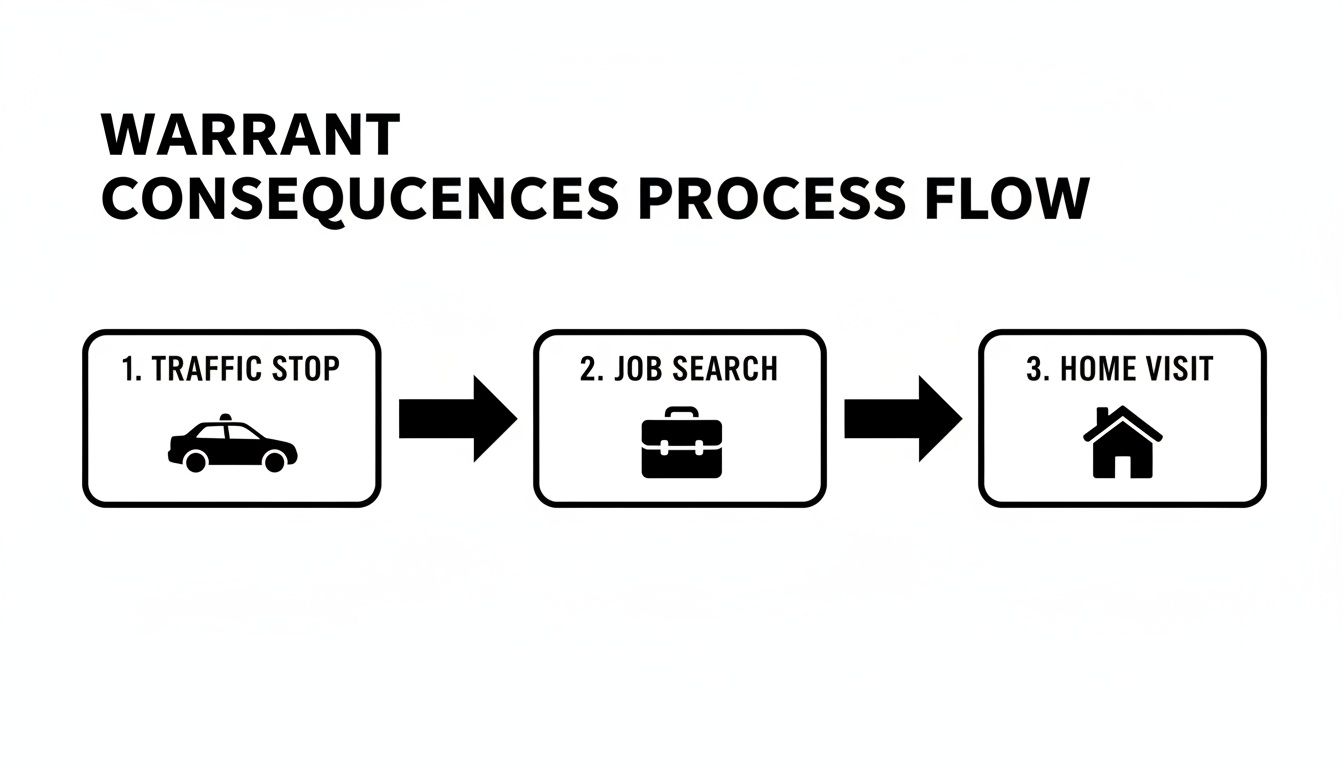
As you can see, an unresolved warrant can interrupt your life when you least expect it, which is exactly why many people choose to get in front of it.
Considering a Voluntary Surrender or Walk-Through
One of the first moves many people consider is arranging a voluntary surrender, which is sometimes called a "walk-through." It sounds scary, but it just means turning yourself in at the jail or courthouse at a scheduled time. The advantages over being caught off guard are huge.
When you turn yourself in, you’re showing the court you’re taking this seriously. Judges and prosecutors in places like Cobb County and Forsyth County often look more favorably on people who take the initiative. It sends a clear signal that you aren't trying to run from the problem.
This controlled approach lets you prepare. You can line up childcare, let your boss know you'll be out, and most importantly, have a plan for posting bond. It’s a world of difference from a surprise arrest at home or work that throws your family into a panic. A criminal defense lawyer can often coordinate the surrender with the police to make the whole process as fast and painless as it can be.
Understanding Bond and Bail Procedures
Once you're in custody, whether from an arrest or a surrender, the immediate goal is getting out. This usually happens by posting bond. A bond is basically a financial promise to the court that you'll show up for all your future court dates. The judge sets the amount, and it can vary a lot depending on the situation.
The court typically looks at a few things:
- The seriousness of the original charge: A felony warrant will almost always have a higher bond than a misdemeanor.
- Your past record: If you have a history of missing court, getting a reasonable bond will be tougher.
- Your ties to the community: Having a job, a home, and family in areas like Roswell or Marietta definitely helps your case.
Posting bond gets you out of jail so you can get back to your life and work on your defense from home, not from a cell. To get more into the weeds on this, you can read our detailed article explaining how bail works in Georgia.
The Role of a Defense Attorney in Warrant Cases
Trying to handle arrest warrants in GA on your own is a tough road. A criminal defense attorney is a critical resource right from the start. They can verify the warrant, often find out the bond amount ahead of time, and help coordinate a voluntary surrender to keep your time in custody to a minimum.
An attorney's involvement can transform a frightening, confusing ordeal into a structured, manageable process. They are your advocate, speaking for you with the police and the court.
At a bond hearing, a lawyer argues for a fair bond by highlighting your reliability and connections to the community. If the warrant is just a bench warrant for a missed court date, they can file a motion to have it "recalled," or canceled. This kind of proactive work is essential in the local courts in Alpharetta, Johns Creek, and the surrounding areas. That experience can be the difference-maker for the outcome of your case.
Common Questions About Georgia Warrants
When you're dealing with something as serious as an arrest warrant, you're bound to have questions. It's a confusing and stressful situation, and getting straight answers is the first step toward figuring out what to do next. Here are some of the most common questions we hear from folks in Cumming, Marietta, Forsyth County, and across North Georgia.
We want to clear up the confusion and give you the information you need. Each answer is designed to be direct and helpful, shedding more light on how this process really works.
Can a Warrant Be Issued Without Me Knowing?
Yes, and it happens all the time. An arrest warrant is an order for law enforcement to take you into custody; it's not like a court summons that has to be served on you personally.
This means you could have an active warrant right now and not even know it. Many people first find out they have a warrant during a routine traffic stop, or when police show up at their home or job. That surprise factor is exactly why it’s so important to be proactive if you even think there might be an issue.
How Long Does an Arrest Warrant Stay Active in Georgia?
This is a critical point that trips a lot of people up. In Georgia, arrest warrants do not expire. They stay active forever, or until one of two things happens: you are arrested, or a judge officially recalls (quashes) the warrant.
A warrant from five, ten, or even 20 years ago is just as valid today as the day it was issued. Time does not make a warrant disappear. It remains a live order in police databases until it is formally handled through the court system.
The idea that a warrant just "falls off the books" after a few years is one of the most dangerous myths out there. It leads to unexpected arrests long after the original incident has been forgotten.
Will a Warrant from Georgia Show Up in Another State?
Absolutely. Georgia shares its warrant information with national law enforcement databases, especially the National Crime Information Center (NCIC), which is run by the FBI.
Every police officer in the country has access to this system. If you get pulled over in another state, they will run your name. An active warrant from Cobb County, Alpharetta, Roswell, or anywhere else in Georgia will pop right up, leading to your immediate arrest. From there, you could face extradition back to Georgia to deal with the original charge.
What Is the Difference Between a Bond and Bail?
People use these terms interchangeably, but they're technically different things. Bail is the amount of money a court requires to release you from jail pending trial. Bond is the agreement or promise you make to the court.
Here's an easy way to think about it:
- Bail is the price tag the judge sets.
- Bond is the payment method you use.
For example, if bail is set at $5,000, you could pay the full amount yourself (a cash bond) or hire a bail bondsman who posts a surety bond for you in exchange for a fee. Either way, the goal is to guarantee you’ll show up for all your future court dates.
Can I Just Pay a Fine to Make a Warrant Go Away?
Almost never. An arrest warrant isn't a bill you can pay off. It’s a command for your arrest so you can be brought before a judge to answer for the underlying issue. This holds true even for a bench warrant that was issued because you missed a court date for a traffic ticket.
While you might have been able to just pay the original ticket, once a warrant is issued, the game changes. The court is now dealing with a separate problem: your failure to appear. To resolve the warrant, you have to go through the proper court process, which means appearing before a judge. You can't just pay a fine to skip that step.
Dealing with an outstanding warrant is overwhelming, and the uncertainty can be paralyzing. At Brian Hansford Law, we get it. With over 25 years of experience, including years as a prosecutor, Brian Hansford knows how to navigate this system from the inside out. If you or a family member has a warrant in Alpharetta, Roswell, Marietta, or the surrounding counties, don't wait for a knock on the door. Contact us for a consultation to protect your rights and your future. Visit us at https://challengemycharge.com.
