
You may be sitting with a pink summons, a court date, or a phone full of texts from the person involved, trying to figure out whether assault 3rd degree ct is a minor misunderstanding or something that can seriously damage your future. Many individuals charged with this offense aren't hardened criminals. They're people who got into an argument, touched someone in anger, acted carelessly, or got blamed after a chaotic incident.
The problem is that Connecticut doesn't treat this charge casually. A misdemeanor label can mislead people into thinking they should just explain themselves and move on. That's often a mistake. In practice, these cases can turn on small details, inconsistent statements, visible marks, medical records, and whether the state can prove the right mental state.
An Introduction to Connecticut Assault Charges
At 11:30 p.m., an argument turns physical, police arrive, and officers separate everyone before they have the full story. One person points to a red mark, another says it was self-defense, and an arrest follows within minutes. By the next morning, the case can look settled on paper even though the hard part is only beginning.
That is how many third-degree assault cases start in Connecticut courts. From a defense perspective, the early police narrative matters, but it is rarely the whole case. Prosecutors often file this charge quickly because it fits a wide range of disputes, from domestic arguments to bar fights to chaotic incidents where no neutral witness saw the full sequence.
Why this charge feels simple but isn't
The first question I usually hear is more concrete: was there an injury, and how serious was it? That matters, but it is only part of the analysis. In many assault 3rd degree cases, the actual fight is over the defendant's mental state.
That point sounds technical until you see how these cases are proved.
Intent, recklessness, and criminal negligence are different ways of assigning blame. Intent is the clearest version. A person acts on purpose to cause injury. Recklessness is different. It works like driving far too fast through a crowded parking lot. The person may not want anyone hurt, but consciously disregards a known risk. Criminal negligence is one step removed from that. It is closer to failing to notice a risk that a reasonable person should have recognized, especially in a situation involving an object that can cause injury.
Those distinctions are often the battleground. Police reports tend to compress messy events into a clean accusation. A good defense tests whether the evidence supports the specific mental state the state chose to charge.
Key questions often include:
- Who started the physical contact, and what happened seconds before it
- Whether the injury claimed was minor, preexisting, or caused some other way
- Whether witness accounts change over time or conflict with texts, photos, or video
- Whether the facts show a deliberate act, a reckless act, or an accident
- Whether the case is being overcharged from a heated but brief encounter
A third-degree assault case can look straightforward at arraignment and much weaker once the evidence is examined carefully.
What people should do early
Early decisions shape these cases. Delay usually helps the prosecution, not the defense, because memories fade, surveillance footage disappears, and informal contact with the complaining witness can create new problems.
A practical checklist:
- Preserve texts, call logs, voicemails, and social media messages.
- Photograph your own injuries, the scene, and anything that helps show what really happened.
- Write out a timeline while the details are still fresh.
- Do not contact the other person unless your lawyer has confirmed it will not violate a court order or bond condition.
- Treat the first court date seriously, even if the charge sounds like a low-level misdemeanor.
Clients often hurt their own cases by assuming they can explain everything later. Assault cases do not usually turn on one dramatic fact. They turn on small facts collected early and used well.
What Is Assault in the Third Degree in Connecticut
An argument turns physical for a few seconds. Someone has a bruise, someone calls police, and by the next court date the case is framed as assault in the third degree. At that point, the fight is often less about whether contact happened and more about how the state labels your state of mind.
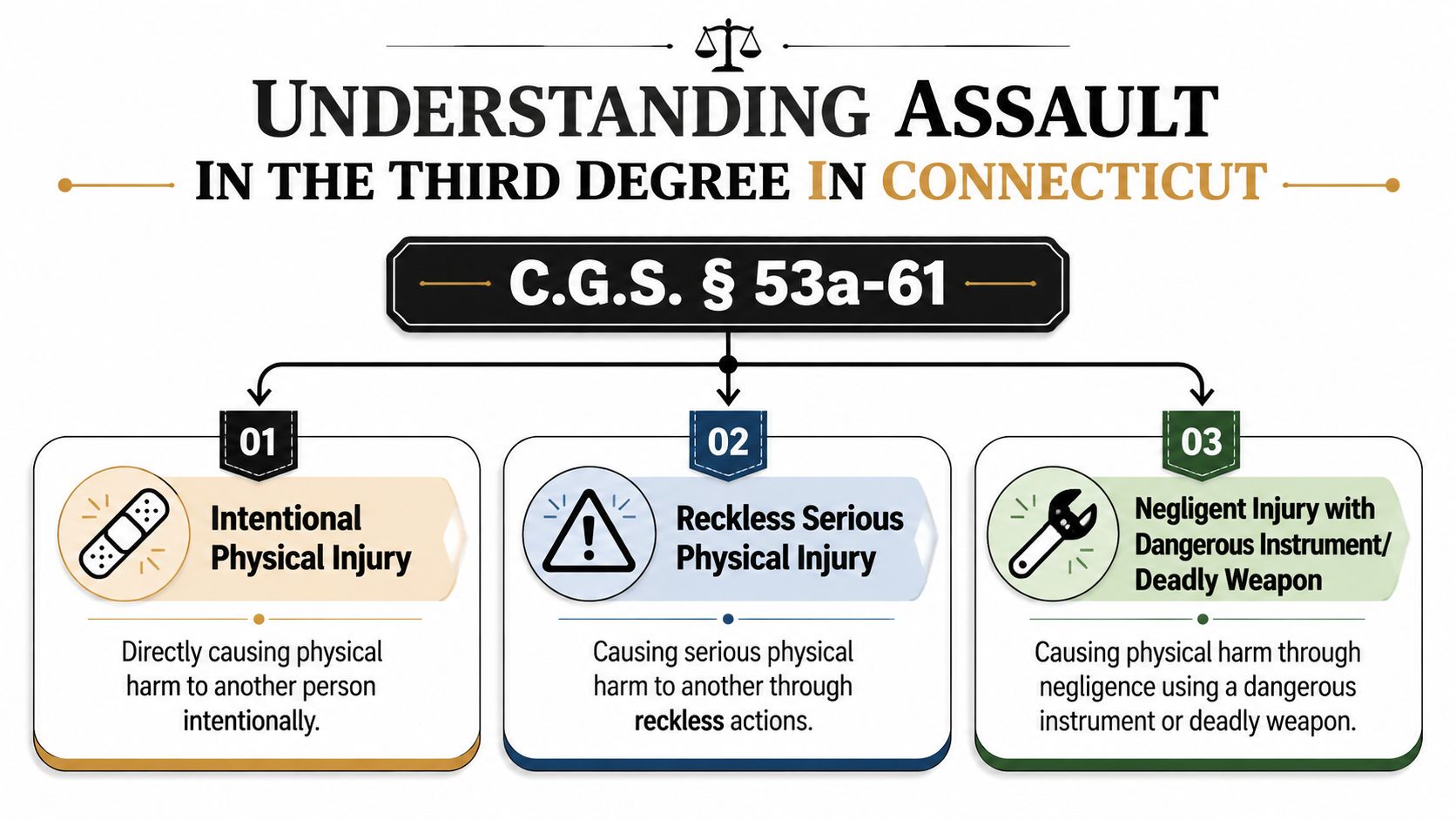
Connecticut treats third-degree assault as one charge with three different theories. That distinction matters in real courtrooms because the defense strategy changes depending on whether the prosecutor claims you acted intentionally, recklessly, or with criminal negligence involving a weapon or instrument. As noted earlier, this offense is charged under C.G.S. § 53a-61 and is generally prosecuted as a Class A misdemeanor. The weapon-based negligent version carries its own sentencing risk, which the next section addresses in more detail.
The three legal pathways
Under C.G.S. § 53a-61, a person can face a third-degree assault charge for:
- Intentionally causing physical injury
- Recklessly causing serious physical injury
- With criminal negligence, causing physical injury by means of a deadly weapon, dangerous instrument, or electronic defense weapon
Those are different routes to the same charge, but they are not interchangeable. Prosecutors often plead broadly at the start. A careful defense presses them to commit to a theory and then tests whether the evidence supports it.
| Legal theory | Core issue | What the state must show |
|---|---|---|
| Intentional physical injury | Purposeful conduct | You meant to cause the injury |
| Reckless serious physical injury | Conscious disregard of risk | You were aware of a substantial risk and ignored it |
| Criminally negligent injury with weapon or instrument | Failure to perceive obvious danger | You should have recognized the risk, and the injury involved the listed object or weapon |
Intent, recklessness, and negligence in plain English
Intentional conduct usually involves a direct act aimed at another person. A punch thrown during an argument is the common example, but intent can also be inferred from smaller facts such as body position, words said just before contact, and whether the act was repeated. In practice, intent is often argued from circumstances because few people announce what they meant to do.
Recklessness is a different mental state. Here, the claim is not that you wanted the injury. The claim is that you saw a serious risk and went ahead anyway. A useful comparison is driving far too fast through a crowded parking lot to make a point. The purpose may not be to hit anyone, but the disregard for a known danger becomes the issue.
Criminal negligence sits one step lower, but it still carries real exposure. This is the failure to notice a risk that should have been obvious, especially when an object such as a tool, knife, or other instrument is involved. The prosecutor's argument is usually that a reasonable person would have recognized the danger, even if you did not.
That difference in mental state is where many defensible cases live.
Why mental state becomes the battleground
In Connecticut assault cases, the same brief incident can be described three different ways depending on which witness is talking and which facts the police emphasize. A shove during a chaotic argument may be described as intentional violence, reckless behavior, or an accident tied to a dangerous object. The legal label matters because each version requires different proof.
That is why defense work in these cases focuses on details that people initially overlook:
- Whether the contact was deliberate, reflexive, or part of mutual movement
- Whether the claimed injury matches the level of force described
- Whether the evidence supports "physical injury" or the higher concept of "serious physical injury"
- Whether the object involved legally fits the state's theory
- Whether texts, video, medical records, or witness timing undercut the prosecution's version
I often tell clients that mental state works like the difference between aiming at a result, ignoring a known risk, and missing a danger you should have seen. Those are not small wording differences. They are often the difference between a charge that holds up and one that can be reduced, contested, or resolved much more favorably.
There is also a practical side people miss. Even before the criminal case is over, an assault arrest can affect background checks, employment, and online search results. For some clients, part of the damage control after a case includes addressing what appears online, and resources like this guide to repairing online reputation can help with that separate problem.
A good defense does not stop at the police summary. It examines whether the state chose the right mental state, whether the injury claim fits the statute, and whether the available proof can carry that burden in court.
Penalties and Long-Term Consequences of a Conviction
A third-degree assault conviction doesn't end when court ends. The direct penalty matters, but the longer shadow is often what changes a person's life.

The sentence is only part of the problem
Connecticut classifies this offense as a Class A misdemeanor. In practical terms, that means real exposure to jail, probation, protective orders, court conditions, and a criminal record. The weapon-based negligent version creates an especially harsh result because the statutory one-year maximum term may not be suspended or reduced under the statute discussed earlier.
Even when jail doesn't happen, people still walk away with consequences that feel much bigger than "just a misdemeanor."
Practical rule: If you're evaluating an assault plea, don't ask only what happens this month. Ask what shows up on a background check next year.
What follows you after the case
A conviction can affect daily life in ways people don't see coming at arraignment.
- Employment problems often show up first. Violent-offense records can raise concerns for employers, especially in jobs involving trust, public contact, supervision, schools, healthcare, or security-sensitive roles.
- Housing issues can surface next. Landlords and property managers may hesitate when they see an assault conviction.
- Professional licensing concerns can become a separate problem for nurses, teachers, commercial drivers, and others in regulated work.
- Immigration consequences can be serious for non-citizens. Those cases need coordinated criminal and immigration advice.
- Reputation damage can linger online long after a case is resolved. If your name is already attached to public allegations, a practical next step can include a guide to repairing online reputation so you understand what can and can't be cleaned up.
What doesn't work
People often try three bad strategies.
First, they minimize the charge because it's not a felony. Second, they assume the other person can readily "drop it." Third, they plead too early because they want the stress over with. All three can create damage that's hard to reverse.
A better approach is slower and more disciplined. Review the evidence, assess the actual injury claim, examine the mental state issue, and weigh any plea offer against the lasting record consequences. That's how smart decisions get made in assault cases.
Common Scenarios That Lead to Assault Charges
Most third-degree assault arrests don't begin with elaborate criminal conduct. They begin with ordinary conflict that turns physical for a few seconds and then gets translated into criminal allegations.

Connecticut practice sources note that even slight injuries can support a third-degree assault charge, including a shove or slap that leaves a visible mark, which shifts the case toward proving causation and witness credibility beyond a reasonable doubt, as discussed in this Connecticut third-degree assault overview.
A neighbor dispute that gets out of hand
Two neighbors are arguing about noise, parking, or a property line. One steps closer. The other puts hands on him to move him back. Nobody goes to the hospital, but there's redness on the face or arm, and police photograph it.
That kind of case surprises people because it doesn't feel like "assault" in the everyday sense. In court, though, the visible mark becomes evidence, and the issue becomes whether the contact was intentional, justified, or exaggerated after the fact.
A bar or restaurant incident with conflicting witnesses
A disagreement starts with words. Someone throws a drink, someone pushes a shoulder, someone lands a punch, and suddenly there are multiple witnesses who saw different parts of the encounter. These cases often look strong for the state at first because there are plenty of people around. In practice, they can become messy because witnesses were distracted, drinking, or only saw the ending.
That matters because credibility isn't counted by headcount alone. One clear surveillance clip can outweigh several shaky witness statements.
A domestic argument involving thrown objects
One of the most common patterns is an argument at home where somebody throws an object in anger, grabs a wrist, blocks a doorway, or makes physical contact during a struggle over a phone or keys. The emotional intensity of these cases often leads to fast arrests.
The state doesn't need a dramatic injury to bring the charge. It needs evidence that the contact caused injury and that the injury is tied to the accused person.
A reckless act that causes more harm than expected
Not every assault case begins with a deliberate strike. A roughhousing incident, a sports confrontation, or a foolish physical act can lead to a serious accusation if someone falls awkwardly or gets hurt. That's where the recklessness analysis starts to matter.
People charged in these situations often say the same thing: "I didn't mean for anyone to get hurt." Sometimes that's true and still not enough. Sometimes it's the beginning of a strong defense. The details decide which one it is.
How to Build a Defense Against Assault 3rd Degree
An arrest isn't a conviction, and in this category of case, the defense often starts with refusing to accept the police version as the final version.

Start with the pressure points in the state's case
A good defense usually focuses on one or more specific weak spots rather than making a broad claim that "none of this happened."
Some of the most productive angles include:
- Self-defense or defense of others. If you used force because you reasonably believed it was necessary to protect yourself or another person, that can change the entire case.
- Lack of intent. In an intentional-injury case, the state has to prove more than contact. It has to prove the required state of mind.
- Weak injury evidence. Not every complaint of pain becomes reliable proof of statutory injury.
- Causation problems. If the alleged injury could have come from something else, the state's theory weakens.
- Mistaken identity or false accusation. These issues appear more often than people think, especially in chaotic group incidents or emotionally charged domestic cases.
Match the defense to the evidence
Experienced case analysis is essential. Different defenses require different proof.
| Defense angle | Useful evidence |
|---|---|
| Self-defense | Photos, 911 audio, witness accounts, your injuries |
| Accident or lack of intent | Video, timing, context, physical layout |
| No provable injury | Medical records, delayed treatment, inconsistent descriptions |
| False allegation | Texts, prior disputes, motive evidence, contradictions |
| Misidentification | Surveillance, location data, independent witnesses |
People often hurt their own case by talking too much before the evidence is gathered. A rushed explanation can lock you into facts that later turn out to be incomplete or wrong.
Charges get dropped or reduced when the defense gives the prosecutor a reason to doubt proof. That usually comes from evidence, not outrage.
What tends to work and what doesn't
What works is disciplined evidence collection, targeted witness review, and a theory that fits the facts. What usually doesn't work is relying on the complainant to "tell the court they don't want to go forward," assuming the mark is too minor to matter, or entering court unprepared.
For people trying to understand possible dismissal pathways, this practical breakdown of how to get assault charges dropped is a useful starting point. In Georgia-based criminal defense practice, firms such as Brian Hansford Law handle assault and related misdemeanor defense matters, but a Connecticut case still needs a lawyer who understands Connecticut procedure, local prosecutors, and how these mental-state issues are litigated in that court system.
The Criminal Court Process for Misdemeanor Assault
The court process feels intimidating mostly because it moves in stages that aren't familiar. Once you know what each stage is for, the case becomes easier to manage strategically.
Arrest, booking, and first conditions
After an arrest, the court may impose conditions right away. That can include orders about contact with the complaining witness, residence restrictions, or other limits that affect work and family life immediately. Violating those conditions can create a second problem fast.
That first period is when preserving evidence matters most. Screenshots disappear, videos get overwritten, and witness memories shift.
Arraignment and early case positioning
At arraignment, the judge addresses the charge, conditions, and the next court date. This isn't a formality. It sets the tone for how the case begins. A defense lawyer can address conditions that are too restrictive, make sure rights are protected, and start shaping how the case is viewed.
A clear walkthrough of the steps in the criminal justice process can help if you're trying to understand what comes after the first appearance.
Pretrial work is where many assault cases are won
Most misdemeanor assault cases don't turn on a dramatic trial moment. They turn on pretrial work. That's where the lawyer obtains reports, reviews video, analyzes medical records, identifies inconsistencies, and negotiates from a position grounded in facts rather than fear.
Typical decision points include:
- Whether to challenge the charge directly
- Whether to seek a reduction or alternate resolution
- Whether the evidence is weak enough to try the case
- Whether any diversionary or record-protective option is realistically available
If the case doesn't resolve, it proceeds toward trial. At that stage, the themes developed early become critical. Who caused what injury, what mental state can be proved, and whether the witnesses hold up under scrutiny.
Why You Need an Experienced Connecticut Defense Lawyer
Third-degree assault cases look smaller on paper than they feel in real life. That's because they combine several things people usually aren't prepared to handle alone: a violent-offense allegation, technical mental-state issues, credibility disputes, and consequences that can outlast the sentence.
A defense lawyer doesn't just stand next to you in court. The lawyer tests whether the state can prove the right statutory theory, protects you from making avoidable mistakes, addresses damaging court conditions early, and evaluates whether a reduction, dismissal, negotiated resolution, or trial is the right path.
This kind of charge also punishes delay. Witnesses become less useful. Digital evidence disappears. The prosecution's version hardens if nobody challenges it early.
If you're trying to choose counsel carefully, this guide on how to find a good criminal lawyer covers the right questions to ask before you hire anyone.
The smartest move after an assault arrest is usually the same: get confidential legal advice quickly, preserve evidence, and don't assume the charge is minor just because it's called a misdemeanor.
If you need criminal defense guidance and want to speak with a firm that handles serious misdemeanor and felony matters, Brian Hansford Law offers consultations for people facing charges and trying to protect their record, license, and future.
