
In Georgia, what's often called "assault 3rd degree" in other states is known simply as simple assault. It's a misdemeanor, but don't let that fool you. The charge often covers actions that create a reasonable fear of immediate harm in someone else—even if you never actually touch them. Getting a handle on what that really means is the first step when looking into a charge like this.
Unpacking a Simple Assault Charge in Georgia

When most people hear "assault," they immediately picture a fistfight. But in Georgia, the law casts a much wider net, and the details can be surprising. A simple assault charge often hinges on the threat of violence, not the violence itself.
The core of the offense is causing "reasonable apprehension of immediately receiving a violent injury." Think about a heated argument. If someone suddenly draws back their fist as if to punch you, your gut reaction is to flinch and feel a jolt of fear. That feeling—the reasonable belief you're about to get hit—is exactly what a simple assault charge is built on. No physical contact needed.
The Role of Intent and Context
For any action to be considered simple assault, the prosecutor has to show it was intentional. An accidental gesture during a conversation just doesn't cut it. The move has to be a deliberate attempt to make the other person afraid of getting hurt.
The context of the whole situation is just as critical. Courts in areas from Alpharetta and Cumming to Johns Creek will dig into the entire story, asking questions like:
- Words and Actions: What was actually said? Were threats shouted while making a menacing gesture?
- The Environment: Where did this happen? A tense moment in a crowded Roswell restaurant might be viewed differently than a private disagreement at home.
- The Relationship: The history between the people involved can add a lot of context to whether a threat felt real or not.
This breakdown of what happened and why it happened is crucial. It’s not just about a single action, but what a reasonable person would have felt in that exact moment.
To make it clearer, let's break down the components a prosecutor has to establish for a simple assault charge to stick.
Key Elements of a Simple Assault Charge in Georgia
| Element | What It Means in Plain English | Common Example |
|---|---|---|
| An attempt to commit a violent injury | You tried to physically hurt someone but didn't succeed. | Swinging a punch at someone but missing completely. |
| An act that places another in reasonable apprehension of immediately receiving a violent injury | Your actions made a reasonable person believe they were about to be physically harmed, right then and there. | Raising a fist or a heavy object during an argument in a threatening way. |
Understanding these elements is key, because every case comes down to whether the specific facts meet these tests.
It's All About the Victim's Perception
One of the most important takeaways is that the law zeroes in on the alleged victim's perception. The big question is whether a reasonable person in their shoes would have genuinely feared immediate harm.
A charge of simple assault does not require proof of physical contact. The act of placing someone in reasonable fear of imminent injury can be enough to satisfy the standard in Georgia.
This means that even if you had no intention of actually following through, making a credible threat can land you in serious trouble. For folks living in communities from Milton and Marietta to Forsyth and East Cobb counties, grasping this concept is essential. The charge is based on the fear you create, not the physical damage you cause.
What "Simple Assault" Actually Means Under Georgia Law
To really get a handle on what the state calls "simple assault," we have to look at the law itself, specifically O.C.G.A. § 16-5-23. The language might seem dense, but in practice, it really comes down to two different ways someone can be charged. Understanding these two scenarios is the first step for anyone looking into this kind of charge.
The first way is pretty clear-cut: an attempt to commit a violent injury. Think of it as the classic "swing and a miss." Someone in a heated argument in a Marietta parking lot throws a punch but doesn't connect. Even with no physical contact and no one getting hurt, the attempt to cause injury is enough to get charged with simple assault.
The second, and much more common, scenario involves causing a reasonable apprehension of immediately receiving a violent injury. This is where most of the confusion comes from. It’s not about what actually happened, but about what someone genuinely believed was about to happen to them.
The Idea of "Reasonable Apprehension"
That phrase—reasonable apprehension—is the linchpin that turns a simple argument into a criminal offense. It's not about whether someone is overly sensitive; it’s about whether an average person, standing in their shoes, would have felt a real and immediate fear of getting hurt.
Let's say a disagreement in a Roswell coffee shop gets loud. One person suddenly lunges toward the other while shouting threats. Even if they pull up short, that aggressive movement, combined with the threatening words, is likely enough to put the other person in fear of being hit. That fear—that apprehension—is the heart of the charge. It's precisely why no one has to actually be touched.
The focus in these cases isn't necessarily on what you intended to do. The critical question is whether your actions created a credible and immediate fear of harm in the other person's mind.
This is a vital point. It shows just how much weight the law gives to perceived threats and intimidating actions, especially when things get tense.
You Don't Have to Touch Anyone
This is worth repeating: you can be charged with simple assault in Georgia without ever laying a finger on someone. It's probably the single biggest misunderstanding about this charge. A threatening gesture, an aggressive advance, or even waving an object around in a menacing way can be enough.
This standard has huge implications. Simple assault is, by far, the most common violent crime reported nationally. In 2023 alone, there were over 4.8 million incidents. And since only about 36.8% of these incidents are ever reported to the police, the cases that do make it to court often depend heavily on the alleged victim's story and any witness accounts. You can find more details on these trends in these national violence statistics.
For anyone in communities like Forsyth County or East Cobb, understanding this distinction is key. A simple assault charge isn't about proving a physical injury occurred; it’s about the violation of a person's right to feel safe from immediate harm. At its core, the charge is about the fear and intimidation your actions created.
Potential Penalties and Long-Term Consequences
Getting convicted for simple assault in Georgia isn't just a minor issue. While the immediate court penalties are serious enough, the real trouble often comes later, creating unexpected problems in a person's personal and professional life for years to come. It’s important to understand exactly what the stakes are.

Georgia law classifies simple assault as a misdemeanor of a high and aggravated nature. This gives the court significant leeway in handing down a sentence, but remember, these are maximums—not automatic punishments.
A judge will look at everything, from the specific details of the incident to a person's prior criminal history, before deciding on a sentence.
Immediate Court-Ordered Penalties
The penalties a judge can impose directly are no small matter. While every case is different, the statutory maximums paint a clear picture of what the court can do.
- Fines: A person could be ordered to pay a fine of up to $1,000.
- Jail Time: The law allows for a jail sentence of up to 12 months.
On top of that, a judge might order probation, community service, or require attendance in anger management classes. These alternatives are fairly common, especially for first-time offenders, but they are never a guarantee. It all comes down to the unique facts of the case.
Beyond the Courtroom: The Ripple Effect
The consequences of a simple assault conviction don’t stop at the courthouse doors. That conviction creates a permanent mark on a person's record that pops up on background checks, creating major roadblocks in life. This is where the true, lasting pain of a misdemeanor is often felt.
A criminal record isn't just a piece of history; it's an active barrier that can shut doors for years. Many people are shocked to find out how a single misdemeanor conviction impacts their ability to get a job, rent an apartment, or even pursue an education.
These "collateral consequences" aren't part of the official sentence, but they hit just as hard. For people living in competitive areas like Forsyth County, East Cobb, or Johns Creek, these hurdles can be especially tough to overcome.
How a Conviction Can Impact Your Daily Life
Having a simple assault conviction on your record can set off a chain reaction of problems. These issues can surface months or even years after the case was thought to be over.
Here’s a breakdown of the most common areas affected:
- Employment Opportunities: Nearly every employer runs a background check. A conviction for a crime involving the threat of violence is a huge red flag, particularly for jobs in fields like education, healthcare, or anything requiring a security clearance.
- Housing Applications: Landlords run background checks, too. An assault on your record can get your rental application denied flat-out, making it incredibly difficult to find a place to live.
- Professional Licensing: If a career requires a state license—think nursing, real estate, or even cosmetology—a conviction could lead to an application being denied or a current license being revoked.
- Firearm Rights: A misdemeanor conviction for an assault charge classified as domestic violence can, under federal and state law, lead to the permanent loss of the right to own a gun.
These are just a few examples. The impact is real, and it highlights how seriously an assault charge should be taken from the very beginning.
How Simple Assault Differs From Other Charges
In Georgia's system, the lines between different assault-related charges can feel a bit blurry. It's helpful to understand the specific details that separate a simple assault charge from others like simple battery or the much more serious aggravated assault. The difference usually boils down to a few key factors: was there physical contact, how bad was the injury, and was a weapon involved?
A simple assault charge—often what people mean when they talk about "assault 3rd degree"—is fundamentally about the threat of getting hurt. It’s all about an act that places another person in reasonable fear that they are about to suffer a violent injury. The moment actual physical contact is made, the situation can escalate into a completely different charge.
Simple Assault vs. Simple Battery
The most common point of confusion is the difference between simple assault and simple battery. Thankfully, the dividing line is pretty clear and direct: physical contact.
- Simple Assault: This charge is all about creating a reasonable fear of being hurt. Picture someone in an Alpharetta parking lot argument aggressively raising their fist. Nobody gets touched, but the threat is obvious. That's simple assault.
- Simple Battery: This charge requires intentional physical contact of an insulting or provoking nature, or causing some physical harm. Even a light push during a dispute in a Roswell bar could be enough to qualify as simple battery.
In short, assault is the threat, while battery is the follow-through. You can get a deeper dive into these definitions in this article explaining what assault and battery mean in Georgia.
The Leap to Aggravated Charges
When certain elements enter the picture, a charge can jump from a misdemeanor "simple" offense to a much more serious felony "aggravated" offense. This escalation dramatically increases the potential penalties and the long-term damage a conviction can cause.
Two main factors typically trigger this upgrade: the use of a weapon and the intent to cause severe harm. An object that could be used to inflict serious injury—even a common item like a heavy bottle or a baseball bat—can turn a simple assault into aggravated assault. Similarly, if a battery results in serious disfigurement or the loss of a bodily function, it becomes aggravated battery.
Recent data really puts the prevalence of these charges into perspective. In 2023, the United States saw approximately 5,398,290 assault victimizations. For residents in our local communities like Alpharetta, Cumming, and Johns Creek, these numbers show just how frequently these situations pop up. While the majority are simple assaults, which often proceed with very limited evidence, it underscores just how important a detailed examination of the facts is in every single case. You can read more about these national crime victimization trends.
Comparing Georgia's Assault-Related Charges
To really clarify these distinctions, it helps to see the charges laid out side-by-side. The specific details of what happened—whether it was witnessed in Milton or Marietta, Forsyth County or Cobb County—are what determine exactly what charge the prosecutor files.
Assault and Battery Charges in Georgia at a Glance
This table breaks down the key differences between the most common assault-related charges seen in Georgia courts.
| Charge | Key Element | Typical Severity | Common Example |
|---|---|---|---|
| Simple Assault | Creating fear of imminent injury (no contact needed) | Misdemeanor | Threatening to punch someone during an argument. |
| Simple Battery | Unwanted physical contact (insulting or harmful) | Misdemeanor | Shoving someone during a disagreement. |
| Aggravated Assault | Assault with a deadly weapon or intent to murder/rape/rob | Felony | Waving a knife at someone in a threatening manner. |
| Aggravated Battery | Battery causing serious bodily harm or disfigurement | Felony | Striking someone with an object, causing a severe injury. |
Ultimately, what defines a charge of assault 3rd degree, or simple assault, is the absence of physical contact and serious injury. Understanding this framework gives a much clearer picture of how law enforcement and prosecutors categorize these offenses based on the unique evidence and circumstances of each case.
Common Defenses and Evidentiary Challenges
When facing an assault 3rd degree charge, it's important to remember that the prosecutor’s version of events is just one side of the story. An accusation is not a conviction. A number of solid defenses can be raised, each focusing on the specific facts of what actually happened. The goal in any defense is always to introduce reasonable doubt by chipping away at the state's case.
The path forward involves a meticulous look at every piece of evidence—and, just as importantly, the lack of it—to build an accurate picture of the incident.
Arguing Self-Defense or Defense of Others
Self-defense is probably the most well-known defense to an assault charge. In Georgia, a person is justified in using force to protect themselves when they reasonably believe they are in imminent danger of unlawful force. The same logic applies if someone steps in to defend another person.
There's a critical catch, though: proportionality. The force used must be proportional to the threat. If someone yells at another person and they respond by physically attacking them, a self-defense claim is unlikely to succeed. The key question is always whether the reaction was reasonable given the circumstances at that very moment.
The concept of "reasonable belief" is crucial. The evaluation isn't about whether a threat actually existed in hindsight, but whether a reasonable person in that position at that exact moment would have believed they were in immediate danger.
This defense requires a deep dive into the entire incident, from the moments leading up to the confrontation to the actions taken by everyone involved.
The flowchart below shows how Georgia law breaks down the different types of assault charges.
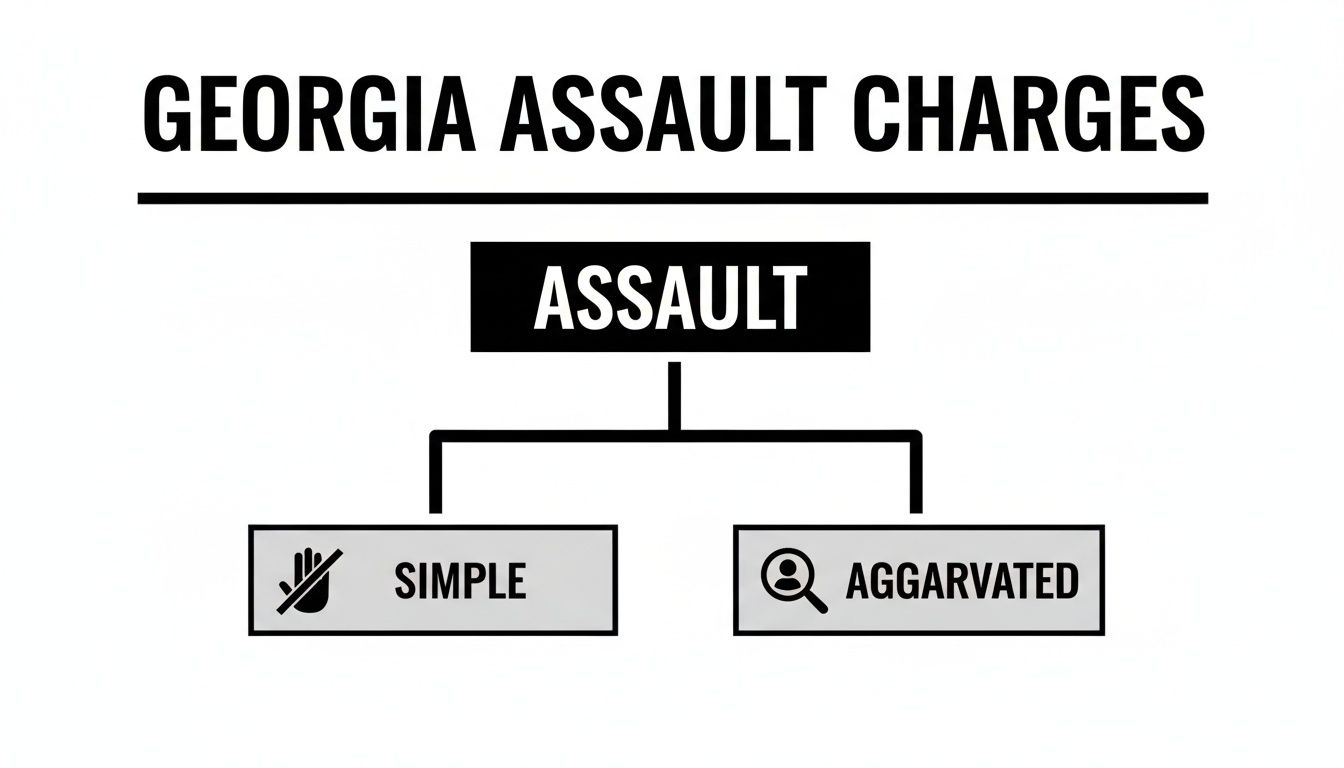
As you can see, there's a fundamental split between simple assault, which often involves no physical contact, and aggravated assault, which involves much more serious elements.
Challenging the Element of Intent
A simple assault charge requires intent. The prosecution has to prove that a person either intended to cause an injury or knowingly acted in a way that would make a reasonable person fear immediate harm. If the actions were accidental or completely taken out of context, this core element of the crime hasn't been met.
For instance, an animated hand gesture during a heated argument could easily be misinterpreted as a threat. In situations like these, showing that there was no criminal intent can be a very effective defense. Context is everything.
Highlighting Evidentiary Issues
Often, the best defense isn't about what evidence the prosecution has, but what it's missing. Assault cases can be surprisingly light on hard proof, frequently boiling down to one person's word against another's.
Common evidentiary challenges often include:
- Conflicting Testimonies: When witnesses give contradictory stories, it creates cracks in the prosecution's narrative and damages their credibility.
- Lack of Physical Evidence: The absence of injuries, video footage, or other physical proof can create significant reasonable doubt.
- Witness Credibility: The accuser's or witness's reliability can be called into question due to their motives, personal biases, or inconsistencies in their statements.
Factual Disputes and False Accusations
Sometimes the defense is simple: the incident never happened the way the accuser says it did, or the accused wasn't the one involved. Factual disputes like mistaken identity or false accusations are more common than one might think, especially in chaotic situations or arguments fueled by anger or revenge.
In these scenarios, it becomes critical to investigate the accuser’s background, uncover any potential motives to lie, and find alibi witnesses who can place the accused elsewhere. A thorough investigation is the only way to effectively counter a wrongful accusation. To better understand the process, it might be helpful to read this guide on how to get assault charges dropped when the facts are on your side.
Navigating the North Georgia Court Process

Being charged with assault 3rd degree is unnerving. For most people, the biggest source of anxiety comes from simply not knowing what to expect from the court system. Once you understand the basic roadmap of a misdemeanor case, the journey ahead becomes a lot less intimidating. While every case has its own unique facts, the fundamental stages are the same across North Georgia.
It all starts right after the arrest. The first stop is booking, which is just an administrative process: fingerprints, a mugshot, and filling out paperwork. Shortly after, a person will have a first appearance or bond hearing. This is where a judge decides on the conditions of release, including setting a bond amount.
The Initial Court Appearances
The first formal day in court is the arraignment. This is a brief hearing where the prosecutor officially reads the charges, and a plea is entered—typically "guilty," "not guilty," or "no contest." Pleading "not guilty" at this stage is almost always what happens. It doesn't mean the case is going to trial; it's a standard step that gets the case moving and gives a lawyer the time needed to dig into the evidence.
After the arraignment, the case moves into the pre-trial phase. This is where the real work begins. A defense attorney will file motions for discovery, which requires the prosecutor to hand over every piece of evidence they have—police reports, witness statements, body camera footage, you name it.
The pre-trial phase isn't just about waiting for the next court date. It’s an active, strategic period where the heavy lifting happens. This is when an attorney picks apart the state's case, finds the weak spots, and builds a powerful defense.
This is also the time for negotiations with the prosecutor. Depending on the strength of the evidence, these talks could lead to a plea deal for a lesser charge, a more favorable sentence, or even entry into a diversion program. You can get a deeper look at these first crucial steps in this guide on what happens when you get arrested.
Local Differences in North Georgia Courts
Even though the framework is the same across Georgia, the way misdemeanor cases are actually handled can vary quite a bit from one courthouse to another. The municipal courts in Alpharetta and Roswell, for instance, often operate differently than the larger State and Superior Courts in Forsyth County or Cobb County.
These local quirks can affect everything from how long a case takes to what kind of deals are on the table.
- Pre-Trial Intervention (PTI) Programs: Many North Georgia courts, especially in Forsyth and Cobb County, have great diversion or PTI programs for first-time offenders. If someone qualifies, they can complete things like community service or anger management classes to get the charges completely dismissed and keep their record clean.
- Court Calendars: A court's caseload matters. The busy dockets in Marietta's Cobb County courts might mean a longer wait between court dates compared to the smaller, faster-moving municipal courts in places like Milton or Johns Creek.
The Path to Resolution
If a case isn't resolved during the pre-trial phase—whether through dismissal, a plea agreement, or a diversion program—it gets scheduled for trial. At trial, the prosecutor has the burden of proving every element of the charge beyond a reasonable doubt to a judge or jury. The defense attorney's job is to dismantle their case, cross-examine their witnesses, and show the jury why there is doubt.
Knowing this step-by-step process helps you see the big picture. From the moment of arrest to a potential trial, every stage is an opportunity to challenge an assault 3rd degree charge and work toward the best possible outcome.
Common Questions About Assault Charges in Georgia
If you're looking into a charge like assault, you probably have a lot of questions. The answers always come down to the specific facts of the situation, but getting a handle on the basics is a crucial first step. Here are some of the most common questions.
Can I Be Charged With Assault if I Never Touched Anyone?
Yes, absolutely. This is one of the biggest surprises for people. In Georgia, a simple assault—which is what is being discussed with a third-degree charge—doesn't require any physical contact whatsoever. The law cares about whether certain actions made someone else feel like they were in immediate danger of getting hurt.
Think of it this way: a threatening gesture, like drawing a fist back while yelling a threat, can be enough. The whole case hinges on creating a reasonable fear of harm, not on whether an injury actually occurred.
What Happens if the Other Person Wants to Drop the Charges?
This is a huge, and very common, misunderstanding. Once the police are called and an arrest is made, the person who called them doesn't have the power to just "drop the charges." It's out of their hands.
The decision to move forward with a criminal case belongs solely to the State of Georgia, which is represented by the prosecutor's office. While the prosecutor might take the alleged victim's wishes into account, they are not bound by them. If there's other evidence—like a 911 recording, photos, or police bodycam footage—they will often prosecute the case regardless.
The case is officially "The State of Georgia v. [Defendant's Name]," not one person against another.
Does a Third-Degree Assault Charge Mean I'm Going to Jail?
Not necessarily. A conviction for simple assault is a misdemeanor, and while that carries a potential maximum sentence of up to 12 months in jail, that's the worst-case scenario, not a guarantee. Judges in Georgia have a lot of leeway in sentencing.
They're going to look at several things, including:
- The specific facts of what happened.
- A person's criminal history, if any.
- Any mitigating factors that can be presented.
For many people, especially first-time offenders, alternatives like probation, fines, community service, or anger management classes are very common outcomes. The final result really depends on the unique details of the case and the strength of the defense.
Understanding the reality of an assault charge is the first step toward building a defense that protects your future. At Brian Hansford Law, I use my experience as a former prosecutor to see the case from every angle. With over 25 years of experience, I know how to defend your rights. If you're facing charges in Alpharetta, Cumming, Forsyth County, or anywhere in North Georgia, contact us for a consultation at https://challengemycharge.com.
