
A lot of assault vs battery cases start the same way. An argument gets loud in an Alpharetta parking lot, someone steps forward in a Roswell bar, a hand goes up, a shove follows, and within hours you're in a North Atlanta courtroom or trying to figure out whether you need a criminal defense lawyer before the first appearance.
What makes these cases stressful is that the words sound interchangeable in everyday speech, but they are not interchangeable in court. That difference matters immediately. It affects what the State has to prove, what defenses work, whether a misdemeanor defense attorney can push for reduction or dismissal, and how much risk you face in Fulton County, Forsyth County, Cobb County, or Gwinnett County.
People charged in Cumming, Johns Creek, Milton, Sandy Springs, Marietta, and Duluth usually want the same answers fast. What exactly am I charged with? Can they prove it? Is this a misdemeanor or a felony? Can I keep this from damaging my record, job, license, or future? Those are the right questions. Understanding the line between assault and battery is often the first useful step toward answering all of them.
Facing an Assault or Battery Charge in North Atlanta
A recent charge often comes with very little clarity. You may know there was an argument. You may know police only heard one side first. You may know alcohol, road rage, a family dispute, or a misunderstanding made everything worse. But it's frequently unclear whether the allegation fits assault, battery, or both.

That confusion is normal. In day-to-day conversation, people say “assault” to mean any violent encounter. Courts don't work that way. A threat that creates fear of immediate harm can be treated very differently from actual physical contact. If the case happened in a bar in Roswell, outside an apartment complex in Johns Creek, or during a domestic dispute in Cumming, that distinction can shape the entire defense from day one.
What people usually get wrong
Many defendants assume the case is simple if there wasn't a serious injury. That's often a mistake. Another common mistake is thinking a charge will disappear if both people were angry, both people were yelling, or the contact was brief. Those facts matter, but they don't end the analysis.
The distinction is more technical:
- Threat cases can still be prosecuted: A person doesn't have to land a punch to face an assault allegation.
- Contact cases can be broader than expected: A battery allegation doesn't require catastrophic injury.
- Police reports are only a starting point: Officers arrive after the event. They usually build the initial narrative from statements, visible marks, witness accounts, and available video.
- Local court handling matters: A charge filed in one North Atlanta court may move very differently than a similar charge in another.
Early decisions matter. What you say to police, what you text afterward, and whether you contact the accuser can help or hurt the case before your lawyer gets the first discovery packet.
Why urgency is justified
These cases don't sit still. Prosecutors start evaluating witness credibility and charging options immediately. A person who thought they only needed a traffic ticket attorney or reckless driving lawyer because the incident grew out of a road rage stop can suddenly find themselves needing a misdemeanor defense attorney or felony defense lawyer instead.
If you're charged in Alpharetta, Roswell, Marietta, or anywhere in North Atlanta, the first practical move is to treat the case as serious, even if you believe the situation was exaggerated. That mindset leads to better choices, better evidence preservation, and better defense strategy.
The Core Legal Distinction Between Assault and Battery in Georgia
The shortest workable explanation is this. Assault is the threatened or attempted violence. Battery is the physical contact. If someone raises a bat and makes another person reasonably fear an immediate strike, that's assault. If the bat connects, that's battery.
That basic difference isn't just academic. It affects the evidence, the defenses, and the negotiating advantage in plea discussions.
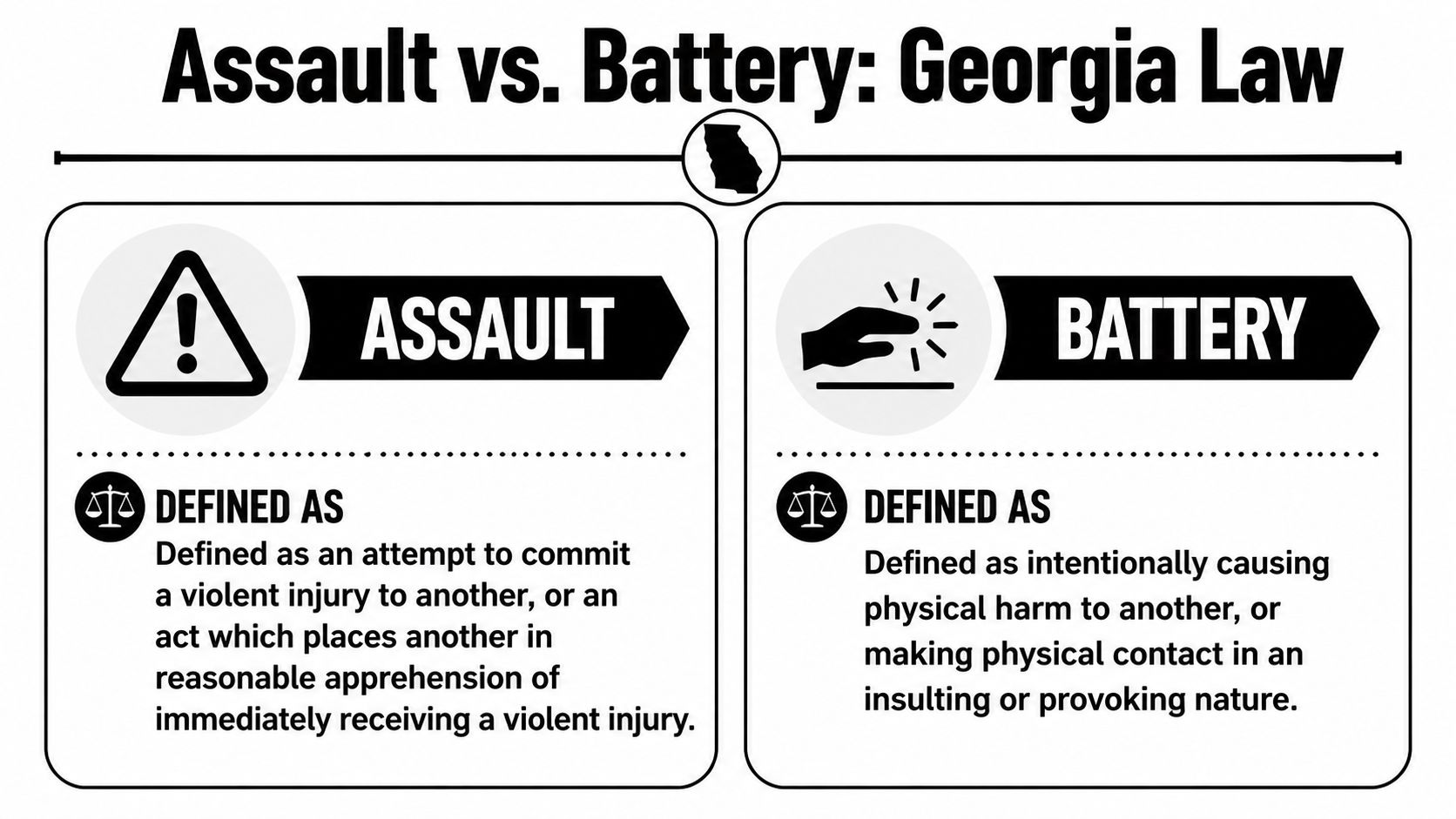
Georgia assault vs battery at a glance
| Element | Simple Assault (O.C.G.A. § 16-5-20) | Simple Battery (O.C.G.A. § 16-5-23) |
|---|---|---|
| Core conduct | Attempting violent injury or placing another in reasonable fear of immediate violent injury | Intentionally making insulting or provoking physical contact, or intentionally causing physical harm |
| Physical contact required | No | Yes |
| Victim focus | Fear or apprehension of immediate harm | Actual contact or harm |
| Typical example | Swinging and missing, or stepping in with a raised fist and immediate threat | Shoving, slapping, poking, striking |
| Key defense focus | Intent, immediacy, and whether the person was actually put in fear | Intent, nature of contact, consent, accident |
A charge can include both offenses when the facts support both. A missed punch can support one theory. A landed punch can support another. That's why readers searching assault vs battery in Georgia often discover that the answer isn't “one or the other.” Sometimes it's both.
The practical distinction most clients remember
For most clients, the best way to remember it is simple:
Practical rule: If the allegation is “you made me think you were about to hurt me,” you're in assault territory. If the allegation is “you touched me in an insulting, provoking, or harmful way,” you're in battery territory.
That sounds clean on paper. Real cases aren't clean. In real files, witness stories conflict, video catches only part of the encounter, and both sides often claim the other person escalated first.
Why this difference matters beyond labels
The consequences can still be serious even at the misdemeanor level. In major U.S. markets, simple assault is typically treated as a misdemeanor with fines up to $1,000 and up to 6 months in jail, while battery can carry fines up to $2,000 and similar jail exposure, according to this discussion of assault and battery penalties and prevalence. That same source notes that in 2018 the Bureau of Justice Statistics reported three out of every 1,000 people in the United States were victims of aggravated assault.
Those figures aren't Georgia sentencing advice. Georgia statutes and court practice control Georgia cases. But they show why these charges get treated seriously by police, prosecutors, employers, and background screeners.
What doesn't work
Clients sometimes focus on the wrong point. They want to prove they are “not violent” in a general sense, or that the whole incident was “blown out of proportion.” That may be true, but it doesn't answer the legal question.
What works is narrower:
- identifying whether the allegation is fear, contact, or both
- isolating the exact moment the State claims a crime occurred
- testing intent
- testing credibility
- finding video, 911 audio, bodycam, and witness inconsistencies early
That shift, from broad denial to element-by-element analysis, is where real defense work begins.
Deconstructing the Charges What Prosecutors Must Prove
A prosecutor doesn't win an assault or battery case by saying the situation looked bad. The State has to prove specific elements beyond a reasonable doubt. That is where many cases become more defensible than the arrest paperwork suggests.

What the State must show in an assault case
For an assault theory, prosecutors generally focus on attempted violence or conduct that placed another person in reasonable apprehension of immediate harm. The key word is immediate. Not future harm. Not vague anger. Not general hostility.
That means several questions become central:
- Was there an act, not just bad blood?
- Did the act create fear of imminent harm?
- Was the alleged victim aware of the threat when it happened?
- Can the State prove intent from words, conduct, distance, and timing?
A critical evidentiary point is that assault requires the victim to be aware of the threat, while battery can occur even if the victim was unaware at the time of contact, as discussed in this analysis of assault and battery evidentiary distinctions.
If the alleged victim didn't perceive the threat, the prosecution may have a problem on an assault count, even if the defendant acted aggressively.
That issue comes up more often than people think. A person yelling from too far away, a gesture no one saw, or a claim built after the fact may not satisfy the awareness requirement.
What the State must show in a battery case
Battery is different because the prosecution is now focused on actual contact. The legal fight usually turns on whether the contact was intentional, harmful, or insulting and provoking.
The same evidentiary discussion linked above also notes that battery doesn't require serious injury and that even minor contact can qualify if it is insulting or provoking in nature. That's why a battery case doesn't automatically rise or fall on medical records. Some do. Many don't.
The pressure points in proof
A former prosecutor learns quickly that these cases often hinge on a few recurring fault lines:
Intent
Intent is rarely proven by confession. The State usually tries to infer it from movement, tone, distance, prior tension, and aftermath. Defense counsel should test whether the conduct was deliberate or just chaotic.
Witness reliability
One witness may say “he lunged.” Another may say “they were both crowding each other.” Bodycam may show anger but not the initiating act. Surveillance may show movement but no audio. Each gap matters.
Sequence
In a fast-moving confrontation, sequence decides a lot. Who approached first? Who blocked exit? Who raised hands first? Did contact happen before or after the alleged threat? Those details can separate mutual argument from criminal conduct.
For readers comparing related charges, this overview of third-degree assault issues is useful because it shows how charging language can alter the defense focus.
What actually creates reasonable doubt
A defense doesn't need to prove perfection. It needs to expose uncertainty in the State's narrative.
The strongest cross-examination often isn't dramatic. It's precise. Timing, distance, lighting, wording, camera angle, and prior statements can all cut into the prosecution's certainty.
What usually does not help is arguing every point at once. Better results come from identifying the one or two elements the State can't prove cleanly and pressing there.
Potential Penalties in Alpharetta Roswell and Marietta Courts
When people call after an arrest, they usually ask the same blunt question. What am I facing? That's the right question, but the answer depends on how the case is charged and whether the State keeps it at the misdemeanor level or pushes it toward a felony theory.

Misdemeanor exposure is still serious
Many defendants hear “misdemeanor” and assume the case is minor. Courts don't see it that way. A misdemeanor assault or battery conviction can still affect employment, professional licensing, housing applications, firearm rights analysis, school discipline, and family court issues.
Nationally, misdemeanor simple assault or battery may lead to fines in the $1,000 to $2,000 range and up to 6 to 12 months in jail, while aggravated assault penalties in U.S. jurisdictions can reach 20 years in prison and fines over $10,000, especially when a deadly weapon or a risk of great bodily harm is involved, according to this summary of assault and battery penalties.
Those numbers show the gap between misdemeanor and felony exposure. In Georgia practice, that gap is exactly why the early defense goal is often to stop escalation, challenge aggravating facts, and keep the case from hardening into the most serious version the State can charge.
What local courts care about
Judges and prosecutors in Alpharetta, Roswell, and Marietta don't review these files in a vacuum. They look at the conduct alleged, injury level, weapon allegations, criminal history, whether the event was domestic, whether children were present, whether alcohol played a role, and whether the defendant followed bond conditions.
The practical consequences often include more than jail and fines:
- Probation terms: Reporting requirements, no-contact provisions, treatment, or classes.
- Court compliance burdens: Missed dates create fresh problems fast.
- Permanent record issues: Even a low-level conviction can continue to surface on background checks.
- Negotiation pressure: The State may offer a plea that looks easy in the short term but carries long-term cost.
Felony risk changes everything
If a case is charged as aggravated assault or aggravated battery, the posture changes immediately. Investigation becomes more urgent. Witness outreach becomes more important. Video preservation can't wait. Delay helps the State, not the defense.
Readers dealing with more serious charging concerns often benefit from reviewing how felony assault allegations are framed in this discussion of first-degree assault issues, even though Georgia charging terms require Georgia-specific analysis.
When a file contains any allegation of a weapon, substantial injury, or repeated force, the safest assumption is that prosecutors will evaluate the case for felony treatment unless the defense gives them a reason not to.
What tends to help and what tends to hurt
Helpful facts often include prompt evidence collection, neutral witnesses, incomplete or contradictory video, proof of self-protection, and a clean documented history of compliance after arrest.
Unhelpful facts include angry texts, social media commentary, violation of no-contact conditions, and trying to “work it out” directly with the complaining witness after release.
A good defense lawyer doesn't just react to the accusation. The lawyer manages the risk profile the court sees from the first hearing forward.
Why Jurisdictional Nuances in North Georgia Matter
Georgia keeps assault and battery as distinct offenses. That matters because the defense strategy has to match the exact charge, not just the event. In some states, the law has moved toward consolidation, but that isn't how Georgia handles these cases.
A broader comparison of state approaches notes that some jurisdictions, including Washington state, have consolidated assault and battery into unified statutes, while Georgia has not. The same comparison also shows how widely penalties can vary elsewhere, including Illinois simple assault at 30 days jail and $1,500 fine, and Wisconsin battery causing bodily harm at 9 months jail and $10,000 fine, in this discussion of jurisdictional differences.
That kind of variation is why out-of-state internet advice can mislead Georgia defendants. The terminology may sound familiar, but the charging structure, plea options, and courtroom expectations may not match what happens in Fulton County, Forsyth County, Cobb County, or Cherokee County.
Local practice shapes outcomes
Statewide law applies statewide. Court culture doesn't.
A municipal court calendar in one North Atlanta jurisdiction may move quickly and push for fast misdemeanor resolution. A superior court handling a felony allegation may involve a very different pace, discovery posture, and negotiation environment. Some prosecutors insist on stricter no-contact conditions. Some judges focus heavily on pretrial conduct. Some courts expect defense counsel to narrow factual disputes early if a negotiated outcome is realistic.
Why local experience matters in assault vs battery cases
Assault vs battery cases turn on details, and local knowledge helps with details that aren't written in the statute book:
- Charging patterns: Some offices file both counts where others may streamline.
- Bond expectations: Courts vary in how they handle first appearances and conditions.
- Proof preferences: Some prosecutors lean heavily on officer testimony. Others want civilian witnesses locked down early.
- Negotiation timing: In some courts, the best opportunity comes before formal hardening of the file. In others, it comes after discovery exposes weaknesses.
The same facts can produce different strategic choices depending on where the case is pending and who is reviewing it.
That doesn't mean justice changes by zip code. It means practical defense work is local. A lawyer who regularly handles North Atlanta criminal cases will usually make faster decisions about venue-specific procedure, prosecutor habits, and what kind of presentation is likely to move the case.
Proven Defense Strategies from a Former Prosecutor
The best defense strategy depends on the exact allegation, but some themes repeat. From a former prosecutor's perspective, the strongest defenses don't rely on broad outrage about being charged. They attack the legal weak points in a disciplined way.
Self-defense is powerful when the facts support it
Georgia recognizes self-defense under O.C.G.A. § 16-3-21. In an assault case, that can matter even without physical contact if the defendant acted because of a reasonable fear of harm. In a battery case, self-defense may explain why contact occurred and why it was legally justified.
This defense works best when the facts line up cleanly. Threatening movements, crowding, prior aggression, witness accounts, video, and bodycam statements all matter. It works less well when the defendant kept pursuing after the danger had passed, or when later messages make the event sound retaliatory rather than protective.
Lack of awareness can defeat an assault theory
One of the most overlooked defenses in assault cases is simple. If the alleged victim wasn't aware of the threat, the State may struggle to prove reasonable apprehension.
A person can't be placed in fear of immediate harm if they didn't know the act occurred. That doesn't answer a battery count, but it can be a major issue on an assault count. It is often missed because police reports summarize emotion after the event, not perception at the exact moment the threat was allegedly made.
Consent and accident matter more in battery than most people think
According to this discussion of assault and battery defenses in Georgia, proving consent or accidental contact can lead to dismissal in battery cases, and GBI reports show this accounts for nearly 30% of dismissed charges. That same discussion notes that a frequently missed defense for assault is the victim's lack of awareness.
Those ideas show up in real North Atlanta cases. Contact during sports, horseplay, crowd movement, or chaotic bar environments may be rude or regrettable without being criminal. The key issue is whether the contact was intentional, insulting, provoking, or harmful under the law.
Credibility battles decide many outcomes
A large share of assault vs battery cases come down to whose version survives scrutiny. That's why defense work often includes:
- Pulling video quickly: Surveillance systems overwrite. Delay costs evidence.
- Comparing statements carefully: The 911 call, officer narrative, and later affidavit may not match.
- Testing motive: Divorce, custody disputes, jealousy, job conflict, and neighborhood tension can shape accusations.
- Checking physical possibility: Distances, angles, lighting, and line of sight often expose exaggeration.
A former prosecutor knows how the State builds these cases. That perspective helps identify where the file looks stronger than it really is and where witness testimony is likely to break under detail.
What usually doesn't work
Some responses feel natural but damage the defense:
- Contacting the accuser directly: That can violate bond conditions and create new evidence.
- Posting online: Social posts get screenshotted and reinterpreted badly.
- Assuming a minor injury means a minor case: It doesn't.
- Waiting for court before gathering evidence: By then, key video may be gone.
Building the defense early
A strong defense often starts with a checklist, not a courtroom speech.
- Preserve video, texts, call logs, photos, and names of neutral witnesses.
- Follow bond conditions exactly.
- Stop discussing the facts with anyone except counsel.
- Review whether the case is better attacked on intent, awareness, self-defense, consent, or credibility.
- Decide whether the goal is dismissal, reduction, diversion if available, or trial positioning.
For someone searching how to fight an assault charge in Cobb County or a misdemeanor defense attorney near me, the practical answer is that strategy has to match the charge. One option for Georgia defendants needing assault-related criminal defense information is Brian Hansford Law, which addresses case evaluation and defense planning in assault matters.
Frequently Asked Questions About Assault and Battery Charges
Can I be charged with both assault and battery from the same incident
Yes. If the facts support both a threat of immediate harm and actual physical contact, prosecutors may file both. Whether both counts survive depends on the exact conduct alleged and how the evidence is framed.
Does a verbal threat alone count as assault in Georgia
Not always. The issue is whether the conduct created a reasonable fear of immediate violent injury. Pure words without immediate ability or accompanying action are usually harder for the State to use as an assault case than words combined with movement, proximity, or an attempted strike.
If there was no injury, can the case still go forward
Yes. Lack of serious injury does not end the case. Some assault allegations involve fear without contact. Some battery allegations involve contact that is insulting or provoking even if the injury is minor or absent.
What should I do right after an arrest or citation
Do three things fast. First, don't discuss the facts with police beyond basic identifying information once you've asserted your right to counsel. Second, preserve evidence, especially video, texts, and witness names. Third, comply with every court date and bond condition.
Will a misdemeanor conviction still show up on a background check
It can. That is one reason these cases deserve serious attention even when they are not charged as felonies. A misdemeanor resolution that seems manageable in the moment can still create long-term employment and licensing problems.
How are these cases different from a traffic or DUI case
The evidence issues can overlap, especially when a road rage stop leads to both driving charges and person-to-person charges. But assault and battery cases usually turn more heavily on witness credibility, intent, immediate fear, and the nature of any contact. If the same event also triggered reckless driving, DUI, or a license issue, you need a lawyer who can evaluate the whole file together rather than treating each charge in isolation.
If you're facing an assault or battery charge in Alpharetta, Roswell, Johns Creek, Milton, Cumming, Marietta, or the surrounding North Atlanta courts, Brian Hansford Law handles criminal defense matters including assault, misdemeanor, felony, DUI, and related court representation. A prompt case review can help identify the exact charge, preserve evidence early, and map out the most practical defense path before the case gains momentum.
