
You got arrested last night in Alpharetta, Roswell, Cumming, or Marietta. Maybe it was a DUI stop, a drug possession charge, reckless driving, or a misdemeanor that escalated fast. You woke up with bond paperwork, a court date, a suspended-license fear hanging over your head, and one question that matters more than the rest: what do I do first?
Many assume the first move is to explain themselves, call the prosecutor, or wait for the first court date. That's usually a mistake. The first move is to put a qualified criminal defense lawyer in place as your attorney of record so the court and the prosecution have one official point of contact for your case.
That sounds technical. In practice, it's protection.
In a legal market with about 463,600 law firms as of 2024, and with lawyer employment projected to grow 5% between 2023 and 2033, choosing a lawyer with real local criminal defense experience matters even more in North Atlanta’s crowded legal environment, according to legal industry statistics compiled by Remote Attorneys. If you're trying to understand the first hours after an arrest, this guide on what happens when you get arrested helps frame the bigger picture.
The Most Important Step After a North Georgia Arrest
The biggest risk after an arrest isn't only the charge itself. It's what happens in the days right after it.
A person charged with DUI in Forsyth County may think the case starts at arraignment. A driver cited in Alpharetta for reckless driving may assume it's just a traffic court problem. Someone arrested for marijuana, prescription drug possession, or theft in Cobb County may think silence alone is enough. It isn't. Cases start moving before most defendants understand what the court file even says.
What people get wrong in the first few days
Clients in crisis often focus on the wrong task first. They want to tell their side, fix the misunderstanding, or ask the prosecutor for leniency. Those instincts are normal, but they don't protect the record, preserve objections, or control communication.
What works is getting formal representation in place early enough that:
- Deadlines are tracked: court dates, filing dates, and notice requirements don't get missed.
- Communication gets controlled: the prosecutor and court know who must receive filings and notices.
- Strategy starts immediately: a DUI lawyer, drug possession lawyer, or misdemeanor defense attorney can begin evaluating stop issues, search issues, witness problems, and negotiation posture.
The court system rewards procedure. Clients who wait often learn that too late.
Why this step matters more than people expect
People often hire a lawyer in conversation before they hire one in court. Those are not the same thing. Advice over the phone is helpful. A consultation is helpful. But until someone is officially entered into the case, the file may still treat you as the person who must receive and respond to everything directly.
That distinction becomes urgent if you're facing jail exposure, license consequences, or a fast-moving court calendar in Fulton County, Forsyth County, Cobb County, Cherokee County, or Gwinnett County. If your goal is to fight a traffic ticket, avoid license suspension, protect a commercial license, or defend a felony charge, the designation of attorney of record is often the first serious layer of defense.
What an Attorney of Record Actually Means for Your Case
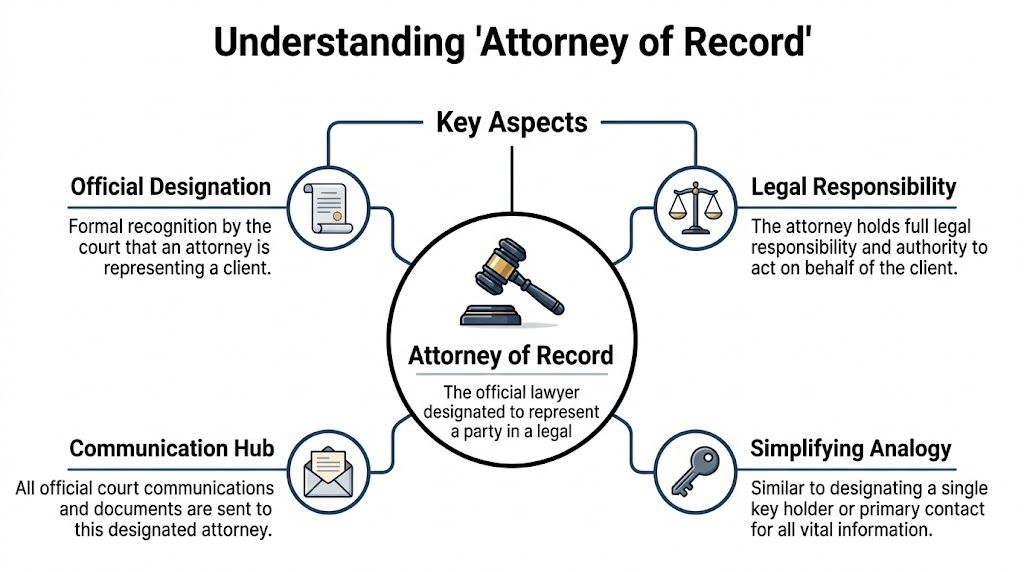
An attorney of record is the lawyer the court officially recognizes as representing you in the case. Not your advisor. Not a lawyer you talked to. Not a lawyer whose number you saved. The court-recognized lawyer.
This functions similarly to naming one official spokesperson in a crisis. Once that happens, the judge, clerk, and prosecutor know exactly who speaks for you in the legal file.
The practical definition that matters
In criminal cases, the attorney of record is the sole lawyer formally recognized by the court. That designation requires prosecutors to stop communicating directly with the represented client and route communication through counsel. The verified data also states that this step reduces defendant coercion risks by 70-80% and correlates with 25-40% higher dismissal rates in misdemeanor cases due to enhanced procedural oversight, as summarized in the provided attorney of record reference.
Those numbers matter because they describe something clients feel immediately. The case gets less chaotic once the communication channel is formalized.
What changes the moment the lawyer is officially in
Once the attorney of record is in place, several things change at once.
- The prosecutor deals with counsel: that lowers the chance that a frightened defendant says something damaging in a hallway call or informal conversation.
- Service of documents becomes organized: notices, filings, and updates go where they're supposed to go.
- The defense can act through the file: your lawyer can respond in a formal, recognized way rather than trying to manage the case from the outside.
For a DUI defendant in Cumming, that may mean immediate control over court communication while the lawyer reviews the stop, testing process, and officer observations. For someone facing a speeding ticket, reckless driving charge, or suspended license issue in Alpharetta or Johns Creek, it means the case stops being a DIY problem.
What this designation does not mean
It does not mean the lawyer can erase the charge by filing one form.
It does not mean you can ignore your lawyer, skip court, or stop helping prepare the defense. And it does not mean every case should be handled the same way. A traffic ticket attorney handling a local citation may use the designation mainly to control notices and negotiate resolution. A felony defense lawyer in Superior Court may use it to start motion practice, protect discovery rights, and shut down damaging direct contact.
If your lawyer isn't formally on the case, don't assume the court sees you as represented.
Why clients in crisis should care
The phrase sounds procedural. The impact is personal.
When someone is scared about jail, immigration consequences, professional licensing, school discipline, or losing the ability to drive to work, the first legal protection is often not a courtroom speech. It's making sure one lawyer stands between the client and the system in an official capacity.
That is why experienced criminal defense lawyers treat the attorney of record filing as a serious move, not a clerical detail.
The Powers and Responsibilities of Your Official Counsel
Once a lawyer becomes your attorney of record, the job is active, not symbolic. This role carries responsibility for the file, the deadlines, the court appearances, and the decisions that shape the defense.
A lot of clients think hiring a DUI attorney or criminal lawyer means "someone I can call if something happens." Formal representation is different. It means the lawyer is now accountable for managing the case in court.
What your attorney is expected to do
An attorney of record typically handles the practical work that keeps a case from drifting off course:
- Receive official notices: arraignments, motions hearings, trial settings, and other court communications.
- File documents that matter: entries of appearance, motions, responses, waivers, and other pleadings tied to the defense.
- Stand up in court on your behalf: for many hearings, the court expects the officially recognized lawyer to appear and speak.
- Manage negotiations: plea discussions, discovery issues, and procedural disputes should move through counsel.
- Protect the record: objections, legal arguments, and procedural positions usually need to be made correctly and on time.
This is why clients with pending DUI charges, reckless driving accusations, or drug cases shouldn't rely on vague assurances that "a lawyer is looking at it."
Advice is not the same as representation
A consultation is not an appearance. Paying for strategy advice is not the same as filing into the case. Even strong legal advice has limits if the lawyer hasn't taken the formal step that puts their name on the docket.
That distinction matters in busy North Georgia courts, where clerks, judges, and prosecutors move by file status. If the file doesn't show your lawyer as counsel, the system may still treat you as the person responsible for direct receipt and response.
A lawyer can't protect deadlines the court never sends to them.
Why office systems matter too
Clients often judge a defense lawyer by courtroom skill alone. That's important, but case management matters too. Criminal defense work involves documents, dates, reminders, discovery tracking, and client communication. Law firms that use structured internal systems are usually better positioned to avoid preventable mistakes.
For readers curious how firms organize intake, follow-up, and case communication behind the scenes, this overview of CRM software for law firms gives a useful non-courtroom look at the operational side of legal practice. Good systems don't replace judgment. They support it.
What clients should expect from official counsel
If your lawyer is attorney of record, you should expect clarity on a few basics:
- What court are we in
- What are the next deadlines
- Who is handling communication
- What should I do, and what should I avoid saying or doing
- Do I need to appear personally at the next setting
Those questions sound simple. In criminal cases, simple questions often keep people out of bigger trouble.
How This Process Works in North Georgia Courts
Local practice matters. The way an attorney of record enters a DUI case in Forsyth County can feel different from how a traffic ticket attorney handles a municipal matter tied to Alpharetta or Roswell. The basic concept is the same, but the pace, paperwork, and court culture can vary.
In Georgia, the attorney of record must file a formal notice of appearance under Uniform Superior Court Rule 4.1. The verified data also states this is especially important in DUI cases in courts like Cobb and Forsyth County, where up to 15% of DUI dismissals can be tied to representation lapses, making timely filing a serious issue for the defense, according to the provided Georgia appearance reference.

DUI and serious traffic cases
If you're charged with DUI in Cumming, Roswell, Sandy Springs, Marietta, or Alpharetta, your case may involve multiple moving parts. There may be a criminal court date, a license issue, and immediate concerns about driving privileges, bond conditions, or alcohol testing requirements.
A lawyer stepping in as attorney of record in that setting usually needs to do more than file paper. The lawyer needs to identify the right court, confirm the pending settings, verify what has already been filed, and make sure nobody assumes the client is still handling communication alone.
In a reckless driving or speeding ticket case, the same formal entry can still matter. People underestimate "minor" traffic charges until they see how quickly license concerns, missed dates, or bad pleas can snowball.
County-by-county reality
North Georgia clients often search for a DUI lawyer near me or how to fight a traffic ticket because their case feels local. That's correct. It is local.
- Forsyth County: DUI and misdemeanor calendars can move quickly, and clients often need immediate direction on appearance requirements.
- Fulton County: a larger system can create confusion about which court division is handling the matter and what filing has already been received.
- Cobb County: traffic-related offenses and DUI cases can require careful attention to court scheduling and representation status.
- Gwinnett and Cherokee Counties: local practice, clerk procedures, and courtroom expectations still shape how smoothly the case starts.
A lawyer who regularly handles North Atlanta criminal defense usually knows the difference between a problem that needs a motion, a problem that needs a phone call to the clerk, and a problem that needs the client in court immediately.
Where people lose ground
The biggest early problems usually aren't dramatic legal issues. They're administrative mistakes with legal consequences.
Common examples include:
- No appearance on file: the client assumes the lawyer "has it handled," but the docket doesn't reflect representation.
- Mixed communication: the client, family member, and lawyer all contact the court or prosecutor separately.
- Late transfer of counsel: one lawyer is leaving the case while the new lawyer hasn't formally entered yet.
- Unclear court assignment: the client shows up in the wrong courtroom, wrong building, or wrong county calendar.
In local criminal practice, paperwork mistakes can become leverage for the other side.
What a local attorney watches for
In North Georgia courts, experienced counsel usually checks a few things immediately:
| Issue | Why it matters |
|---|---|
| Correct case number | A filing tied to the wrong case may not protect you |
| Court type | Municipal, State, Superior, and Recorder's Court matters don't operate identically |
| Upcoming hearing date | Missed settings create damage fast |
| Bond conditions | Travel, testing, or no-contact rules may already be in effect |
| License-related deadlines | DUI and serious traffic matters often affect more than the criminal file |
At this point, the title attorney of record stops sounding abstract. In practice, it means someone is now responsible for getting these details right.
The Steps to File or Change Your Attorney of Record
The filing process is usually straightforward when handled promptly. The anxiety comes from not knowing what the paperwork means or who is supposed to do what.
The first scenario is simple. You hire a criminal defense lawyer, DUI attorney, or traffic ticket lawyer, and that lawyer files the notice that tells the court, "I represent this person." The second scenario is more delicate. You already have counsel, but you need to change lawyers without leaving a gap in representation.

Filing the first appearance
When a lawyer is first entering the case, the process usually includes these steps:
Confirm the exact charge and court
A lawyer needs the citation, accusation, warrant, bond paperwork, or court notice. Small details matter. A wrong case number or wrong court slows everything down.Prepare the appearance document
The filing is often called a Notice of Appearance or Entry of Appearance. The form tells the court and prosecutor that counsel now represents the defendant.File it with the correct court
The document has to reach the right clerk, under the right case, in the right format for that court.Serve the prosecutor if required
That gives the state formal notice that communication should now go through counsel.
Practical rule: Don't assume a retainer agreement by itself puts the lawyer on the case. The court has to receive the filing.
Changing lawyers without creating a gap
Switching attorneys can be necessary. Sometimes communication breaks down. Sometimes the case changes and the client wants a different approach. Sometimes a lawyer withdraws because of a conflict or nonpayment.
A clean transition usually involves:
- A withdrawal or consent to withdraw: the current lawyer asks the court for permission to step out, when required.
- A substitution or new appearance: the incoming lawyer enters the case so there isn't a period where nobody is formally responsible.
- Court approval when needed: some judges want the transition documented before the old lawyer is released.
If cost is part of the issue, some defendants also need to understand whether they may qualify for appointed counsel or need to complete an affidavit of indigency before the court considers that request.
What the filing often looks like
The language is usually plain and formulaic:
COMES NOW undersigned counsel and files this Notice of Appearance on behalf of the Defendant in the above-styled action, and requests that all future notices, pleadings, and communications be served upon counsel of record.
That kind of filing isn't dramatic. It's effective because it removes confusion.
What clients should do before signing anything
Before a lawyer files in, ask:
- Will you file the appearance immediately
- Who will receive court notices
- Do I still need to appear at the next date
- If I want to change counsel later, how is that handled
Those questions can prevent a lot of damage in DUI cases, license suspension matters, misdemeanor defense, and felony defense alike.
Your Rights and the Dangers of Not Having an Attorney of Record
The risk isn't only being unrepresented. The risk is thinking you're protected when you aren't officially protected yet.
A person can have a family friend "helping." They can have a lawyer who gave advice after arrest. They can even believe a firm is handling the case because someone answered the phone and discussed strategy. None of that substitutes for formal entry into the file.
Your case with formal counsel versus on your own
| Situation | With an Attorney of Record | Without an Attorney of Record (Pro Se) |
|---|---|---|
| Court communication | Official notices are directed to counsel handling the file | You may be expected to track and respond personally |
| Prosecutor contact | Communication should go through your lawyer | You may face direct pressure, questions, or plea discussions alone |
| Deadlines | A lawyer monitors filings, settings, and responses | Missed dates and missed filings become more likely |
| Legal filings | Motions and appearances can be made in proper form | You may not know what to file or when |
| Case strategy | Decisions can be tied to evidence, procedure, and local practice | Many defendants react issue by issue instead of following a plan |
| Courtroom advocacy | Someone recognized by the court speaks for you | You must answer for yourself unless and until counsel enters |
The rights people accidentally weaken
Defendants hurt their own cases in predictable ways when no attorney of record is in place.
- They talk too much: to police, prosecutors, probation officers, court staff, or even opposing witnesses.
- They miss small deadlines: and small deadlines can carry big consequences.
- They accept bad resolutions: because the offer sounds like a quick exit.
- They misunderstand the charge: especially in DUI, reckless driving, drug possession, or family violence situations where collateral consequences can be severe.
If the court still sees you as pro se, you carry the burden of managing a system you likely don't use every day.
What doesn't work
Three approaches fail often.
First, waiting for the first court date and hoping things become clearer. They usually become more complicated.
Second, assuming a ticket or misdemeanor isn't serious enough to require immediate formal representation. That's how avoidable consequences attach to otherwise manageable cases.
Third, trying to split responsibility between yourself and a lawyer. Criminal cases need one clear channel. Mixed control causes confusion, inconsistent messaging, and preventable mistakes.
What works better
The safer approach is simple. Choose counsel promptly. Make sure the lawyer files in. Confirm the filing reached the court. Then stop freelance lawyering your own case.
That applies whether you need a DUI lawyer in Cumming, a traffic ticket attorney in Alpharetta, a reckless driving lawyer in Roswell, or a felony defense lawyer in Marietta.
Choosing the Right Defense Attorney in Alpharetta or Cumming
Choosing an attorney of record is not the same as choosing the first lawyer who answers the phone. The role is too important for that.
With more than 1.37 million lawyers actively practicing in the United States as of 2025, and a significant increase since 2020, the market is crowded. That makes specialized, local experience a critical filter, according to the verified lawyer statistics published by Clio.

What to look for first
If you're hiring a DUI lawyer, drug possession lawyer, misdemeanor defense attorney, or speeding ticket lawyer in North Atlanta, focus on fit, not slogans.
Look for:
- Local court familiarity: experience in Alpharetta, Cumming, Roswell, Marietta, Johns Creek, Milton, and surrounding county courts.
- Relevant charge experience: DUI cases raise different issues than theft, drug, or license suspension matters.
- Former prosecutor insight: some lawyers understand charging decisions and plea structures from both sides.
- Responsiveness: if your case is urgent, delays in communication are a bad sign.
The trade-offs clients should weigh
A very large firm may have broader staffing, but your file may move through multiple hands. A solo practitioner may offer direct contact, but availability can become a concern if calendars get crowded. A lawyer who handles "a little bit of everything" may not be the strongest choice for a high-stakes DUI or criminal case in a local court that moves fast.
That doesn't mean one type of practice is always better. It means you should ask practical questions, not just fee questions.
Ask who will appear in court. Ask who files the entry of appearance. Ask how quickly the lawyer can step in if your arraignment is close. Ask whether the lawyer regularly handles your type of case in your court.
A useful way to vet a firm
Even outside criminal law, strong firms usually think carefully about visibility, trust, and client communication. This article on Winning Law Firm Marketing Strategies for Sustainable Growth is aimed at law firms, but it also helps clients see how serious firms present expertise and stay accountable in a competitive market.
If you're comparing options, this guide on how to find a criminal lawyer gives a practical framework for the search.
The right attorney of record is not just licensed. The right attorney is ready to take control of the case immediately and in the right court.
Frequently Asked Questions About Your Legal Representation
How fast can a lawyer become my attorney of record
Often very quickly, if you act fast and provide the paperwork the lawyer needs. In urgent cases, the critical issue is getting the right court information, charge details, and hearing date immediately so the filing can be prepared and sent without delay.
Can I talk to the prosecutor myself if I already hired a lawyer
You shouldn't unless your lawyer specifically tells you to do so. Once representation is formalized, communication should run through counsel. Direct conversations can create problems even when you're trying to help yourself.
Do I still have to go to court if I have an attorney of record
Sometimes yes. Sometimes no. It depends on the charge, the court, and the type of hearing. A lawyer should tell you clearly whether your appearance is required. Never assume you can skip a date because you hired counsel.
What if I want to change lawyers before trial
You can often change lawyers, but it needs to be done carefully so there isn't a gap in representation. The outgoing lawyer may need to withdraw, and the new lawyer should enter the case promptly.
Is an attorney of record important for a traffic ticket too
Yes, especially if the ticket involves reckless driving, a serious speeding allegation, license consequences, a commercial driver's license, or a court that expects formal handling. Some traffic cases look small until they threaten your record or your ability to drive.
What should I bring to the first meeting with a defense lawyer
Bring every document you have. That includes tickets, bond papers, court notices, jail release paperwork, license paperwork, and any messages or emails related to the case. If you have nothing but the court date and charge, bring that and don't wait.
If you're facing a DUI, traffic charge, drug case, misdemeanor, or felony in Alpharetta, Cumming, Roswell, Marietta, Johns Creek, Milton, or the surrounding North Atlanta area, Brian Hansford Law can help you act quickly and protect your position early. Brian Hansford brings over 25 years of legal experience, including work as a former prosecutor, and the firm focuses on practical criminal defense that starts with getting control of the case immediately. If you need clear answers, fast action, and experienced court representation, reach out for a consultation now.
