
When you hear "auto dealer fraud," you might picture one specific scam. In reality, it’s a broad term covering a whole range of deceptive practices that can pop up when a vehicle is being bought or sold. This refers to any intentional misrepresentation—whether it’s about the car's history, its financing details, or even the buyer's own identity. These issues can affect both consumers and dealerships.
The Growing Problem of Auto Dealer Fraud in Georgia
Buying and selling cars involves big money and even bigger stacks of paperwork. This complexity creates fertile ground not just for honest mistakes, but for outright deception. An accusation of auto dealer fraud is a serious matter, and these allegations are surfacing all across Georgia, from Alpharetta to Marietta.
Think about it from two sides. Imagine a buyer in Cumming who suspects the odometer on their "new" car was rolled back by thousands of miles. On the other hand, picture a dealership in Forsyth County realizing that a buyer used a fake ID and phony pay stubs to drive off the lot with a high-end SUV. Both of these scenarios fall squarely under the auto dealer fraud umbrella, and frankly, we're seeing more and more of them.
A National Issue with Local Impact
This isn't just a Georgia problem; it's a nationwide trend with very real financial fallout. Recent data paints a pretty stark picture. In 2025, auto loan fraud in the U.S. hit all-time highs, with Americans on track to file nearly 90,000 complaints with the Federal Trade Commission (FTC). Digging deeper, auto lenders faced an eye-watering $9.2 billion in fraud risk in 2024 alone, a 16% jump from the year before. You can read more about this spike in auto loan fraud complaints and its staggering impact.
This surge puts everyone on edge. Dealerships in communities like Johns Creek, Milton, and Roswell are under intense pressure to catch fraud before it happens, while buyers are more skeptical than ever.
The heart of any auto dealer fraud allegation is intent. The key question is whether one party knowingly misled the other to gain a financial advantage. This is what separates fraud from a simple mistake or a misunderstanding during the sales process.
Because the stakes are so high, it's helpful to understand what these accusations actually mean. The term covers a wide array of activities—some targeting unsuspecting buyers, and others aimed at the dealerships themselves.
Common Types of Auto Dealer Fraud at a Glance
To give you a clearer idea of what we're dealing with, here's a quick rundown of the common schemes that lead to auto dealer fraud allegations. These situations can be complex, but they usually fall into a few key categories.
| Type of Fraud | What It Looks Like |
|---|---|
| Misrepresentation of Condition | Hiding major accident damage, not disclosing a salvage title, or rolling back the odometer. |
| Financing & Pricing Deception | Burying hidden fees, lying about interest rates, or "yo-yo" financing scams. |
| Identity & Document Fraud | Using a stolen or synthetic identity or forged documents to get a car loan. |
Whether you're a buyer in East Cobb worried about a recent purchase or a dealership employee in Cobb County facing a serious accusation, grasping these fundamental concepts is an important step. This guide will walk you through the different sides of auto dealer fraud in Georgia, giving you clear, straightforward information.
Common Schemes Classified as Auto Dealer Fraud

When we talk about auto dealer fraud, it’s not just one specific act. The term actually covers a whole spectrum of deceptive practices that can happen anytime during a car deal. It’s a collection of scams, and knowing what they look like is useful for anyone buying or selling a vehicle.
This isn't just about a pushy salesperson. At its core, this type of fraud involves a "material misrepresentation"—which is a way of saying someone may have made a false statement about a key fact that convinced another party to make a decision. Let’s break down some of the most common schemes.
Misrepresenting a Vehicle's History and Condition
One of the oldest tricks in the book is hiding a car's real past. The entire goal is to make a used vehicle seem far more valuable or reliable than it truly is.
For example, a seller might get a car with 150,000 miles on it. Using special software, they can illegally roll back the odometer to show only 50,000 miles, instantly erasing 100,000 miles of wear and tear on the engine, transmission, and everything else. That’s classic odometer fraud, a direct misrepresentation about a crucial fact.
Another frequent scheme is title washing. This is where a vehicle with a "branded" title—like "salvage" from flood damage or "rebuilt" after a major collision—is moved to a state with lax title laws. The paperwork is processed there to "wash" the brand off, letting the car be sold with a clean title to an unsuspecting buyer in places like Alpharetta or Roswell.
The real problem in these situations is the deliberate concealment of critical information. A buyer is led to believe they're getting a well-maintained, low-mileage car, but what they actually get is a vehicle with a hidden, and often dangerous, history.
Deceptive Financing and Pricing Tactics
The alleged fraud isn’t always about the car itself; sometimes it's buried deep in the financing paperwork. These schemes are designed to get more money out of a buyer than they may have agreed to pay.
A particularly notable tactic is called "yo-yo" financing. Here’s the setup: you agree on a price and interest rate, sign all the papers, and drive off the lot in your new car. A few days or a week later, the dealership calls to say your financing "fell through." They demand you come back immediately to sign a new contract, usually with a much higher interest rate or a bigger down payment.
Other questionable pricing tactics include:
- Hidden Fees: Slipping charges for unwanted add-ons, like pricey extended warranties or VIN etching, into the contract without the buyer’s clear consent.
- Bait and Switch: Advertising a car at a fantastic, too-good-to-be-true price to get customers in the door. Once you’re there, you’re told that specific car is "already sold" before they pressure you into buying a more expensive model.
- Trade-In Undervaluing: Purposely giving you a lowball offer for your trade-in vehicle, far below its true market value.
Loan Application and Document Fraud
It's important to know that fraud can go both ways. Sometimes, it’s the buyer who is accused of committing fraud against the dealership. For instance, a person might falsify a loan application with an inflated income or fake job history just to qualify for a loan they couldn't get otherwise. This can also involve creating forged documents like phony pay stubs or bank statements. For more details on this, our guide on penalties for fraudulent checks touches on similar document forgery issues.
When this happens, a dealership in Forsyth County or East Cobb is exposed to a huge financial risk if the buyer defaults on the loan.
In the end, all these schemes boil down to one thing: deception for financial gain. Whether it's a seller hiding a car’s wrecked past or a buyer faking their income, the intent to mislead is what defines auto dealer fraud.
It's easy to think of auto dealer fraud as something that only happens to car buyers, but it’s very much a two-way street. Dealerships themselves are increasingly becoming the targets of some pretty sophisticated scams. This puts them in a tough spot, where the intense pressure to catch a fraudster can sometimes mean innocent employees or even legitimate customers get put under a microscope.
The truth is, car dealerships in places like Alpharetta, Cumming, and Johns Creek aren't just in the business of selling cars. They're also forced to be a frontline defense against serious financial crime. It creates a high-stakes environment where one missed detail can cost the business tens of thousands of dollars.
The Challenge of Forged Documents
One of the most common threats dealerships run into is the use of high-quality forged documents. Technology has made it simpler than ever for criminals to create incredibly realistic-looking pay stubs, utility bills, and even bank statements. These fakes are designed for one purpose: to paint a false picture of a buyer's financial stability.
Imagine a salesperson in Roswell looking at a full folder of paperwork. The pay stubs look right, the bank statement shows plenty of money, and the ID seems legit. In the fast-paced world of car sales, trying to spot a well-made forgery is incredibly difficult, and it puts dealership staff in a difficult position.
This isn't just a "what if" scenario; it's a growing crisis. A recent Experian Automotive survey found that nearly 90% of dealers are deeply worried about fraud, and 70% feel that fraudulent activities are on the rise. You can learn more about the financial impact of this trend and how dealerships are trying to fight back.
Synthetic Identity Fraud: The Phantom Buyer
Going beyond just faking papers for a real person, an even more complex scheme called synthetic identity fraud has popped up. This is a much more elaborate deception where criminals don’t just steal an identity—they build a brand new, completely fake one from the ground up.
Here’s a breakdown of how it works:
- Creation: A fraudster takes real information (like a stolen Social Security number, often from a child or someone who has passed away) and mixes it with fabricated details like a fake name, address, and date of birth.
- Cultivation: They use this new "synthetic" identity to get small lines of credit, which they pay off faithfully to build a good credit history over time.
- Execution: After months or even years of building up this fake person's credit score, they walk into a dealership, apply for a big auto loan, and drive off with an expensive vehicle.
Of course, the car and the "buyer" are never seen again. The dealership gets stuck with a loan that will never be paid, a vehicle that's gone, and a trail that leads to a person who doesn't even exist. This type of auto dealer fraud is especially hard to catch before it's too late.
When a bad deal like this slips through, the financial damage is huge. The same Experian study showed that dealers reported an average of four fraudulent deals getting past them in the last year, with 45% estimating their loss per incident was between $10,000 and $20,000.
Straw Purchases and Other Scams
Another fraud that hits dealerships hard is the straw purchase. This is when someone with good credit buys a vehicle for someone else with poor credit who couldn't get a loan on their own. While it might not seem like a big deal, it's often a form of bank fraud because the lender is being intentionally tricked about who the real driver—and responsible party—will be.
For a dealership in Marietta or anywhere in Cobb County, these situations are a legal minefield. They're caught between trying to help customers and their duty to the lenders to vet buyers correctly. The constant threat of these varied and evolving schemes is exactly why dealerships are on such high alert, putting stricter verification processes in place that can affect every single transaction.
When you're accused of auto dealer fraud, the situation can spiral in two very different directions. It's not just one legal battle; it can be two, happening at the same time, each with its own rulebook and end game. You have the criminal justice system on one side and the civil court system on the other. Understanding how they differ is a key part of comprehending the situation.
Think of a criminal case as the State of Georgia versus an individual or a dealership. Here, the government—represented by a prosecutor—is stepping in. Their goal is to enforce the law and punish what they see as a crime against the public. A civil case, on the other hand, is a private fight—a car buyer suing a dealership, for instance. The goal isn't jail time; it's money.
The Criminal Prosecution Path
When a prosecutor files criminal charges, the stakes are incredibly high. A person's freedom could be on the line. To get a conviction, the prosecutor must prove the accused is guilty "beyond a reasonable doubt." This is the highest standard of proof in the justice system. It means the evidence has to be so overwhelming that there’s no other logical explanation for what happened.
In Georgia, auto dealer fraud cases often involve charges like:
- Theft by Deception: This is when someone is accused of getting property (like cash or a vehicle) by intentionally misleading someone about a key fact.
- Forgery: This could mean anything from creating a fake bill of sale to altering a car's title or using a phony pay stub to secure a loan.
- Identity Fraud: Using someone else’s personal information without their permission to get a car loan or title is a classic example of this.
A criminal conviction can carry life-altering consequences, including potential jail or prison sentences, crippling fines, and a criminal record. The system’s focus here is on punishment, not on making the alleged victim whole again.
The Civil Lawsuit Path
A civil lawsuit is an entirely different beast. Here, the person who feels wronged (the plaintiff) sues the person or business they blame (the defendant). The objective is purely financial—to recover money for their perceived losses.
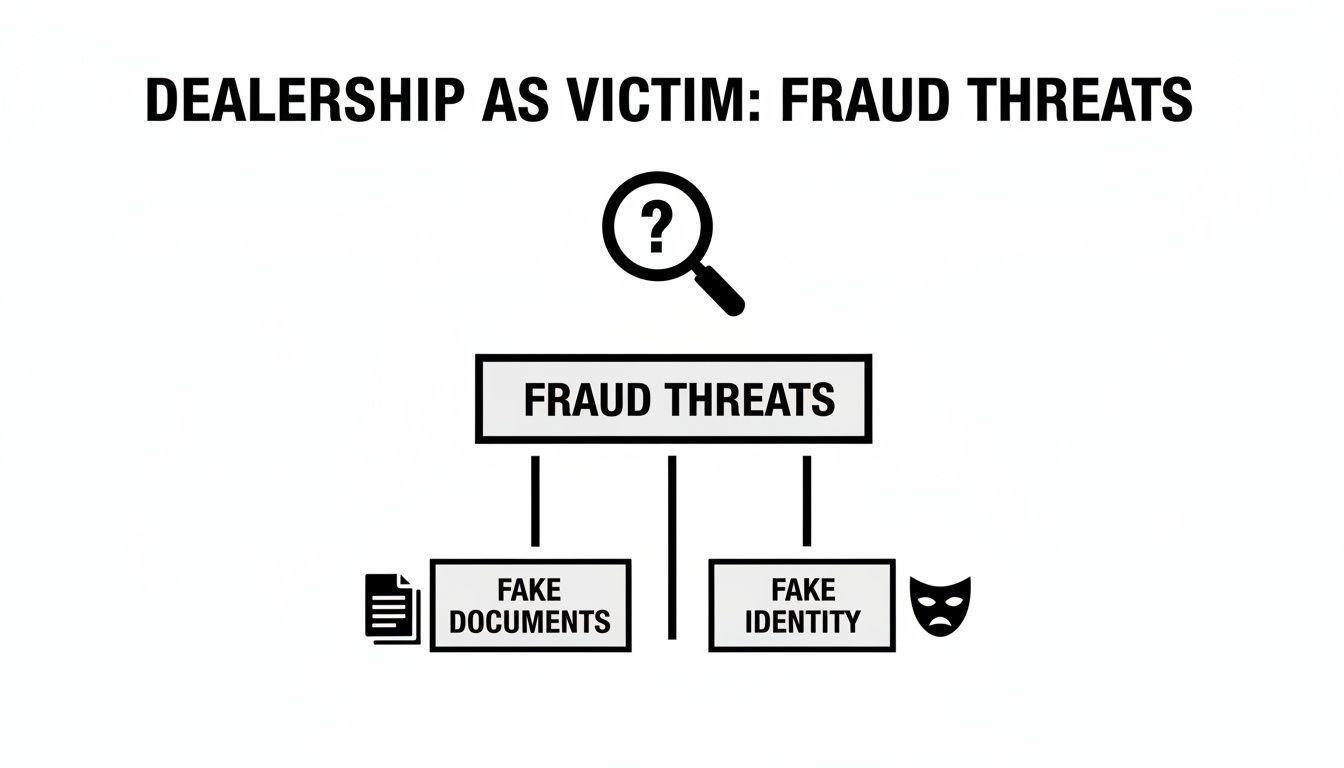
As this graphic shows, many of these disputes start with claims about fake documents or false identities. In a civil court, the standard of proof is much lower. The plaintiff only needs to prove their case by a "preponderance of the evidence."
This standard just means "more likely than not." Picture a scale with each side's evidence stacked on it. Whichever side tips the scale, even slightly, wins.
If the plaintiff wins, the court can order the defendant to pay damages. This could be the cost of car repairs, the difference in the vehicle's true value, or even a complete refund of the purchase price. To get a better sense of how these cases play out, you can learn more about Georgia's auto fraud law and its specific provisions.
It’s completely possible for one action to trigger both cases. For example, if a dealership is accused of rolling back an odometer, the State could bring criminal charges for Theft by Deception. At the exact same time, the buyer could file a civil lawsuit to get their money back. Navigating both of these arenas is a complex process.
What To Do If You're Accused of Auto Dealer Fraud

It’s an incredibly stressful moment. Whether you’re a dealership employee in Marietta or a private seller in Alpharetta, learning that you are under investigation for auto dealer fraud can turn your world upside down. Knowing what initial steps can be taken is helpful for preparing for what's ahead.
When investigators first reach out, they have one goal: to gather information. It’s a common mistake to think that just explaining your side of the story will make the problem disappear. In reality, statements made can be used in the investigation. The right to remain silent is a very important protection.
Immediate Steps to Take
As soon as you find out you're being investigated, the focus often shifts to preserving evidence and preparing for the next steps. The first few hours and days are critical.
Here are a few initial actions to consider:
- Gather Every Document: Collect every single piece of paper and digital file related to the vehicle sale. This means sales contracts, loan applications, wholesale records, emails, text messages, and even internal dealership notes.
- Create a Detailed Timeline: Write down everything that happened, in order, from your point of view. Note who you talked to, what was said, and when important decisions were made. Memories can fade quickly, making a written record very valuable.
- Don't Discuss the Case: It may be best to avoid talking about the allegation with anyone—not colleagues, not friends, and certainly not the other people involved in the transaction. Casual conversations are easily twisted or misremembered.
This systematic approach can help ensure that all the facts are secured and ready for an attorney to review. It gives you a solid foundation to work from.
How a Defense Attorney Can Help
From the moment an investigation starts, a criminal defense attorney can act as a crucial buffer between you and law enforcement. Instead of an individual speaking directly to investigators, all communication can go through their lawyer. This shield helps ensure constitutional rights are respected every step of the way.
An experienced defense attorney does more than just speak for you. They can launch their own independent investigation, digging into the facts from a legal perspective that investigators may not have.
This involves a deep dive into the documents that have been collected to pinpoint potential weaknesses in the accusation. For example, in most auto dealer fraud cases, the prosecutor must prove the accused acted with intent to deceive. An attorney will analyze the evidence to determine if the issue was really just an honest mistake, a simple misunderstanding, or bad information that came from someone else.
For anyone facing these accusations in communities like Roswell, Johns Creek, or anywhere in Cobb and Forsyth Counties, understanding these initial steps is key. It helps demystify a confusing process and allows a person to move forward with preparation, not panic. A structured, immediate response is the first step toward navigating the complexities of an auto dealer fraud investigation.
When you're facing something as serious as an auto dealer fraud accusation, the experience of the person standing beside you in court matters immensely. A knowledgeable criminal defense attorney can make a big difference—not just in the outcome, but in how you navigate the entire stressful process. It’s not just about understanding the law; it's about understanding how the other side thinks and builds its case against you.
This is where a background as a former prosecutor can be invaluable. An attorney who has spent time on the prosecution side has a unique insight into how the state puts its cases together. They know the exact evidence prosecutors look for, the arguments they favor, and the weak points they might try to exploit in a defense.
Why a Prosecutor’s Experience Matters
Choosing an attorney with this dual perspective can provide a distinct advantage. Brian Hansford has over 25 years of experience in the criminal justice system, and that includes critical time spent as a prosecutor. This background provides a deep, firsthand understanding of how allegations of theft and white-collar crimes—charges directly related to auto dealer fraud—are built and pursued.
This experience allows for a proactive, not reactive, approach. It means a defense can be designed to challenge the prosecution's case head-on. It’s about more than just responding to accusations; it’s about dissecting them piece by piece before they ever get to a jury. For more on this, check out our article on how to find a good criminal lawyer to learn what really counts.
A Personalized and Meticulous Approach
Every auto dealer fraud case is different. A successful defense depends entirely on a personalized and meticulous review of every single document and detail. There's no one-size-fits-all strategy; the goal is to protect a person's rights at every turn.
This includes:
- Scrutinizing the Evidence: We carefully examine every piece of paperwork, from the sales contract and financing agreements to internal communications, searching for inconsistencies or errors in the prosecution's narrative.
- Challenging Intent: We focus on the critical element of intent. Many fraud cases hinge on whether an action was a deliberate attempt to deceive or simply an honest mistake. Proving a lack of criminal intent can dismantle the state’s entire case.
- Local Knowledge: We bring a firm grasp of the local court systems in Alpharetta, Cumming, and across Cobb and Forsyth Counties. Knowing the judges, prosecutors, and local procedures can be a home-field advantage.
At Brian Hansford Law, we are committed to this level of detailed preparation. We believe that protecting your future requires a defense that is as thorough and determined as the prosecution you are up against.
If you are in Johns Creek, Milton, Roswell, or Marietta and find yourself under investigation, you don’t have to go through it alone. Contact Brian Hansford Law today for a consultation. Let's discuss your situation and show you how our experience can help protect your rights and your livelihood.
Frequently Asked Questions About Auto Dealer Fraud
When you’re dealing with a vehicle transaction, a lot of questions can pop up, especially once the words auto dealer fraud are on the table. Here are some plain-English answers to the most common questions we get from clients. Think of this as a practical guide to build on what we’ve already covered.
Can I Face Charges If I Did Not Know Information Was False?
This is a critical question. In most Georgia fraud cases, the prosecution has to prove a person acted with intent—in other words, that they knowingly and willfully set out to deceive someone.
A lack of intent can be a powerful defense. For instance, if you passed along documents a third party gave you and you had every reason to believe they were genuine, that context matters. An honest mistake is not a crime.
Think about it: a simple error on a mountain of paperwork because of a misunderstanding is worlds apart from a calculated lie. Criminal fraud charges are meant for deliberate deception for financial gain, not for oversights or good-faith mistakes. The core of any defense in these cases is examining what a person actually knew and when they knew it.
What Is the Difference Between Sales Talk and Illegal Fraud?
There’s a clear line between "puffing" and illegal fraud, and Georgia law recognizes this distinction. Puffing is just exaggerated, subjective sales talk that a reasonable person wouldn't take as a guaranteed fact.
You know the phrases: calling a used car a "fantastic deal" or claiming it "runs like a dream." These are just opinions.
Fraud, on the other hand, is about lying about a material fact. A material fact is a specific piece of information so important that it directly influences whether someone buys the car.
Here’s where it gets serious:
- Stating a car has 40,000 miles when you know for a fact the odometer was rolled back from 140,000.
- Claiming a vehicle has a clean title when you're hiding the fact it was declared a total loss in a flood.
- Asserting the vehicle was never in an accident when you have a report showing it had major collision damage.
These aren't opinions—they're factual statements meant to mislead a buyer. That’s the kind of thing that Georgia's fraud laws are designed to address.
What Happens If a Car Dealership Accuses Me of Using a Fake Pay Stub?
If a dealership suspects you used a fake pay stub or other fraudulent documents, their first move will probably be to cancel the sale and demand you bring the car back immediately.
But it rarely stops there. They also have the right to file a police report with local law enforcement.
If a report is filed, an official investigation can begin. This could lead to serious felony charges like Forgery or Theft by Deception. The level of response often comes down to the vehicle's value and how strong the dealership’s evidence of intentional fraud is.
During an investigation, detectives will likely try to verify your employment and income with the company on the pay stub. They will also want to speak with you to get your side of the story—which is a conversation a person should consider having with an attorney present. The process starts with fact-finding before any charges are ever formally filed.
Can a Dealership Employee Be Held Responsible for the Company's Actions?
Yes. An individual employee can be charged if there's evidence they personally and knowingly took part in a fraudulent act, even if it was done to benefit the dealership. The key factors are always personal involvement and the intent to deceive.
For example, if a salesperson lies about a car's accident history just to lock down a commission, they can be held individually accountable for that specific statement. Simply working at a dealership where fraud happened doesn't automatically mean every staff member is in trouble. An investigation will zero in on who knew what, who made the false statements, and who profited from the deception.
If you or someone you care about is under investigation for auto dealer fraud in Alpharetta, Cumming, or anywhere in the surrounding North Georgia communities, you need to understand exactly what you're up against. Brian Hansford Law brings over 25 years of experience to the table, including critical time spent as a prosecutor. That background gives us a unique perspective on how these cases are built and, more importantly, how they can be challenged.
Don't wait. Contact us for a consultation at https://challengemycharge.com.
