
When you hear the term "auto fraud," you might picture a simple bad deal or a dispute over a used car sale. But in the context of the law, it's something far more serious. Auto fraud involves intentional deception related to a vehicle's sale, financing, or title—and it can lead to severe criminal consequences. This guide is here to cut through the confusion, explaining the most common schemes and how Georgia law treats these offenses.
Understanding Auto Fraud Law
The heart of any auto fraud case is criminal intent. There’s a world of difference between an honest mistake on paperwork and deliberately falsifying information to make a quick buck. Think about it: accidentally writing down the wrong mileage is one thing. Knowingly rolling back an odometer to trick a buyer into paying more? That's a crime.
This distinction is what separates a civil disagreement from a serious criminal charge. When law enforcement investigates auto fraud, they aren't just looking for errors; they're searching for a deliberate plan to mislead. This could be anything from hiding a car's salvaged past to lying on a loan application. The stakes are high, with penalties that go well beyond fines to include possible jail time and a felony record that can follow someone for life.
The Scope of Deception in Vehicle Transactions
Auto fraud isn't limited to a specific type of transaction. It can happen at a high-end dealership, a private sale, or during the financing process. It’s a broad term that covers a whole range of deceptive practices. Understanding the different schemes gives a clearer picture of what a prosecutor might build a case around.
Some of the most common scenarios that trigger auto fraud charges include:
- Odometer Fraud: Illegally altering a vehicle’s mileage to inflate its value.
- Title Washing: A complex process where a vehicle's title is moved through different states to scrub its history, like a salvage or flood-damage brand.
- VIN Cloning: A sophisticated scheme where the Vehicle Identification Number (VIN) from a legally registered car is put on a stolen one to conceal its true identity.
- Financing Fraud: Intentionally providing false information on a loan application, such as inflating income or using a synthetic identity.
The central question in any auto fraud case is always intent. For a conviction, the prosecution must prove beyond a reasonable doubt that the accused person knowingly and willfully engaged in a deceptive act for financial gain. Without solid proof of this deliberate intent, the case can fall apart.
Local Impact in North Georgia Communities
These aren't abstract legal issues; they are real problems affecting people right here in communities like Alpharetta, Cumming, and Forsyth County. As more car sales and financing move online, the opportunities for fraud have exploded, impacting folks across Johns Creek, Marietta, and Cobb County.
This guide serves as a practical resource, providing clear, straightforward information about this area of criminal law. The goal is to break down the legal concepts, explain the potential charges, and offer a clear overview for anyone trying to make sense of an auto fraud investigation. We’ll look at Georgia's specific laws and show how a simple mistake can sometimes be misinterpreted as criminal intent, giving you a roadmap to navigate this complex legal terrain.
Common Schemes and How They Unfold

Auto fraud isn’t just one specific crime. It's a whole category of deceptive practices, each with its own playbook designed to mislead buyers, sellers, and lenders. These schemes are all about manipulation, and they almost always leave a trail of financial wreckage.
Understanding how these scams work is the first step toward spotting the red flags. With so many car deals happening online now, the distance between the parties involved only makes it easier for fraudsters to operate.
Odometer Rollback and Digital Deception
One of the oldest tricks in the book is odometer fraud. Back in the day, it meant physically rolling back the numbers on a dashboard. Now, it’s gone digital. With modern tools, a dishonest seller can illegally alter a car's mileage with just a few clicks, making a high-mileage vehicle look practically new.
Imagine a car with 150,000 miles suddenly showing only 50,000. Its resale value shoots up illegally. The unsuspecting buyer from a place like Milton or Roswell not only pays way too much but is also blindsided by expensive maintenance problems that shouldn't exist. This is a clear violation of both federal and state auto fraud law.
Title Washing: Hiding a Vehicle's Damaged Past
Another widespread scheme is title washing. Think of a car's title as its official biography—it records major events like accidents or flood damage. When a car is totaled or severely damaged, it gets a "salvage" or "flood" brand on its title, which craters its value.
Title washing is the criminal process of erasing that history. A scammer will take a salvaged car from one state and re-register it in another with looser title laws. The new title comes out "clean," with no mention of its troubled past. This "washed" car is then sold to a buyer in an area like East Cobb who has no idea they're buying a dangerously compromised vehicle.
The heart of title washing is concealment. The seller knows the car has a history of major damage but intentionally hides it to get a higher price. That's fraud, plain and simple.
VIN Cloning: Identity Theft for Cars
VIN cloning is one of the most serious forms of auto fraud. Every car has a unique 17-digit Vehicle Identification Number (VIN), which acts like its fingerprint. In a VIN cloning scheme, criminals steal a car and replace its VIN plate with one from a legitimate, legally registered vehicle of the same make and model.
This makes the stolen car look completely legitimate to law enforcement and buyers. The cloned car is often sold quickly, leaving the new owner with a vehicle that could be seized at any moment. It's an incredibly complex crime that can be a nightmare to unravel.
Financial Fraud Schemes in Auto Loans
The deception doesn't stop with the car itself. It runs deep into the financing process, where financial auto fraud has become a massive and growing problem. It usually happens in one of two ways:
- Loan Application Fraud: This is when a borrower deliberately lies on a loan application to get approved. They might inflate their income, invent a job, or hide other debts to qualify for a loan they couldn't get otherwise.
- Synthetic Identity Fraud: A much more sophisticated scheme. Here, a criminal creates a brand-new, fake identity by combining a real Social Security number (often stolen from a child) with made-up details like a name and date of birth. They use this "synthetic" identity to build credit and then apply for car loans with zero intention of ever paying them back.
The scale of this is staggering. By 2025, auto loan fraud in the U.S. had hit unprecedented levels, with the Federal Trade Commission (FTC) on track to get nearly 90,000 consumer complaints by the end of the year. Synthetic identity fraud exploded, with estimates suggesting that nearly 1 in every 114 auto loan applications involved a fabricated identity.
Many of these acts fall under the umbrella of financial crimes. For those interested, you can learn more about what is considered a white collar crime in our detailed guide.
Georgia's Criminal Statutes and Potential Penalties
When an act of auto fraud happens in Georgia, it’s not just a civil disagreement between a buyer and a seller. It can quickly escalate into a criminal investigation with serious charges. The state has specific laws designed to punish the deception and financial harm these schemes cause, turning what might seem like a simple dispute into a life-altering legal battle.
An act like hiding a car's flood damage or lying about its accident history isn't just bad business—it can be charged as Theft by Deception. If you falsify information on a car loan application, you could be looking at charges of Forgery or even Identity Fraud. Each law is tailored to a specific type of fraudulent activity.
Connecting Fraudulent Acts to Criminal Charges
Prosecutors in jurisdictions like Forsyth County and Cobb County have several key statutes in the Georgia Code they rely on to build auto fraud cases. The specific charge they choose depends entirely on the evidence and the actions an individual allegedly took.
Here are the most common criminal offenses that come into play:
- Theft by Deception (O.C.G.A. § 16-8-3): This is the workhorse of auto fraud prosecutions. It applies when someone knowingly gets property through deceit—think selling a car with a rolled-back odometer or a washed title. The prosecutor's main job here is to prove someone intentionally misrepresented the facts to make the sale.
- Forgery (O.C.G.A. § 16-9-1): This charge applies anytime someone fakes, alters, or possesses a fraudulent document to deceive someone. In the context of car sales, this could mean creating a fake title, drafting a bogus bill of sale, or forging signatures on loan paperwork.
- Identity Fraud (O.C.G.A. § 16-9-121): Using someone else's personal information without their consent to get something valuable—like a car loan—is a classic example of identity fraud. This statute is also used to prosecute synthetic identity schemes, where criminals invent a fake person to get financing.
In Georgia, the dollar value of the car or money involved is a huge factor. It often decides whether the crime is treated as a misdemeanor or a much more serious felony, which directly impacts the severity of the potential penalties.
To better illustrate how these laws are applied, the table below outlines the common charges and their potential consequences.
Potential Criminal Charges in Georgia Auto Fraud Cases
| Criminal Offense | Applicable Scenario in Auto Fraud | Classification (Misdemeanor/Felony) | Potential Penalties |
|---|---|---|---|
| Theft by Deception | Selling a vehicle with a known, undisclosed major defect (e.g., bad engine, rolled-back odometer). | Misdemeanor if value is $1,500 or less. Felony if over $1,500. | Up to 1 year in jail (misdemeanor); 1-10 years in prison (felony). |
| Forgery (1st Degree) | Creating or signing a fake car title, bill of sale, or loan document to defraud a buyer or lender. | Felony | 1-15 years in prison. |
| Identity Fraud | Using another person's name and Social Security number to obtain a car loan. | Felony | 1-10 years in prison and fines up to $100,000. |
| Odometer Fraud | Knowingly tampering with, altering, or rolling back a vehicle's odometer with intent to mislead. | Felony | Fines and potential prison time under state and federal law. |
This table shows just how quickly a bad deal can turn into a criminal case with years of prison time on the line. The specific facts of a case will determine which charges, if any, a prosecutor decides to pursue.
Misdemeanor Versus Felony Consequences
The line between a misdemeanor and a felony in an auto fraud case is critical. This classification determines everything—from the amount of potential jail time and fines to the long-term impact on someone's criminal record, their right to own a firearm, and future employment opportunities.
A misdemeanor is the less severe charge. In Georgia, a standard misdemeanor conviction carries a penalty of up to 12 months in jail and a fine of up to $1,000. An auto fraud case might be charged as a misdemeanor if the amount of money involved is under $1,500.
A felony, on the other hand, is far more serious. If the value involved in the fraudulent deal is more than $1,500, Theft by Deception becomes a felony. The penalties jump significantly:
- One to ten years in prison for theft of property valued over $1,500.
- Even higher penalties for forgery and identity fraud, which are almost always charged as felonies regardless of the dollar amount.
This value-based system means that the exact same act can lead to dramatically different outcomes. For example, using a fraudulent check to buy a cheap "beater" car might be treated very differently than doing the same for a high-end luxury vehicle. To learn more about how these financial crimes are handled, you can read our guide on the consequences of a fraudulent checks penalty.
Cases in communities like Alpharetta, Roswell, or Johns Creek, will be handled in the Fulton County court system. If someone is in Cumming or other parts of Forsyth County, or in Marietta and East Cobb, their case will fall under those respective jurisdictions. These courts see auto fraud cases regularly, and understanding how serious these charges are is the first step in understanding the process.
The High Stakes of an Auto Fraud Investigation
An accusation of auto fraud is far more than a simple legal headache. The fallout can ripple through every corner of an individual's personal and professional life. These investigations are often pursued aggressively, partly because the financial stakes are so high. Even a minor, unintentional mistake can quickly drag someone into a complex criminal inquiry with lasting repercussions.
The sheer dollar amounts involved often fuel the intensity of these investigations. According to a TransUnion analysis from October 2025, the average loss from a single auto loan fraud incident in the U.S. was a staggering $19,611. To put that in perspective, this figure is 21 times higher than the average loss from credit card fraud. That number alone shows why financial institutions and law enforcement dedicate significant resources to these cases. You can explore more data on this trend by reviewing the full TransUnion report.
How Good People Get Caught in the Net
It’s a common myth that only career criminals face auto fraud charges. The truth is, many well-intentioned people get blindsided by an investigation. It often happens because of a simple error or just being unaware of a vehicle's history.
For example, imagine someone sells a car they bought used a few years ago. They didn't know it at the time, but the previous owner had the title "washed" to hide serious flood damage. When they sell the car, the new buyer uncovers the problem and reports it. Even though the seller acted in good faith, they could be implicated just because they were the last person in the chain of title.
It can also be something as simple as a mistake on a loan application. Maybe an applicant put down an optimistic estimate of their income, not thinking much of it. That could easily be misinterpreted as an intentional act of deception. Not every person accused of fraud set out with bad intentions, but the investigation process often treats everyone with the same level of suspicion from the very beginning.
This infographic breaks down how auto fraud often involves multiple layers of criminal activity under Georgia law.
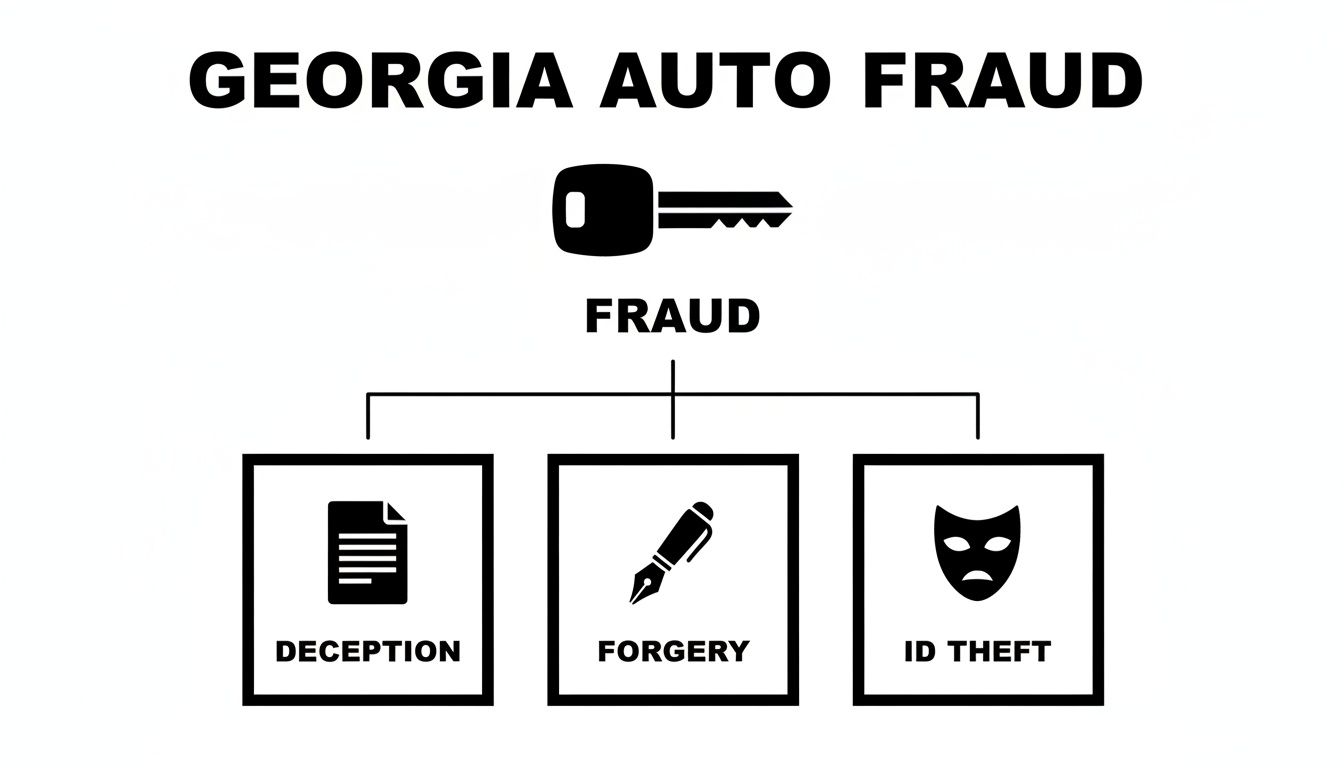
As the diagram shows, a single auto fraud case can involve elements of deception, forgery, and identity theft, creating a complicated legal situation.
The Cascading Consequences of an Investigation
The moment an investigation begins, the consequences can be immediate and severe—long before a case ever reaches a courtroom. Understanding these potential impacts is crucial for anyone in this situation, whether they’re in Alpharetta, Marietta, or anywhere in between.
The potential fallout can include:
- Frozen Assets: Banks may freeze accounts if they suspect fraudulent activity, cutting off access to the money needed for daily life.
- Damaged Credit: An investigation can trigger alerts on a credit report, making it difficult to get a loan, mortgage, or even a new credit card.
- Reputational Harm: Being accused of fraud can damage someone's standing among friends, family, and in their community, creating a tremendous amount of personal stress.
- Employment Risks: Many employers run background checks. A pending fraud investigation—let alone a conviction—can put a job or future career opportunities at serious risk.
The initial phase of an auto fraud law investigation is a critical time. The actions taken and the information provided can significantly shape the direction of the case and its ultimate outcome.
Because the stakes are so high right from the start, a proactive and informed approach is absolutely essential. The consequences aren’t just about potential fines or jail time; they threaten an individual's financial stability, reputation, and future.
Building a Defense: The Core Issues
When someone is accused of auto fraud, crafting a defense isn't about pulling a rabbit out of a hat. It's about a careful, deliberate look at the specific facts and evidence in the case. The strength of any defense boils down to the unique circumstances, and almost every strategy circles back to one critical element: intent.
The prosecution carries the heavy burden of proving someone knowingly and willfully set out to deceive another person for financial gain. If they can't prove that deliberate mindset beyond a reasonable doubt, their case for an auto fraud law violation starts to crumble. This is where the line between an honest mistake and a criminal act is drawn, and it's often where a case is won or lost.
The Question of Intent
A strong defense often starts by asking a simple question: was there actual criminal intent? It's surprisingly common for honest errors to be blown out of proportion and labeled as fraud, especially when dealing with complex paperwork and multiple parties.
Think about these real-world scenarios:
- An Honest Mistake: A private seller lists their car with certain features because that's what they were told when they bought it. The information turns out to be wrong, but their mistake wasn't an intentional lie—it was just passing along bad info.
- Unawareness of History: Someone sells a car without any clue that a previous owner "washed" the title to hide a salvage history. They acted in good faith, completely in the dark about the car's fraudulent past.
- Clerical Errors: A simple typo on a loan application, like swapping two numbers in an income field, could get flagged as fraud. It wasn't a scheme to deceive a lender; it was just a careless mistake.
Proving a lack of intent is about reframing the story. An attorney works to show that what the prosecution calls a calculated scheme was actually an unfortunate misunderstanding or a simple human error.
This is especially true with the recent spike in application fraud. Equifax Canada noted that automotive fraud jumped by more than 50% in 2025, with much of it tied to mistakes or exaggerated information on applications. While this shows how easily misstatements can happen, a defense focuses on separating an accidental error from an outright lie. You can discover insights on Equite Association's 2025 report to see these trends firsthand.
Challenging the Evidence
The other cornerstone of a solid defense is putting the prosecution's evidence under a microscope. The state has to present solid, legally obtained proof to back up its accusations. If an attorney can find weak spots in their evidence, the whole case can be thrown into doubt.
An evidentiary challenge means asking tough questions like:
- Is the Chain of Custody Intact? How were key documents like titles and sales contracts collected and stored? If evidence wasn't handled properly, an argument can be made that it's no longer reliable.
- Are Witness Statements Credible? Testimony from buyers, dealership staff, or loan officers needs to be consistent. Any contradictions, fuzzy memories, or signs of bias can be used to poke holes in their story.
- Was the Evidence Legally Obtained? Any information gathered by violating an individual's rights, like through an illegal search, can't be used against them in court. A lawyer would make sure every investigative step was by the book.
By scrutinizing every piece of the puzzle—from digital records to signed papers—an attorney will look for the gaps and inconsistencies that undermine the prosecution's case. The goal is to demonstrate that the state simply cannot meet its high burden of proving guilt beyond a reasonable doubt.
Knowing the law in your specific area is also a must. For those in North Georgia, navigating these issues requires a real understanding of our state's laws and local court procedures. You can learn more about Georgia's legal landscape to get a better sense of the local context. In the end, a successful defense always comes down to a thorough analysis of the facts and a powerful presentation of the evidence—or lack thereof.
Why an Experienced Auto Fraud Defense Attorney Makes a Difference
When an individual is under investigation for auto fraud, it’s easy to feel overwhelmed. These cases are rarely simple. They hinge on mountains of documents, very specific state laws, and prosecutors who know how to build a convincing narrative. To fight back effectively, one might need someone who understands exactly how the other side thinks and operates.
This is where years of hands-on experience become a powerful asset. A strong defense isn't just about showing up in court to answer charges; it’s about getting ahead of the investigation from the very beginning. It means digging into every piece of paper, every statement, and every shred of evidence the prosecution thinks they have.
Thinking Like a Prosecutor
With over 25 years in the legal field, including critical time spent as a prosecutor, I’ve seen these cases from both sides of the aisle. That experience provides a unique advantage—knowing the prosecution’s playbook because I used to use it. This helps in understanding how they build their cases, what evidence they lean on most heavily, and where the weak spots in their arguments are likely to be.
This insight allows for a proactive defense, not a reactive one. An attorney with this background can anticipate the prosecution's next move and prepare for it long before it happens. This kind of foresight is absolutely crucial when facing serious charges in jurisdictions like Forsyth County or Cobb County.
Having worked on both sides of the courtroom gives a complete, 360-degree view of a criminal case. It helps in spotting hidden challenges and finding opportunities that a less experienced attorney might miss, allowing for a defense that’s both tough and smart.
Building a Defense Strategy That Fits Your Case
No two auto fraud cases are the same. A title washing allegation in Marietta is going to have completely different facts than a loan application fraud case in Alpharetta. That’s why a cookie-cutter defense strategy just won’t work. The only effective approach is one that is built from the ground up to address the specific details of a particular situation.
Here’s what that looks like in practice:
- Protecting Rights: First and foremost, a defense attorney makes sure an individual's constitutional rights are defended at every single stage, from the initial investigation to the final courtroom appearance.
- Scrutinizing the Evidence: The attorney goes through the prosecution's evidence with a fine-tooth comb, looking for inconsistencies, procedural mistakes, or any other weaknesses that can be used to their client's advantage.
- Negotiating from a Position of Strength: When an attorney sits down with prosecutors, it’s with a complete command of the facts and a clear understanding of the case's merits and flaws.
- Preparing for Trial: Every single case should be prepared as if it’s going to trial. This ensures readiness for anything and that no stone is left unturned.
Whether a case is in Cumming, Johns Creek, Roswell, or Milton, the commitment is to give dedicated, personalized legal representation. The goal is always to achieve the best possible outcome—whether that’s getting the case dismissed, negotiating a reduction in charges, or winning a "not guilty" verdict in court. A defense built on decades of real-world experience provides the steady hand needed to fight back against these serious allegations.
Answering Common Questions About Auto Fraud
When an individual is caught in the middle of an auto fraud investigation, a million questions can race through their mind. Let’s walk through some of the most common ones we hear from people facing these allegations.
What Should I Do If Investigators Contact Me About a Vehicle Sale?
If law enforcement shows up at a person's door or calls them about a car they sold, their first instinct might be to explain everything. But it’s critical to understand their rights.
An individual is not required to give a statement or hand over records right then and there. While not being obstructive is important, it’s wise to first understand exactly what the investigation is about before answering questions. Saying the wrong thing, even with the best intentions, can create misunderstandings that are hard to undo later.
Can I Be Charged with Fraud for an Unknown Washed Title?
This is a big one. The key to most auto fraud cases in Georgia is intent. The prosecutor can’t just show that a car had a washed title; they have to prove that the seller knew it was fraudulent and intentionally deceived the buyer for financial gain.
If someone sold a vehicle without any idea that its title history was dirty, that lack of knowledge becomes the centerpiece of a defense. Of course, proving what someone did or didn’t know isn’t simple—it all comes down to the evidence.
Remember, in any fraud case, the burden of proof is squarely on the prosecution. Their job is to present solid evidence that proves a deliberate scam, not just an unfortunate situation where the seller was as much in the dark as the buyer.
Is It a Crime to Exaggerate Income on a Car Loan Application?
Yes, it absolutely can be. Intentionally putting false information on a loan application—like inflating income to get approved—can fall under Georgia’s statutes for financial fraud or theft by deception.
Lenders and prosecutors don't take this lightly. From their perspective, it's a direct attempt to secure a loan under false pretenses, leading to potential financial losses. The seriousness of the charge will often hinge on the size of the loan and just how significant the misrepresentation was.
How Does a Former Prosecutor's Experience Help?
Having a lawyer who used to be a prosecutor is like having a coach who knows the other team's playbook inside and out. They’ve been on the other side, building these exact types of cases. They understand the strategies, know what evidence prosecutors value most, and can spot the weaknesses in their arguments.
This unique insight isn't just theoretical. It allows for a defense strategy that proactively challenges the state's case, anticipating their moves and building a counter-narrative from a position of strength.
When you're staring down the complexities of an auto fraud investigation, you may need guidance from someone who's seen it all. At Brian Hansford Law, we bring over 25 years of experience, including time spent as a prosecutor, to the table. We are here to protect the rights of our clients and build the strongest defense possible. If you need help in Alpharetta, Cumming, Marietta, or anywhere in North Georgia, contact us for a consultation.
