
A DUI charge in Georgia throws a wrench into your relationship with your auto insurance company, to put it mildly. Insurers see a DUI as a massive red flag—a serious indicator of risk. That perception leads to some harsh realities: severe premium increases, the possibility of getting your policy dropped altogether, and a mandatory SR-22 filing.
Simply put, finding and keeping affordable auto insurance after a DUI becomes a whole new challenge.

What Happens To Your Car Insurance After A DUI
Think of your auto insurance policy as a handshake agreement with your provider. A DUI conviction shatters that agreement from their point of view. Almost overnight, your status as a driver changes. You’re moved out of the standard-risk pool and dropped squarely into a high-risk category.
This reclassification is what triggers the sudden and steep consequences that follow.
For anyone living in Georgia communities like Alpharetta, Cumming, or Roswell, understanding what’s coming is the first step toward navigating this new reality. The fallout isn't just financial; it’s a mess of administrative hurdles that directly impact your ability to legally get behind the wheel.
Immediate Insurance Consequences Of A Georgia DUI
Here’s a quick rundown of what you can expect to happen almost immediately after a DUI conviction hits your record. These are the most common outcomes for drivers across Forsyth and Cobb County.
| Consequence | What This Means For You |
|---|---|
| Severe Premium Increases | Your rates are going to jump, likely by a lot. Insurers adjust premiums to offset the higher risk they now associate with covering you. |
| Policy Non-Renewal/Cancellation | Your current insurer might decide you're too risky to continue covering. They may cancel your policy or, more commonly, simply refuse to renew it when the term is up. |
| Mandatory SR-22 Filing | The state will almost certainly require you to file an SR-22. This isn't insurance, but a certificate from your insurer proving you have Georgia's minimum liability coverage. |
These are the most common consequences, but they are often just the beginning of the administrative headaches you’ll face after a DUI conviction.
The changes to your insurance policy are swift. Your provider won't wait long to reassess your risk profile once they learn of the conviction. While every case has its own nuances, here are the three main impacts you're almost certain to face:
- Severe Premium Increases: This is practically a guarantee. Your insurance rates will go up because you are now seen as a much higher risk to insure.
- Policy Non-Renewal or Cancellation: Don't be surprised if your current insurance company decides to part ways. Many standard carriers will not renew the policy of a driver with a fresh DUI conviction.
- Mandatory SR-22 Filing: Georgia requires most drivers convicted of a DUI to file an SR-22. This is a form your insurance company files with the state to prove you're carrying the legally required amount of liability coverage.
These insurance headaches often arrive alongside other penalties, like a suspended driver's license. You can learn more about how a DUI impacts your driving privileges by reading about license suspension after a DUI in Georgia.
A DUI conviction fundamentally changes how insurance companies see you. You're no longer just another driver; you become a statistic in a high-risk category, and your premiums will reflect that new reality for years.
Ultimately, the first letter you get from your insurer after a conviction sets the stage for a long period of higher costs and stricter rules.
Why A DUI Sends Your Insurance Premiums Through The Roof
At its core, the auto insurance business is all about risk. When you first sign up for a policy, the company looks at dozens of factors to figure out what kind of driver you are and places you in a risk pool with similar drivers. A DUI conviction completely shatters that calculation. It's like being kicked out of the "safe driver" club and tossed into a category insurers see as a major financial gamble.
Think of it this way: before the DUI, your insurance company saw you as a predictable, everyday driver. Afterward, their statistical models red-flag you as someone far more likely to get into another accident. This isn't personal; it's a cold, hard financial decision based on mountains of data. To an insurer in Forsyth County or Cobb County, a DUI on your record is a giant flare signaling future risk, and they have to adjust your premiums to match.
The Financial Shock Of Being Reclassified
This is why your rates don't just creep up—they explode. The massive price jump is the insurer's way of covering the much higher chance they'll have to pay out a claim for you down the road. You're no longer considered part of the general driving population. You've been moved into a high-risk pool, and that comes with a much steeper price tag that will follow you for years.
The shift is abrupt and often a huge financial blow. A DUI is one of the single most expensive marks you can have on your driving record, and the new premium can quickly become a major monthly burden.
For many people, the spike in auto insurance after a DUI is one of the biggest financial hurdles they face, sometimes even more than the court fines. A conviction sends premiums soaring, with 2025 data showing drivers can expect an average annual increase of $2,467 nationwide. In many cases, this can take a standard full-coverage policy from around $2,638 a year to well over $5,000. In certain states, the jump is even more extreme. You can explore the full 2025 insurance report to see just how costly this one mistake can be.
"An insurance company's primary job is to manage risk. A DUI is seen as a major breach of responsible driving behavior, fundamentally altering the risk equation and forcing the insurer to charge a premium that reflects this new, higher level of uncertainty."
How Insurers Turn a DUI Into Dollars
The moment a DUI hits your driving record, the insurance company's underwriting process kicks into overdrive. They don't just see the charge; they see a whole chain of potential costs. Here's a look at what's happening behind the curtain:
- Loss of Safe Driver Discounts: Any "good driver" or "claims-free" discounts you had are almost always wiped out instantly. That alone can cause a big rate hike before any new penalties are even added.
- A Major Surcharge: Insurers tack on a hefty surcharge specifically for major violations like a DUI. This is a direct penalty that can easily increase your base premium by 100% or more.
- SR-22 Filing Requirement: Needing an SR-22 officially labels you as a high-risk driver. The administrative costs and the risk tied to that filing are passed directly to you through higher rates.
- A Full Policy Review: The insurer will re-evaluate your entire policy. They may raise your rates for liability, collision, and comprehensive coverage because they now see you as a greater risk across the board, not just for impaired driving.
Each of these elements piles on top of the others, leading to the astronomical premium increases drivers see. This isn't just a simple penalty; it's a complete reassessment of your insurability based on a new, much riskier profile. For drivers here in Georgia, it means navigating a much more expensive and restrictive insurance world for years to come. The insurer's goal is to make sure the premium you pay accurately reflects the potential cost of covering you from that point forward.
Understanding The Georgia SR-22 Requirement
After a DUI in Georgia, you'll find yourself dealing with a lot of confusing paperwork and unfamiliar requirements. One of the most common—and misunderstood—is the SR-22. It's a term that causes a ton of anxiety, mostly because people think it’s some kind of special, expensive insurance policy they have to buy.
Let's clear this up right now: an SR-22 is not insurance. Think of it more like a report card. It's a document your insurance company sends directly to the Georgia Department of Driver Services (DDS) to prove you're carrying the state's minimum required liability coverage.
This form, officially a "Certificate of Financial Responsibility," is the state's way of keeping you on a short leash. It's usually triggered after a license suspension from a DUI conviction. Before they let you back on the road, the state wants solid proof that you are financially responsible.
What The SR-22 Process Entails
Getting an SR-22 filed is a pretty straightforward process, but it's absolutely critical you get it right. You can't just fill out a form and send it in yourself; your auto insurance provider has to do it for you. The first step is to call your current insurer and ask them to file one on your behalf.
This is where drivers in places like Johns Creek and Milton often hit a major roadblock. A lot of the big, standard insurance companies—the ones you see on TV all the time—want nothing to do with SR-22s. The moment you ask, they see you as a high-risk driver and might just choose to drop you at your next renewal instead of taking on the risk.
An SR-22 filing officially re-categorizes you as a high-risk driver. For many standard insurers, that’s a deal-breaker, forcing you to find a company that specializes in non-standard or high-risk policies.
If your current provider says no, you’ll have to shop around for a new one that works with high-risk drivers. These companies are used to handling SR-22s and will file the certificate with the state for you. It usually costs a small fee, typically around $25 to $50. Once it's filed, the SR-22 is attached to your policy, and the state knows your coverage is being monitored.
This infographic really breaks down how a conviction flips the switch on your insurance costs.
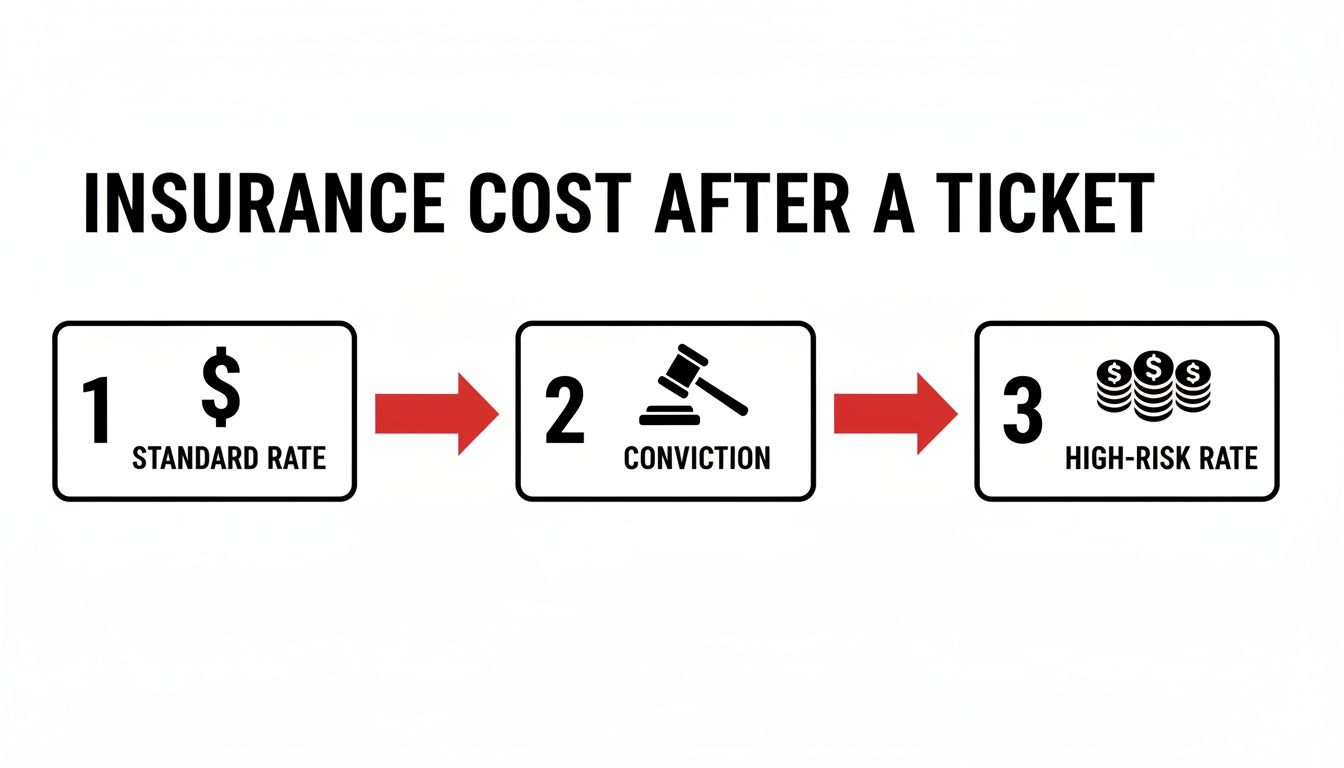
As you can see, the conviction is the moment you get moved from the standard-risk pool into the high-risk category, which is exactly what triggers those higher rates.
Maintaining Your SR-22 Is Absolutely Critical
In Georgia, you’ll typically be required to maintain an SR-22 for three consecutive years. Think of this as a probationary period where you must keep continuous, uninterrupted insurance coverage. No excuses.
This is the most important part. If your policy gets canceled, you miss a payment, or you let it lapse for any reason at all, your insurance company is legally required to tattle on you. They immediately file a notice called an SR-26 with the Georgia DDS, letting them know you're uninsured.
The consequences are both severe and immediate:
- Your driver's license will be suspended all over again.
- That three-year SR-22 clock? It resets right back to zero.
A simple mistake like a late payment can set you back years, forcing you to start the entire license reinstatement process from the beginning. Perfect compliance isn't just a suggestion; it's essential. To get a better handle on all the license-related issues, you can learn more about the administrative license suspension hearing in Georgia and see how everything connects. Understanding the whole picture is the key to finally putting a DUI behind you.
How To Find Affordable Insurance With A DUI
After a DUI conviction in Georgia, the sticker shock from your new insurance premium can feel like a punch to the gut. It's natural to want to stick with your current insurance provider—it's familiar and seems like the easiest path forward. But loyalty at this stage is almost always the most expensive mistake you can make. Your insurer now sees you as a high-risk driver, and you can be sure your new rates will reflect that reality.
The single most important thing you can do right now is to start shopping around immediately. Don't just assume your current company will give you a fair deal, or even a reasonable one. It’s time to get proactive and find a policy built for your new situation.
Focus Your Search On Non-Standard Carriers
Think of the insurance market like the medical field. For a routine check-up, you go to your family doctor. But for a complex heart issue, you need a cardiologist. After a DUI, you're no longer a routine patient—you need a specialist. In the insurance world, these specialists are called non-standard or high-risk carriers.
These companies exist specifically to provide coverage for drivers who don't fit the preferred-risk profile anymore. While your mainstream insurer in Marietta or East Cobb might flat-out deny you coverage or quote you an astronomical price, non-standard carriers are built for exactly this scenario.
A DUI conviction makes you a specialist's client in the insurance world. Non-standard carriers are equipped to handle SR-22 filings and understand the risk profile, often resulting in more manageable quotes than you’d get from a standard provider.
This is where you'll find your most competitive options for auto insurance after a DUI. They are accustomed to filing SR-22s and won't flinch when you bring it up.
Actionable Steps To Lower Your New Premium
Even when you're dealing with a high-risk policy, you aren't powerless. There are several concrete actions you can take to try and chip away at those premiums and make your coverage more affordable. While your rates are still going to be higher than before, every little bit helps.
Here are a few strategies to bring up with potential insurers:
- Complete a Defensive Driving Course: Finishing a state-approved defensive driving or DUI risk reduction program can sometimes earn you a small discount. More importantly, it shows insurers you’re serious about being a responsible driver.
- Ask About Vehicle-Specific Discounts: The car you drive really matters. Insurers often offer discounts for vehicles with advanced safety features like anti-lock brakes, airbags, or modern anti-theft systems.
- Increase Your Deductible: This is a classic trade-off. If you raise the amount you're willing to pay out-of-pocket for a claim (your deductible), your premium will usually go down. Just make absolutely sure you can comfortably afford that higher deductible if an accident happens.
- Re-evaluate Your Coverage: You must maintain Georgia's minimum liability limits, no exceptions. But do you still need full coverage (collision and comprehensive) on an older car that isn't worth much? Dropping it could save you a significant amount of money each month.
Taking these steps can help soften the financial blow. But it’s also important to be realistic. The challenge of finding affordable auto insurance after a DUI is significant and the consequences stick around for years. You'll be dealing with mandatory high-risk policies and SR-22 certificates, all of which amplify your costs.
A recent analysis shows that a DUI conviction adds an average of $2,467 to annual premiums nationwide—a far greater financial penalty than just an at-fault accident. If you're curious about where costs are headed, you can understand the 2025 auto insurance landscape and its trends.
This data really puts the financial impact of a DUI into perspective. The premium increase isn’t just a minor bump; it's a massive surcharge that often dwarfs the hit from other common driving violations.
Financial Impact Of A DUI Vs Other Violations
This table illustrates the average annual premium increase for a DUI compared to other common driving violations, highlighting its significant financial impact.
| Violation Type | Average Annual Premium Increase (Nationwide) | Severity Level |
|---|---|---|
| DUI | $2,467 | Severe |
| At-Fault Accident | $840 | Moderate |
| Reckless Driving | $755 | Moderate-High |
| Speeding Ticket (16-29 mph over) | $290 | Minor-Moderate |
| Running a Red Light | $230 | Minor |
As you can see, a DUI moves you into a completely different cost bracket for several years, making it one of the most financially damaging events a driver can experience.
The Long-Lasting Shadow of a DUI on Your Driving Record
A DUI conviction isn’t some temporary headache that disappears once you’ve paid your fines and finished your classes. It casts a long shadow over your driving record, following you for years and making things like getting affordable auto insurance after a DUI a serious challenge.
Think of your driving record as the story you tell insurance companies. A clean record tells a story of a safe, reliable driver, which earns you their best rates. A DUI, on the other hand, is a permanent chapter in that story—one that signals high risk to any insurer in Georgia, and they won't forget it for a very, very long time.
How Long Will a DUI Actually Affect Your Insurance?
While a DUI conviction stays on your Georgia criminal record permanently, its direct hit to your insurance premiums has a more defined timeline. Most insurance companies will keep hitting you with a surcharge for that DUI for anywhere from three to seven years. For that entire period, you’re officially in the "high-risk driver" category, and your premiums will absolutely reflect it.
That means long after your court case is closed, you’ll still be paying the price every time your insurance bill arrives. You’ll only start to see those rates slowly come back down to earth after you’ve strung together several years of perfectly clean driving, gradually rebuilding an insurer’s trust.
This isn't happening in a vacuum, either. The entire auto insurance market is getting tougher. In fact, new data shows that driving violations shot up 17% year-over-year in 2024, blowing past pre-pandemic numbers. That spike includes an 8% jump in DUI offenses over 2023, which is directly contributing to higher premiums as insurance companies get more defensive. You can read more about how these national trends are fueling premium hikes into 2025.
Navigating a Tougher Insurance Landscape
With violations on the rise nationwide, insurance companies are tightening their belts and becoming far less forgiving. For drivers here in Forsyth County and Cobb County, that industry-wide change makes the financial sting of a DUI even worse. The pool of "high-risk" drivers is getting bigger, and insurers are raising rates for everyone to cover their bases.
In this kind of market, a DUI conviction doesn't just mean higher rates—it can slam the door on your options. Fewer companies will even be willing to offer you a policy, potentially pushing you into the expensive, specialized "non-standard" insurance market.
This is why a conviction is so serious. The fallout goes far beyond the courtroom, creating a financial burden that can mess with your budget and your freedom for the better part of a decade. Finding reasonably priced insurance becomes a long-term project, one that depends entirely on safe driving and the slow ticking of the clock.
How A Strong Legal Defense Can Mitigate Insurance Issues
The sticker shock from your auto insurance after a DUI is a serious concern, but the best way to control that financial damage starts long before you get a renewal notice in the mail. It starts with the charge itself.
Facing the DUI head-on with an experienced lawyer isn’t just about the outcome in the courtroom; it's a direct investment in protecting your financial future from years of punishingly high insurance premiums.

The final verdict in your DUI case creates a ripple effect that hits your insurance status hard. A conviction sends a clear, high-risk signal to your insurer, triggering all the severe consequences we've talked about. A different legal outcome, however, can tell a completely different story.
The Connection Between Your Case and Your Premiums
Insurance companies don’t really dig into the specifics of what happened on the roadside. They look at one thing: the final conviction on your driving record. This is exactly why a solid defense strategy is so critical. A skilled attorney will explore every possible angle to challenge the evidence and procedures used in your case.
The goal is simple: achieve a better result than a standard DUI conviction. Here are a couple of potential outcomes that can make a huge difference:
- Charge Reduction: Getting a DUI charge reduced to a lesser offense, like reckless driving, can be a game-changer. Insurers still see reckless driving as a serious violation, but its impact on your rates is often significantly less severe than a DUI.
- Case Dismissal: In some situations, it's possible to get the charges thrown out entirely. If there’s no conviction, there's nothing for the insurance company to penalize you for.
The outcome of your legal proceedings is the single most influential factor in determining your insurance future. A reduced charge or a dismissal can prevent you from being automatically placed in the highest-risk category, saving you thousands of dollars over the long term.
A lesser charge might mean a much smaller premium hike or could even help you avoid that dreaded SR-22 requirement altogether. For a deeper dive into how these cases are defended, you might be interested in our guide on how to beat DUI charges in Georgia.
Protecting Your Financial Future
At the end of the day, the link is crystal clear: a better result in court leads to a better result with your insurer. While no outcome is ever guaranteed, putting up a strong defense gives you a crucial opportunity to influence the long-term financial fallout.
This isn’t just about dealing with the immediate court penalties. It's about being proactive to preserve your insurability and keep your future costs as manageable as possible. For folks living in Cumming, Milton, or Marietta, taking this strategic approach can make a monumental difference in the years following a DUI charge.
Common Questions About DUI And Georgia Auto Insurance
Trying to figure out your car insurance after a DUI charge in Georgia can be incredibly confusing. It's a stressful time, and most people find themselves asking the same urgent questions. We'll cut through the noise and give you direct answers to the biggest concerns people have about auto insurance after a DUI.
This is all about giving you practical, real-world information, especially if you're in areas like Alpharetta, Roswell, and Johns Creek, so you can understand the road ahead.
Will My Insurer Find Out About My DUI Immediately?
No, your insurance company won't get an alert the day after an arrest. Insurers typically pull your motor vehicle record (MVR) when your policy is up for renewal. That's when a conviction will pop up, and they'll re-evaluate you as a driver.
There's a big exception, though. If your license gets suspended and the state requires you to get an SR-22 filing, you have to contact your insurer to set it up. That action immediately tips them off to the situation, which will trigger a review of your policy and rates long before renewal time.
Most insurance providers review your driving record at renewal time, which is when a DUI conviction will typically surface. However, a state requirement for an SR-22 filing will force you to notify them much sooner.
Can I Switch Insurance Companies With A Pending DUI?
Yes, you can absolutely shop for a new insurance policy while your DUI case is still pending. Right now, your rates are based on your current driving record, which doesn't show the pending charge. A new insurer won't see it until there's a conviction and it officially hits your MVR.
While this can be a smart move, just know it isn't a permanent fix. Once the conviction is on your record, the new insurance company will find out at your first renewal and adjust your rates accordingly. It doesn't let you hide the DUI forever.
How Long Does A DUI Affect My Georgia Insurance Rates?
A DUI conviction has a long financial shadow. Here in Georgia, you can expect a DUI to inflate your auto insurance premiums for anywhere from three to seven years. The exact timeline depends on the insurance company.
During that time, you'll be classified as a high-risk driver, which comes with significantly higher costs. The good news is that after several years of keeping your record clean with no more tickets or incidents, your rates will slowly start to come back down.
Is It Possible To Get Insurance If My Policy Is Canceled?
Absolutely. If your current insurer drops you or refuses to renew your policy after a DUI, you aren't out of options. The best place to start looking is with companies that specialize in non-standard or high-risk insurance.
These insurers exist specifically to cover drivers who don't fit the standard mold. Yes, the premiums will be higher, but they are set up to handle SR-22 filings and provide the coverage you need to stay legally on the road in Georgia.
A DUI charge is a serious matter with lasting consequences, but you don't have to face it alone. The team at Brian Hansford Law has the experience to guide you through the process and fight for the best possible outcome for your case. If you need a strong defense in Cumming, Marietta, or anywhere in Forsyth or Cobb County, contact us at https://challengemycharge.com.
