
When someone gets arrested in Georgia—whether it's in Alpharetta, Roswell, or anywhere in Forsyth County—the first thing on everyone's mind is getting them out of jail. This process almost always brings up two words: bail and bond. People use them interchangeably all the time, but they mean very different things.
Getting a firm grasp on the difference is the first step to understanding the options.
The core distinction is simple: Bail is the total amount of money a court requires to guarantee a defendant comes back for their hearings. A bond is the specific method you use to pay that bail amount.
Think of it like buying a car. The bail is the car's sticker price. The bond is how you pay for it—do you pay the full amount in cash, or do you get a loan to cover the cost? That choice has major financial consequences.
Key Concepts: Bail vs. Bond
It's important to remember that bail isn't a fine or a punishment. It’s more like a security deposit to make sure the defendant shows up for every required court date. If they do, the bail money is usually returned when the case is over. A bond, on the other hand, is the actual agreement or payment made to meet the court's bail requirement.
This table breaks down the core differences at a glance.
Bail vs Bond At a Glance
| Concept | What It Is | Who Sets It | Purpose |
|---|---|---|---|
| Bail | The total dollar amount the court requires for a defendant's release. | A judge or a pre-set bail schedule. | To ensure the defendant appears for all future court proceedings. |
| Bond | The method of payment used to secure the defendant's release. | The defendant or their family chooses the method. | To fulfill the financial requirement set by the court's bail order. |
Knowing the difference between the price (bail) and the payment method (bond) is critical when deciding how to secure someone's release.
A Quick Look at Bail's History
Believe it or not, our modern system of paying for release is a huge shift from its historical roots. Originally, bail was just a promise to appear in court, backed by a pledge to forfeit money if that promise was broken—no cash had to be paid upfront.
But by the late 1700s, this started to change, creating real problems for people who didn't have cash on hand. The first time a judge is recorded setting a cash bond so high it couldn't be paid was in 1835, which kicked off the cash bail system we recognize today.
The core purpose of bail is not to punish but to act as a security deposit. It's the court's way of ensuring the accused returns to face the charges against them.
Understanding these foundational concepts is crucial. For a deeper dive into how this system works on the ground in Georgia, you can read our guide on how bail works in Georgia. This knowledge will help you understand the different paths to pretrial release, from paying the full cash amount yourself to working with a bail bondsman.
Comparing The Different Types Of Bonds In Georgia
Once a judge sets a bail amount, the next major hurdle is figuring out the best way to pay it. In Georgia, there are a few options, and each one works very differently, with its own set of rules and financial strings attached. Getting a handle on these differences is crucial whether you're dealing with a case in Cobb County, Alpharetta, or Forsyth County.
The flowchart below gives you a quick visual of the decision-making process you face once bail is set.
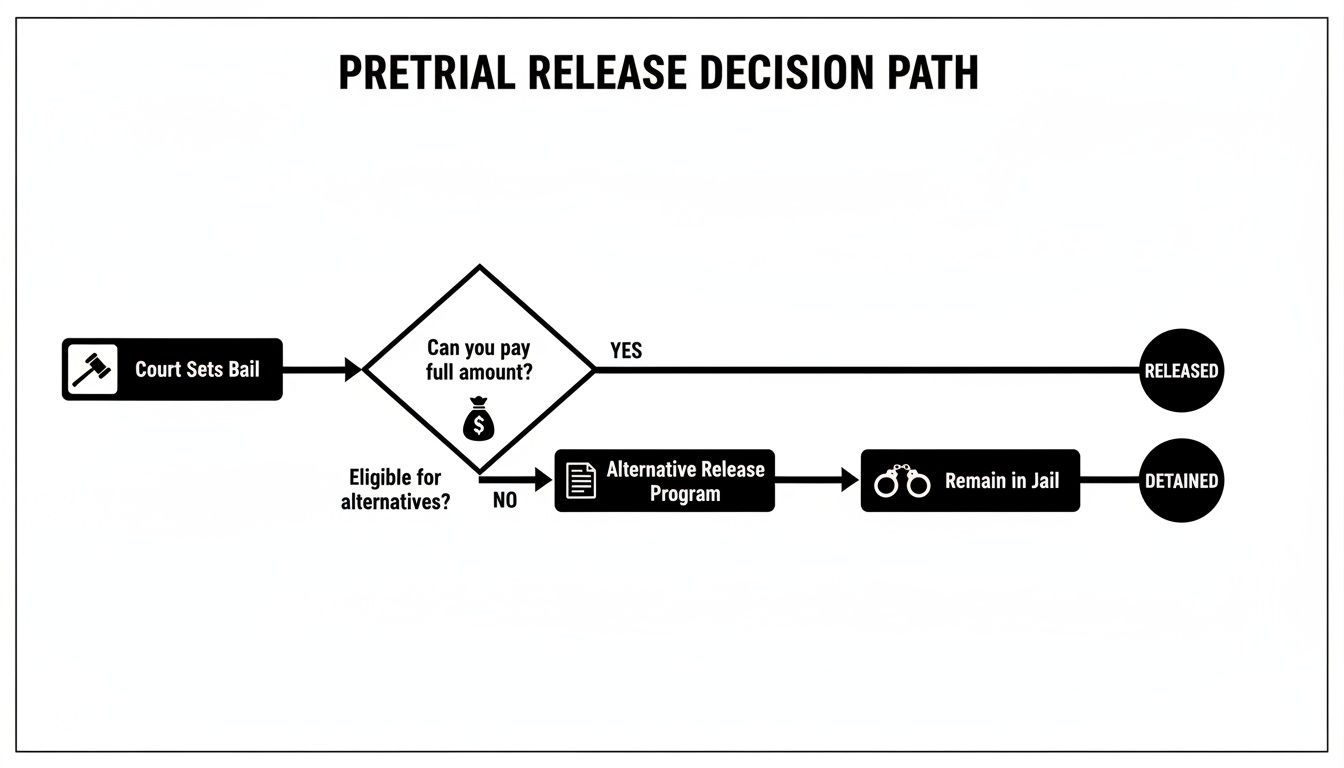
As you can see, the path splits right away: either you can pay the full amount yourself, or you need to find an alternative route, like working with a bonding company.
Cash Bonds A Direct Payment
A cash bond is exactly what it sounds like. It means you, or your family, pay the entire bail amount directly to the court. You can usually pay with cash, a cashier's check, and sometimes even a credit card, depending on the jail. The big upside here is that you get the money back.
After the person shows up for all their court dates and the case is officially closed, the court refunds the full amount, though they might subtract some minor administrative fees or court fines. The obvious drawback is that if the bail is high, coming up with thousands of dollars in cash is a massive financial strain for most people.
Surety Bonds The Most Common Approach
When a cash bond is just too much to handle, a surety bond is where most people turn. This is where a bail bondsman comes into the picture. You pay the bondsman a non-refundable fee, which is typically 10-15% of the total bail amount.
For that fee, the bondsman puts up the full bail amount with the court on your behalf, essentially guaranteeing the court that the defendant will show up. For instance, if bail is set at $20,000, the bondsman's fee would be somewhere between $2,000 and $3,000. That money is the bondsman's profit for taking the risk—you don't get it back, even if the charges are dropped.
This method has become more and more common as bail amounts have climbed over the decades. In fact, reliance on surety bonds for pretrial release nearly doubled from 24% to 49% between 1990 and 2009 alone. You can read more about this trend in a report on bail practices from The White House archives.
Property Bonds Using Real Estate As Collateral
A property bond is an option that lets a defendant use real estate—like a house—as collateral to secure their release. This route is far less common because the process is slow and complicated. To even qualify, the property must be in Georgia, have no liens against it, and its equity needs to be worth at least double the bail amount.
The court will place a lien on the property. If the defendant skips a court date, the court can start foreclosure proceedings to get its money. Because of the high stakes and the mountain of paperwork needed for appraisals and verification, property bonds are really only a last resort for extremely high bail amounts when cash or surety aren't feasible.
A key difference to remember is that a cash bond is a refundable deposit, while the fee paid for a surety bond is a non-refundable payment for a service. This distinction is critical for financial planning.
Personal Recognizance Bonds An Exception To The Rule
Finally, there’s the Personal Recognizance (PR) bond, often called being "released on your own recognizance." This is the best-case scenario, but it's also the hardest to get. It means the judge trusts the defendant enough to release them based on nothing more than their written promise to come back to court.
No money changes hands for a PR bond. This is usually reserved for people with little to no criminal history, strong community ties like a stable job or local family, and who are facing minor, non-violent charges. A judge in a place like Roswell or Marietta has to be fully convinced the person isn't a flight risk or a danger to anyone before granting this type of release.
How The Bond Process Actually Works Step-By-Step
When a judge sets bail, the clock starts ticking on a process that can feel incredibly overwhelming, especially if you've never been through it before. Understanding the sequence of events is the first step toward bringing some clarity to a stressful time.
Whether you're dealing with the courts in Forsyth County, Cobb County, or elsewhere in Georgia, there's a clear path from that initial hearing to the moment of release. This guide breaks down exactly what you can expect.
Step 1: Confirm Bail Amount And Conditions
The whole process kicks off the moment a judge sets bail, which usually happens at a first appearance hearing. This is the first and most critical piece of information you need. The judge will state the total bail amount and spell out any specific conditions for release, like no-contact orders or travel restrictions.
Getting these details exactly right is essential. This information dictates every move you make next and helps you decide which type of bond makes the most sense for the situation. To get a better feel for what goes on during this initial court appearance, you can learn more about what happens at a bond hearing.
Step 2: Choose The Right Type Of Bond
With the bail amount confirmed, the next big decision is how to pay it. As we've covered, the main options are a cash bond or a surety bond through a bonding company.
- Cash Bond: If you have the funds to pay the full bail amount directly to the court, this is the most straightforward route. The money is held by the court and is generally returned once the case concludes, minus any administrative fees.
- Surety Bond: If the bail is too high to pay in full, contacting a bail bondsman is the go-to alternative. You'll pay them a non-refundable fee—typically 10-15% of the total bail—and they post the full amount on your behalf.
This is a purely financial decision. It comes down to balancing the immediate out-of-pocket cost against the total amount of money you're willing to put on the line.
The decision to use cash or a bondsman hinges on one thing: financial capacity. A surety bond requires a smaller upfront payment but it's non-refundable. A cash bond requires the full amount, but you get it back later.
Step 3: Work With A Bail Bondsman If Needed
If you decide a surety bond is the way to go, you'll need to find a licensed bail bondsman. When you call one, they will ask for basic information about the defendant, the charges, and the bail amount. From there, they'll explain their fee structure and any collateral requirements they might have.
Be prepared for a detailed contract. This agreement outlines your obligations as the indemnitor (the person guaranteeing the bond), including making sure the defendant appears for all court dates. Read this document very carefully, as it specifies what happens if the defendant fails to show up.
Step 4: Gather Documentation And Make The Payment
Whether you’re paying a cash bond at the courthouse or a fee to a bondsman, you'll need to gather some specific items. Getting this step right is crucial for avoiding any delays.
Here’s a quick overview to help you stay organized during what can be a confusing process.
Bond Process Checklist for Georgia Defendants
| Step | Action Required | Key Consideration |
|---|---|---|
| 1. Gather IDs | Have a valid, government-issued photo ID for the person posting the bond (the indemnitor). | The name on the ID must match the person signing the paperwork. |
| 2. Prepare Payment | Secure the funds for either the full cash bond or the bondsman's fee. | Confirm what payment types are accepted (cash, cashier's check, credit card). |
| 3. Collect Info | Have the defendant's full name, booking number, and the jail's location ready. | This ensures the payment is applied to the correct person and case. |
| 4. Sign Paperwork | Carefully read and sign all required documents from the court or the bondsman. | You are making a legally binding promise. Understand all terms before signing. |
| 5. Post the Bond | Submit the payment and completed paperwork to the jail's bonding desk or the clerk of court. | Keep copies of every receipt and document for your records. |
Once the bond is officially posted, the jail begins its release process. The paperwork part might be quick, but the actual release can take several hours, depending on how busy the facility is. Following these steps systematically can make the entire experience much more manageable.
Understanding The Financial Reality Of Posting Bond
When you’re trying to get someone out of jail, it often comes down to one thing: money. The financial choices you make just hours after an arrest can have long-term effects, so it’s critical to understand where your money is going—and if you’ll ever get it back. The biggest difference between paying cash bail yourself and using a bonding company is whether you’re making a refundable deposit or paying a non-refundable fee.
Think of a cash bond like a security deposit for an apartment. You pay the full amount directly to the court. As long as the defendant shows up for every required court date, that money is returned to you when the case is over. Keep in mind, the court might subtract some administrative fees or fines from the total.
A surety bond, on the other hand, is a service fee. The money you pay a bail bondsman is their fee for taking on the financial risk of guaranteeing the defendant appears in court. This payment is never refundable, no matter how the case turns out.
Breaking Down The Costs Of A Surety Bond
For most families, especially when facing a high bond amount in places like Forsyth or Cobb County, coming up with the full cash amount isn't realistic. A surety bond becomes the only practical path to getting their loved one released. The bondsman's fee is typically a percentage of the total bond, usually between 10% and 15% here in Georgia.
This makes getting out of jail more affordable upfront, but that money is gone for good.
- Example 1 A Misdemeanor Charge: If bond is set at $5,000, you can expect to pay a non-refundable fee to a bondsman of $500 to $750.
- Example 2 A Felony Charge: For a more serious charge with a $20,000 bond, the non-refundable premium would be between $2,000 and $3,000.
This fee is the price of the service. You're paying the bonding company to put up the full $20,000 with the court so you don't have to tie up your own assets.
The crucial takeaway is that a surety bond fee is a permanent expense. While it secures immediate release for a fraction of the total bail, that money is gone for good once paid to the bonding company.
The Role Of Collateral In Securing A Bond
Sometimes, the bondsman's premium isn't enough to make them feel secure, especially if the bond amount is extremely high or they believe the defendant is a flight risk. In these cases, the bonding company will require collateral on top of their fee.
Collateral is a valuable asset you pledge to the bondsman to secure the bond. It could be the title to your car, valuable jewelry, or even a lien against your house. If the defendant skips court, the bondsman can legally seize and sell your collateral to get back the full bond amount they now have to forfeit to the court. This adds another layer of serious financial risk for the family and friends who co-sign.
The Economic Pressures Of The Bail System
The way our bail system is structured puts immense financial pressure on families, often forcing them to use a surety bond even if they can barely scrape together the fee. This problem is made worse by existing disparities in the justice system. National studies have shown that bond amounts can be set significantly higher for minority defendants than for their white counterparts arrested for similar crimes.
This systemic issue creates an impossible choice for many. In one recent year, the median bond for felony charges was $10,000, yet the median annual income for people in pretrial detention was just over $15,000. With that kind of gap, paying a full cash bond is simply out of reach for most, making the non-refundable bondsman fee the only available path to freedom. You can read more about these financial and racial disparities in a brief on bail practices from the Indiana University Public Policy Institute. Understanding these economic realities is key to appreciating the true cost of posting bond.
What Happens After The Bond Is Posted
Posting bond gets you, your friend, or your loved one out of jail, but it’s crucial to understand that this is the beginning of a new phase, not the end of the legal process. A release on bond is always conditional, meaning the court attaches a specific set of rules that must be followed to the letter until the case is completely resolved.
Think of it as a contract with the court. Any misstep can void the agreement, undoing all the time and money spent securing the release and leading to immediate, serious consequences.
Understanding Your Release Conditions
Every single person released on bond is subject to conditions set by a judge. While these can be tailored to the specifics of a case, some are standard across all Georgia courts, whether you're in Alpharetta, Marietta, or Cumming. The absolute most important condition is that the defendant must appear for every single scheduled court date. No exceptions.
On top of court appearances, a judge will often add other requirements to protect the community or prevent new issues from arising. These frequently include:
- No-Contact Orders: This is a strict prohibition against any form of contact—direct or indirect—with the alleged victim or anyone else specified in the order.
- Travel Restrictions: A defendant might be ordered to remain within a certain area, like Forsyth County or the state of Georgia, and may have to surrender their passport.
- Regular Check-ins: The release order may require the defendant to check in with a pretrial services officer on a regular schedule.
- Substance Abuse Restrictions: This can range from refraining from all alcohol and drug use to submitting to random drug or alcohol screens.
These conditions are not suggestions; they are court orders. Violating any of them, even if it seems minor or accidental, can get the bond revoked.
The Consequences Of Failing To Appear
The most severe violation of bond conditions is a Failure to Appear (FTA) in court. When someone misses their court date, it sets off an immediate chain reaction of negative consequences. The court views this as a broken promise—the core of the bond agreement.
First, the judge will issue a bench warrant for the person's immediate arrest. This means any police officer who runs their name can take them back to jail on the spot. At the same time, the court starts bond forfeiture proceedings.
A Failure to Appear in court instantly transforms a defendant into a fugitive in the eyes of the law. It triggers a bench warrant for their arrest and begins the process of forfeiting the entire bond amount to the court.
If a cash bond was posted, the court keeps the money. The person who paid it will lose every penny, permanently. If a surety bond was used, the bail bondsman is now on the hook to pay the court the full bond amount. To avoid a huge financial loss, the bondsman becomes highly motivated to find the defendant.
Bail bonding companies will actively and aggressively search for the person who skipped court. They often hire recovery agents—sometimes called bounty hunters—to locate the individual and bring them back into custody. It's the only way they can prevent having to forfeit the bond. On top of all that, an FTA often leads to a new, separate criminal charge of "Bail Jumping," which piles more potential penalties on top of the original charges.
How A Defense Attorney Can Impact The Bail Process
Those first few hours after an arrest are a blur of confusion and stress. But the first appearance hearing is a critical moment where having the right professional on your side can make a massive financial difference. While this is just for educational purposes, it shows how an experienced attorney can strategically shape the outcome of the bond process right from the start.
An attorney’s main job at this stage is to be an advocate. They can build and deliver a persuasive argument to the judge for a lower bail amount. In some cases, they can even argue for a Personal Recognizance (PR) bond, which means you get released with no money down. This is about more than just asking for a break; it’s about presenting a solid case that the defendant isn't a flight risk or a danger to the community.
Arguing For Favorable Release Terms
A good defense lawyer knows exactly what judges in local courts—whether it's Alpharetta, Roswell, or Forsyth County—are looking for when they set bond. They know how to highlight the key information that points toward a more favorable outcome for their client.
This means presenting clear evidence of things like:
- Strong Community Ties: This could be local family, a steady job, or having lived in the area for a long time.
- Minimal Criminal History: Pointing out a clean record or a history of always showing up for court dates goes a long way.
- The Nature of the Offense: An attorney can provide important context that might lessen the perceived seriousness of the charges.
By putting together a logical argument backed by these kinds of details, a lawyer can often convince a judge to set a much more reasonable bond. This alone can save a family thousands of dollars in cash or non-refundable fees to a bondsman. Knowing what to look for in representation is critical; these questions to ask a criminal defense attorney can help you get started.
Negotiating Release Conditions
It’s not just about the money. A lawyer can also negotiate the specific conditions of release. Judges often add extra rules, like no-contact orders, travel bans, or mandatory check-ins. An attorney can push back on conditions that are excessive or unnecessary, making sure the terms are fair and don’t completely disrupt a person’s ability to work and live while the case moves forward.
One of the biggest advantages of having representation at a bond hearing is their ability to present a structured, persuasive case for a lower bond or PR release. It's almost always more effective than a defendant or their family trying to navigate this complex process on their own.
Ultimately, having a skilled advocate in your corner from day one is a huge strategic advantage. Their deep understanding of the local court system and their ability to frame a compelling argument can directly impact both the financial cost of getting out of jail and the personal freedom of the defendant during the entire pretrial period.
Questions We Often Hear About Bail And Bonds
When you're dealing with the justice system in Georgia, the pretrial release process can bring up a lot of questions. Even after you get a handle on the basic differences between bail and a bond, real-life situations always create new uncertainties. Here are some clear, straightforward answers to the questions we hear most often.
Can A Bail Amount Be Reduced After It Is Set?
Yes, it's absolutely possible to get a bail amount reduced after a judge has already set it. The way to do this is by having an attorney file what's called a motion for bond reduction.
The key to a successful motion is presenting a stronger argument or new information that wasn't available at the first appearance hearing. An attorney might argue that the initial bail amount was excessive under the law, or they can present compelling evidence of the defendant's strong community ties to show they are not a flight risk. This is a formal court proceeding, and you need a well-prepared case to convince a judge to lower the amount.
What Happens If I Cannot Afford Any Type Of Bond?
This is a tough situation for many families. If you cannot afford to pay a cash bond in full and also can't cover the non-refundable fee for a surety bond, the defendant will have to stay in jail until their case is resolved.
It's a difficult reality that people often remain in custody not because they're a danger to the community, but simply because they don't have the money to secure their freedom. In very limited cases, a judge might reconsider the bond if presented with overwhelming evidence of financial hardship, but this is not guaranteed.
How Long Does It Take To Be Released After Bond Is Posted?
Once the payment is made and all the paperwork is approved, how long does it take to actually get out? The timeline can vary quite a bit. The release process starts right after the bond is posted, but it’s rarely instant.
Several factors will affect the wait time:
- The Jail's Workload: Bigger facilities, like those in Cobb County or Forsyth County, are busy and can have a backlog, which means longer waits.
- The Time of Day: Posting bond late at night or over a weekend can definitely slow things down.
- Staffing: The number of deputies on duty to process the release paperwork makes a huge difference.
As a general rule, you can expect the release to take anywhere from a few hours up to 12 hours or even longer, depending on the circumstances.
Do I Get The Bondsman's Fee Back?
No, you do not. The fee you pay a bail bondsman for a surety bond is never refundable. This payment, which is typically 10-15% of the total bail, is the bonding company’s earned fee for taking on the financial risk of guaranteeing the full bail amount to the court.
Even if the charges get dropped the very next day or the case is dismissed down the road, that fee is gone for good. This is a critical point to remember when deciding whether to use a bonding company or post a cash bond yourself.
Understanding the nuances of Georgia's bail and bond system can be overwhelming, but this information can help you better understand the process. If you or a loved one are navigating the criminal justice system, contact Brian Hansford Law. You can reach us at challengemycharge.com.
