
In Georgia, the distinction between battery vs assault boils down to one simple element: assault is an act that makes someone reasonably fear they’re about to be harmed, while battery is the act of actually making unwanted physical contact.
Think of it this way: assault is the threat, and battery is the follow-through.
The Core Distinction Between Assault and Battery in Georgia

Many people in areas like Alpharetta, Cumming, and Forsyth County use the words “assault” and “battery” interchangeably. But in a Georgia courtroom, they are two separate offenses with distinct definitions. Understanding this difference is a key part of comprehending the nature of a charge.
The real dividing line is physical contact. Assault focuses on the victim's state of mind—did they have a reasonable fear of getting hurt right then and there? Battery, on the other hand, is about the physical act of touching someone offensively without their permission.
Fear vs. Force
For an act to count as assault, no one actually has to be touched. Swinging a fist and missing, or even just lunging aggressively at someone, can lead to an assault charge if it made the other person legitimately fear they were about to be hit. The entire focus is on the threat and the apprehension it causes.
Battery, however, requires actual physical contact. This contact doesn't need to cause a black eye or a broken bone. A simple unwanted push, a grab of the arm, or even an offensive poke can be considered simple battery in Georgia. What matters is that the physical touching was intentional and unconsented.
Knowing the line between assault and battery is critical. In the United States, an assault charge can be a misdemeanor or a felony, depending on its seriousness. Battery is specifically defined as a crime involving unwanted physical force. This distinction has a huge impact on how a case is prosecuted and what the potential penalties might be.
Assault vs Battery at a Glance
To make it even clearer, here's a quick side-by-side look at the essential elements defining assault and battery in Georgia.
| Core Element | Assault | Battery |
|---|---|---|
| Physical Contact | Not required; the focus is on the threat. | Required; involves unwanted physical touch. |
| Victim's State | Experiences reasonable fear of harm. | Experiences actual physical contact. |
| Primary Action | An attempt or threat to injure. | Intentionally causing harm or offensive contact. |
| Common Example | Shaking a fist at someone threateningly. | Pushing or striking another person. |
This table highlights the fundamental divide: assault is about creating fear, while battery is about making contact.
How Assault and Battery Charges Work in Georgia
People often use the terms "assault" and "battery" interchangeably, but in Georgia, they are two very distinct offenses. The core difference really boils down to threat versus actual contact.
However, the law gets much more specific, breaking these offenses down into different levels of seriousness. A minor dispute in a Roswell or Marietta parking lot can escalate into a significant issue depending on the exact circumstances. Understanding the nuances between Simple Assault, Aggravated Assault, Simple Battery, and Aggravated Battery is the first step in comprehending the situation.
What separates these charges? It comes down to factors like the intent behind the action, whether a weapon was involved, and the level of harm that was actually caused.
The Basics: Simple Assault vs. Simple Battery
Simple Assault is often misunderstood. Under Georgia law, it's defined in two ways: either an attempt to violently injure someone, or doing something that puts them in "reasonable fear" of being violently injured right then and there. Notice what’s missing? Any requirement for physical contact. A raised fist and a credible threat can be enough for a charge.
Simple Battery, on the other hand, is all about the contact. It occurs when a person intentionally makes physical contact of an "insulting or provoking nature" or when they intentionally cause physical harm. That shove during an argument in a Johns Creek parking lot? That could easily be classified as Simple Battery.
Let’s break it down:
- The Action: Simple Assault is about creating the fear of getting hurt. Simple Battery is about the act of unwanted physical contact.
- The Result: For an assault charge to stick, the victim must have felt a reasonable sense of immediate danger. For battery, the result is the offensive touching or minor physical injury itself.
- The Classic Example: Winding up an arm as if to throw a punch is assault. Actually landing that punch—or even just a push—is battery.
When Things Get Serious: Aggravated Assault vs. Aggravated Battery
The situation completely changes when certain "aggravating" factors are present. This is where a misdemeanor can suddenly turn into a serious felony, carrying much heavier penalties. This escalation is a critical turning point in any case and often depends on very specific details.
A key takeaway here is that the presence of a weapon or the intent to cause severe harm dramatically changes the equation. An act that might otherwise be a misdemeanor can quickly become a felony conviction that can have lasting effects.
Aggravated Assault is an assault committed with a specific, heightened intent or with a weapon. It includes an assault:
- With the intent to murder, rape, or rob.
- With a deadly weapon or any object that, when used offensively, is likely to cause serious bodily injury.
- By discharging a firearm from a vehicle toward another person.
For instance, threatening someone with a knife isn't simple assault; it’s aggravated assault because a deadly weapon is part of the equation. The potential for serious harm is what elevates the charge.
Aggravated Battery focuses on the severity of the injury inflicted. It happens when someone maliciously causes bodily harm to another by seriously disfiguring their body, rendering a limb or organ useless, or causing brain damage. A punch that leaves a bruise is likely simple battery. A punch that breaks a jaw or causes permanent scarring? That's when a person could be looking at an aggravated battery charge.
How a Victim's Status Can Escalate Charges
Georgia law gives extra protection to certain people because of their profession or vulnerability. If an assault or battery is committed against a "protected" person, the charge and its potential penalties can automatically become much more severe. This is a crucial detail that prosecutors in Cobb County and Forsyth County will not overlook.
These protected classes often include:
- Police Officers: Any assault or battery against an on-duty officer is treated with extreme seriousness.
- Individuals over 65: The law recognizes the vulnerability of seniors, and offenses against them are punished more harshly.
- Pregnant Women: Intentionally harming a pregnant woman can elevate a simple battery to a high and aggravated misdemeanor, or even a felony, depending on the outcome.
- Emergency Medical Personnel: Just like police, EMTs and firefighters are a protected class.
Think about it this way: a simple shove that might be a misdemeanor under normal circumstances could easily become a felony if the person shoved is a police officer trying to make an arrest. Context is everything in these cases, and it shows how a single action can lead to vastly different consequences.
How Charges Escalate from Misdemeanor to Felony
An altercation that begins as a simple argument can quickly spiral into a felony charge. In Georgia, the line between a misdemeanor and a felony in assault and battery cases isn't always clear, but it often hinges on a few critical factors that prosecutors will examine under a microscope. Understanding these elements is important because the difference in consequences is massive.
The very first distinction is between a threat and actual physical contact. This is the starting point for any assault or battery case.
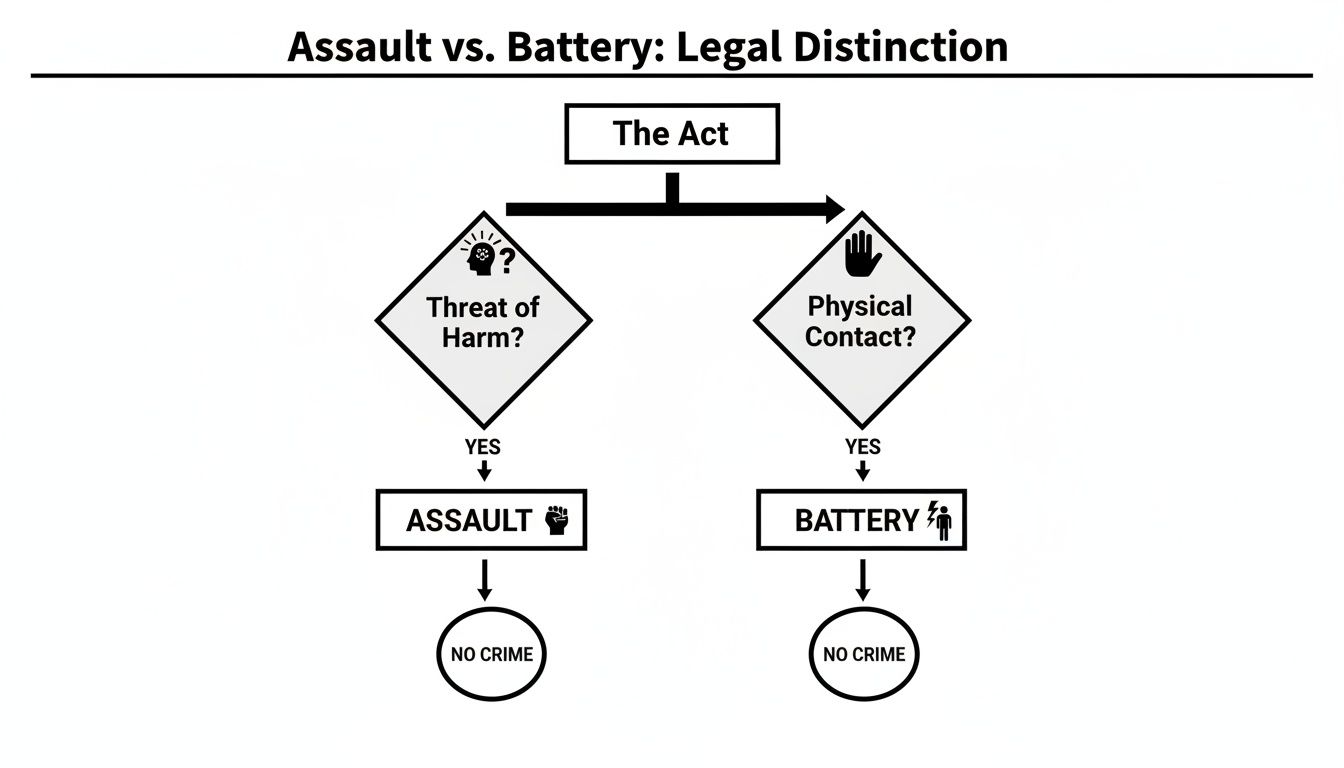
As you can see, the path a charge takes splits right away based on whether the act was a threat or involved physical harm. From there, the details determine just how serious it gets.
The Impact of a Deadly Weapon
One of the quickest ways for a charge to jump to a felony is the presence of a deadly weapon. A verbal threat might be a simple assault, but making that same threat while holding a knife, a baseball bat, or a gun instantly becomes aggravated assault—a serious felony.
And the term "deadly weapon" is broader than many think. Under Georgia law, it's not just about guns and knives. Any object used in a manner likely to cause serious bodily injury can qualify. There have been cases where a steel-toed boot, a broken bottle, or even a vehicle was classified as a deadly weapon. The use of an object like that shows a higher level of danger and intent, which is exactly what a prosecutor looks for to pursue a felony conviction. You can learn more about the critical difference between a felony and a misdemeanor to grasp the full weight of this distinction.
Intent to Cause Serious Bodily Harm
The defendant's state of mind—or intent—is another key piece of the puzzle. Did the person just intend to shove someone, or did they act with the goal of inflicting severe, lasting damage? Prosecutors will scrutinize the act itself to argue what the intent was. For example, a single punch thrown in a heated argument will likely be charged as simple battery.
But repeated blows, kicking someone who is already on the ground, or targeting a vulnerable part of the body—like the head or neck—can all be used as evidence of malicious intent. That malice is what elevates a simple battery to aggravated battery, a crime that carries far heavier penalties, including the real possibility of a long prison sentence.
The core question becomes: was the act intended to be merely offensive or provoking, or was it meant to disfigure, disable, or cause grave injury? The answer to that question often determines whether someone faces a misdemeanor or a felony.
The Victim's Status as an Escalating Factor
As we've touched on, the identity of the victim plays a huge role in how these cases are charged. An assault or battery against someone in a "protected class" automatically makes the situation far more serious. These classes include:
- Law Enforcement Officers: Any threat or violence against an on-duty police officer is prosecuted aggressively.
- Senior Citizens: Individuals aged 65 or older receive special protection under Georgia law.
- Public School Employees: This covers teachers, administrators, and even bus drivers while they're performing their official duties.
- Pregnant Women: Intentionally harming a pregnant woman is specifically defined as a high and aggravated misdemeanor or even a felony.
These laws are on the books to protect vulnerable people and public servants. An act that would be a simple battery if it happened to a regular citizen could easily become a felony with mandatory prison time if the victim is a police officer in Forsyth County or a senior citizen in Milton. This context is a crucial element that can completely change the outcome of a case.
Common Defense Strategies in Assault and Battery Cases
When a person faces an assault or battery charge in Georgia, it’s easy to feel like the story is already written. But the truth is, these situations are rarely black and white. Several recognized defense strategies can bring crucial context to the forefront, challenging the prosecution's version of events.
It’s not about finding loopholes. It's about ensuring the full story is told. Whether actions were taken to protect oneself, a loved one, or were simply misunderstood, these defenses are essential for a fair outcome. The right strategy always comes down to the specific facts of a case.
Self-Defense and Defense of Others
The most widely known defense is self-defense. The idea is straightforward: individuals have the right to protect themselves from harm. Under Georgia law, this means a person can use reasonable force if they genuinely believe it’s necessary to stop someone from causing them immediate bodily harm.
This principle also extends to protecting other people. If someone sees another person in imminent danger, they are generally allowed to step in with the same level of force the person being attacked could use. For example, if someone intervenes to stop an unprovoked attack on a stranger in a Marietta park, their actions could be justified under the "defense of others" doctrine. In either scenario, the key is that the force used must be proportional to the threat.
A critical point to remember is that the threat must be immediate. A self-defense claim won't hold up for retaliating against a past wrong or a vague threat of future violence. The law is designed to address present danger, not to settle old scores.
Georgia's Stand Your Ground Law
Georgia is a "Stand Your Ground" state, which adds a powerful layer to self-defense claims. According to O.C.G.A. § 16-3-21, a person generally has no "duty to retreat" before using force to defend themself, as long as they are in a place where they're legally allowed to be.
This means if someone confronts you in a public space in Alpharetta or even in your own home in Cumming, you are not required to try and escape before defending yourself against a credible threat. To learn more about how this works, you can read about Georgia's self-defense laws in detail. While this law is a strong tool, its success depends heavily on the specifics of the encounter, especially who the initial aggressor was and whether the fear of harm was reasonable.
The Role of Evidence in Building a Defense
A defense strategy is only as strong as the evidence supporting it. Today, evidence comes from everywhere, and every piece helps paint a complete picture of what really happened. Simply stating "it was self-defense" is never enough—it must be proven.
Here are some of the key types of evidence that are often looked for:
- Witness Testimony: Statements from neutral bystanders who saw what happened can be invaluable. They can confirm a version of the story, like who started the fight or that the alleged victim was actually the aggressor.
- Surveillance Footage: Video from security cameras, doorbell cameras, or cell phones is often the most objective evidence available. A clear video can instantly prove a self-defense claim or show that no crime occurred at all.
- Digital Communications: Text messages, emails, and social media posts can provide important context. They might reveal a history of threats from the other person or establish a state of mind leading up to the incident.
- Physical Evidence: The presence—or absence—of injuries on both people can speak volumes. For instance, defensive wounds might support a self-defense claim, while a total lack of injury on the alleged victim could undermine their story of a violent battery.
Ultimately, a successful defense strategy requires meticulously gathering and presenting all available evidence. Each piece is a building block in telling the true story of what led to the charge.
Special Considerations in Assault and Battery Cases
Assault and battery charges can get complicated fast. While a simple fight might seem straightforward, things change when you factor in the relationship between the people involved or the specific nature of the altercation. It’s critical to understand these special circumstances because they trigger entirely different legal processes and carry much heavier consequences.
These aren't treated like typical disputes. They fall under unique legal frameworks designed for sensitive and serious situations.
Domestic Violence and the Family Violence Act
When an assault or battery happens between family members, people living together, or current or former partners, it will likely be prosecuted under Georgia's Family Violence Act (FVA). This is a crucial difference because an FVA case adds a whole separate layer of civil penalties on top of the criminal charges. This means a person could face jail time and fines while also being hit with a Temporary Protective Order (TPO).
A TPO has an immediate and severe impact. The accused is often ordered to:
- Stop all contact with the alleged victim.
- Leave a shared home, even if they own it.
- Surrender any firearms.
- Pay temporary child support.
Violating a TPO is a separate crime in itself, which means new charges and more legal trouble. This dual-track system of criminal and civil actions makes domestic violence cases in places like Cobb County and Forsyth County extremely complex.
Navigating the Juvenile Justice System
When a minor under 17 is accused of assault or battery, their case usually goes to the juvenile court system. The focus here isn't the same as in the adult criminal world. The main goal is supposed to be rehabilitation instead of punishment, but the consequences can still be serious and follow a young person for years.
Instead of a criminal conviction, a guilty finding is called an "adjudication of delinquency." The potential outcomes, known as dispositions, can vary widely.
The juvenile system is designed to correct behavior, not just to punish. However, an adjudication of delinquency can still impact a young person's future, affecting everything from school records to future employment opportunities.
Possible dispositions might include:
- Strictly monitored probation.
- Mandatory counseling or therapy.
- Placement in a youth detention center (YDC).
For more serious offenses, especially those involving major injuries or weapons, a prosecutor can push to have the minor tried as an adult. This is a significant decision that exposes the juvenile to the full force of the adult criminal justice system and its much harsher penalties.
The Gravity of Sexual Assault and Battery
Sexual assault and battery are in a category all their own. In Georgia, these acts are defined by their non-consensual sexual nature and are prosecuted with extreme severity. A sexual battery charge, for example, involves unwanted physical contact with someone's intimate parts. Depending on the specifics, the charges can easily escalate to felony aggravated sexual battery. To see just how serious assault penalties can get, you can read our article on 1st-degree assault.
These cases are not only legally complex but also carry a heavy social stigma and the potential for lifelong consequences, including mandatory sex offender registration. The numbers from the U.S. Sentencing Commission underscore just how seriously these offenses are treated, revealing 57,287 reported cases in a single fiscal year. The statistics also show that 93.6% of sexual abuse offenders were men, a significant gender disparity in these cases. The penalties are designed to reflect the profound violation that these acts represent.
Long-Term Consequences of a Conviction
An assault or battery conviction isn't just about the immediate penalties like fines or jail time. It creates a ripple effect that can disrupt a person's life for years, long after the sentence is served. The table below breaks down some of the most significant long-term impacts, showing how both misdemeanor and felony convictions can affect a person's future.
| Area of Impact | Potential Misdemeanor Consequences | Potential Felony Consequences |
|---|---|---|
| Criminal Record | Permanent record, visible on background checks. | Permanent felony record, often disqualifying for certain rights. |
| Employment | Difficulty passing background checks for many jobs, especially in education, healthcare, or government. | Severely limited job prospects; often barred from licensed professions (e.g., law, medicine, real estate). |
| Housing | May be denied rental applications by landlords running background checks. | Extremely difficult to find housing; often barred from public housing. |
| Gun Rights | Potential loss of firearm rights, especially in domestic violence cases (Lautenberg Amendment). | Permanent loss of the right to own or possess firearms under federal and state law. |
| Voting Rights | Generally retained, but may be suspended while incarcerated. | Right to vote is lost while incarcerated and on probation/parole; must take steps to restore rights after sentence completion. |
| Social Stigma | Can damage personal and professional reputation within the community. | Carries a heavy social stigma that can lead to social isolation and damaged relationships. |
The distinction between a misdemeanor and a felony is vast, but as you can see, even a misdemeanor conviction can close doors that are hard to reopen. It's a permanent mark that can follow a person everywhere, impacting their ability to work, find a place to live, and even exercise constitutional rights.
Navigating the Legal Process After a Charge

Being charged with a crime like assault or battery in Georgia can be incredibly disorienting. One minute life is normal, the next a person is thrown into a complex system with its own rules, timelines, and terminology. The first step toward regaining some control is simply understanding the road ahead.
The process kicks off with an arrest, which leads to booking at a local jail in places like Cobb or Forsyth County. This is where a photo, fingerprints, and personal information are taken, officially entering the person into the system.
The Initial Stages of a Criminal Case
Shortly after an arrest—usually within 72 hours—there will be what's called a first appearance or bond hearing. A judge takes a quick look at the basic facts, states what the charges are, and decides if the person can be released on bond and under what conditions.
This hearing is a critical first hurdle. The bond is the money paid to get out of jail while the case proceeds, and the amount is based on things like how serious the charge is and the person's connections to the community.
Next, the prosecutor will formally file charges. This is done through an "accusation" for misdemeanors or an "indictment" from a grand jury for felonies. This is the official document that lays out the specific laws a person is accused of breaking.
A common misconception is that charges will just be dropped if the alleged victim changes their mind. The decision to prosecute belongs entirely to the State of Georgia, not the individual.
From Arraignment to Potential Trial
The next major court date is the arraignment. Here, a person stands before a judge as the formal charges are read, and is asked to enter a plea. The standard options are "guilty," "not guilty," or "nolo contendere" (no contest). Pleading "not guilty" at this stage is a standard procedure to keep all options open.
After arraignment, the case moves into the discovery and motions phase. This is the part where a defense team formally requests all the evidence the prosecutor has—police reports, witness statements, videos, everything. Pretrial motions can also be filed, which could be anything from challenging how evidence was collected to arguing for a full dismissal of the case.
From there, the case can go a few different ways:
- The charges could be dismissed by the prosecutor.
- A plea agreement might be negotiated.
- The case could be set for a trial.
Every step in this process, from an initial bond hearing in Roswell to a potential jury trial in Marietta, involves critical decisions. Getting through it requires a clear-eyed understanding of the legal map and an awareness of the process.
Common Questions About Assault and Battery Charges
When dealing with the justice system, things can get confusing fast. Here are a few answers to the questions most often heard about assault and battery in Georgia to help clear up some common misunderstandings.
Can Someone Be Charged with Assault If They Never Touched Anyone?
Yes, absolutely. In Georgia, physical contact does not have to be made for a person to be charged with assault. The law defines assault as any act that puts someone else in reasonable fear of immediately receiving a violent injury.
A threatening gesture, like raising your fist as if you're about to strike, can be enough. So can a menacing statement combined with some action that's clearly meant to intimidate. If the other person reasonably believed they were about to be hurt, that can be enough for an assault charge, even if they were never touched.
What Makes a Battery Charge Aggravated?
A simple battery charge gets elevated to aggravated battery when the act maliciously causes serious bodily harm. This doesn't refer to a minor bruise. This includes causing disfigurement, rendering a body part useless, or inflicting significant brain damage.
The key difference between simple battery and aggravated battery is the severity of the injury inflicted on the victim. A heated argument that ends in a shove is one thing; an attack that causes permanent harm is something else entirely in the eyes of the law.
The core difference really comes down to intent and outcome. Simple battery is about offensive contact or minor harm. Aggravated battery involves a malicious intent that results in severe, often life-altering, physical damage.
If Someone Else Starts a Fight, Is It Automatically Self-Defense?
No, it's not automatic. To successfully claim self-defense, the force used must have been reasonable and proportional to the threat being faced at that moment.
If a person responds with excessive force—or if they continue to fight after the immediate threat is over—they could find themselves facing criminal charges. The specific facts of what happened are critical in court when determining if a self-defense claim is valid.
Are Words Alone Enough to Be Considered an Assault?
Generally, no. Just words, without any accompanying action, are usually not enough to constitute an assault in Georgia.
However, when those words are combined with an action or gesture that makes a person reasonably fear they're about to be harmed, it can cross the line into assault. The context of the situation is everything. A verbal threat made while lunging at someone or holding an object is far more serious than a simple insult.
If you are looking for more information about an assault or battery charge in Alpharetta, Cumming, or anywhere in Forsyth or Cobb County, you can find more resources online. Contact Brian Hansford Law for experienced guidance by visiting https://challengemycharge.com.
