
Getting pulled over is almost always a stressful experience, but knowing exactly what to do can help keep things calm from the very beginning. The most important thing is to remain predictable and safe, which sends a clear signal to the officer that you plan to cooperate. Your first few actions really do set the tone for the entire stop.
What to Do When You See Flashing Lights
The second you spot those flashing lights in your rearview mirror, a few simple, deliberate actions can make all the difference. Traffic stops are the most common way the public interacts with law enforcement in the United States. To give you some perspective, police stopped more than 12 million drivers in 2022 alone.
Given how frequent these encounters are, it helps to have a clear game plan. Think of it as a mental checklist for the first 60 seconds of the stop, designed to create a safe, predictable environment for everyone involved.
Safely Pulling Over
First things first: you need to acknowledge the officer and pull over safely. Flip on your right turn signal right away. This tells the officer you see them and you’re complying.
Next, find a safe spot to stop. Look for the right-hand shoulder, a quiet side street, or a well-lit parking lot if you’re near one. The key is to avoid stopping in a live traffic lane, on a bridge, or anywhere that could block traffic or create a hazard.
Once you’re stopped, what you do inside the car is just as critical. Kill the engine, roll your driver’s side window all the way down, and—if it’s dark—turn on your interior dome light. These small steps allow the officer to see into your car, showing them you aren’t a threat and helping to de-escalate any potential tension before it even starts.
This image breaks down the most common reasons drivers get pulled over.
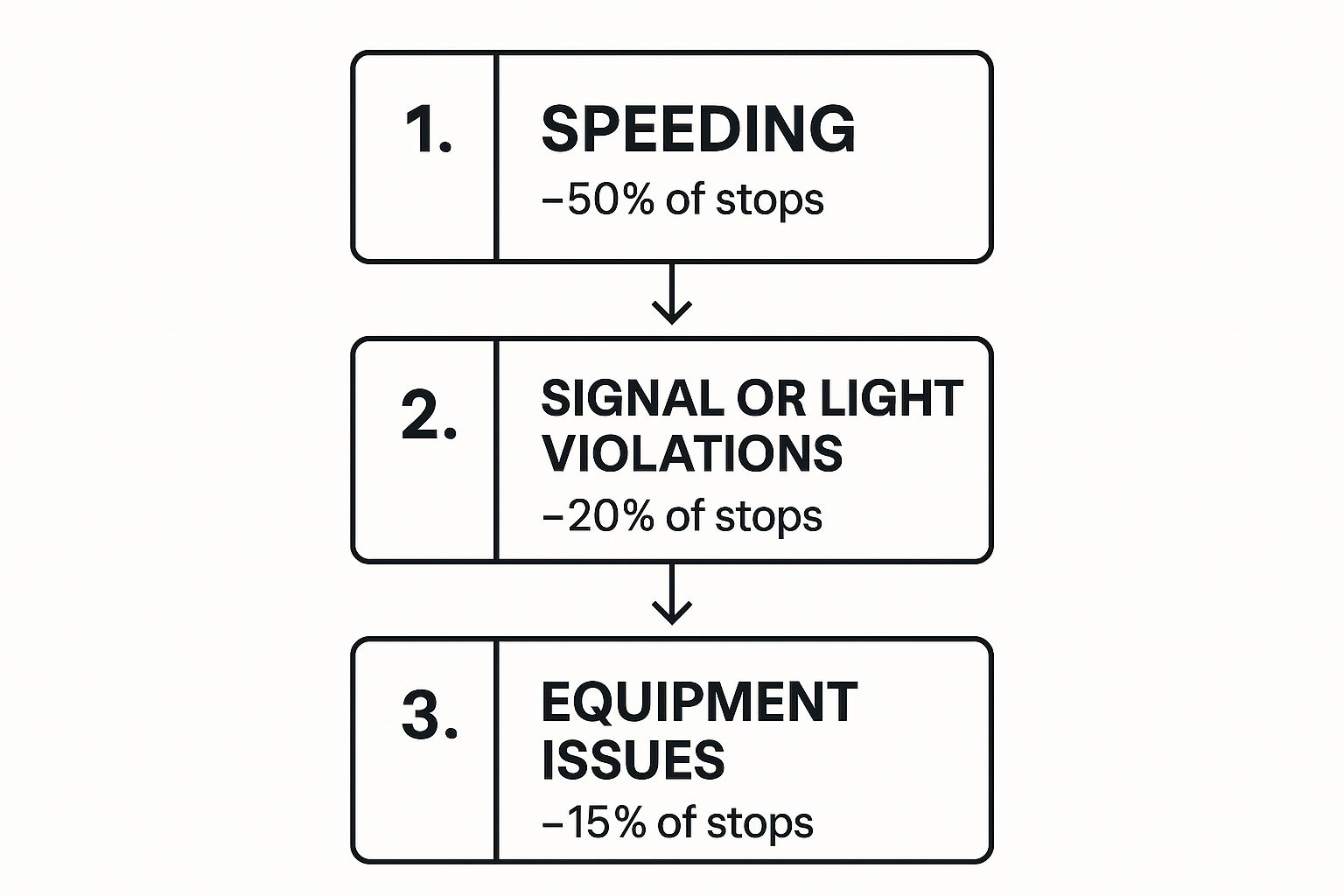
As you can see, most stops are for simple moving violations or equipment issues.
To make these initial steps even clearer, here’s a quick-reference table.
Your Initial Actions During a Traffic Stop
This table outlines the immediate steps you should take to ensure safety and clarity when being pulled over.
| Action | Why It Matters |
|---|---|
| Acknowledge with Turn Signal | Immediately shows the officer you see them and intend to comply with the stop. |
| Pull Over Safely & Promptly | Choose a safe location like the right shoulder or a side street to avoid creating a traffic hazard for you or the officer. |
| Turn Off Engine & Turn On Interior Light (at night) | De-escalates the situation by making it easier for the officer to see inside your vehicle and assess the environment. |
| Roll Down Driver’s Window | Opens a clear line of communication and demonstrates your willingness to interact. |
| Place Hands on Steering Wheel | A universal sign of cooperation that keeps your hands visible and shows you are not a threat. |
| Wait for Instructions | Avoids sudden movements. Wait for the officer to ask for documents before you start reaching for them. |
Following these steps methodically helps keep the interaction calm and straightforward.
Keeping Your Hands Visible
After you’ve pulled over and stopped the car, put both of your hands on the steering wheel where they can be easily seen. This is a powerful, non-verbal way to show you’re being cooperative.
It’s crucial to avoid any sudden movements. Don’t start digging through your glove compartment, reaching under the seat, or fumbling in your pockets. The officer approaching your car has no idea what to expect, and keeping your hands in plain sight is one of the best ways to signal that you are not a threat.
The initial moments of a traffic stop set the tone for the entire interaction. Calm, deliberate actions demonstrate respect and an intention to cooperate, which can help ensure the process is as smooth and efficient as possible for everyone involved.
Just wait for the officer to get to your window and give you instructions. When they ask for your license, registration, and insurance, tell them where the documents are before you move to get them. For example, you could say, “My wallet is in my back pocket. I am going to reach for it now.” Narrating your actions like this eliminates surprises and helps keep the situation calm.
Understanding the Reasons for a Traffic Stop
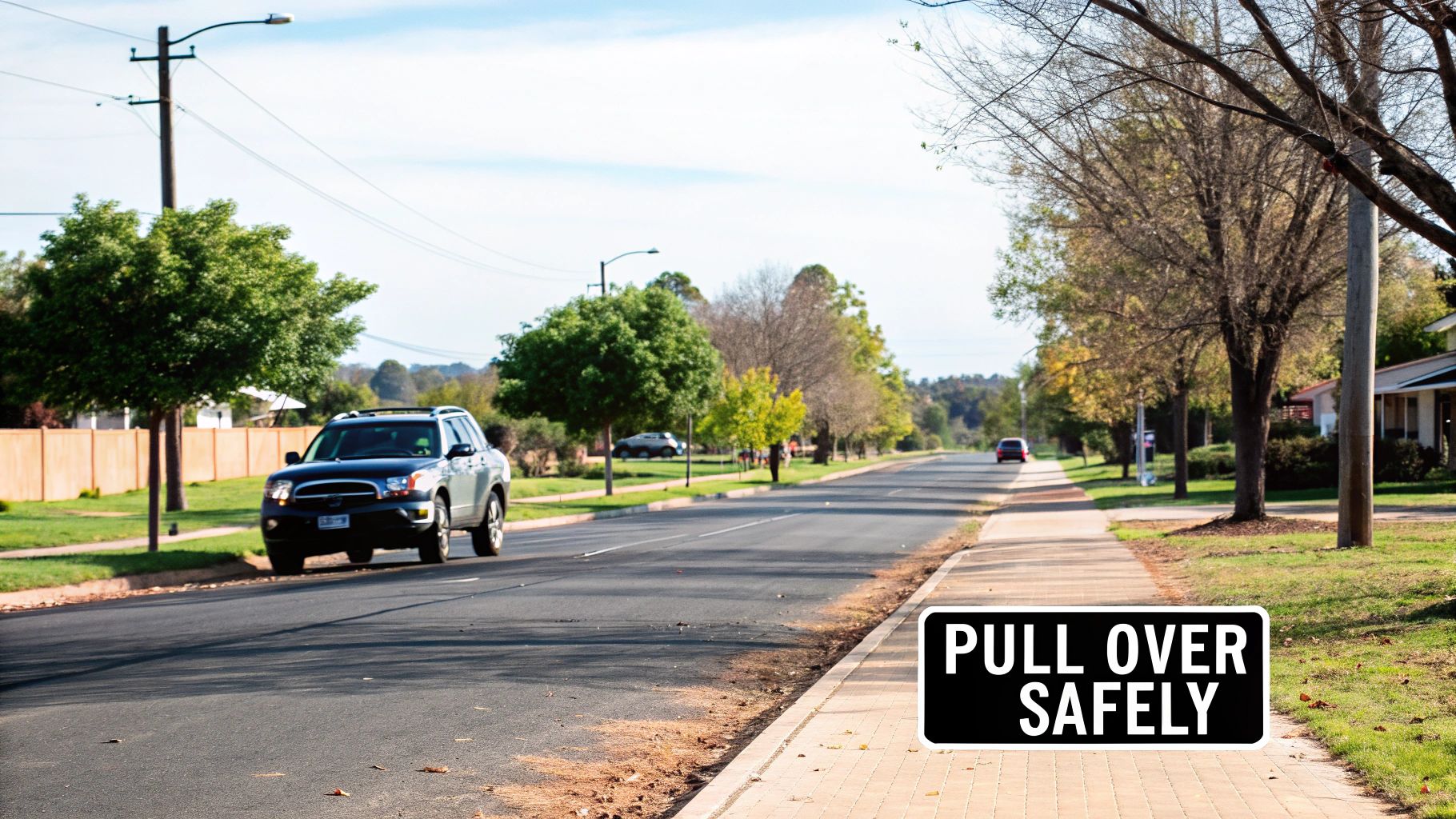
It almost always starts with the same question: “Why me?” When those blue and red lights flash in your rearview mirror, your mind races. While speeding is the reason everyone knows, officers can initiate a traffic stop for a whole host of issues.
Knowing what officers are trained to look for isn’t about pointing fingers; it’s about being an aware, defensive driver. It can help you stay on top of vehicle maintenance and, hopefully, reduce your chances of getting pulled over in the first place.
Generally, traffic stops fall into a few key categories, each tied to a different part of driving and vehicle ownership.
Common Moving Violations
The most frequent reason for a traffic stop is a moving violation. These are simply actions a driver takes that break traffic laws while the car is in motion. Think of them as violating the active “rules of the road.”
Obvious ones like speeding or running a red light come to mind, but plenty of less obvious mistakes can also get you pulled over.
A few common moving violations include:
- Improper Lane Changes: Weaving between lanes without a signal or cutting someone off.
- Following Too Closely: This is just a formal term for tailgating, and it creates a serious safety hazard.
- Illegal Turns: Making a U-turn where it’s prohibited or turning from the wrong lane.
- Failure to Yield: Not giving the right-of-way to pedestrians or other cars when you’re required to.
These laws exist to keep traffic flowing safely and predictably. When an officer sees one of these violations, they may pull you over to address the immediate risk.
Equipment and Administrative Issues
Not every stop is about how you’re driving. Sometimes, the problem is with the vehicle itself or its paperwork. These are often called “non-moving” violations because they’re an issue whether the car is parked or on the highway.
An equipment violation means some part of your car isn’t working as required by law. It could be as simple as a burned-out headlight, a broken taillight, or window tint that’s too dark. Keeping up with basic vehicle maintenance is your best defense against these stops.
An administrative violation is all about your vehicle’s status. This means things like an expired registration sticker on your license plate or lapsed insurance. Officers can easily spot an expired tag from a distance, making it a very common reason for a stop.
The reasons behind traffic stops are a major topic of public debate right now. Policy changes that limit the scope of these stops have shown real results. In Los Angeles County, for example, after new limits were put in place, there was a 21% drop in total traffic stops between March and December 2022 compared to the same period in 2021. Equipment-related stops—often seen as inefficient—fell by a staggering 60%.
The Concept of a Pretextual Stop
Now and then, an officer might use a very minor traffic or equipment violation as an excuse—a pretext—to pull someone over and investigate an unrelated suspicion. This is what’s known as a pretextual stop. For example, an officer might stop a driver for a tiny crack in a taillight because they have a hunch something else is going on.
The key here is that the initial reason for the stop is technically a legitimate, though minor, violation. This gives the officer the justification to interact with the driver. It’s a complicated area of the law, and the rules can vary.
While the small violation is the official reason, it might not be the real reason for the officer’s interest. This is a big reason why it’s so important to understand all the minor things that can trigger a stop. For a deeper dive on this, you might be interested in our guide on whether police can stop you for no reason.
Navigating Your Conversation With an Officer
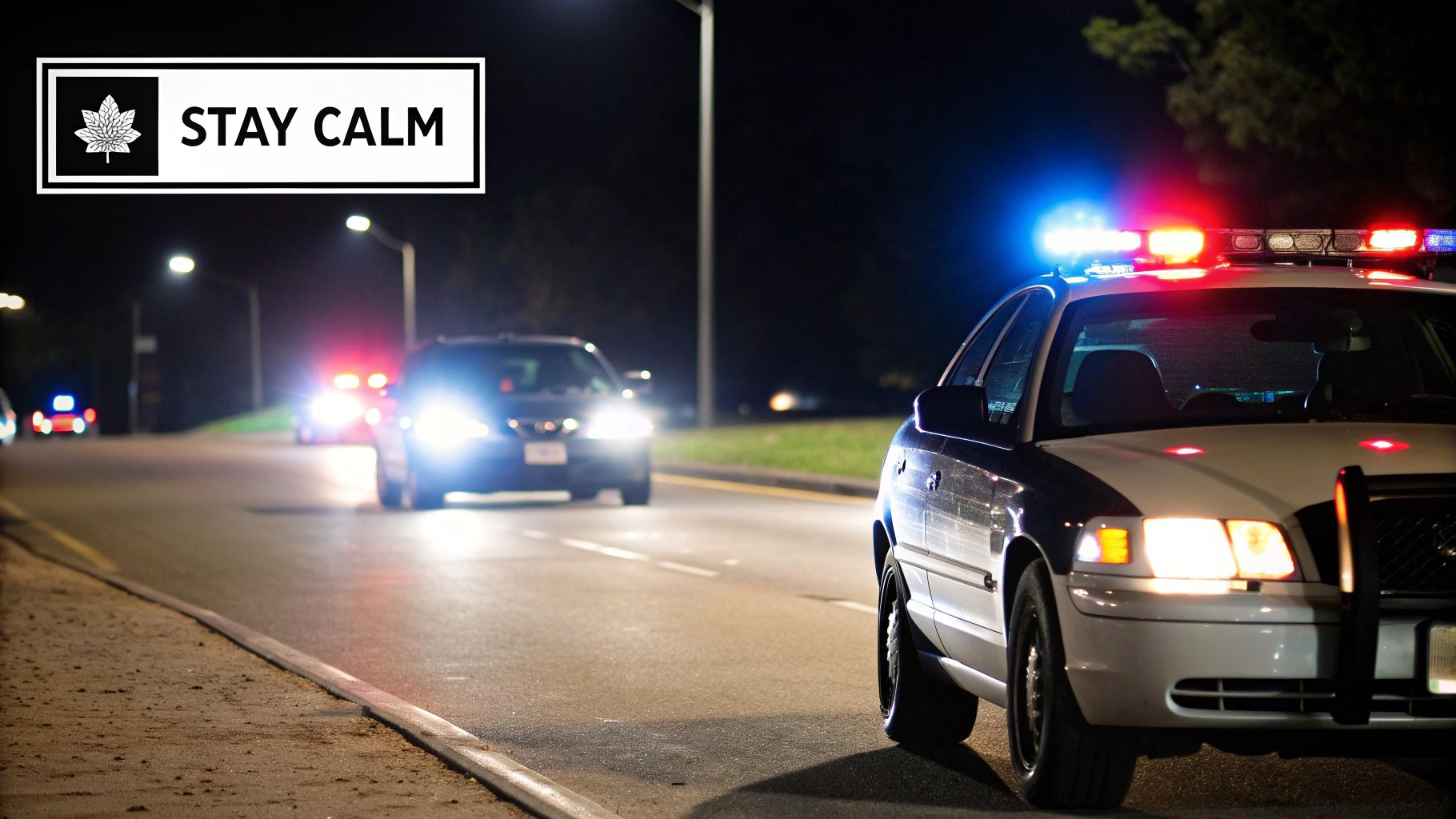
The conversation you have during a traffic stop isn’t a casual chat—it’s a formal interaction where your words and actions carry significant weight. How you communicate, both with what you say and what you do, can steer the entire encounter. Staying calm, being polite, and speaking directly is always a good approach. It helps the stop go smoothly for everyone involved.
From the moment an officer walks up to your window, they are observing you. Your goal should be to cooperate without accidentally saying or doing something that complicates things for yourself. It’s a delicate balance, but one you can manage effectively.
The Dos and Don’ts of Communicating
When the officer starts asking questions, the golden rule is to be respectful but brief. Less is truly more in this situation. Answer the direct questions you’re asked, but fight the urge to over-explain, tell a long story, or volunteer information the officer didn’t request.
For instance, if you’re asked, “Do you know why I pulled you over?” a simple “No, officer” is a complete and perfectly fine answer. Trying to guess or launching into an explanation might just give the officer more information than they need.
Here are a few practical tips to keep in mind:
- Do Keep Your Hands Visible: The first and most important thing is to keep your hands on the steering wheel where the officer can see them. This is a clear, non-verbal signal that you are not a threat.
- Do Be Polite: Using “sir,” “ma’am,” or “officer” is a sign of respect that helps keep the interaction professional.
- Don’t Make Sudden Movements: If you need to reach for your license or registration, tell the officer what you’re about to do before you do it. Say something like, “Officer, my registration is in my glove box. I’m going to reach for it now.”
- Don’t Argue: The side of the road is not the courtroom. Trying to debate the ticket or the reason for the stop won’t change the outcome and will only escalate the tension.
Following these guidelines creates a predictable, non-confrontational environment that benefits both you and the officer.
Answering Questions and Providing Documents
You will always be asked for your driver’s license, vehicle registration, and proof of insurance. It’s a good idea to have them easily accessible.
Beyond that, the officer might ask other questions. It’s crucial to understand that while you must provide your documents, you are not required to answer questions that could incriminate you, such as, “How much have you had to drink tonight?”
Answering questions during a traffic stop requires careful consideration. While politeness is essential, it is equally important to be mindful of the information you share. A calm and direct approach can help protect your interests while fulfilling your obligations.
This is where the exchange can get tricky. You have the right to politely decline to answer certain questions. Remember, an officer needs a specific level of suspicion to dig deeper than a routine stop, and your answers can sometimes provide that. You can learn more about the standard officers must meet by reading our posts on reasonable suspicion.
Remaining Calm Under Pressure
Let’s face it, getting pulled over is stressful for anyone. But your ability to manage that stress is one of the most powerful tools you have. When you stay calm, you can think more clearly, listen to what’s being said, and respond in a measured way.
If you feel your anxiety rising, just take a slow, deep breath. Focus on one instruction at a time. Your calm demeanor goes a long way toward de-escalating the situation and shows the officer you’re cooperative and in control.
Keep in mind, the officer is also trying to keep the situation safe. By staying composed and predictable, you’re helping create a safer interaction for everyone. A calm driver is much easier to communicate with, and that helps get the stop over with as quickly as possible.
A Guide to Vehicle Searches
Nothing ramps up the anxiety of a traffic stop quite like an officer asking to search your car. The rules can feel murky, but they generally boil down to a few key situations. Knowing what’s what can help you understand what’s happening if you ever find yourself in this position.
This guide is purely for your information—the goal is simply to walk you through the common reasons an officer might conduct a search during a stop.
Searches Based on Consent
The most straightforward scenario is a consent search. This is exactly what it sounds like: an officer asks for your permission to search your vehicle, and you say yes. They might ask, “Do you mind if I have a look inside your car?”
If you give consent, they can search. It’s crucial to know that you have the right to decline. A simple, polite, “Officer, I do not consent to a search” is all you need to say. Granting permission is completely voluntary, and without it, an officer needs another reason to proceed.
The Standard of Probable Cause
Another critical term you’ll hear is probable cause. This is a much higher bar than the “reasonable suspicion” an officer needs just to pull you over. Probable cause means the officer has solid facts or evidence to reasonably believe a crime has been committed and that your vehicle contains evidence of that crime.
Here’s a simple way to think about it: reasonable suspicion is like seeing smoke in the distance. It suggests there might be a fire. Probable cause is getting closer and not only seeing the smoke but also smelling burning wood and seeing flames—a much stronger reason to believe a fire is actually happening.
So, what gives an officer probable cause? It usually comes down to what they can see, smell, or hear. For instance, if an officer walks up to your window and smells a strong odor of marijuana or sees drug paraphernalia on the passenger seat, that can be enough to establish probable cause to search your car.
The standard for a search is much higher than for the initial stop. An officer can’t just go on a hunch; they need specific, concrete facts pointing to evidence of a crime before they can search without your permission.
The Plain View Doctrine
This idea leads right into the plain view doctrine. This principle allows an officer to seize evidence without a warrant if it’s sitting out in the open, clearly visible from where they are allowed to be. During a traffic stop, if an officer sees something illegal inside your car just by looking through the window, they can generally take action.
For the plain view doctrine to apply, two conditions must be met:
- The officer must be in a lawful position to see the item. Standing beside your car during a valid traffic stop counts.
- The illegal nature of the item must be immediately obvious. A bag of what looks like narcotics on the dashboard is a clear example.
This is why it’s always a good idea to keep your car tidy, especially the dashboard and seats. It simply reduces the chance of anything being misunderstood or seen from the outside.
An Overview of Different Search Scenarios
To tie these ideas together, the table below breaks down the common situations that might lead to a vehicle search. Again, this is just for your general understanding.
| Search Scenario | General Informational Description |
|---|---|
| Consent Search | The driver voluntarily gives the officer permission to search the vehicle after being asked. |
| Probable Cause Search | An officer has a reasonable belief, based on tangible evidence (like sight or smell), that the vehicle contains evidence of a crime. |
| Plain View Doctrine | An officer sees an illegal item in clear sight from outside the vehicle during a lawful stop. |
| Search Incident to Arrest | If a driver is arrested, officers may be able to search the area within the person’s immediate control at the time of the arrest. |
By understanding these different types of searches, the process becomes much less of a mystery. Each scenario is governed by its own rules, all designed to balance the needs of law enforcement with your individual rights.
How Traffic Stop Practices Are Changing
The experience of being pulled over isn’t static. It’s constantly shaped by bigger conversations happening around law enforcement, public safety, and community trust. All across the country, police departments are rethinking traffic stop procedures and priorities, often driven by new internal policies and public feedback.
If you understand this evolving landscape, you get a much clearer picture of modern policing. It explains why the reasons for getting pulled over—and how often it happens—can vary so much from one town to the next, or even from one year to the next.
Shifting Enforcement Priorities
Lots of law enforcement agencies are taking a hard look at how they handle minor infractions. In the past, getting stopped for something small like a single broken taillight or an expired tag was pretty common. Now, a growing number of departments are deliberately moving away from these kinds of stops.
The logic is simple: free up officers to focus on genuine public safety threats. Things like high-speeding, reckless driving, and DUIs pose a much greater risk to everyone on the road. This shift is a direct result of community input and internal data showing that targeting dangerous driving is a far more effective use of police resources.
So, while you’re just as likely to get pulled over for doing 20 over the speed limit, you might be less likely to see those blue lights for a minor equipment issue than you would have been a few years ago.
The Impact of New Policies
When you look at the data from cities making these changes, the trend is undeniable: fewer traffic stops overall. This isn’t just a random dip; it’s the direct outcome of new policies instructing officers to prioritize violations that create an immediate threat to public safety.
For instance, some departments have specifically told their officers to stop focusing on low-level infractions that don’t directly endanger others. This strategic move is designed not only to improve community relations but also to make sure that enforcement actions are tied directly to making the roads safer.
The numbers often tell a powerful story about policy changes. When departments alter their enforcement priorities, the data on traffic stops can change dramatically, reflecting a new approach to policing the roads.
A perfect example comes from Rochester, New York. The city hit a peak of 8,037 traffic stops back in 2017. After re-evaluating their strategies, that number dropped steadily year after year, landing at just 2,107 stops in 2023. That’s a massive 74% decrease from the peak and shows just how much policy can reshape the on-the-ground reality of a traffic stop. You can dig deeper into these trends in Rochester policing to see the full picture.
Building Community Trust
At the end of the day, these changes are part of a much larger effort to build stronger, more positive relationships between police and the communities they serve. When people feel that traffic stops are being conducted fairly and for legitimate safety reasons, it goes a long way toward building trust.
By focusing on truly dangerous driving, police departments aim to make the roads safer while cutting down on negative interactions over minor issues. This evolving strategy is reshaping what it means to be pulled over, with a clear emphasis on addressing real safety hazards. The goal is a more targeted and effective approach to traffic enforcement for everyone.
Common Questions About Being Pulled Over
Even after you know the basics of a traffic stop, it’s the specific, lingering questions that can cause the most stress. When those blue lights flash in your rearview mirror, all that theoretical knowledge suddenly gets very real, very fast.
This section is designed to be a quick-reference guide. We’ll tackle some of the most common “what if” scenarios drivers ask about, giving you clear, direct information to help you feel more prepared on the road.
What If I Am a Passenger During a Stop?
Being a passenger when a car gets pulled over is an awkward spot. The good news is that the stop is almost always directed at the driver and the vehicle, not you.
For the most part, you are not required to provide identification unless the officer has a reasonable suspicion that you, personally, have committed a crime. While the driver has to hand over their license and registration, passengers don’t have that same obligation. That said, it’s always a good idea to stay calm, keep your hands visible, and avoid interfering with the officer’s interaction with the driver. Any sudden movements or argumentative behavior can escalate a simple stop into something much more complicated.
Can I Record the Traffic Stop?
With a smartphone in nearly every pocket, this question comes up a lot. The general understanding is that you have a right to record police officers in public, and that includes a traffic stop, as long as you aren’t interfering with their duties.
If you decide to record, do it openly. You can place your phone on the dashboard or have another passenger hold it. The most important thing is that the act of recording doesn’t get in the way of the officer or create a safety issue for anyone involved.
Recording can create a valuable, objective record of the entire interaction. Just make sure it doesn’t prevent you from complying with orders, like keeping your hands in plain sight.
Do I Have to Get Out of the Car?
This is a critical point to understand. If a police officer orders you to step out of your vehicle during a traffic stop, you are generally required to comply. This is widely considered a matter of officer safety, and courts have consistently upheld their authority to make this command.
Refusing to exit the car when ordered can lead to new problems, including potential charges for obstruction. The best approach is to calmly follow the instruction. Once you’re outside the car, keep your hands visible and wait for the officer’s next directions.
What Happens If a Stop Leads to an Arrest?
Most traffic stops end with a warning or a ticket, but sometimes they escalate. If an officer develops probable cause to believe a more serious crime has been committed, an arrest can happen right there on the roadside.
At that point, the encounter shifts from a simple stop to the formal criminal justice process. You will likely be transported to a police station for booking. To understand what that involves, you can read our detailed guide on what happens when someone is arrested. This resource breaks down all the steps that follow an arrest.
Can I Refuse a Breathalyzer Test?
This is a complex area. Many states, including Georgia, have “implied consent” laws. This means that by accepting a driver’s license, you have already agreed to submit to a chemical test (like a breathalyzer or blood test) if an officer has probable cause to suspect you’re driving under the influence.
Refusing that test isn’t a free pass. It often triggers automatic administrative penalties, like an immediate driver’s license suspension, completely separate from any DUI case. So, while you can refuse, that refusal has its own serious consequences.
It’s helpful to know the different types of tests you might face:
- Field Sobriety Tests: These are the physical coordination tests, like the walk-and-turn or one-leg stand. In most places, these are voluntary, and you can politely decline to perform them.
- Preliminary Alcohol Screening (PAS): This is the small, portable breathalyzer used on the side of the road. Depending on state law and your age (for instance, if you’re under 21), you may be able to refuse this test without penalty.
- Evidentiary Chemical Test: This is the formal breath or blood test, usually done at the police station after an arrest. This is the test tied to implied consent laws, and refusing it is what triggers the harshest automatic penalties.
Understanding the difference between these tests is crucial. Each one serves a different purpose in an officer’s investigation and carries different weight.
