
That phone call is one of the worst you can get. A friend or family member is in jail, and you’re the one they’ve reached out to for help. When you’re trying to figure out how to bond someone out of jail, the whole system can feel overwhelming and confusing.
The key is to push past the initial panic and start methodically gathering the right information. A clear head and a focused plan will get you much further than frantic, repeated calls.
What to Do Immediately After an Arrest in Georgia

Those first few hours after an arrest are swimming in uncertainty. While your loved one is being processed by law enforcement, your job is to become an information-gatherer. This isn't about moving fast; it’s about being accurate.
Understanding the Booking Process
Before anyone can be bonded out, they have to be "booked." This is just the standard administrative grind of taking fingerprints, snapping a mugshot, and logging personal details into the jail’s system. For a more detailed breakdown of this first stage, you can read our guide on what happens when you get arrested.
This process isn't instant. It can easily take several hours, especially at larger facilities like the ones in Cobb County or Forsyth County. During booking, the person arrested usually can't make calls or be released. It's frustrating, for sure, but it's a completely normal part of the process.
Just knowing that a few hours of processing time is standard can help manage stress. The goal is to have everything ready to go the moment they’re officially in the system and a bond can be posted.
Gathering Critical Information for Release
To post a bond successfully, you need exact details. Any wrong or missing information will bring everything to a screeching halt. Before you even think about calling the jail or a bail bondsman, get these facts straight:
- Full Legal Name: No nicknames. You need their complete, legal name exactly as it shows on their driver's license or ID.
- Date of Birth: This is a crucial identifier, especially for common names.
- The Specific Jail Location: This is a big one. An arrest in Milton doesn't guarantee they're at the Milton jail. They could be transported to the main Fulton County Jail in Atlanta. You have to confirm where they physically are.
Luckily, most Georgia counties, including Forsyth and Cobb, have online inmate search tools on their sheriff's office websites. These databases are almost always the quickest way to confirm someone's location and get their booking number—another vital piece of information you’ll need. If you strike out online, a polite call to the jail's main, non-emergency phone number is the next logical step.
Decoding Your Georgia Bond Options
When you get that dreaded call saying a loved one is in jail, the terminology thrown around can be overwhelming. At its heart, a bond is a financial promise made to the court. It’s an assurance, backed by money or property, that the person arrested will show up for every required court date.
Getting a handle on the different types of bonds available in Georgia is a first step toward making a clear-headed decision in a deeply stressful situation.
You’ll generally run into three main options: a Cash Bond, a Surety Bond, and a Release on Recognizance (ROR) bond. Each one works differently, and the best choice hinges on a person's financial situation and the details of the case.
Cash Bonds Explained
A cash bond is exactly what it sounds like. You pay the entire bond amount directly to the court clerk. If a judge sets bond at $5,000, you have to deliver $5,000 in cash, a cashier's check, or another approved payment form right to the jail or courthouse.
The biggest upside here is financial. As long as the defendant makes every court appearance, the full bond amount is returned to you when the case is over (minus minor administrative fees). The obvious drawback, of course, is coming up with a large sum of money on short notice, which just isn't realistic for most families.
Understanding Surety Bonds
This is the most common route and the one that involves a bail bonding company. With a surety bond, you hire a licensed bondsman to post the bond for you. You pay them a non-refundable fee—typically between 10% and 15% in Georgia.
So, for that same $5,000 bond, you would pay the bondsman a fee of $500 to $750. They then post a guarantee for the full $5,000 with the court, taking on the financial risk. This option is popular because it makes getting someone out of jail much more affordable in the short term. The U.S. bail bond industry is massive—expected to hit $3.5 billion by 2025—which shows just how many families in places like Cumming and Roswell rely on this service. You can learn more about the growth of the bail bond industry from IBISWorld.
Key Takeaway: The fee you pay a bondsman is never refundable. You are paying for a service, and that service is complete the moment your friend or family member walks out of jail.
The Possibility of an ROR Bond
A Release on Recognizance (ROR) bond costs absolutely nothing. A judge can grant an ROR when they are confident the person arrested isn't a flight risk and has solid ties to the community. The defendant is released on their signature alone, which is a written promise to return for court.
This is the ideal outcome, but it’s entirely up to a judge. ROR is typically reserved for people with little to no criminal history who are facing minor, non-violent charges. To better understand the mechanics of how judges make these decisions, check out our guide on how bail works in Georgia.
Comparing Your Georgia Bond Options
To make it a bit clearer, here’s a quick breakdown of your main choices when posting bond in Georgia.
| Bond Type | What You Pay | Is It Refundable? | Best For… |
|---|---|---|---|
| Cash Bond | The full bond amount | Yes, minus court fees, after the case is over. | Situations where you have the full cash amount available and want it back. |
| Surety Bond | A 10-15% non-refundable fee to a bondsman. | No, this is the bondsman's fee for their service. | Most situations, as it requires the least amount of cash upfront. |
| ROR Bond | $0 | N/A | Minor offenses when a judge grants it based on low flight risk. |
Each of these paths serves a different purpose. Knowing the financial realities and what you're committing to from the start is absolutely vital.
The Process of Posting Bond in North Georgia
Once you’ve figured out your bond options, the next step is actually getting it done. The process to bond out of jail can feel overwhelming, but it really boils down to two paths, whether you’re at the Forsyth County Jail or a smaller city jail in Alpharetta or Roswell. You’ll either pay the whole amount yourself or hire a bondsman to post it for you.
This flowchart breaks down the basic steps, from the moment of arrest all the way to release.
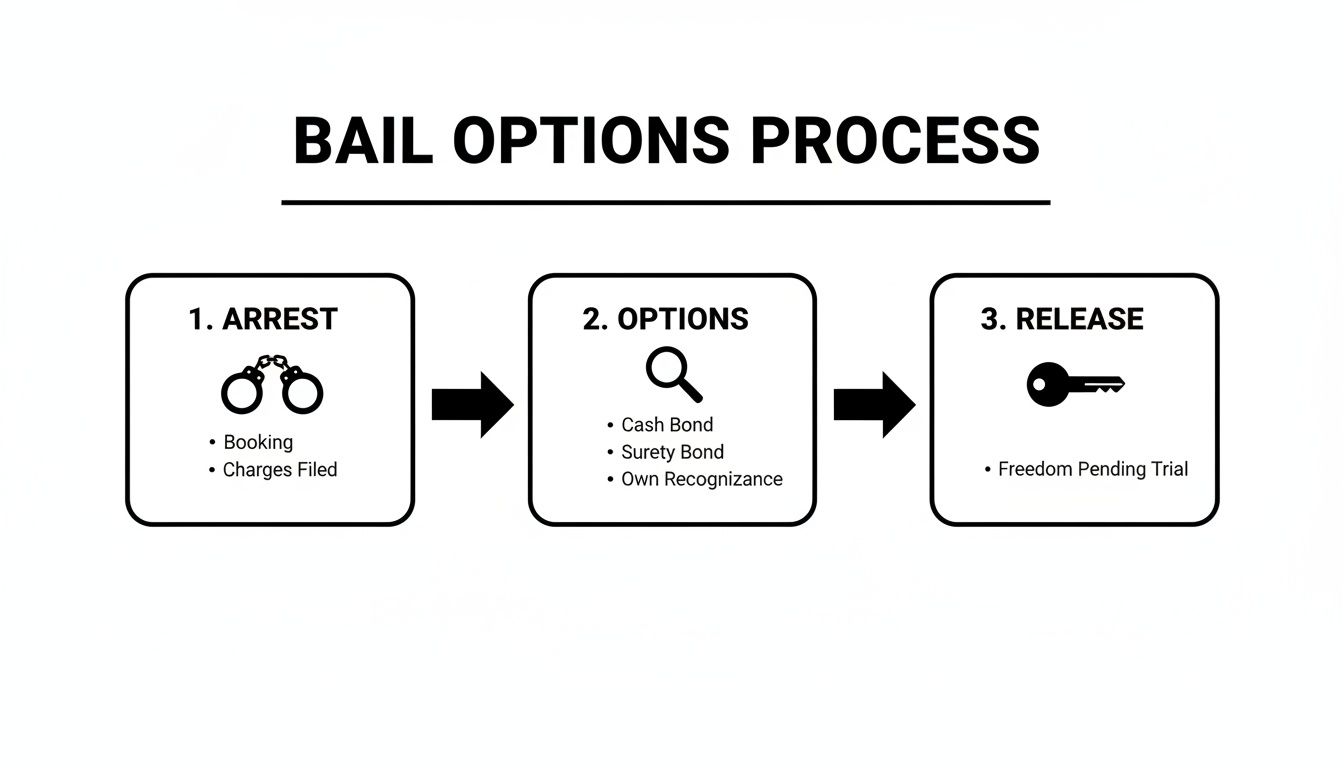
As you can see, that moment after an arrest forces a critical decision for any family: how to secure that release.
The Cash Bond Route
If the funds are available, you can post a cash bond. This means you are responsible for paying the entire bond amount directly to the jail or courthouse. For example, if the judge sets a $2,500 bond, you have to show up with $2,500 in hand.
Just be aware that every jurisdiction has its own way of doing things:
- Payment Forms: Most jails in places like Cobb County and Johns Creek will take cash or a cashier's check. Personal checks are a definite no-go.
- Location: You almost always pay the bond right at the jail where your loved one is being held. It’s a good idea to call ahead to confirm the exact location and the hours they accept bond payments.
- Documentation: You’ll need your own valid government-issued ID, plus the inmate's full name and booking number.
This is the most direct path, but it obviously requires having a large sum of cash ready to go. The big advantage here is that you get that money back (minus minor court fees) once the case is completely over.
Working with a Bail Bondsman
For most families, hiring a bail bondsman is the more realistic option. This is what’s known as a surety bond. Instead of coming up with the full bond amount, you pay the bondsman a non-refundable fee—typically 10-15% of the total.
So, for that same $2,500 bond, you’d pay the bondsman somewhere between $250 and $375. In return, the bondsman posts a guarantee for the full $2,500 with the court, taking on the financial risk if the defendant doesn't show up for their court dates.
Be prepared to give the bondsman a lot of information. They'll need the defendant’s full name, date of birth, booking number, the specific charges, and the name of the jail where they're being held.
The huge plus here is the much lower upfront cost, which lets you get someone out of jail quickly without having to empty a bank account. The key thing to remember, though, is that the fee you pay the bondsman is for their service. It’s never returned, no matter how the case turns out.
Sometimes, a bond isn't set automatically, and you need a formal hearing to get one. You can learn more about that separate process in our guide on what happens at a bond hearing. Ultimately, deciding which route to take comes down to one's financial situation and comfort level.
How Georgia Courts Determine Bond Amounts
It can feel like a complete mystery how a judge or magistrate lands on a specific bond amount. It’s not just a number pulled out of thin air. In Georgia, the process is actually a mix of pre-set schedules and a judge’s own discretion, all aimed at making the amount fit the crime and the individual.
For a lot of common charges, especially misdemeanors, courts in places like Cobb and Forsyth County rely on something called a bond schedule. Think of it as a pre-approved price list for specific offenses. If someone gets arrested for a charge on that list, they can often post bond right away without ever seeing a judge, which really speeds up the whole process of getting out of jail.
Factors a Judge Considers
When the charge isn't on the bond schedule, or if it's a more serious accusation, a judge has to get personally involved. They don't just guess; they weigh several critical factors to arrive at a decision.
A judge will carefully look at:
- The Severity of the Alleged Crime: A DUI charge in Roswell is almost guaranteed to have a lower bond than a serious felony charge filed in Forsyth County.
- The Defendant's Criminal History: Someone with a clean record is viewed very differently than a person with a long history of similar offenses.
- Ties to the Community: Do they have a steady job in Milton? Does their family live in Johns Creek? Strong local connections suggest a person is much less likely to disappear.
- Potential Flight Risk: The judge has to make a call on whether the individual might try to leave the state or country to avoid facing their court dates.
Putting It All Together: A Scenario
Let's imagine two very different situations. First, you have a long-time East Cobb resident with a stable career and no prior arrests who is charged with shoplifting. A judge, seeing the strong community ties and the low-level offense, would likely set a pretty low bond—or maybe even grant a Release on Recognizance (ROR).
Now, contrast that with someone facing a serious drug trafficking charge in Marietta. This person has few local connections and a history of skipping court dates. In that case, a judge will see a major flight risk and a potential danger to the community, leading to a much, much higher bond amount to make sure they show up for court.
The bail bond system is a massive piece of the American justice process. It's a huge industry that facilitates over two million bailouts in the U.S. every single year, handled by roughly 15,000 bail agents. This just goes to show how often families find themselves trying to figure this all out. You can find more insights into the global bail bond services market from Kentley Insights.
Once you understand these factors, it becomes clear that a bond amount isn’t arbitrary at all. It’s a calculated figure based on a risk assessment—an attempt to balance a person's right to be out of jail before trial with the need to protect the community and see that justice is done.
The Attorney's Role in the Bond Process

When a friend or family member is behind bars, the primary goal is to get them out. Fast. While a bail bondsman is a key player for the financial side of things, a criminal defense attorney plays a completely different—but just as critical—role in the push to bond out of jail.
Their work can start immediately, helping cut through the noise and confusion that families often face alone. An attorney isn't just for the trial months down the road; they can provide immediate help right at the bonding stage. They know the local court procedures in places like Forsyth and Cobb County and can often get straight to the right people, avoiding the delays and dead ends that are so common.
Arguing for a Better Bond Outcome
This is where having an experienced attorney can be beneficial. If the bond amount set by the initial schedule seems way too high, or if bond was denied entirely, a lawyer can formally request a bond hearing in front of a judge.
That hearing is a huge opportunity. It’s not about just pleading for a lower number. It’s about building a strong, persuasive case for why the person deserves a reasonable bond or should even be released on their own recognizance (ROR). An attorney knows exactly what evidence to gather and how to present it.
Here’s what a lawyer might emphasize at a bond hearing:
- Strong Community Ties: Proving the person has deep roots in areas like Milton or Johns Creek—think family, homeownership, or just living there for years.
- Steady Employment: Showing proof of a stable job in a place like Alpharetta or Marietta is powerful. It demonstrates that the person is a contributing member of the community.
- Minimal Flight Risk: Making the case that the defendant has every reason to stay and see the case through, not run.
- Lack of Criminal History: Pointing to a clean or minor record to frame the current charge as an outlier, not a pattern of bad behavior.
A skilled attorney can take a standard case and personalize it. For a young adult from East Cobb with a steady job facing a first-time offense, an attorney can powerfully argue that a high, preset bond amount is excessive and doesn't fit the individual circumstances.
This kind of pointed advocacy can make an incredible financial and emotional difference for a family. By presenting a well-reasoned argument backed by facts, an attorney works to secure a release under the best possible terms. Getting a lawyer involved early isn't just about bail; it's the first step in building a strong defense from the ground up.
Common Questions After Posting a Bond
Once someone has navigated the stressful process of getting a person out of jail, a whole new set of questions usually pops up. Posting the bond isn't the end of the road; it's really the beginning of the case. It's a temporary release, not a get-out-of-jail-free card, and it comes with some serious strings attached.
Here are some of the most common things people ask after they've posted a bond.
How Long Does It Take to Get Released After Bond is Posted?
This is the first question on everyone's mind. Once the paperwork is filed and the money is accepted, the jail has to process the release. Unfortunately, it's rarely an instant process.
The timeline really depends on the size and current workload of the facility.
- In smaller city jails, like those in Alpharetta or Milton, release might happen within a few hours.
- But at the larger county detention centers in Cobb or Forsyth, it's wise to be prepared for a wait. It can easily take 6 to 12 hours—and sometimes longer if it's a busy night or they're short-staffed.
One way to help speed things up is to ensure all paperwork is filled out perfectly the first time. Any mistakes will just cause more delays.
What Happens to the Bond Money if the Charges Get Dropped?
This is a big one, and the answer depends entirely on how the bond was posted.
If a cash bond was paid directly to the court for the full amount, that money is typically returned. Once the case is officially dismissed and closed, the court will issue a refund, though they'll usually subtract some small administrative fees. This process can take several weeks.
On the other hand, if a bail bondsman was used for a surety bond, the 10-15% fee paid is non-refundable. Think of it as a service fee. The bondsman was paid to guarantee the full bond amount to the court so the person could be released, and they fulfilled their end of the deal. The outcome of the case doesn't change that.
Can a Judge in Georgia Deny Bond?
Yes, absolutely. While it doesn't happen in every case, a judge has the authority to deny bond. This is typically reserved for very serious felony charges where the judge feels the person is either a significant danger to the community or an extreme risk to flee and not return for court.
One of the biggest red flags for a judge is a history of failing to appear for court dates. If bond is denied, the individual will have to remain in jail until their case goes to trial.
It's critical to remember that being out on bond isn't true freedom—it's a conditional release. The person released has to follow a strict set of rules, known as bond conditions, set by the judge.
What Are Bond Conditions?
Bond conditions are the rules a person must live by while they are out of jail awaiting their trial. Violating any of them is a fast track back to a jail cell.
Common conditions often include:
- No contact of any kind with the alleged victim.
- Attending mandatory counseling, like anger management or substance abuse classes.
- Submitting to random drug and alcohol screens.
- Regular check-ins with a supervising officer.
Breaking these rules is not taken lightly. The judge can revoke the bond, issue a new arrest warrant, and the money posted will be forfeited. It's absolutely essential to understand and follow every single condition to the letter.
If you are trying to navigate the criminal justice system in Roswell, Marietta, or East Cobb, you need clear answers and a strong defense. With over 25 years of experience, including time as a prosecutor, Brian Hansford Law can protect your rights. For a dedicated legal advocate, visit https://challengemycharge.com.
