
The moments after an arrest can be a whirlwind of stress and confusion. One of the first things to figure out is how to "bond out" of jail. In simple terms, this is the process of getting someone released from custody by making a financial guarantee to the court that they will show up for all their future court dates. This whole process kicks off shortly after booking, and there are a few different ways to get it done, from paying cash upfront to hiring a bail bondsman.
Your Immediate Options After an Arrest in Georgia

When a friend or family member is arrested, the first question is always, "How do we get them out?" It can be an overwhelming feeling, but understanding the first few steps can make the situation a lot more manageable. There’s a defined procedure, and knowing the options is the key to navigating it.
After someone is arrested and goes through the booking process, a bond amount is usually set. This isn't a fine or a punishment; it's collateral to make sure the person comes back to court. The amount might be predetermined from a standard schedule for certain offenses, or it could be set by a judge who looks at the specifics of the case. For anyone on the outside trying to help, the goal is to meet that financial requirement and get them released.
Understanding the First Steps
Once you find out about the arrest, the first thing is to gather some key information: the person's full name, their date of birth, and exactly which jail they're in. Knowing the location is critical because facilities in places like Forsyth County or Cobb County all have their own specific rules and procedures.
With that information in hand, you can start looking at the different ways to post a bond. It usually comes down to a few main choices.
Common Methods for Securing Release from Jail
When it comes to posting bail, there are three primary routes. Each one works a bit differently, and the best choice often depends on the financial situation and the specifics of the case. Here's a quick breakdown for comparison.
| Release Method | Who Pays the Court | Primary Consideration |
|---|---|---|
| Cash Bond | You or a family member | You pay the full bond amount upfront, but it's refundable (less fees) after the case. |
| Surety Bond | A bail bondsman | You pay a non-refundable fee (10-15%) to a bondsman, who then covers the full amount. |
| Recognizance Bond (ROR) | No one | The judge grants release on a promise to appear, with no money required. This is rare. |
Choosing the right path is a big decision. A cash bond gets the money back, but the full amount must be available. A surety bond is more accessible for many, but the fee is gone for good. And an ROR bond is ideal, but it's entirely up to the judge.
Getting released on bond isn't the end of the situation—it's just the beginning. It allows for the freedom to go back to one's life and begin to prepare, but it comes with a serious obligation to show up for every court date and follow any rules the judge sets.
The path taken really depends on the bond amount and individual finances. For many people, calling a bail bondsman is a practical first move. They know the ins and outs of the local jails, whether in Alpharetta, Roswell, or Marietta, and can walk someone through the fees and paperwork.
To get a better handle on these early stages, you can find more details in our guide on what happens when you get arrested. It's a good place to start to get ready for the next steps.
The Different Types of Bonds in Georgia
When trying to get someone released from jail, you'll quickly find that Georgia’s system has a few different options. The best path forward usually comes down to the specifics of the arrest and the financial situation. Getting a handle on how each type of bond works is the first step to making a clear-headed decision during what is always a stressful time.
Each option for posting bond comes with its own rules, costs, and timelines. The choice made can affect everything from immediate out-of-pocket expenses to whether any of that money is returned after the case is closed.
Cash Bonds: The Direct Payment Route
A cash bond is exactly what it sounds like: the full bail amount is paid directly to the court in cash. If bail is set at $5,000, the entire $5,000 must be handed over to the jail or the clerk of court.
The biggest plus here is that the money is fully refundable. Once the case is over and the defendant has shown up for all their court dates, the court returns the bond money, though they might take out court costs or fines. The major downside, of course, is that most people don’t have thousands of dollars sitting around to post bail.
Surety Bonds: Working with a Bail Bondsman
This is, by far, one of the most common ways people get out of jail. A surety bond means you hire a bail bonding company to post the bail on your behalf. Instead of paying the full amount, you pay the bondsman a non-refundable fee, which in Georgia is typically between 10% to 15% of the total bond.
For that same $5,000 bond, you would pay a bondsman a fee of $500 to $750. The bondsman then gives the court a "surety"—a financial guarantee for the full $5,000. They're the ones taking the risk if the defendant doesn't show up for court.
This makes getting released much more affordable for most families. The fee is a business transaction, so it won't be returned, but it's a way to avoid fronting the entire bail amount.
Bail bondsmen almost always require a co-signer, also called an indemnitor, who agrees to be on the hook for the full bond amount if the defendant disappears. For larger bonds, they might also require collateral, like a car title or a deed to a house, to protect their investment. You can learn more about how bail bonds work to get a better feel for this arrangement.
Property Bonds: Using Real Estate as Collateral
A property bond allows the use of real estate as collateral to secure someone's release from jail. This route is less common because it’s much more complicated than using cash or a bondsman.
To post a property bond, one has to prove the property has enough equity to cover the entire bail amount. This kicks off a long and tedious process that involves:
- Getting a recent appraisal of the property.
- Providing a title search to prove there are no existing liens.
- Submitting tax assessments and mortgage statements.
The court puts a lien on the property. If the defendant fails to appear, the court can start foreclosure proceedings to collect the bail money. Because of all the paperwork and hoops to jump through, a property bond is almost always the slowest way to get someone out of jail.
Recognizance Bonds: Release on Your Word
In some cases, a judge might decide to release someone on their own recognizance (ROR). This is also called a "signature bond" because the person is released based on nothing more than their written promise to show up for all their court dates.
An ROR bond costs nothing. It's usually reserved for people with little to no criminal history who are facing low-level, non-violent charges. The judge will also look for strong ties to the community, like a stable job and local family. While this is an ideal scenario, it's completely up to the judge and simply isn't an option for many offenses.
How Bail Amounts Are Determined
Ever wonder why one person’s bail is a few thousand dollars while another’s is in the tens of thousands? It’s not an arbitrary number pulled out of thin air. A judge weighs several key factors to land on a final figure.
The goal is to strike a balance between ensuring public safety and allowing an individual their freedom while their case is pending. This is a critical part of the initial court proceedings, whether in Alpharetta, Milton, or anywhere else in North Georgia. It’s a system designed to assess risk, not to punish.
The Judge's Core Considerations
When a judge sets bail, they're performing a risk assessment. Their main objective is to figure out two things: how likely is this person to show up for all their court dates, and do they pose a danger to the community if released?
Several key elements guide this evaluation:
- Severity of the Alleged Crime: This is usually the starting point. More serious charges, like violent felonies, are going to get higher bond amounts than misdemeanors. The potential sentence if convicted plays a huge role here.
- The Defendant's Past Record: A history of skipping court or a lengthy criminal record sends up a red flag, making someone a higher risk. On the other hand, a clean record can work in their favor, suggesting they're more likely to follow court orders.
- Ties to the Community: Strong local connections can make a big difference. Having a steady job, owning a home, or having family in the area (like in Roswell or Cumming) shows stability. It suggests the person is much less likely to flee.
A judge will also look at the defendant's financial situation and consider if they pose a specific threat to any one person if released. You can get a much deeper look into how these arguments play out by reading our guide on what happens at a bond hearing.
The Role of a Bail Bondsman
Once the bail amount is set, the conversation quickly shifts to how to actually pay it. For many families, this is where a bail bondsman becomes essential. These professionals are the backbone of a huge industry built to help people who can't afford to pay the full cash bond amount themselves.
A bail bondsman essentially acts as an insurance agent for the court. They post a "surety bond," guaranteeing the court the full bail amount will be paid if the defendant disappears. In return for taking on that risk, they charge a non-refundable fee—typically between 10% and 15% here in Georgia.
For example, if bail is set at $10,000, one would pay a bondsman a fee of $1,000 to $1,500. The bondsman then posts the full $10,000 with the court, and the loved one is released. This fee is how the bondsman makes their money and covers their risk.
This arrangement makes getting out of jail financially possible for countless people. The Bail Bond Services industry is a significant one, with revenues projected to hit $3.5 billion by 2025. Even as economic factors change, these services remain a critical part of the justice system for many defendants. You can discover more insights about the bail bond services market on ibisworld.com.
The Agreement with the Bonding Company
Working with a bail bondsman isn't a handshake deal; it's a formal business contract. Before they post anything, they'll almost always require a co-signer, who is also called an indemnitor. This person signs a contract making them financially on the hook for the full bail amount if the defendant doesn't show up for court.
If the bond is particularly high, the bondsman might also ask for collateral to secure the agreement. This could be a lien on a house, a car title, or another valuable asset. It’s simply another layer of protection for the bonding company to prevent a major financial loss. Understanding both the court’s side and the business side of this process is key to navigating it successfully.
Navigating the Jail Release Process in North Georgia
Once the bond type and amount are sorted out, the next stage involves the hands-on, practical steps of getting someone released. This part of the process can be slow and demands a lot of patience. Procedures can be surprisingly different from one jail to another across North Georgia, whether in Cobb County or Forsyth County.
Knowing what to expect can take a huge amount of stress out of the equation. The goal here is to be prepared with the right paperwork and a realistic idea of the timeline to navigate the system as smoothly as possible.
The first major hurdle is understanding how a judge decides on the bail amount in the first place. This is where it all begins.
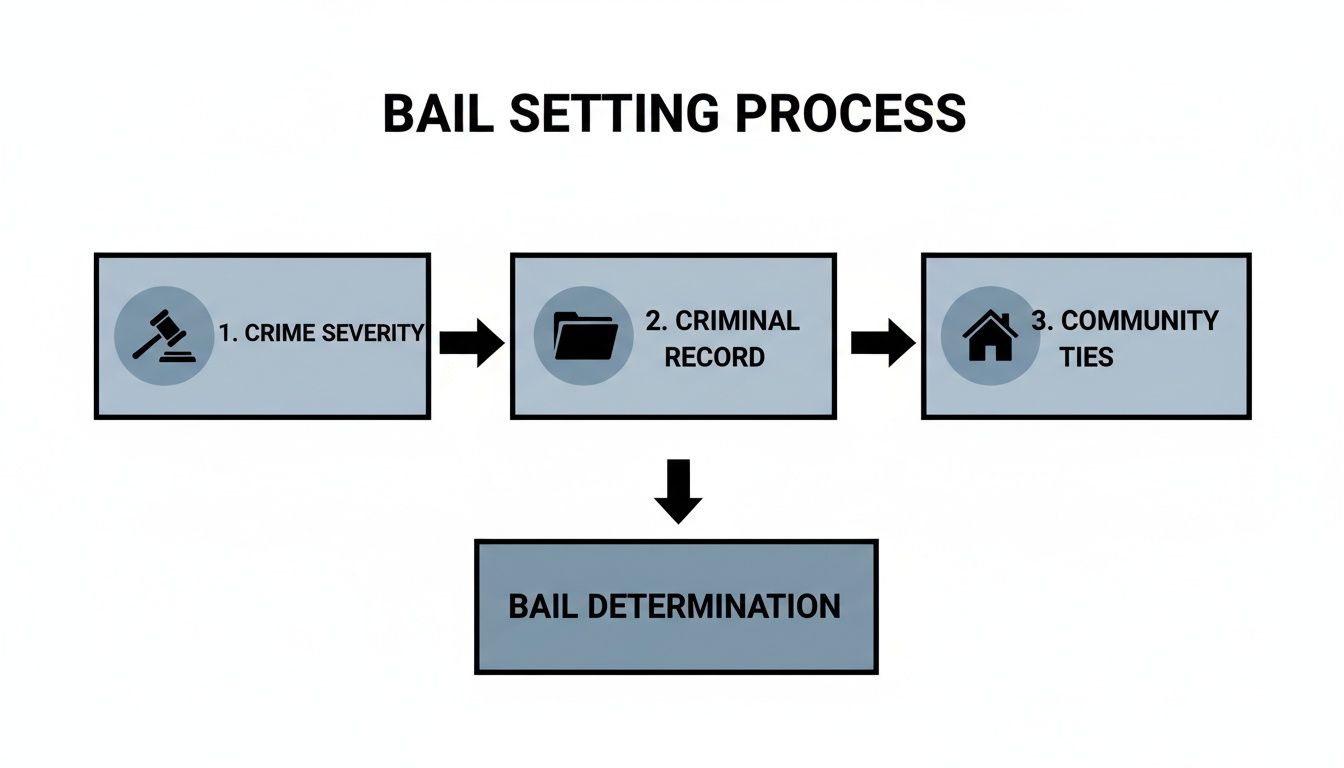
As you can see, it's a mix of factors. The seriousness of the charge, a person's prior record, and their ties to the community in places like Roswell or Marietta all play a crucial role in that final number.
Essential Paperwork and Identification
When going to post a bond—whether paying cash or going through a bail bondsman—proper identification is absolutely required. The person who is financially on the hook for the bond needs a valid, government-issued photo ID. No exceptions.
These are the typical forms of ID that jails will accept:
- A state-issued driver's license or ID card
- A United States passport
- A military ID
One can't just show up with an expired license, a social security card, or a birth certificate. The name on the ID has to be an exact match to the name on the bond paperwork, especially the contract signed with a bonding company. This is a strict requirement they use to make sure the person taking financial responsibility is properly documented.
Managing Your Expectations on Timelines
Here’s where the real frustration often sets in: the waiting. Just because the bond is posted doesn't mean the jail doors swing open immediately. The actual time it takes from the moment the payment is accepted to when the person walks out can range from just a few hours to more than 12 hours.
Several things can slow this down:
- Jail Population: If the facility is busy with a lot of people being booked in or released, everything naturally moves slower.
- Staffing Levels: The number of deputies working directly impacts how quickly paperwork is processed and inmates are moved.
- Shift Changes: This is a big one. Release procedures often grind to a halt or slow to a crawl during staff shift changes.
A common misconception is that once the bond is paid, the person walks out within the hour. In reality, the jail has its own internal process for "out-processing" that simply takes time. It’s always best to prepare for a significant wait.
The reality is that our pretrial detention systems are under a lot of strain. In 2023, there were 7.6 million jail admissions across the country, but those admissions represented just over 5.6 million unique individuals. That means one in every four admissions was someone returning to jail, which speaks to a cycle of re-arrest that keeps facilities crowded and delays processing for everyone. The average daily jail population also swelled to 664,800 people, stretching resources thin. You can read more about the findings on U.S. jail populations on prisonpolicy.org.
Practical Tips for a Smoother Process
While you can’t control the jail's internal clock, steps can be taken to avoid needless delays.
Before heading to the jail in Cumming or any other local facility, make a phone call. Confirm the exact bond amount, ask about any extra jail fees, and—this is important—verify what forms of payment they accept.
Some jails will only take cash for a cash bond. Others might accept a cashier's check. Knowing these little details beforehand can save a wasted trip and a ton of frustration. When dealing with the bonding out process, being prepared is the best tool available.
The Role of an Attorney in the Bond Process

While paying the bond directly or hiring a bondsman are the most common ways to get someone out of jail, they aren't the only options. In many cases, getting an experienced criminal defense attorney involved early can lead to different outcomes, opening up alternatives one might not have realized were on the table.
An attorney doesn't just react to the bond amount set by the court—they can actively challenge it. They understand the factors judges consider and can build a case for a different release arrangement. This can be an advantage that could potentially save thousands of dollars and get a loved one home faster.
Seeking a Better Outcome with a Bond Hearing
That initial bond amount set right after an arrest isn't always set in stone. One of the powerful tools an attorney has is requesting a bond hearing, which is a formal court proceeding where they can argue directly before a judge for a different arrangement.
During the hearing, a lawyer can present evidence and arguments to show that the person arrested is neither a flight risk nor a danger to the community. They can highlight key details that the initial bond schedule might have completely missed:
- Strong Community Ties: Proving the person has deep roots in areas like Cobb County or Forsyth County through family, a steady job, or owning a home.
- Lack of Criminal History: Arguing that a clean record—or a very minor one—suggests the person can be trusted to show up for court.
- The Nature of the Charges: Putting the alleged offense into context to show it may not warrant such a high bond.
The goal is to convince the judge to either lower the bond to something more affordable or, in some scenarios, grant a release on recognizance (ROR), which means no money is required at all.
Exploring Alternatives to a Financial Bond
Beyond just fighting for a lower dollar amount, an attorney can also explore alternatives to traditional financial bonds. Many jurisdictions now have pretrial release programs designed to supervise people in the community instead of keeping them locked up just because they can't afford to pay.
These programs often come with conditions tailored to the individual, like:
- Regular check-ins with a pretrial services officer
- Electronic monitoring (ankle bracelets)
- Mandatory substance abuse counseling or testing
An attorney can make a case for their client to be accepted into one of these programs, presenting them as a responsible candidate who can be safely monitored outside of jail. It’s an approach that focuses on supervision, not on a person's bank account.
The effectiveness of these alternatives is well-documented. For example, since its creation, The Bail Project has provided bail assistance to over 39,000 people. Their clients have a 92% court appearance rate, and the organization has prevented more than 1.38 million days of unnecessary time spent in jail before trial. You can learn more by reading the impact of bail reform efforts from The Bail Project's report.
The Advantage of Early Intervention
Hiring an attorney right away provides the benefit of early intervention. An experienced lawyer can often get involved before the very first court appearance, talking with the prosecution and gathering information to secure a favorable bond from the start. A proactive approach like this might prevent a high bond from ever being set in the first place.
By presenting mitigating factors and showing a commitment to the process, an attorney signals to the court that their client is taking the situation seriously. That strategic communication can be key to avoiding a long, expensive, and stressful stay in jail. When it comes to bonding out of jail, having a skilled advocate involved is often a direct path to a different resolution.
Common Questions About Bonding Out of Jail
When a friend or loved one is arrested, the first thing on your mind is getting them out. The whole process can be overwhelming, and you’re suddenly faced with a lot of urgent questions. Let's walk through some of the most common things people ask when trying to post a bond in Georgia.
Getting clear, direct answers is the best way to cut through the stress and confusion. Understanding these key points will make a huge difference in how the next few hours are navigated.
How Long Does Release Take After Bond Is Posted?
This is usually the very first question everyone asks, and the answer can be frustrating: it varies. Once the bond is officially posted and all the paperwork is accepted, the release isn't instant. The wait can be just a couple of hours, but it can also stretch to more than 12 hours.
Several factors, all of them out of your control, dictate the timeline:
- Jail Staffing: The number of deputies working directly impacts how fast the release procedures are handled. Fewer staff members mean longer waits for everyone.
- How Busy the Jail Is: A chaotic night with a high volume of new arrests or releases will create a bottleneck, slowing everything down.
- Shift Changes: Processing often slows to a crawl or stops altogether during staff shift changes, which typically happen every eight or twelve hours.
It's best to prepare for a potentially long wait. Every jail has its own internal system for "out-processing" an inmate, and it simply takes the time it takes.
What Happens to the Money from a Cash Bond?
If you pay a cash bond directly to the court, you will generally get the full amount back after the criminal case is completely over. This is the biggest advantage of going the cash bond route.
However, that refund depends entirely on the defendant showing up for every single required court appearance. If they miss even one court date, the judge can forfeit the bond, and all of that money will be lost. It’s also important to know that before the funds are returned, the court can deduct any outstanding fines, court costs, or restitution the defendant owes.
Don't expect a quick refund. It can take several weeks, or even months, after the case is officially closed for the court to process the paperwork and mail a check for the cash bond.
Can a Bail Bondsman Refuse to Help Me?
Yes, absolutely. A bail bondsman can decline to post a bond for any reason. Bail bonding companies are private businesses, not a public service. They have every right to decide which clients they’re willing to take a risk on.
A bondsman is essentially a lender making a risk assessment. They might refuse to offer their services for a few common reasons:
- High Flight Risk: If the defendant has a history of skipping court dates (a "failure to appear"), a bondsman will likely see them as too risky.
- Serious Charges: For particularly severe or high-profile felony charges, a bonding company may not want to take on the massive liability.
- Not Enough Collateral: If the bond is very large and the family can’t provide sufficient collateral (like property or other assets) to secure it, the bondsman will probably say no.
At the end of the day, it's a business decision based on how confident they are that the defendant will show up for court.
What Information Do I Need to Start the Bonding Process?
To get the ball rolling on bonding someone out of jail, you need to have specific information ready before making any calls. Being prepared helps the bondsman or the court clerk find the person and their case details quickly.
Before you pick up the phone, try to gather these key details:
- Defendant's Full Name: Make sure you have their complete legal name, spelled correctly.
- Date of Birth: This is a critical identifier, especially for common names.
- Name of the Jail: Be specific. Is it the "Cobb County Jail" or the "Forsyth County Adult Detention Center"?
- Booking Number: If you have it, this is the single fastest way for staff to pull up the correct file.
- The Specific Charges: Knowing what they were arrested for helps the bondsman understand the situation and the likely bond amount.
Having this information ready shows you’re organized and serious. It cuts down on guesswork and makes the whole interaction with a bail bondsman or the court go much more smoothly.
When facing the complexities of the criminal justice system, having an experienced advocate is crucial. At Brian Hansford Law, we are dedicated to protecting rights and fighting for the best possible outcome in a case. If you or a loved one needs help, visit us at https://challengemoncharge.com to see how we can assist you.
