
When people talk about burglary vs robbery, the main difference comes down to one simple thing: burglary is a crime against property, while robbery is a crime against a person. One crime involves breaking into a place; the other involves a direct, forceful taking from someone.
Defining Burglary vs Robbery A Clear Overview

It’s common to hear "burglary" and "robbery" used as if they mean the same thing, but from a classification standpoint, they describe two completely different offenses. Getting this distinction right is important because the charges, evidence, and penalties are worlds apart.
Much of the confusion comes from how these crimes are shown in movies and on TV, where the lines are often blurred for dramatic effect. The real-world separators are the presence of a victim and the use of force. Burglary is all about entering a building or structure illegally with the intent to commit a felony or theft inside. The offense is technically complete the second someone crosses the threshold with that intent—even if they get spooked and leave without taking anything.
Robbery, on the other hand, requires a face-to-face confrontation. It’s defined by taking property directly from another person’s presence using violence, threats, or intimidation.
Distinguishing Core Elements
To really nail down the burglary vs robbery difference, it helps to look at the essential components that prosecutors review. These elements are what determine how an incident is classified and charged. For example, a person breaking into an empty house at night is a textbook burglary. A mugging on the street is a classic robbery.
Think about these key differences:
- Presence of a Victim: A burglary can happen in an empty building. For a robbery to occur, a victim must be present and confronted.
- Use of Force: Force isn’t required for a burglary; walking through an unlocked door counts. In a robbery, force—or the threat of it—is the central element of the crime.
- Nature of the Crime: At its heart, burglary is a property crime. Robbery, because it involves a victim, is always considered a violent crime.
This isn't just a matter of terminology; it changes everything about how a case is categorized. For anyone looking for information on how criminal charges are handled in Georgia, understanding these basic concepts is the first step.
The easiest way to keep it straight is this: you burglarize a structure, but you rob a person. That simple idea cuts through almost all the confusion.
Burglary vs Robbery At a Glance
Here is a quick table that breaks down the fundamental differences between burglary and robbery based on their core elements.
| Element | Burglary | Robbery |
|---|---|---|
| Primary Target | Property or structure (e.g., a house, vehicle, or business) | A person |
| Victim's Presence | Not required for the crime to occur. | Required; property is taken from their immediate presence. |
| Use of Force | Not a necessary element; unlawful entry is the key. | Essential element; involves force, intimidation, or threat. |
| Core Intent | To commit a felony or theft after entering the structure. | To take property from a person through force or fear. |
As you can see, the distinction always comes back to whether the crime was against a place or a person, and whether force was involved in the taking.
Exploring the Legal Elements of Burglary
When you get down to the nitty-gritty of a burglary vs. robbery charge, you have to start by unpacking what burglary actually is. At its heart, burglary is a crime of unlawful entry combined with criminal intent. It’s not just about breaking a window—the specific components that must be present are what really matter.
The first major element is unlawful entry. A lot of people picture someone forcing a lock or shattering glass, but it doesn't have to be that dramatic. The entry simply needs to be without authority. This could be as simple as walking through an unlocked door, slipping into a business through an open loading dock, or even hiding inside a store after closing with a plan to steal something later.
This idea of entering without permission is a core piece of what separates burglary from other property crimes. In some cases, the lines can get a little blurry and even overlap with other offenses. To get a better handle on these distinctions, our guide on criminal trespassing charges in Georgia can be really helpful, since the concept of being on a property without authorization is central to both.
The Critical Role of Intent
The second piece of the puzzle—and you could argue it’s the most important—is the intent to commit a felony or theft. This is what defines the crime. A person has to enter the structure already planning to commit a specific crime once inside.
What this means is that the crime of burglary is technically complete the second that person crosses the threshold with that criminal intent. It doesn't matter if they actually succeed in stealing anything or committing the felony they planned. For instance, if someone sneaks into a garage to steal power tools but gets spooked by a dog and runs off empty-handed, they've still committed burglary.
The crime of burglary is finalized upon entry with intent. The act of theft is a separate consideration; the plan to commit it is what completes the offense.
This is a point that trips a lot of people up. The focus is on the person's state of mind at the moment of entry, not on what happens afterward.
Structures Covered Under Burglary Law
Burglary laws don't just protect houses. The definition of a "structure" is pretty broad and covers a whole range of places where people live, work, or just keep their stuff.
A few common examples include:
- Dwellings: This means houses, apartments, and even hotel rooms.
- Businesses: Think retail stores, offices, warehouses, and factories.
- Outbuildings: Garages, sheds, and barns are all covered.
- Vehicles: Under Georgia's statute, even cars, trucks, and boats count as structures.
When you look at the bigger picture, burglary rates are all over the map globally, which says a lot about different socio-economic conditions and how effective law enforcement is in different places. For example, recent data puts the U.S. burglary rate at 271 per 100,000 people. But then you see countries like Costa Rica (776) and Sweden (657) with much higher numbers. This global context just goes to show how common property crimes like burglary are, even if the specific definitions change from place to place.
Understanding the Crime of Robbery
While burglary hinges on where a crime happens—like breaking into a building—robbery is all about who it happens to. Robbery is a violent crime at its core. The focus shifts from a physical place to a direct, frightening confrontation with another person.
This is a critical point in the burglary vs robbery discussion and why the justice system treats them so differently.
A robbery takes place when someone takes property directly from another person’s "immediate presence" by using force, intimidation, or the threat of violence. The actual value of the property stolen is often an afterthought; what really matters is the violence or threat against the victim. A person's safety has been violated, and that’s why robbery charges carry such a heavy weight.
Think of a street mugging where a purse is snatched after a threat—that’s a classic robbery. The same goes for a convenience store holdup where the clerk is forced to hand over cash. In both cases, you have the key ingredients: a victim, the taking of property, and the use of force or fear.
Force or Fear: The Defining Element
What truly elevates a simple theft to the serious crime of robbery is that element of force or intimidation. This doesn't always mean a physical fight. The threat of harm is often enough to meet the definition.
This gives us two main classifications of robbery:
- Armed Robbery: The most serious form, where a weapon is used. This could be a gun, a knife, or even an object that just looks like a weapon, used to threaten the victim.
- Strong-Arm Robbery: This is when physical force is used without a weapon. Think pushing, punching, or holding someone down to take their property.
The essence of robbery is the confrontation. The crime is against personal safety first and property second. Even if the perpetrator leaves empty-handed, the act of using force or threats to attempt a theft can still lead to a robbery charge.
Real-World Robbery Scenarios
To see how this plays out, just look at a carjacking. This is a specific type of robbery where the target is a vehicle. The attacker forces the driver out of the car with threats or actual violence. It’s not just a car theft; it’s a robbery because a person was directly confronted and put in fear to give up their property.
While robbery is a serious violent crime, recent trend reports show its frequency has actually seen a significant decrease across the United States. Despite being less common than burglary, it brings far more severe consequences. Those same reports also noted a substantial drop in carjackings, which is an aggravated form of robbery. You can find more of these insights in a mid-year 2025 update from the Council on Criminal Justice. Understanding these patterns helps put the seriousness of these offenses into context.
A Comparative Analysis of Critical Differences
When you're trying to understand the real difference between burglary and robbery, it all boils down to four key factors: the nature of the crime itself, whether force was involved, if a victim was present, and the location. They’re both serious felonies, but they are seen as fundamentally different offenses, and that distinction impacts everything from the police investigation to the final sentence.
The most crucial distinction to grasp is the target of the crime. Burglary is a crime against a place, while robbery is a crime committed against a person. Think of this as the central pivot point from which all the other differences branch out.
Property Crime vs Personal Crime
At its very core, burglary is a property crime. It is defined by the act of unlawfully entering a building, a car, or another structure with the intent to commit a theft or another felony once inside. The crime is really against the security and sanctity of that physical space.
Robbery, on the other hand, is always a personal, violent crime. It involves taking property directly from someone using force, threats, or intimidation. The violation here is against the victim’s personal safety, not just their possessions.
The Role of Force and Threats
Force, or the threat of it, is a non-negotiable element of robbery. For a simple theft to become a robbery charge, the offender has to use violence or intimidate the victim into giving up their property. This direct, personal confrontation is what makes robbery such a severe offense.
For a burglary charge, force isn't a required element of the crime. Someone could be charged with burglary just by walking through an unlocked door or climbing through an open window, as long as they had criminal intent. While force might be used to get in—like breaking a lock—it’s the unlawful entry itself, not the force, that defines the crime.
The critical takeaway is that burglary is about a place, focusing on unlawful entry and intent. Robbery is about a person, defined by the violent or threatening act of taking property.
The question of force is often the clearest way to tell the two apart. This simple decision tree helps visualize that crucial difference.
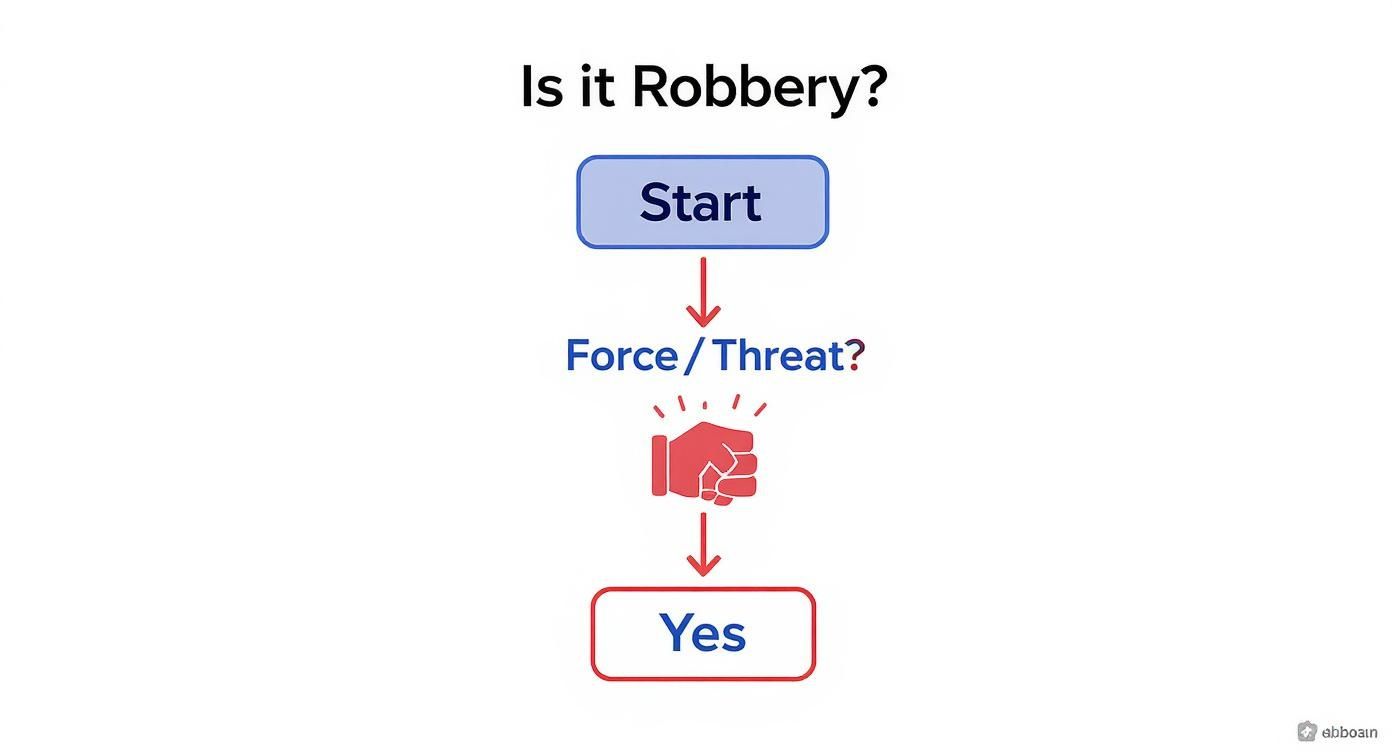
As you can see, the presence of force or a threat is the primary factor that escalates a theft into the much more serious crime of robbery.
To make these distinctions even clearer, let's break them down side-by-side.
Core Distinctions Between Burglary and Robbery
| Comparison Point | Burglary Details | Robbery Details |
|---|---|---|
| Nature of Crime | It's a property crime. The offense is against a structure (home, business, vehicle). | It's a crime against a person. The offense is a violent act against an individual. |
| Element of Force | Not required. The crime is the illegal entry with felonious intent. Force can be used to enter, but it's not a necessary element. | Essential. The crime is defined by the use of force, threats, or intimidation to take property from a person. |
| Victim Presence | Not required. A burglary often happens when a building is empty. | Required. A victim must be present, as the property is taken directly from their person or immediate control. |
| Location | Occurs within a building, dwelling, or vehicle. The location is central to the charge. | Can happen anywhere a person is—on the street, in a park, or even inside a home. The location is secondary to the act itself. |
This table lays out the fundamental building blocks that prosecutors may use to build a case for one charge over the other.
Victim Presence and Location
A victim's presence is another clear dividing line. A burglary can, and often does, happen when a building is completely empty. The crime is committed against the property, so no one needs to be there at the time.
Robbery, however, requires a victim to be present. The definition specifies that the property must be taken from their "immediate presence"—meaning from their person or from an area within their control at that exact moment. This is why you can burglarize an empty house but you can't rob one.
This distinction is recognized globally. For instance, in the European Union, police recently recorded 1,229,429 burglary offenses, compared to 261,361 robberies. Even though burglary is far more common, robbery's direct and violent impact on victims makes it a high-priority concern for law enforcement everywhere. You can review more crime statistics from the EU on the Eurostat website.
Potential Penalties and Long-Term Consequences
When we start talking about burglary vs robbery, the potential penalties really drive home the key difference: one is a property crime, and the other is a violent crime. While both are serious felonies in Georgia, the consequences for robbery are almost always far more severe. Why? Because it involves force or intimidation against a person, and the justice system reserves its harshest penalties for crimes that threaten someone's safety.
A conviction for either one is a heavy burden, but the sentencing ranges tell the real story. Burglary penalties can shift based on things like whether the building was a home or an empty business. But with robbery, the penalties escalate quickly, especially if a weapon is part of the equation.
Felony Classifications and Sentencing
Here in Georgia, robbery is always classified as a violent felony, which means substantial prison time is on the table. If there are aggravating factors, those sentences can climb even higher.
- Robbery: A conviction typically results in a long prison sentence, a direct reflection of the crime's violent nature.
- Armed Robbery: Bring a weapon into the mix, and the penalties become incredibly severe. We're talking about mandatory minimum sentences that can stretch out for decades.
- Burglary: While still a felony, the sentencing range for burglary can be lower, although it will certainly increase if the location was an occupied home.

The presence of a weapon during a robbery is the single most critical factor that can turn a serious charge into one with truly life-altering consequences. This distinction is precisely why robbery is treated with such gravity.
The specific details of every case play a massive role in shaping the final outcome. It's so important to understand what it means when someone is charged with a felony, as it gives crucial context for the entire process.
The Lasting Impact of a Conviction
Beyond the prison sentence and fines, a felony conviction for burglary or robbery leaves a permanent mark: a criminal record that creates lifelong hurdles. This record doesn't just disappear after time is served; it follows you, creating barriers that can impact every part of your future.
These long-term consequences, often called collateral consequences, frequently include:
- Employment Difficulties: So many employers run background checks these days. A felony conviction can make it incredibly difficult to find a job, especially in any field that requires a security clearance or a position of trust.
- Housing Ineligibility: It's common for landlords to deny rental applications from people with felony records, which severely limits housing options.
- Loss of Civil Rights: A conviction can strip a person of fundamental rights, like the right to vote (until the full sentence is completed), serve on a jury, or legally own a firearm.
These are the penalties that extend far beyond the courtroom. They can fundamentally affect a person's ability to ever truly rebuild their life and become a productive member of society again.
Key Factors That Can Make or Break a Burglary or Robbery Case
When you look closely at burglary vs. robbery cases in Georgia, a few key issues almost always come up. These aren't just technical terms; they're the real-world details that often decide the outcome. It really boils down to intent, consent, and the evidence (or lack thereof) that supports the charges.
What Shapes a Burglary Charge?
In a burglary case, the prosecutor has to prove someone entered a building planning to commit a felony or theft inside. This opens the door for a couple of major points of contention.
One of the biggest is the lack of intent. If someone broke into a building but didn't plan to steal anything or commit another crime, is it really burglary? Maybe they were just looking for shelter or got confused and went into the wrong house. If there was no criminal purpose at the moment of entry, the core of the burglary charge starts to fall apart.
Another critical point is consent. The definition says the entry has to be "unlawful." But what if the person thought they had permission to be there? This can happen because of a simple misunderstanding or a past relationship where they were always welcome. This is a world away from someone forcing a door open without any right to be there.
What Matters Most in a Robbery Case?
With robbery, the entire case shifts to the direct confrontation between people. The details of that interaction are everything.
A common issue here is mistaken identity. Robberies happen fast. They’re chaotic, stressful, and often happen in low light. It’s completely understandable for an eyewitness to get it wrong. Questioning the reliability of an identification—considering things like lighting, distance, and the witness's emotional state—can be a powerful part of the story.
The heart of any robbery charge is the use of force or intimidation. If that element is weak, the entire case can be thrown into question.
Finally, you have to scrutinize the element of force or fear. A robbery isn't just a theft; it's a theft accomplished through violence or making someone afraid for their safety. Was there a genuine threat that would make a reasonable person hand over their property? For example, a quick purse snatching with no direct threat is very different from someone pointing a weapon and demanding a wallet. How that moment played out determines if it's a robbery or something else entirely.
Common Questions We Hear
When you get down to the brass tacks of burglary and robbery, the real-world scenarios are where things can get confusing. People often wonder how these charges play out in specific situations. Here are some of the most frequent questions we come across.
Can Shoplifting Turn Into a Robbery Charge?
Absolutely, and it happens faster than you might think. A simple shoplifting case escalates to robbery the moment force or fear enters the picture.
Imagine someone stealing something from a store. If they shove an employee or threaten a security guard on their way out, it's no longer just a theft. That use of force to get away with the stolen goods is what elevates the charge to the much more serious crime of robbery.
Is "Breaking and Entering" Just Another Name for Burglary?
Not quite, although they're very closely related. "Breaking and entering" is simply the act of getting into a building without permission. Burglary, on the other hand, is a specific criminal charge that requires that unlawful entry plus the intent to commit a felony or theft once inside.
So, while breaking and entering is often part of a burglary, it's the intent that makes it a burglary.
Someone can technically commit breaking and entering without it being a burglary if they didn’t have any criminal intent when they went inside. That intent is the crucial difference.
What if Someone Breaks Into a House They Thought Was Empty?
If a person unlawfully enters a home with the plan to steal something, it’s still burglary, even if they were convinced nobody was home.
The presence of a person inside the house doesn't automatically change the crime from burglary to robbery. For it to become robbery, the intruder would have to confront that person and use force or intimidation to take property from them directly. That said, burglarizing an occupied home is always treated more seriously by the courts and can lead to harsher penalties because of the increased danger involved.
Facing criminal charges can be an overwhelming experience. At Brian Hansford Law, we bring over two decades of experience, including time as a former prosecutor, to protect your rights. If you need assistance in Alpharetta, Cumming, Forsyth County, or the surrounding North Georgia areas, visit us at https://challengemycharge.com.
