
If you are facing a felony charge in Alpharetta, GA, you are likely worried about your freedom, your reputation, and your future. A common question we hear is whether a felony conviction will prevent you from pursuing a career in law enforcement. Let's be direct: a felony conviction in Georgia is an absolute, permanent bar to becoming a police officer.
Understanding this reality is the first step toward protecting your future. If you are currently facing charges in Alpharetta or anywhere in Fulton County, the time to act is now, before a conviction occurs. Your future career options are being decided in this moment. Do not speak to law enforcement without an attorney. Call Brian Hansford now for a confidential consultation to protect your record.
Why a Felony Conviction Ends a Police Career in Alpharetta

In Georgia, having a felony on your record makes it legally impossible to become a police officer. This is not a flexible policy that changes from one department to another; it's a hard rule enforced statewide. Whether the charge originated in Alpharetta, Roswell, or Sandy Springs, a felony conviction means a law enforcement career is off the table.
This absolute barrier is enforced by the Georgia Peace Officer Standards and Training (POST) Council. The POST Council acts as the official gatekeeper for every law enforcement job in the state. No one can become a certified peace officer—whether for the Alpharetta Police Department, the Fulton County Sheriff's Office, or any agency in nearby Milton or Johns Creek—without POST approval.
State and Federal Law Are Absolute Barriers
The disqualification is set in stone by both state and federal law. Nationwide, a felony conviction creates significant legal roadblocks, primarily due to strict firearm prohibitions. Federal law under 18 U.S.C. § 922(g) prohibits anyone convicted of a felony from possessing a firearm, an essential requirement for any police officer.
Here in Georgia, the law is even more direct. For communities across North Fulton, from Cumming to Dunwoody, O.C.G.A. § 35-8-7 is the critical statute. It explicitly states that any applicant for POST certification must have zero felony convictions. This law slams the door shut on a police career the moment a felony conviction is entered in Fulton County Superior Court or any other court. You can see how these standards are applied by reviewing the comprehensive data on law enforcement officers across the nation.
Felony Conviction vs. Police Career Eligibility in Alpharetta, GA
This table illustrates the stark difference between a felony conviction and a more favorable outcome in the Fulton County court system.
| Criminal Record Status | GA POST Certification Eligibility | Legal Ability to Carry a Firearm | Hiring Chance with Alpharetta PD |
|---|---|---|---|
| Felony Conviction | No (Permanent Bar) | No (Federal Prohibition) | Zero |
| Reduced to Misdemeanor | Possible (Depends on charge) | Yes (Typically) | Possible (Subject to background check) |
| Charge Dismissed | Yes | Yes | Yes (Subject to background check) |
| Record Restricted | Yes | Yes | Yes (Subject to background check) |
The critical takeaway is this: if you are facing a felony charge, your ability to preserve future career options is being decided right now. A proactive defense aimed at preventing a conviction is not just about staying out of jail; it's about protecting your entire future. A strategic criminal defense attorney can fight to have your charges reduced to a misdemeanor or dismissed entirely, preserving your eligibility.
The First Hurdle: Understanding Georgia POST Certification in Alpharetta

Before anyone can become a police officer in Georgia, they must be certified by the Georgia Peace Officer Standards and Training (POST) Council. This is the state's official license for a career in law enforcement. Every sworn officer, from the Alpharetta Police Department to state troopers, must be POST certified.
This is the first and toughest hurdle if you have a criminal history. POST sets the minimum standards, and local departments in cities like Roswell, Milton, and Sandy Springs cannot ignore them. If you don't meet the state's criteria, you cannot be hired.
Georgia Law Creates a Hard Stop for Felonies
The disqualification for a felony conviction is not a local policy decided by the Alpharetta Police Department. It's written directly into Georgia law, leaving no room for interpretation.
The specific law is O.C.G.A. § 35-8-7(a). It clearly states that an applicant must "not have been convicted by any state or by the federal government of any crime the punishment for which could have been imprisonment for a term of one year or more."
This is the legal definition of a felony in this context. It doesn't matter if you only received probation or if the conviction is decades old. If the crime could have resulted in a prison sentence of one year or more, you are permanently barred from POST certification.
This is not a gray area. When you apply to a police department in North Fulton, their background check is run against POST standards. A felony conviction means your application is dead on arrival.
The Background Check Will Uncover Everything
Every law enforcement agency, from the Johns Creek Police Department to the Fulton County Sheriff's Office, conducts an incredibly thorough background investigation. This process is designed to find your entire history, including arrests, court dates, and the final outcomes of every case. As our guide on what background checks show explains, even dismissed arrests are scrutinized.
The POST application requires you to disclose your complete criminal history. Lying about a felony charge will lead to immediate disqualification for dishonesty. This strict process exists for several critical reasons:
- Public Trust: A felony conviction is seen as a fundamental violation of the public trust required of a police officer.
- Court Credibility: An officer with a felony record would have their testimony constantly challenged in court, jeopardizing cases in Alpharetta Municipal Court or Fulton County State Court.
- Firearm Laws: Federal and state laws prohibit felons from possessing firearms, a core function of the job.
This absolute standard highlights the seriousness of a felony charge in Georgia. The moment you are convicted, the door to a law enforcement career closes permanently. This is why a defense strategy focused on preventing that conviction is the only way to keep your future possibilities open.
The Second Barrier: Federal and State Firearm Prohibitions
Even if you could somehow get past the Georgia POST Council’s rules, a second, equally firm barrier exists: firearm laws. A police officer in Alpharetta, Sandy Springs, or anywhere in Georgia must carry a gun. If you cannot legally possess a firearm, you cannot be a police officer.
This isn't a hiring preference; it’s a non-negotiable reality of federal and state law that makes a felony conviction an automatic disqualifier.
The Federal Gun Control Act of 1968
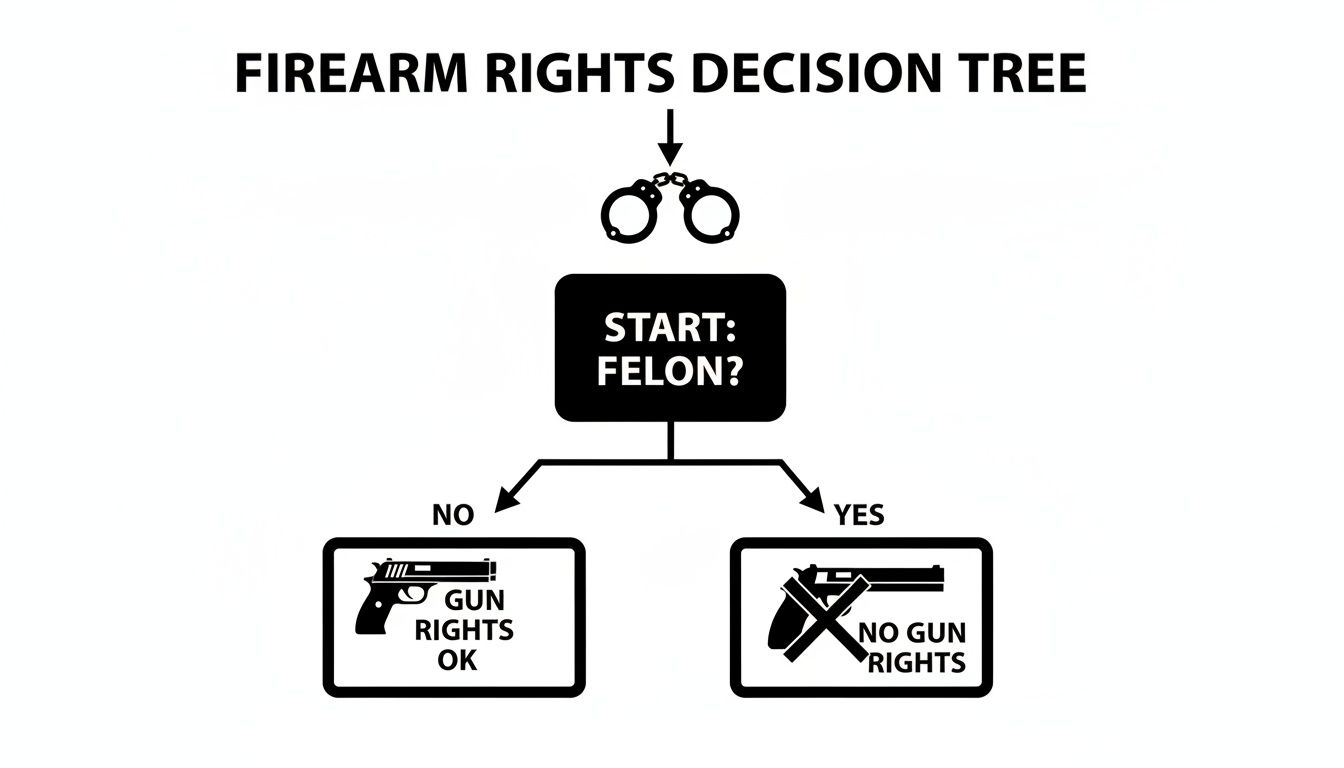
The biggest obstacle is a federal law, the Gun Control Act of 1968. Specifically, 18 U.S.C. § 922(g)(1) makes it a federal crime for anyone convicted of a crime punishable by more than a year in prison—the definition of a felony—to possess a firearm.
This single statute makes it impossible for someone with a felony record to work in law enforcement. An officer in North Fulton cannot do their job if they are legally forbidden from touching their service weapon.
The moment a felony conviction goes on your record, your Second Amendment rights are stripped away. This isn’t up to the discretion of a hiring department; it is an automatic, permanent consequence of the conviction.
This federal ban applies everywhere, from Cumming to East Cobb, with no exceptions for the type of felony or how much time has passed.
Georgia’s Own Firearm Restrictions
Georgia law reinforces the federal ban with its own statute. Under O.C.G.A. § 16-11-131, it is illegal for a convicted felon in Georgia to possess a firearm. While the state offers a path to restore firearm rights for certain non-violent felonies after a significant waiting period, this will not help you become a police officer.
Even if you managed to restore your state-level firearm rights, two immovable roadblocks remain: the separate federal ban under 18 U.S.C. § 922(g)(1) and the Georgia POST Council’s permanent ban on certifying anyone with a felony conviction.
The Only Path Forward is a Proactive Defense
These barriers—POST rules and firearm prohibitions—are absolute. They demonstrate that the most critical time to protect your future is before a conviction. If you are facing felony charges, your only goal should be to avoid that conviction at all costs. An aggressive criminal defense aimed at getting charges dismissed or reduced is the only way to keep the door to a law enforcement career from being permanently locked.
Can a Felony Record Be Overcome for a Police Career in Alpharetta?
A common question is whether legal tools like pardons or record restriction can overcome a felony conviction for a police career. Let's be direct: the odds are incredibly slim. While these tools can help people move on, they don't reset the clock for a law enforcement background check.
The Limits of Record Restriction in Alpharetta
In Georgia, "expungement" is called record restriction. While it's a powerful tool for some misdemeanors and even certain felony arrests, its impact on felony convictions is severely limited.
Under O.C.G.A. § 35-3-37, most felony convictions are not eligible for restriction, meaning they remain on your public record permanently. Even in the rare cases where a felony might qualify, law enforcement agencies conducting background checks have special access to the original, unrestricted records.
A restricted record does not erase history. For a job built on public trust, hiring committees in Alpharetta, Roswell, and Johns Creek will see the original charge. That conviction remains a massive roadblock.
Understanding the Role of a Pardon in Georgia
A pardon from the Georgia State Board of Pardons and Paroles is an official act of forgiveness that can restore civil rights, such as the right to vote or hold public office. However, it’s critical to understand what a pardon does not do:
- It does not erase your conviction. The felony remains on your criminal record.
- It does not seal the record. Law enforcement will still see the original charge and conviction.
- It does not automatically restore firearm rights. That is a separate, complex process.
A pardon is a significant step, but it doesn't change the fact that you were convicted. A police department in Milton or Dunwoody will see that you were convicted of a felony and later pardoned. The disqualifying event—the conviction itself—is still present. By 2010, over 19 million Americans had a felony conviction, and with law enforcement under more scrutiny than ever, hiring standards are only getting tougher.
For those seeking a fresh start in other careers, you can learn about post-conviction options by getting records expunged in our guide. However, for a police career in North Fulton, the only effective strategy is to prevent the conviction in the first place.
Your Defense Strategy in Alpharetta Is the Most Critical Step

Given that a felony conviction permanently closes the door on a police career in Georgia, your real power lies in the moments before a conviction ever happens. A proactive defense is your only tool to keep that door from slamming shut.
This is especially true for those facing charges in Alpharetta, Roswell, and the broader North Fulton area. Deadlines in the Fulton County court system move quickly, and waiting to act can mean losing critical opportunities to protect your future.
Avoiding a Felony Conviction in Fulton County
The primary goal of a strong defense is to prevent a felony conviction from ever appearing on your record. This involves aggressively challenging the prosecution's case from day one.
One of the most effective strategies is negotiating with North Fulton prosecutors to get a felony charge reduced to a misdemeanor. This outcome is a game-changer. While a misdemeanor can still present challenges, it does not trigger the automatic POST ban. You remain eligible to apply.
Another powerful option is entry into a pretrial diversion or conditional discharge program. These programs are often available for first-time offenders in jurisdictions like Fulton County. Upon successful completion, the charge is dismissed entirely. No conviction, no permanent bar.
Your first court date in Alpharetta Municipal Court or Fulton County State Court is a critical juncture. It is not a formality. This is where the foundation for your defense is laid, and strict deadlines for filing motions and preserving evidence begin.
Utilizing Georgia’s First Offender Act in Alpharetta
For qualifying individuals, the Georgia First Offender Act is one of the most powerful legal tools available. If you have no prior felony convictions, your attorney can petition the court to sentence you under this act.
Upon successful completion of your sentence (often probation), the court discharges the case without a conviction being officially entered on your criminal record. For POST certification and police background checks, you have not been convicted of a felony. This can be the difference between a permanent disqualification and a real opportunity. This option requires skillful negotiation and a deep understanding of local court procedures in Alpharetta, Johns Creek, and Milton. An experienced criminal defense attorney in Alpharetta can fight for you to pursue this outcome and protect your future.
Why Choose Brian Hansford to Defend You in Alpharetta
When a felony charge threatens your future, the attorney you choose is the most important decision you will make. You need a lawyer who understands both the law and the local courts of North Fulton.
A Former Prosecutor’s Insight into Your Defense
Brian Hansford brings over 25 years of legal experience, including significant time as a prosecutor in Fulton County. This gives him a tactical advantage. He knows how prosecutors in Alpharetta, Johns Creek, and Roswell build their cases, what evidence they rely on, and where their arguments are most vulnerable. This allows him to anticipate their strategy and build a defense designed to protect your rights and your future.
Deeply Rooted in the North Fulton Court System
Brian Hansford isn't an occasional visitor to the local courts; he is in the courthouses of Alpharetta, Milton, and throughout Fulton County daily. This constant presence has allowed him to build the relationships and procedural knowledge necessary to effectively navigate the system for his clients.
Whether your case is in Alpharetta Municipal Court or Fulton County Superior Court, he understands the tendencies of local judges and prosecutors. That familiarity is crucial when the goal is a charge reduction, entry into a diversion program, or a complete dismissal. Strict police hiring standards, a response to issues of public trust detailed in databases like the Henry A. Wallace Police Crime Database, mean departments from Cumming to East Cobb have zero tolerance for felony records.
A felony charge is an immediate threat to your future. The strategy you choose today in Alpharetta will determine whether career doors are slammed shut forever.
Brian’s approach is direct, strategic, and protective. He understands what is at risk for good people in tough situations. Call Brian Hansford Law today for a confidential case review and protect your future.
FAQ: Criminal Records and Police Careers in Alpharetta, GA
Facing a criminal charge near me raises many questions about future employment. Here are direct answers to common questions we hear in our Alpharetta office.
Q: What if my felony conviction in Fulton County happened a long time ago?
A: For Georgia POST certification, the age of a felony conviction does not matter. It is a permanent disqualifier, whether it happened five or twenty-five years ago. Law enforcement background checks are exhaustive and will uncover your entire adult history, making an old conviction an absolute roadblock.
Q: Can a misdemeanor in Alpharetta stop me from becoming a police officer?
A: Yes, it can. While a misdemeanor doesn't trigger the automatic statewide POST ban like a felony, individual departments in Alpharetta, Roswell, or Milton have their own strict hiring standards. Convictions for crimes involving dishonesty, family violence, or moral turpitude are often grounds for disqualification.
Q: Can I still be an officer if my felony was reduced to a misdemeanor in Alpharetta?
A: Yes, this is often the best strategy to keep a law enforcement career possible. If your attorney successfully negotiates a felony down to a misdemeanor in a Fulton County court, you avoid the permanent POST ban. You will still need to disclose the original arrest, but you remain legally eligible for certification and employment.
Q: If I finish a diversion program in North Fulton, will police see the charge?
A: Yes, law enforcement background checks will almost certainly see the original arrest. However, successfully completing a pretrial diversion program results in a dismissal of the charges, meaning you have no conviction. This is an excellent outcome that keeps your path to becoming an officer open.
If you’re facing a criminal charge in Alpharetta, Johns Creek, or anywhere in North Fulton, the time to protect your future is right now. A single mistake shouldn't close doors to future opportunities. Brian Hansford Law is here to build a strategic defense aimed at protecting your record. Call our office today for a case review.
Meta Title: Can a Felon Be a Police Officer in Alpharetta, GA? | Brian Hansford
Meta Description: A felony conviction is a permanent bar to becoming a police officer in Alpharetta, GA. Learn why from a former Fulton County prosecutor. Call for a consultation.
URL Slug: /can-felon-become-police-officer-alpharetta-ga/
Internal Link Suggestions:
- Link "DUI defense" to
/dui-defense-attorney-alpharetta-ga/ - Link "drug charges" to
/drug-charge-lawyer-alpharetta-ga/ - Link "assault and battery" to
/assault-battery-attorney-alpharetta-ga/ - Link "theft crimes" to
/theft-crime-lawyer-alpharetta-ga/ - Link "Georgia First Offender Act" to a blog post or page about it.
- Link "record restriction" to
/record-restriction-expungement-lawyer-alpharetta/
Schema Recommendations:
{
  "@context": "https://schema.org",
  "@type": "Article",
  "mainEntityOfPage": {
    "@type": "WebPage",
    "@id": "https://challengemycharge.com/can-felon-become-police-officer-alpharetta-ga/"
  },
  "headline": "Can a Felon Become a Police Officer in Alpharetta, GA?",
  "author": {
    "@type": "Person",
    "name": "Brian Hansford"
  },
  "publisher": {
    "@type": "Organization",
    "name": "Brian Hansford Law",
    "logo": {
      "@type": "ImageObject",
      "url": "https://challengemycharge.com/logo.png"
    }
  },
  "image": "https://cdnimg.co/de707790-5550-4abd-b884-e7ebe4766cef/36cd7d83-0f13-4d4a-bb41-9947ccd41e20/can-a-felon-become-a-police-officer-police-career.jpg",
  "datePublished": "YYYY-MM-DD",
  "dateModified": "YYYY-MM-DD",
  "description": "A felony conviction is a permanent bar to becoming a police officer in Alpharetta, GA. Learn why from a former Fulton County prosecutor and how to protect your future.",
  "mainEntity": {
    "@type": "FAQPage",
    "mainEntity": [
      {
        "@type": "Question",
        "name": "What if my felony conviction in Fulton County happened a long time ago?",
        "acceptedAnswer": {
          "@type": "Answer",
          "text": "For Georgia POST certification, the age of a felony conviction does not matter. It is a permanent disqualifier, whether it happened five or twenty-five years ago. Law enforcement background checks are exhaustive and will uncover your entire adult history, making an old conviction an absolute roadblock."
        }
      },
      {
        "@type": "Question",
        "name": "Can a misdemeanor in Alpharetta stop me from becoming a police officer?",
        "acceptedAnswer": {
          "@type": "Answer",
          "text": "Yes, it can. While a misdemeanor doesn't trigger the automatic statewide POST ban like a felony, individual departments in Alpharetta, Roswell, or Milton have their own strict hiring standards. Convictions for crimes involving dishonesty, family violence, or moral turpitude are often grounds for disqualification."
        }
      },
      {
        "@type": "Question",
        "name": "Can I still be an officer if my felony was reduced to a misdemeanor in Alpharetta?",
        "acceptedAnswer": {
          "@type": "Answer",
          "text": "Yes, this is often the best strategy to keep a law enforcement career possible. If your attorney successfully negotiates a felony down to a misdemeanor in a Fulton County court, you avoid the permanent POST ban. You will still need to disclose the original arrest, but you remain legally eligible for certification and employment."
        }
      },
      {
        "@type": "Question",
        "name": "If I finish a diversion program in North Fulton, will police see the charge?",
        "acceptedAnswer": {
          "@type": "Answer",
          "text": "Yes, law enforcement background checks will almost certainly see the original arrest. However, successfully completing a pretrial diversion program results in a dismissal of the charges, meaning you have no conviction. This is an excellent outcome that keeps your path to becoming an officer open."
        }
      }
    ]
  }
}
{
  "@context": "https://schema.org",
  "@type": "Attorney",
  "name": "Brian Hansford",
  "image": "https://challengemycharge.com/brian-hansford.jpg",
  "telephone": "+1-770-642-4229",
  "url": "https://challengemycharge.com",
  "address": {
    "@type": "PostalAddress",
    "streetAddress": "5755 North Point Pkwy #67",
    "addressLocality": "Alpharetta",
    "addressRegion": "GA",
    "postalCode": "30022",
    "addressCountry": "US"
  },
  "hasMap": "https://www.google.com/maps/place/Brian+Hansford+Law/@34.0610055,-84.2491113,17z/data=!3m1!4b1!4m5!3m4!1s0x88f59e69c3ce1833:0x163475ac0450534c!8m2!3d34.0610011!4d-84.2469226",
  "openingHours": "Mo,Tu,We,Th,Fr 09:00-17:00",
  "priceRange": "$$$",
  "areaServed": [
    "Alpharetta",
    "Fulton County",
    "North Fulton",
    "Johns Creek",
    "Milton",
    "Roswell",
    "Sandy Springs",
    "Cumming",
    "Dunwoody",
    "East Cobb"
  ],
  "knowsAbout": ["Criminal Defense Law", "DUI Defense", "Drug Charges", "Felony Defense", "Misdemeanor Defense"]
}
