
You’re driving home through Alpharetta, Roswell, Cumming, or Marietta. Lights come on behind you. You check the mirror and realize the vehicle isn’t a marked patrol car. The person approaching may not be in uniform. That’s when the questions hit fast.
Can an off duty cop pull you over? Do you have to stop? Is this a real officer? If the stop leads to a DUI charge, reckless driving case, speeding ticket, drug possession arrest, or license suspension problem, what you do in the next few minutes can affect the entire defense.
In Georgia, this issue is more complicated than commonly believed. The short answer is that an off-duty officer may have authority to act in some situations. But that does not mean every off-duty stop is lawful, properly handled, or immune from challenge. In many cases, the stop itself becomes the first and best line of defense.
A driver who handles the encounter calmly, verifies identity, protects basic rights, and documents what happened gives a DUI lawyer or criminal defense attorney much more to work with later. That matters in Fulton County, Forsyth County, Cobb County, Cherokee County, and Gwinnett County, where traffic and DUI cases often turn on narrow factual details.
Pulled Over By an Unmarked Car What You Need to Know
The first issue is safety. If an unmarked vehicle signals for you to stop, don’t panic and don’t make sudden moves. A rushed decision can create danger for you and can also create facts the State will later try to use against you.

A careful response usually works better than an emotional one. Slow down. Turn on your hazard lights if needed. Move toward a well-lit public area if you can do so safely. That shows you’re not fleeing, and it reduces the risk of misunderstanding.
For a broader discussion of safe traffic-stop conduct, this guide on being pulled over by police is a useful starting point.
What makes these stops different
A normal stop by a marked patrol car gives most drivers at least some confidence about who is stopping them. An off-duty or unmarked stop strips that away.
That uncertainty creates several immediate problems:
- Identity problems. You may not know whether the person is a police officer.
- Authority problems. Even if the person is an officer, that doesn’t automatically answer whether the stop was lawful.
- Evidence problems. What happened in those first minutes can later affect motions to suppress, witness credibility, and the prosecution’s timeline.
- Safety problems. A plainclothes officer may be mistaken for a threat, and the officer may also misread a cautious driver’s actions.
Practical rule: Treat the situation as real enough to stay safe, but uncertain enough to document carefully.
What usually helps and what usually hurts
Drivers often hurt their cases by arguing roadside, refusing every instruction, or volunteering too much information. None of that tends to improve the outcome.
What usually helps is simpler:
- Pull over safely rather than abruptly.
- Keep your hands visible once stopped.
- Ask for identification calmly if the officer is not in uniform.
- Provide the required documents when lawfully requested.
- Save your explanation for your lawyer, not the roadside.
If the stop later turns into a DUI arrest in Johns Creek, a reckless driving charge in Milton, or a speeding ticket in Sandy Springs, those small choices can become major defense points. A clean, composed interaction gives your attorney room to challenge the stop instead of cleaning up avoidable damage.
The Legal Authority of Off-Duty Officers in Georgia
Georgia generally follows the idea that police authority does not disappear when an officer’s shift ends. In practical terms, that means an off-duty officer may still act when the officer observes criminal conduct or a serious public safety problem.
That’s why the answer to can an off duty cop pull you over is often yes, potentially, but never yes in every circumstance.
Georgia is not the same as every other state
There is no uniform federal standard governing off-duty authority in traffic-stop situations. State law and local practice matter. One reason people get confused is that the rule is not the same everywhere.
Indiana provides a sharp contrast. Indiana Code § 9-30-2-2 explicitly states that an off-duty officer in an unmarked vehicle lacks authority to pull someone over or issue a citation, while states such as Georgia often follow the principle that officers retain 24/7 authority to intervene in observed crimes. National guidance also recognizes the risk involved. The International Association of Chiefs of Police warns that off-duty enforcement has to balance public protection with the danger that a non-uniformed officer may be mistaken for a suspect, as discussed in this article on off-duty traffic-stop authority and Indiana law.
That comparison matters for one reason. A lot of online advice mixes together rules from different states. What may be true in Indiana, Rhode Island, or elsewhere may not control a stop in Alpharetta, Roswell, or Cumming.
Authority exists, but it has limits
An off-duty officer’s possible authority is not a blank check. In Georgia practice, the harder question is rarely whether the officer is still an officer. The harder question is whether the officer acted in a way the law will accept.
A lawful stop still depends on facts such as:
| Issue | Why it matters |
|---|---|
| What the officer claims to have seen | The stop must be tied to actual observations, not a hunch |
| Whether the situation involved danger or a genuine violation | Minor conduct is easier to challenge than immediate threats |
| How the officer identified himself or herself | Poor identification can affect safety and legality |
| Whether on-duty backup was called | That can matter in judging reasonableness and procedure |
| How the encounter escalated | Unnecessary escalation can become a defense issue |
What departments worry about
Departments know these stops can go sideways fast. A plainclothes officer in a personal or unmarked vehicle creates confusion for everyone involved.
The practical trade-off is obvious. If an off-duty officer sees conduct that threatens the public, doing nothing may be hard to justify. But stopping a driver without the usual signs of authority creates risk for the driver, the officer, and responding officers.
A good defense often starts by asking not just whether the officer could act, but whether the officer handled the situation the way a reasonable officer should have.
That’s where many North Atlanta traffic and DUI defenses begin. In a courtroom, broad statements about “24/7 authority” don’t end the analysis. The details do.
Reasonable Suspicion and Probable Cause for the Stop
Even if an off-duty officer had the power to act, the stop still needed a legal basis. That basis usually falls into one of two categories: reasonable suspicion or probable cause.
These terms get thrown around constantly in traffic court, but they’re not interchangeable.
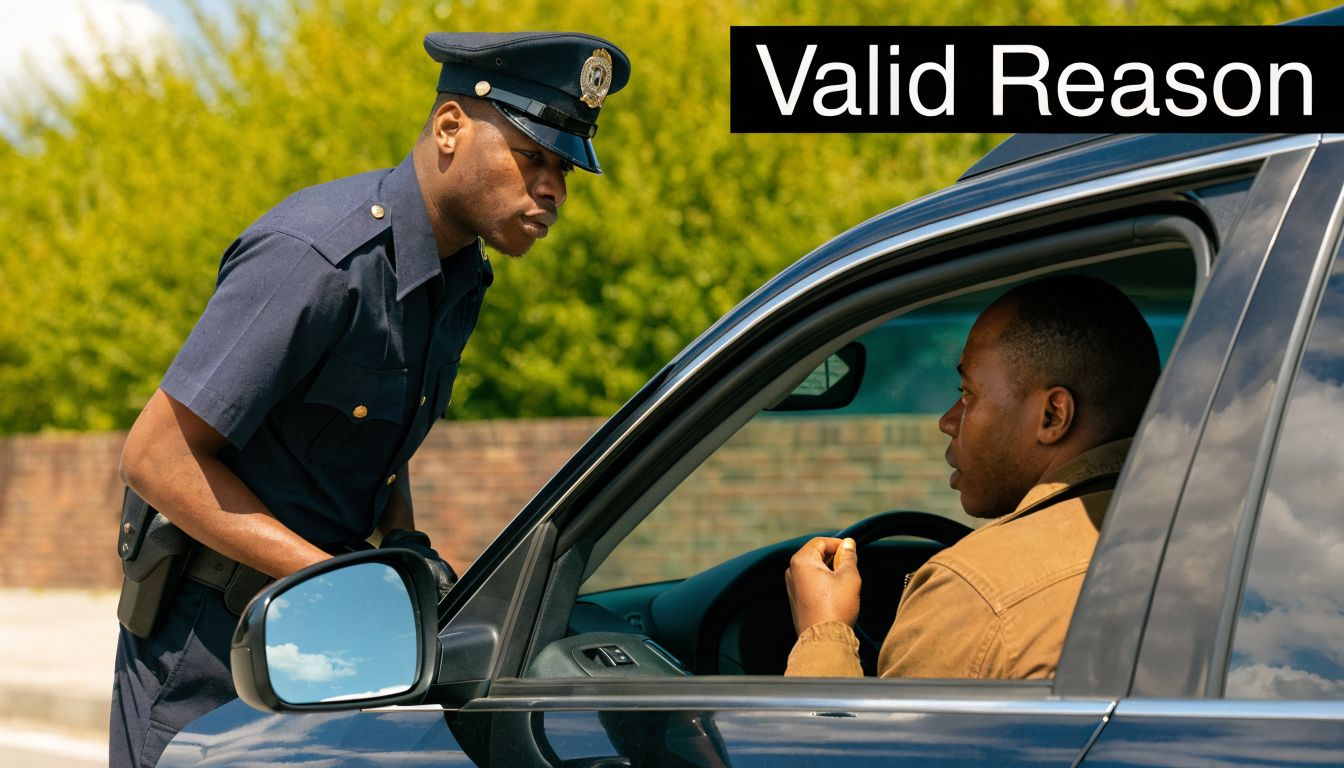
If you want a deeper look at when police can and can’t initiate a stop, this article on whether police can stop you for no reason gives useful context.
Reasonable suspicion
Reasonable suspicion is the lower standard. It means the officer can point to specific facts suggesting criminal activity may be happening.
In a traffic setting, that can involve driving behavior that appears impaired or dangerous. The key is that the officer must be able to describe what was seen in a concrete way.
Examples might include:
- Repeated lane problems that suggest impairment rather than a single minor drift
- Driving behavior that appears confused or unsafe
- Conduct that indicates an immediate need to investigate further
Reasonable suspicion allows a temporary detention and investigation. It doesn’t automatically prove a crime occurred.
Probable cause
Probable cause is stronger. It supports an arrest or citation because the officer claims facts showing a violation occurred.
Common examples in traffic court include:
- Running a red light
- Driving at a visibly excessive speed
- Possessing contraband in plain view
- Committing a clear moving violation
The difference matters because some stops start with a weak explanation that sounds stronger on paper than it did on the roadside. An experienced reckless driving lawyer or DUI attorney will compare the officer’s report, body camera if available, dispatch records, and testimony to see whether the stated basis holds up.
Why this distinction matters in real cases
A driver in Fulton County may be stopped for suspected DUI based on vague allegations of “erratic driving.” A driver in Cobb County may be cited after an off-duty officer says he personally saw a clear lane violation. Those are not the same case, even if both started with lights in the mirror.
If the officer can’t clearly explain why the stop started, the entire case may be vulnerable.
That issue comes up often in DUI cases because every piece of later evidence depends on the initial detention being legal. If the stop was not supported by reasonable suspicion or probable cause, the State may have a much harder time keeping the evidence in play.
Your Step-by-Step Guide During an Off-Duty Stop
When this happens, drivers usually remember one thing clearly. The encounter felt chaotic. What works best is a simple routine you can follow even under stress.
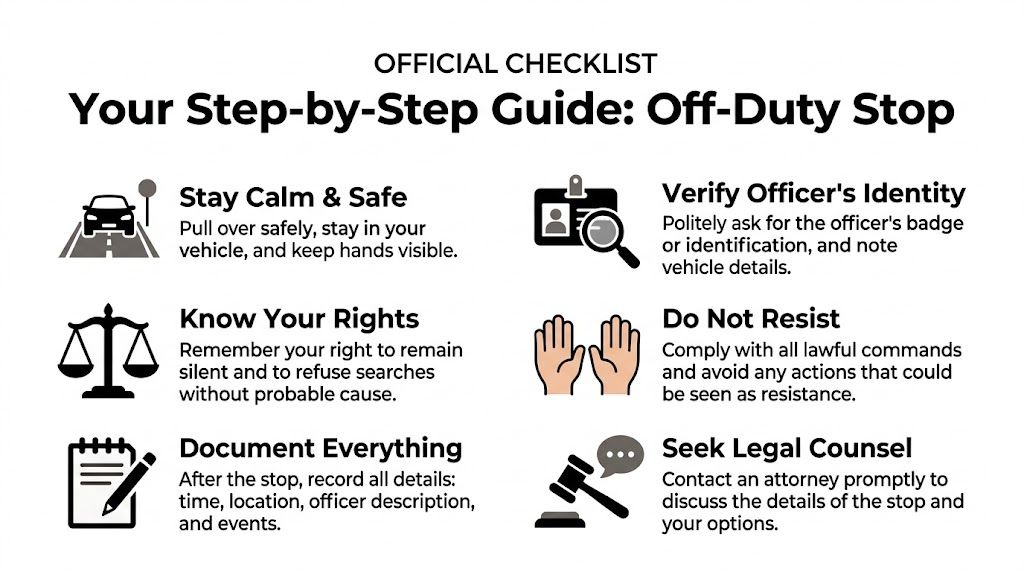
First minute after the lights come on
Start by slowing down and looking for a place where both of you can stop safely. A gas station, wide shoulder, or well-lit lot is often better than a dark roadside if you can reach it without creating danger.
Turn on interior lights if it’s dark. Roll the window down enough to communicate. Keep both hands visible.
That does two things. It lowers the chance of a tense misunderstanding, and it keeps the focus on the officer’s conduct rather than yours.
What to say and what not to say
You don’t need to narrate your life story. You also don’t want a roadside argument about constitutional law.
Use short, controlled statements:
- Ask for identification if the officer is in plain clothes or in an unmarked vehicle. A calm request such as “Officer, may I see your badge or ID?” is appropriate.
- Provide your license, registration, and proof of insurance when asked.
- Don’t consent to searches. If asked, say clearly that you do not consent.
- Don’t answer incriminating questions about drinking, where you came from, or what you may have taken. State that you want to remain silent.
- Don’t resist even if you believe the stop is unlawful.
A practical roadside checklist
- Stay in the vehicle unless ordered otherwise. Getting out unexpectedly can escalate the encounter.
- Watch the details. Try to notice the vehicle make, color, plate, location, and any identifying features.
- Use your phone carefully. If state law and safety allow, you may document the encounter, but don’t make sudden movements or create a physical confrontation over recording.
- Be polite. Respectful language helps. Admissions hurt.
Say less than you think you should. Most drivers talk themselves into trouble long before they realize it.
What to do right after the stop ends
The roadside encounter is only half the issue. What you do next often shapes the defense.
As soon as you are safe, write down:
- The exact location
- The time
- What the officer was wearing
- Whether a badge or credentials were shown
- What the officer said was the reason for the stop
- Whether another officer later arrived
- Any witnesses nearby
If the stop led to a DUI arrest in Johns Creek, a reckless driving case in Milton, a ticket in Sandy Springs, or a drug charge in Roswell, contact a criminal defense lawyer quickly. Early review matters because dispatch logs, camera footage, and officer recollections don’t get easier to challenge with time.
What drivers often get wrong
Some drivers assume that if they complied, they gave up their rights. That’s not true.
Others assume that if they objected loudly enough, they preserved their case. Usually they only gave the prosecutor more statements to use. The better approach is calm compliance, clear refusal of consent, and immediate documentation once the encounter is over.
How a Defense Attorney Can Challenge an Illegal Stop
An off-duty stop is not just a strange fact pattern. It can be the center of the defense. In many traffic, DUI, and criminal cases, the main battle is over whether the officer had the right to stop, detain, question, or search in the first place.
The main tool for attacking that problem is a motion to suppress evidence. If the judge agrees the stop was illegal, the court may exclude the evidence that came from it. That can change the entire case.
For a closer look at that process, see this explanation of a motion to suppress evidence.
Common pressure points in off-duty stop cases
An attorney doesn’t challenge these stops in the abstract. The challenge is built from details.
Some of the most useful issues include:
- Weak justification for the stop. If the officer cannot clearly articulate reasonable suspicion or probable cause, the detention may fail.
- Poor identification. A plainclothes officer who did not properly identify himself creates both credibility and legality problems.
- Escalation over a minor issue. If the encounter became aggressive over a small traffic matter, that can support suppression arguments and complaints.
- Procedure gaps. Missing reports, lack of backup, inconsistent statements, and timeline problems often matter more than drivers realize.
- Jurisdiction and role questions. Depending on the facts, the officer’s location, assignment, and reason for acting may all become relevant.
Misconduct can strengthen the defense
Courts also look hard at how officers act when they exercise authority off duty. Birmingham v. Benson, a 1993 Alabama case, resulted in a $1.6 million judgment against the city for an off-duty officer’s actions, reinforcing that municipalities can face liability when off-duty conduct aligns with official duties, as noted in this discussion of off-duty officer threats and legal exposure.
That case is not a Georgia traffic statute, but it matters for a practical reason. It reflects a larger legal principle. When an off-duty officer claims official authority, the officer’s conduct can create legal consequences far beyond the stop itself.
Legal analysis also supports the point that an off-duty officer’s threats or use of force over minor violations can exceed lawful authority. That matters in defense work because unnecessary escalation can undermine the State’s version of events.
The best suppression motions don’t rely on one flaw. They stack flaws until the stop no longer looks reliable.
Why this matters in North Atlanta courts
A DUI lawyer in Alpharetta, a reckless driving lawyer in Roswell, or a traffic ticket attorney in Marietta isn’t just reading the citation. The primary work is reconstructing the stop.
That means asking questions such as:
| Defense question | Why it matters |
|---|---|
| Who initiated contact and how? | Identification and legality start there |
| What was the exact reason for the stop? | Vague reasons often collapse under scrutiny |
| Did the officer escalate unnecessarily? | Excessive conduct can taint the encounter |
| What evidence came only after the stop? | If the stop falls, later evidence may fall too |
When a stop is weak, the right strategy can pressure the prosecution early. In the right case, that can mean reduced charges, stronger plea bargaining power, or dismissal.
Special Defenses for Off-Duty DUI Stops in Georgia
DUI cases create a different level of risk. Your license, employment, insurance costs, and freedom may all be on the line. An off-duty DUI stop can also create unusual weaknesses in the State’s case.
The stop may be only the first problem
Georgia practice recognizes the off-duty officer doctrine, but that doctrine does not erase procedure. Police training materials, including Georgia POST guidance, require off-duty officers to prioritize calling for on-duty backup. The risk of escalation is one reason for that. A 2022 DOJ report found that 78% of off-duty use-of-force incidents escalate unnecessarily, and failure to follow de-escalation protocols or properly establish probable cause under Terry v. Ohio can support a motion to suppress under Georgia Code § 17-5-30, as summarized in this discussion of off-duty officers and arrest powers.
For DUI defense, that point matters because the prosecution often wants the court to treat the stop as routine. It often isn’t.
Where DUI cases become vulnerable
An off-duty DUI stop can raise questions that don’t appear in a standard patrol case.
Consider the following:
- Field sobriety conditions. Was the testing done on a safe, level, visible surface?
- Observation quality. Did the officer have a clear view, or was the conclusion built from a brief impression?
- Protocol compliance. Did the off-duty officer wait for on-duty backup, or try to run the whole investigation alone?
- Equipment issues. Off-duty officers usually aren’t operating under the same roadside setup as a normal DUI unit.
- Witness reliability. If the officer was coming from a social setting, that may become relevant depending on the facts.
None of those points automatically wins a case. But they can make the State’s proof look far less clean than the citation suggests.
Why defense strategy changes in these cases
A standard DUI case often focuses on driving, officer observations, field tests, chemical testing, and implied consent issues. An off-duty DUI case adds another layer. The defense has to examine the legitimacy of the officer’s intervention itself.
In an off-duty DUI arrest, the State may have to defend both the evidence and the way the evidence was obtained.
That creates opportunities for a DUI attorney in Forsyth County, Gwinnett County, or Cherokee County to challenge the stop from multiple angles at once. Sometimes the issue is probable cause. Sometimes it is officer procedure. Sometimes it is the reliability of everything that happened before uniformed backup arrived.
If you’re facing a DUI after one of these stops, speed matters. License deadlines and court deadlines don’t wait while you sort out whether the stop felt strange. Get the facts reviewed early.
Frequently Asked Questions About Off-Duty Police Stops
Many drivers leave these encounters with one or two very specific questions. Those questions matter because the answer can affect whether you fight the ticket, challenge the arrest, or prepare for a suppression hearing.
Common questions and direct answers
| Question | Answer |
|---|---|
| Can an off duty cop pull you over in Georgia for speeding? | Possibly, depending on the facts. The better legal question is whether the officer had lawful authority and a proper basis for the stop, and whether the stop was handled correctly. |
| Do I have to stop for an unmarked car in Georgia? | You should respond in a safe, cautious way. Slow down, signal compliance, and move to a well-lit public place if possible. Don’t speed away or create the appearance of fleeing. |
| Can I ask an off-duty officer for identification? | Yes. If the person is in plain clothes or in an unmarked vehicle, a calm request to see badge or identification is reasonable. |
| Can I refuse a vehicle search? | Yes. You can clearly say you do not consent to a search. Don’t physically interfere if the officer searches anyway. Let your attorney challenge it later. |
| Should I answer questions about drinking or where I came from? | Usually no. You can provide required identifying information and then assert your right to remain silent. |
| What if the officer threatened me over a minor violation? | That can matter. Threats, force, or unnecessary escalation may support legal challenges and complaints depending on the facts. |
| Can an illegal off-duty stop get a DUI case dismissed? | It can create a strong suppression issue. If the stop is ruled unlawful, the evidence that followed may be excluded. |
| Does it matter if the officer was outside normal procedure? | Yes. In many cases, procedure is where the defense starts. Deviations can affect credibility, legality, and the admissibility of evidence. |
Questions drivers should ask themselves right away
After the encounter, focus on the facts you can still preserve.
- Who stopped me. Was the person in uniform, plain clothes, or partially marked gear?
- What car was used. Was it clearly law-enforcement related or not?
- What reason was given. Did the officer explain the basis for the stop?
- Who arrived later. Did on-duty officers come to the scene?
- What did I say. Any statement about alcohol, medication, speed, or contraband can become evidence.
When to call a lawyer
Call quickly if the stop led to any of the following:
- A DUI arrest
- A reckless driving or speeding charge
- A drug possession allegation
- A suspended license issue
- A court date you don’t understand
- A ticket you want dismissed
Drivers in Alpharetta, Roswell, Johns Creek, Milton, Cumming, Sandy Springs, Marietta, and Duluth often wait too long because they assume the facts will sort themselves out. They usually won’t. If the stop involved an unmarked car, plainclothes officer, or unusual roadside conduct, get the case reviewed before making that assumption.
If you were stopped by an off-duty or unmarked officer in North Atlanta, fast legal review can make a real difference. Brian Hansford Law represents clients facing DUI charges, reckless driving, traffic tickets, license suspension issues, drug possession allegations, and other criminal cases in Alpharetta, Roswell, Johns Creek, Milton, Cumming, Marietta, and surrounding courts. Brian Hansford brings over 25 years of legal experience, including work as a former prosecutor, and offers practical, strategic defense focused on protecting your license, record, and future. If you need same-day guidance about what happened and how to fight the charge, reach out for a consultation.
