
A lot of people ask this question only after they have already booked the trip.
A father in Cumming with an old drug possession conviction wants to take his kids to Orlando. A professional in Johns Creek needs to cross into Canada for work. Someone in Roswell just finished a felony case and assumes that if they can get a passport, they can go anywhere. Then a significant problem appears. Travel after a conviction is rarely a simple yes or no.
The answer depends on where you want to go, whether you are still on probation or parole, what sentence was imposed, and how the destination country classifies your record. For many Georgians, the first barrier is not the airport or the border. It is the supervision terms entered by the court.
Domestic travel and international travel also differ significantly. A person may be free to move around the United States after finishing a sentence, but still face serious trouble if they try to leave the state while on supervision. A person may also be eligible for a U.S. passport and still be refused entry by another country on arrival.
That is why broad internet answers are usually not enough. People searching “can felons travel” need practical guidance, not slogans. They need to know what works, what usually fails, and what to fix before they spend money on flights, hotels, visas, or cruises. They also need to think beyond travel. A conviction can affect background checks, licensing, employment, and future court exposure. If your long-term goal is to reduce the damage from a record, it helps to understand your options for clearing a criminal background.
Your Freedom to Travel After a Felony Conviction
The starting point is simple. A felony conviction does not automatically erase your ability to travel. But it can put layers of restrictions on that freedom.
The three questions that matter first
Before anyone from Alpharetta, Milton, or Marietta makes travel plans, I would focus on three issues:
Are you still under court supervision
If you are on probation or parole, your travel rights are often limited by the court order itself.
Are you traveling inside the U.S. or outside it
Domestic travel usually raises fewer issues once supervision ends. International travel is where admissibility problems begin.
What sentence did you receive
In many countries, sentence length matters as much as, or more than, the label “felony.”
Why people get blindsided
Many assume the passport is the gatekeeper. It is not. The passport question and the entry question are different legal problems.
Someone with a felony from Fulton County may legally hold a U.S. passport but still be denied entry in another country. Someone from Forsyth County may have no issue flying to Florida after supervision ends, but may violate probation if they leave before getting approval. Someone with a DUI in Sandy Springs may discover that a destination country treats that conviction more seriously than Georgia does.
Practical takeaway: Never spend money on nonrefundable international travel until you have checked both your supervision status and the destination country’s entry rules.
The Trade-off
Travel planning after a conviction is about timing and risk.
If the trip is urgent, you may need to pursue permission from a probation officer, a court order, or a country-specific waiver. If the trip is optional, waiting until supervision ends or until more time passes after sentence completion may produce a better result. That is often the difference between a smooth trip and an expensive denial at the border.
The First Hurdle Probation and Parole Travel Restrictions
For many people, this is the part that matters most. They are not asking whether they can theoretically travel someday. They want to know whether they can go next month for work, a funeral, a family vacation, or a cruise.
Existing online material often mentions travel restrictions during supervision but does not explain how enforcement works. That gap matters for people in Forsyth County, Cobb County, and across North Atlanta. One analysis specifically notes that guidance is thin on the practical process and consequences for supervised individuals seeking to travel, especially in places like greater Atlanta (ETIAS discussion of felony travel restriction gaps).

What supervision usually means in practice
If you are on probation or parole, assume you need permission before you travel outside the approved area. That includes interstate travel, and international travel is usually even more sensitive.
Probation officers and supervising authorities do not treat every request the same. A short family trip with advance notice and a clean reporting history is very different from a last-minute request tied to an unresolved violation issue. Travel tied to work may be viewed differently than purely recreational travel. International travel often receives more scrutiny because the supervision authority has less practical control once you leave the country.
If you need a more detailed breakdown of that issue, this guide on can you travel on probation is a useful starting point.
How to request permission the right way
A good request is not casual. It is documented, specific, and early.
I tell clients to treat the request like a file that may be read later by a probation officer, a supervisor, a judge, or a prosecutor. That means clarity matters.
Use this checklist:
- Give advance notice: Do not wait until the week of travel unless there is a real emergency.
- State the reason clearly: Work, family emergency, medical need, court-related obligation, and planned vacation do not get viewed the same way.
- List exact dates and locations: Include departure date, return date, lodging, and contact information.
- Show compliance: If you are current on reporting, fines, treatment, testing, and other conditions, that should be obvious.
- Provide documents: Employer letters, medical paperwork, funeral information, or itinerary details can help.
What officers and courts tend to look at
Travel permission often turns on common-sense factors.
Here are the issues that usually matter most:
- Compliance history: Missed reports, failed tests, or unpaid obligations hurt credibility fast.
- Nature of the offense: A person convicted of a nonviolent property offense may be viewed differently than someone with a history of violence.
- Purpose of travel: Business and family necessity usually carry more weight than leisure.
- Trip length: A shorter, defined trip is easier to evaluate than an open-ended request.
- Destination concerns: International travel raises extra risk because returning to supervision can become a practical problem if something goes wrong.
Tip: If the trip matters, build the record before asking. Finish required classes, stay current on payments, and avoid any new police contact.
What happens if you travel without permission
People make the costliest mistake in this situation.
Unauthorized travel can be treated as a probation or parole violation. That can lead to a warrant, arrest, jail exposure, and a harder path on every future request. It also damages credibility with the same court system you may need later for sentence modification, early termination, or other relief.
The biggest practical mistake is assuming that because a destination is domestic, it is safe. It is not safe if supervision terms require approval.
Domestic trips and international trips are not the same request
A trip to another state may be easier to approve than a trip overseas. A probation officer can often evaluate a domestic itinerary with less concern than international travel involving customs checks, foreign entry rules, and more uncertainty if you are denied entry and delayed on return.
For that reason, people in Alpharetta, Duluth, or Sandy Springs should not assume that one approved domestic trip means international permission will follow. Each request stands on its own facts.
Domestic Travel Within the United States
A man finishes his sentence, books a flight from Atlanta to Phoenix for a work trip, and assumes the felony on his record is the issue. In many cases, it is not. For domestic travel, the pertinent question is whether anything is still active in the case or tied to the person.
Freedom of movement usually returns after the sentence ends
If you have completed your sentence and no court order, supervision term, warrant, or reporting rule still applies, travel inside the United States is generally allowed. A felony conviction by itself does not usually stop someone from driving across state lines, boarding a domestic flight, or taking a family trip.
That is the practical answer many people need. Georgia clients often ask whether a past conviction means they can no longer leave the state. Usually, the answer is yes, they can travel. The safer answer is to confirm that the case is over before they spend money on tickets, hotels, or rental cars.
The trouble usually comes from loose ends
In my experience, domestic travel problems come from unresolved obligations, not from the label "felon" standing alone.
Watch for issues like these:
- Active warrants or probation violation allegations: A routine trip can turn into an arrest if your name hits during police contact or another records check.
- Unfinished sentence terms: Community service, fines, classes, reporting duties, and other conditions can matter if the court still has authority over you.
- Sex offender registration rules: Some people must report travel, update addresses, or comply with timing rules that make even a short trip more complicated.
- Family law enforcement issues: Separate court problems, including support-related enforcement, can create travel headaches that have nothing to do with the original felony.
Flying is usually possible, but flying is not a legal clearance
TSA does not deny boarding solely because someone has a felony record. That said, the airport is a poor place to learn about an old warrant, a missed reporting obligation, or a clerical problem in your case.
Clients from North Georgia sometimes focus on whether the airline will let them on the plane. The better question is whether any agency has a reason to stop them once they are in the system. Those are different risks, and the second one is the one that causes damage.
A practical pre-trip check
Before you leave town, review the paperwork and the record. Do not rely on memory, and do not assume a case closed years ago was cleaned up correctly by every court, clerk, and agency involved.
Use this checklist:
- Read the sentencing order and any later modifications
- Confirm probation, parole, or supervised release has formally ended
- Check for warrants, pending violations, or missed court dates
- Review any registration, reporting, or address-update duties
- Carry documents that show compliance if your history makes questions likely
Domestic travel is often available after a felony conviction. The people who get into trouble are usually the ones who assume freedom and verified nothing.
Passport Eligibility Versus International Admissibility
Many people think a felony conviction automatically blocks a passport. That is not the rule.
The accurate legal distinction is this. Passport eligibility is a U.S. government question. Entry into another country is a foreign immigration question. Those are separate systems with separate decision-makers.

A passport is often available
Verified legal guidance states that individuals with felony convictions are generally eligible to obtain U.S. passports unless they fall into specific federal categories. The same guidance explains that passport approval does not guarantee entry to destination countries and that the State Department controls departure authority while foreign nations control entry authority (passport and admissibility distinction explained here).
That distinction matters because many travelers from Alpharetta or Johns Creek get approved for a passport and assume the hard part is over. It is not.
Situations that can still affect passport eligibility
The verified data allows a limited list of federal categories that can affect passport issuance. These include:
- International drug trafficking convictions involving border crossing
- Active federal arrest warrants
- Felony subpoenas
- Court-ordered travel restrictions
- Supervised release for certain drug crimes
Those are narrow categories compared with the much broader range of reasons another country may deny entry.
The expensive mistake people make
A traveler gets a passport, books airfare, reserves hotels, and maybe even boards the plane. Then they land and immigration officers in the destination country review criminal history, ask about sentencing, or compare the offense to local law. The traveler is refused entry and sent back.
The passport did its job. It allowed departure. It never guaranteed admission abroad.
Key takeaway: A valid U.S. passport answers only one question. It does not answer whether Canada, the UK, Australia, Japan, or any other country will admit you.
Why sentence details matter so much
Foreign immigration systems often care about details that people overlook:
- whether jail time was imposed
- how long the custodial sentence was
- whether the offense has a local equivalent
- how much time has passed since sentence completion
- whether the country allows waivers, rehabilitation, or discretionary review
For anyone asking “can felons travel internationally,” the passport question is only the first screen. The harder part is admissibility.
Which Countries Can Felons Travel To A Global Guide
A traveler from Alpharetta clears TSA, lands in Toronto, and gets turned around by border officers over an old Georgia DUI. Another traveler with a different sentence history walks into Italy with no issue. That is how international travel works after a felony. The hard question is not whether you have a passport. The hard question is whether the destination country will admit you under its own rules.
Every country writes its own entry standards. Those standards often track sentence length, offense type, local law equivalency, and the time that has passed since the case ended. For Georgians, that creates two separate jobs before any trip abroad. First, make sure probation, parole, or supervised release allows the travel. Second, check the destination country's admission rules with the same care you would use for a court deadline.
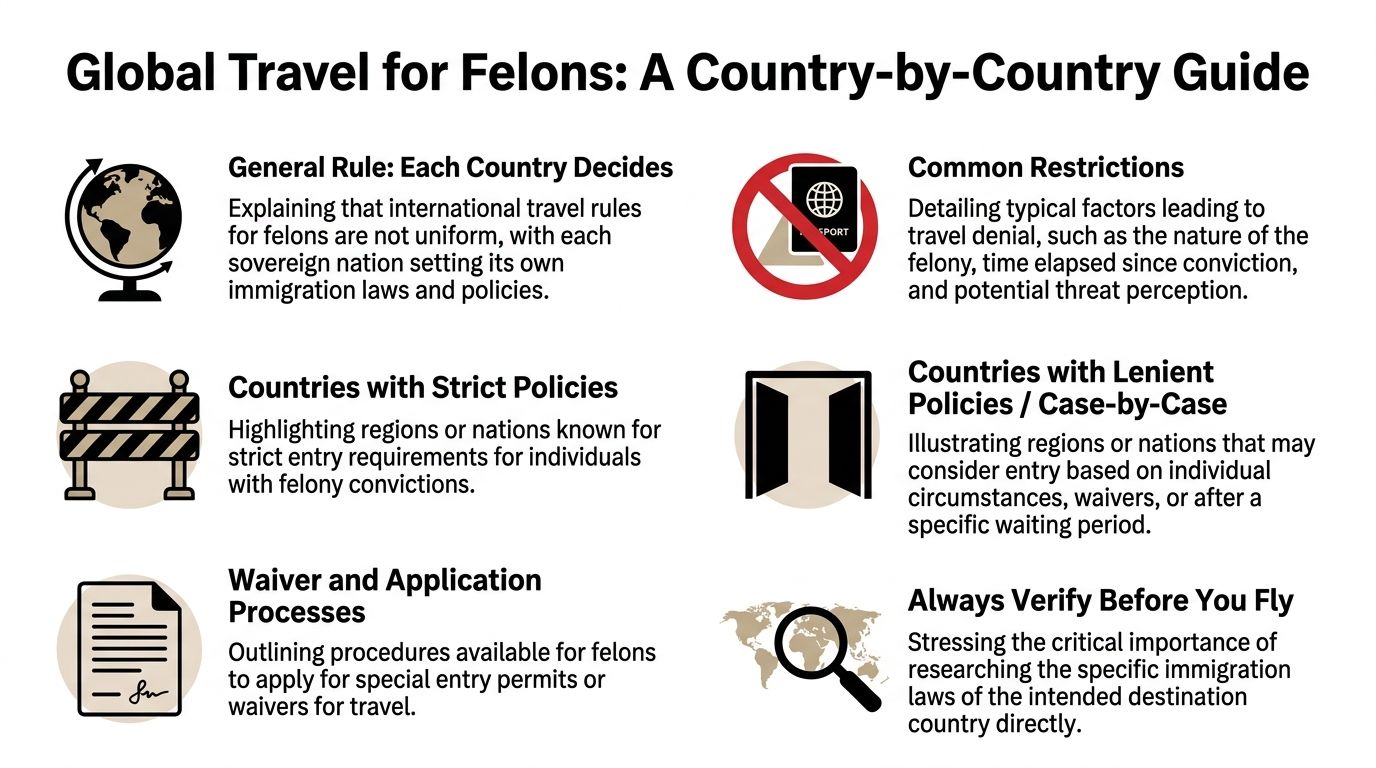
A practical way to sort countries
In my practice, it helps to divide countries into three real-world groups.
Strict-entry countries regularly deny travelers with certain convictions or sentences. Canada is the country that surprises Georgia travelers most often. Japan can also be strict. In these places, a conviction that seems old or minor in Georgia can still stop the trip.
Discretionary-review countries may admit one traveler and deny another with a similar record. The outcome can turn on court documents, the exact sentence, rehabilitation evidence, and how the offense compares to local law.
Lower-friction destinations may not routinely screen for criminal history on short tourist entry, especially for visa-exempt travel. That helps, but it is not a promise. Border officers still have authority to ask questions and refuse admission.
Sentence details drive many outcomes
The label "felony" does not tell the whole story. Sentence details often matter more.
Some countries focus heavily on whether any jail or prison sentence was imposed and how long that custodial sentence was. Others care more about whether the offense has an equivalent crime under their own law. A Georgia plea that looked manageable at the time can create a travel problem years later because the sentence crossed a threshold that matters abroad.
That is one reason defense work on the front end matters so much. Anyone dealing with charges now should understand how to find a criminal lawyer in North Georgia who evaluates long-term travel consequences before accepting a plea.
Country comparison table
| Country | General Policy | Key Factors Considered | Potential for Waiver or Further Review |
|---|---|---|---|
| Canada | Often strict for criminal history. | Whether the Georgia offense matches an indictable offense under Canadian law, and the sentence imposed. | Possible in some cases through rehabilitation or special permission, depending on the record and timing. |
| United Kingdom | Often sentence-sensitive. | Custodial sentence length, offense history, and current entry rules. | Sometimes, but the facts matter. |
| Australia | Character-based review can be strict. | Sentence history, police records, visa application disclosures, and character concerns. | Possible through the visa process with supporting records. |
| Japan | Often strict for certain sentences and offenses. | Imprisonment history and the country's statutory exclusions. | Limited, and many travelers need country-specific review before booking. |
| New Zealand | Statutory bars can apply in some cases. | Length of sentence and how recently it was imposed. | Case-specific review may be available. |
| Schengen countries | Rules vary by country, and short tourism can be easier than in Canada. | Entry method, sentence history, offense type, and any alerts or visa issues. | Depends on the country and the traveler's record. |
Canada causes the most border shocks
Canada is where many Americans learn, at the airport or land crossing, that foreign immigration law does not care what Georgia called the case. Canadian officers look at the Canadian equivalent of the offense. That distinction matters.
DUI cases are a common example. A traveler may think, "It was only a Georgia DUI from years ago." Canadian authorities may view the offense through a very different legal lens. I have seen people lose flights, hotel money, hunting trips, weddings, and work events because they assumed an old conviction would not matter.
The practical lesson is simple. If Canada is the destination, check admissibility before you spend money.
The UK, Australia, Japan, and New Zealand each raise different problems
The United Kingdom often turns on sentence length and the details behind the conviction. A non-custodial result may be treated very differently from a case that involved a substantial jail sentence.
Australia usually requires closer screening through the visa process for travelers with criminal records. The issue is not just the conviction. It is whether the applicant meets the country's character requirements and provides complete, accurate records.
Japan has a reputation for strict treatment of certain criminal histories, especially where imprisonment was imposed. New Zealand also applies statutory bars in some circumstances tied to sentence length and timing.
These are not countries to treat as interchangeable. A person denied by one may still have a workable path in another. A person allowed into Europe may still have a serious problem in Canada.
Europe can be easier, but easy is not the same as safe
Many travelers with records focus on Europe because entry for short tourism can be more straightforward in some Schengen destinations than it is in Canada or Australia. That can be true. It is still smart to verify current rules before departure, especially if the conviction involved drugs, violence, fraud, or a meaningful custodial sentence.
Rules change. Screening systems change. Airline staff and border officers can also force a decision point long before you reach your hotel.
What to do before booking anything
Treat an international trip like a legal checklist, not a guess.
- Pull the final sentencing paperwork, not just the accusation or dismissal paperwork from another count.
- Check whether supervision terms still limit travel, even if the trip is weeks away.
- Review how the destination country classifies the offense, especially for DUI, drug, theft, and violence cases.
- Answer visa and entry questions truthfully. A false answer creates a new problem that can be worse than the old conviction.
- Resolve waiver or rehabilitation issues early if the destination country allows them.
People get into trouble when they ask, "Can felons travel?" as if there is one worldwide answer. There is not. The right question is narrower and more useful. Can this person, with this Georgia record, this sentence, and this supervision status, enter this specific country on these travel dates? That is the question that protects your money, your trip, and your freedom.
Take Control Contact a North Georgia Felony Defense Lawyer
Travel problems usually start much earlier than the trip itself.
They start when a person pleads guilty without understanding the long-term effect of the sentence. They start when someone on probation assumes an informal yes from an officer is enough. They start when a traveler thinks an old Georgia conviction is only a local issue, then learns that a foreign government reads it very differently.
That is why the strongest travel strategy begins with the criminal case, not the vacation.

What works before conviction
If you are facing charges now in Alpharetta, Roswell, Cumming, Johns Creek, Milton, Marietta, or nearby counties, the best way to protect future travel is to fight for the best possible outcome now.
That can mean different things depending on the case:
- A reduction from felony to misdemeanor
- A negotiated sentence that avoids a harmful custodial threshold
- A defense strategy aimed at dismissal
- A resolution that protects employment and international mobility
- A careful response to DUI, drug possession, theft, or traffic-related charges before they snowball
For many people searching for a DUI lawyer in Alpharetta, a DUI attorney in Roswell, a drug possession lawyer in Cumming, or a felony defense lawyer near me, the immediate focus is jail, license issues, and court dates. Those are urgent. But future travel can also be a serious collateral consequence.
A reckless driving plea, a drug case, or a felony sentence in Cobb County or Forsyth County can affect border entry years later. That is one reason strategic court representation matters from day one.
What works after conviction
If the conviction already exists, the question becomes damage control.
Some of the most useful steps include:
Review the exact final disposition
Do not rely on memory. Pull the sentencing documents, accusation or indictment, and final order. International admissibility often turns on the precise sentence, not how you casually describe the case.
Explore record relief where available
Verified data notes that expungement or record-related relief can mitigate how records appear in background checks, including the Florida example under §943.0585 discussed in the verified material. Georgia has its own record-restriction framework, and eligibility depends on the charge and case outcome.
Prepare for waiver-based countries
The verified material references practical strategies such as waivers and rehabilitation for countries like Canada. Those processes are not quick fixes, but they may be the right path when travel is important for work or family reasons.
Fix supervision issues first
If probation, parole, unpaid obligations, or a pending violation still exist, solve that before making travel plans. A foreign admissibility strategy does not help if the Georgia court system is the first obstacle.
Practical advice: If your case is active, ask your lawyer to evaluate travel consequences before any plea is entered. If your case is closed, ask for a post-conviction review based on the exact sentence and the countries you need to visit.
Why local criminal defense experience matters
Travel issues do not arise in a vacuum. They usually connect to the underlying charge.
A person looking for a speeding ticket lawyer in Marietta, a traffic ticket attorney in Sandy Springs, or help with how to fight a traffic ticket may not think travel matters. But repeated traffic issues can trigger license problems, bench warrants, or escalated charges. A driver searching for a license suspension lawyer in Fulton County or court representation in Forsyth County is dealing with another kind of mobility problem. A person facing DUI or drug charges in Duluth or East Cobb may be one plea away from a record that affects travel far beyond Georgia.
That is why the right defense approach is not only about the next court date. It is about protecting the future.
If you need to travel soon
If the trip is coming up, move quickly and realistically.
Do this in order:
- Confirm whether you are still on probation, parole, or any supervised release
- Get the final sentencing records
- Identify the destination country’s current admissibility rules
- Look at whether the country uses sentence thresholds, offense equivalency, or discretionary review
- Decide whether court permission, a visa application, a waiver, or a postponement is the safest move
People often want a shortcut. There usually is not one. What there is, however, is a disciplined legal review that can keep you from making a very expensive mistake.
A final word for North Georgia readers
If you live in Alpharetta, Roswell, Johns Creek, Milton, Cumming, Sandy Springs, Marietta, or the surrounding North Atlanta area, the core answer is this: can felons travel? Yes, sometimes. But whether you can travel now, where you can go, and how much risk you face depends on details that should never be guessed at.
If you are still choosing a lawyer, this guide on how to find a criminal lawyer in North Georgia can help you evaluate experience, responsiveness, and local court knowledge before you make a decision.
The earlier you address the problem, the more options you usually have. That is true for DUI defense, felony defense, misdemeanor defense, record issues, and travel-related consequences alike.
If you need clear answers about charges, sentencing exposure, probation limits, DUI consequences, record issues, or how a conviction could affect your ability to travel, contact Brian Hansford Law. The firm serves clients across Alpharetta, Roswell, Johns Creek, Milton, Cumming, Marietta, and North Atlanta with focused criminal defense representation, practical strategy, and confidential case guidance.
