
When you see those flashing blue lights in your rearview mirror, one of the first questions that likely pops into your head is, "Can the police search my car?" It’s a great question, and the answer isn't a simple yes or no. The officer's ability to search your vehicle depends entirely on the specific circumstances of your stop.
Understanding these situations is the first step toward protecting your rights.
Your Rights During a Traffic Stop
Picture this: you're driving home through Alpharetta or Cumming and get pulled over. That interaction is governed by a core principle of American freedom—the Fourth Amendment, which protects you from unreasonable searches and seizures. Think of this constitutional safeguard as a fence around your privacy. But, like any fence, there are a few specific gates an officer might be able to open.
The key is knowing what gives an officer the authority to look inside your vehicle. This guide will walk you through these concepts in plain English, so you can move from a place of uncertainty to one of informed awareness. We'll explore the rules that apply to every traffic stop, whether you're in Forsyth County, Roswell, or anywhere else in Georgia.
The Foundation of Vehicle Searches
At its heart, the system is trying to strike a balance between your right to privacy and law enforcement's need to investigate potential crimes. While officers generally need a warrant to search private property like your home, vehicles are treated a bit differently. Why? Because they're mobile, and evidence can be moved or destroyed in an instant.
This isn't a new concept. The U.S. Supreme Court established the "automobile exception" way back in 1925 in a case called Carroll v. United States. This ruling allows for warrantless searches of a car if an officer has probable cause. This single, long-standing rule has shaped how traffic stops are handled across the country.
Key Concepts to Know
To really get a handle on whether a search is permissible, you need to understand a few core ideas that we’ll dive into throughout this guide.
- Probable Cause: This is more than just a gut feeling or a hunch. It's a reasonable belief, based on specific facts and circumstances, that a crime has been committed and that evidence of that crime is sitting inside your car.
- Consent: If you voluntarily say "yes" to a search, you’ve essentially given up your Fourth Amendment protection for that specific interaction. It's important to remember that you generally have the right to say no.
- Plain View: If an officer sees something obviously illegal—like drugs on your passenger seat—from outside your car, they can seize it without a warrant.
These principles are the bedrock of an officer's authority during a stop. Recognizing the difference between a routine traffic stop and a situation that justifies a search is critical. It all comes back to a central idea you might have heard of: your reasonable expectation of privacy in your vehicle.
Understanding Probable Cause for a Vehicle Search
You hear the term "probable cause" a lot, but what does it actually mean when you’re on the side of the road in Roswell or Marietta? Put simply, probable cause is the standard an officer needs to meet to search your car without a warrant. It’s more than just a hunch; it’s a reasonable belief, based on real facts, that a crime is happening and evidence of it is in your vehicle.
An officer can’t just decide to search your car because you seem nervous or because of the neighborhood you’re in. They have to point to specific, tangible things they can see, smell, or hear that would lead any reasonable person to believe there’s illegal activity afoot.
Think of it like this: getting pulled over for a broken taillight is just one piece of the puzzle. It doesn't give the officer the whole picture. But if they walk up to your window and smell marijuana or see a half-empty bottle of vodka on the floor, they're adding more pieces. Once enough pieces click together, they can form a clear picture—and that picture is probable cause.
What Creates Probable Cause
So, what are these "puzzle pieces" that can take an officer from a routine stop to a full-blown search? Every situation is different, of course, but a few common scenarios tend to pop up again and again.
It’s all about sensory information—what the officer can physically observe. These are the details that stand up in court and justify a search under the Fourth Amendment.
Here are a few of the most common triggers:
- The Smell of Contraband: The distinct odor of burnt marijuana or an alcoholic beverage coming from inside the car is one of the biggest reasons officers give for conducting a search.
- Items in Plain View: If an officer can see something illegal just by looking through your car window, that’s a game-changer. This could be anything from drug paraphernalia on the passenger seat to open containers of alcohol.
- Admissions by the Driver or Passengers: If you or someone else in the car admits to having something illegal, that statement alone can be enough to establish probable cause for a search.
It's critical to remember that even with probable cause, the police don't get a free-for-all. The search has to be limited to the areas where they could reasonably expect to find the specific evidence they're looking for.
The Difference Between Suspicion and Probable Cause
The line between an officer's suspicion and true probable cause can feel blurry, but it's a massive distinction. Let's say you get pulled over in Johns Creek for failing to signal a lane change. The officer has the right to stop you and write a ticket, but that's it. That stop doesn't automatically give them a key to your trunk.
Now, imagine during that same stop, the officer notices you're sweating and your hands are shaking. Is that enough? No. Your nervousness is just a suspicion. It doesn’t give them the grounds to start searching. They need something more concrete.
But if, while talking to you, the officer shines their flashlight and spots a small bag with white powder sticking out from under the seat, everything changes. That suspicion just hardened into probable cause. They now have a tangible, observable fact connecting your car to a potential crime, which justifies taking a closer look. Without that extra piece of evidence, any search based on your nervous behavior would almost certainly be thrown out in court. This is a crucial factor when we analyze whether police can search your car.
While the Fourth Amendment generally requires police to get a warrant before searching your property, that rule has a lot of exceptions when it comes to vehicles. Probable cause is a big one, but it's far from the only situation where an officer can search your car during a traffic stop.
Knowing these exceptions is critical to understanding your rights on the road. They cover everything from you giving permission to what happens if your car is towed away. Let's walk through these common scenarios so you know what to expect.
Giving Consent to a Search
The simplest way for an officer to search your car is to get your permission. This is called a consent search. If an officer asks to look inside your car and you say "yes," you have voluntarily waived your Fourth Amendment rights for that search.
The question might sound casual, like, "You don't mind if I take a quick look in your vehicle, do you?" If you agree, they don't need a warrant or probable cause. It is absolutely vital to know that you have the right to refuse. A clear and polite, "Officer, I do not consent to a search," is all you need to say. Your refusal cannot be used as a reason to search the car anyway.
Important Takeaway: When an officer asks for your consent to search, it's often because they don't have another justification. You can protect your privacy by simply and respectfully saying no.
The Plain View Doctrine
Another major exception is the plain view doctrine. It’s just what it sounds like: if an officer sees something illegal from a place they are allowed to be, they can seize it without a warrant.
For example, say you're pulled over for speeding in Milton. When the officer comes to your window, they see a bag of marijuana on the passenger seat. Because it was in plain sight from outside the car, the officer can seize it. That discovery then gives them the probable cause they need to conduct a full search of your vehicle.
This flowchart helps show how an officer's observations can quickly escalate from a simple stop to a search.
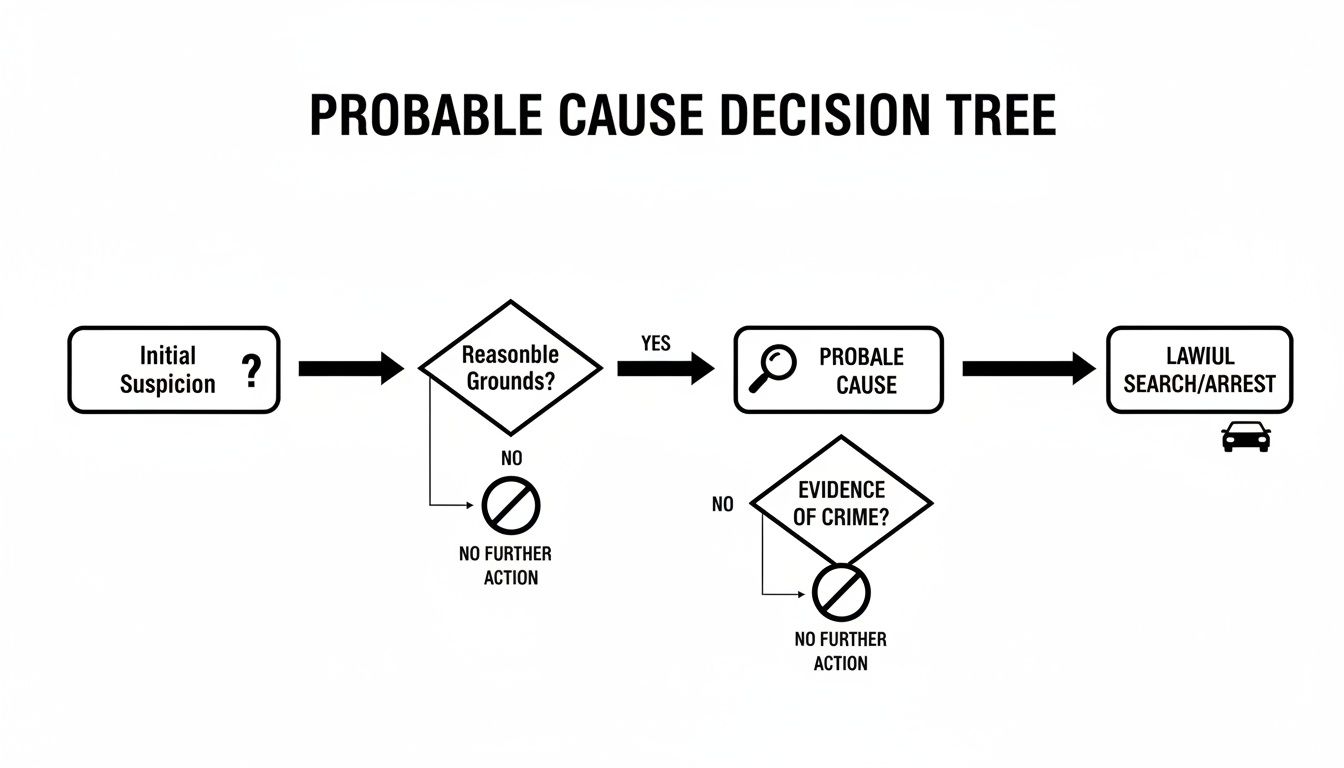
As you can see, what starts as a routine stop can turn into a full-blown search the moment an officer spots something incriminating in plain view.
Searches Connected to an Arrest
If you are arrested during a traffic stop, the police are allowed to perform a search incident to arrest. This search is meant to find weapons that could harm the officer and to prevent you from destroying any evidence related to the crime you're being arrested for.
This isn't a free-for-all, though. The search is generally limited to the area within your immediate control—what is often called the "lunge" or "grab" area. In a car, that typically means the passenger compartment and any containers inside it, locked or not. If you're arrested for DUI in East Cobb, for instance, an officer can search the passenger area for open alcohol containers.
K-9 Unit Alerts
You've seen police dogs on TV sniffing cars, and it happens in real life, too. If a trained and certified police K-9 "alerts" on your vehicle, that alert alone is enough to establish probable cause for a search. The dog's signal is considered reliable evidence that drugs are present.
But there are rules. An officer can't make you wait an unreasonable amount of time for a K-9 unit to get there. If the reason for the stop is finished—like a speeding ticket has been written—they can't detain you indefinitely just to wait for a dog to arrive.
Inventory Searches After Impoundment
Finally, if your car gets towed and impounded after an arrest or an accident, police can conduct an inventory search without a warrant. The stated purpose isn't to look for evidence but to document everything inside the vehicle.
This is done for three main reasons:
- To protect your property from being lost or stolen while in police custody.
- To protect the police from false claims that they stole something from your car.
- To check for dangerous items like weapons or explosives.
Even though it’s an administrative procedure, any contraband an officer finds during an inventory search can be used against you in court. If they find illegal drugs in your glove box while cataloging items at an impound lot in Forsyth County, you can be charged for it.
Traffic stops are one of the most common interactions people have with law enforcement, but they don't always result in a search. According to the Bureau of Justice Statistics, in 2022, 18.5% of U.S. residents had police contact, the lowest rate since 2008. While more than 12 million drivers were stopped, that number is down from 24 million in 2018. Of those pulled over, 3.5% reported their vehicle was searched, and 61% of them felt the search was illegitimate. You can discover more about these policing survey results to see how these dynamics are changing.
How to Navigate a Traffic Stop
Knowing the rules of a vehicle search is one thing. Actually using that knowledge during the stress of a real-world traffic stop is something else entirely. The flashing lights in your rearview mirror and the officer at your window can be intimidating for anyone. This guide will walk you through how to handle the interaction calmly, safely, and in a way that protects your rights without making the situation worse.
The number one goal in any traffic stop is safety—for you, your passengers, and the officer. How you act in those first few moments can set a calm, professional tone for the entire encounter.
Your Initial Actions Matter
Once you see the lights, pull over to a safe spot as soon as you can. Turn off your car, switch on the interior light if it’s dark, and place both of your hands on the steering wheel. This is a simple, non-verbal way to show the officer you’re cooperative and not a threat.
Wait for the officer to approach and ask for your documents. You are required to provide your driver’s license, vehicle registration, and proof of insurance. It’s always a good idea to keep these documents somewhere you can get to them easily. Fumbling around in your glove box or under your seat can be misinterpreted. For a deeper look into the specifics, check out our detailed guide on being pulled over in Georgia.
Communicating Clearly and Respectfully
How you talk to an officer can make all the difference. Stay polite and calm, even if you feel frustrated or nervous. Answer basic identifying questions, but remember that you have the right to remain silent about where you're going or where you've been.
This becomes critical if the officer asks to search your vehicle. The question might sound casual, like, "You don't mind if I take a quick look inside, do you?" Your answer needs to be just as calm but very clear.
A simple and firm, "Officer, I do not consent to a search," is all you need to say. You don't have to explain why or make an excuse. Politely refusing is your constitutional right.
This is a crucial point. When you give consent, you are essentially waiving your Fourth Amendment protections for that specific interaction. By clearly stating your refusal, you keep those rights intact, which can be absolutely vital later on.
Understanding Driver and Passenger Rights
While the driver is in control of the car, passengers have rights, too. A passenger generally isn't required to show ID unless the officer has a reasonable suspicion that they've committed a crime. Just like the driver, passengers can remain silent and aren't obligated to answer questions about their travel plans.
It's also important to know that a passenger can't give valid consent for a search of the entire car. They can only agree to a search of their personal property, like a purse or backpack. If the driver refuses consent for a vehicle search, that decision generally overrides anything a passenger might say about the car itself.
Statistics show why knowing these rights is so important, especially for people in communities across Forsyth County, Cobb County, and East Cobb. The racial disparity in traffic stops is stark: Black drivers are searched or arrested 9% of the time, compared to only 3% for white drivers. Public opinion reflects this concern, with 63% of Americans opposing routine drug searches during minor traffic stops without a warrant.
These numbers aren't just abstract—they highlight why being able to assert your rights calmly and confidently is so powerful. By handling the stop correctly, you can get through the encounter safely while protecting your privacy.
How an Unlawful Search Is Challenged
So, what happens when an officer oversteps their authority during a traffic stop? A search that violates your Fourth Amendment rights isn't just a mistake—it triggers a powerful safeguard known as the Exclusionary Rule.
Simply put, the Exclusionary Rule is like a gatekeeper for evidence. If a judge agrees that a search was conducted improperly, any evidence found during that search can be blocked from being used against you in court. It’s the system's way of making sure constitutional protections have real teeth.
The Motion to Suppress
The tool used to enforce this rule is a formal request called a Motion to Suppress Evidence. This motion asks the court to "suppress," or throw out, the improperly obtained evidence. It's a make-or-break moment in many criminal cases because if the motion is granted, it can completely gut the prosecution's case.
Imagine you're pulled over in Alpharetta for a minor traffic violation. The officer doesn't see or smell anything suspicious but decides to search your car anyway, finding something illegal in your trunk. A successful Motion to Suppress would argue that the officer lacked probable cause for that search, making it unconstitutional. As a result, the evidence found in your trunk could be thrown out.
A Motion to Suppress is not just a technicality; it's a fundamental challenge to the legality of the government's actions. It holds law enforcement accountable to the same rules that protect everyone's privacy.
By filing this motion, an attorney asks a judge to take a hard look at the specific details of your traffic stop and decide if your rights were respected. You can learn more about how a Motion to Suppress Evidence works in our detailed guide.
The Real-World Impact
A successful motion can completely change the direction of a case. Without the suppressed evidence, the prosecution might not have enough left to move forward. This often leads to one of two outcomes:
- Reduced Charges: The prosecution may offer a plea to a much lesser offense.
- Case Dismissal: In many situations, the case is dismissed entirely.
This is exactly why a detailed review of every search is so critical. The question of whether police can search your car is complex, and the answer almost always comes down to the small, specific details of the interaction.
Despite how often they happen, vehicle searches are frequently not very effective. Millions of searches occur during traffic stops, yet they rarely turn up significant contraband. A Stanford analysis highlighted ongoing racial disparities in these searches, even in states where marijuana is legal. Data from California showed that during late-night hours, when 10% of 3.4 million stops in 2019 resulted in searches, the amount of contraband found was minimal. You can discover more insights about these vehicle stop statistics and see the bigger picture.
Protecting Your Rights After a Vehicle Search
We've walked through the complex world of police vehicle searches, from probable cause to consent. Getting a handle on these rules is a great first step. But if police have already searched your car and you're now facing the consequences in places like Cumming, Johns Creek, or Alpharetta, knowing what to do next is absolutely critical.
Figuring out your options after a vehicle search almost always means picking apart every single detail of the traffic stop. What happened? What was said? This is where having a seasoned professional in your corner can make all the difference.
The Value of a Former Prosecutor's Perspective
When you're trying to challenge a vehicle search, you need to see the situation from every angle. A former prosecutor brings a unique and powerful perspective because they know firsthand how these cases are built by the state. They've been on the other side.
This kind of background is invaluable for spotting the weak points in the prosecution's case, such as:
- Was the initial traffic stop even permissible?
- Did the officer truly have probable cause to justify the search?
- How was consent obtained? Was it actually voluntary?
- Did the police overstep their bounds and search areas they weren't allowed to?
Someone like Brian Hansford, with his years of experience as a prosecutor, has seen these tactics from both sides of the aisle. He understands how police and prosecutors think, which allows him to conduct a deep-dive review of everything that happened during your stop. This is exactly the kind of insight you need to explore every possible defense.
Scheduling a consultation isn't just a small step—it's a significant move toward protecting your future. It’s your chance to have the facts of your case analyzed by someone who knows the system inside and out.
If you are facing charges after a vehicle search in Forsyth County, Cobb County, or the surrounding areas, don't wait to get help. The choices you make right now can have a lasting impact on your life. Your most important next step is to get a clear, informed perspective on your situation.
A Few Common Questions About Car Searches
It’s completely normal to feel a little rattled during a traffic stop. Most people aren't sure what they can or can't do, leading to a lot of the same questions. Here are some clear, direct answers to the things drivers most often worry about when police want to search their car.
Your Rights and Police Questions
Do I have to answer if an officer asks, "Is there anything illegal in the car?"
No, you absolutely do not. The Fifth Amendment gives you the right to remain silent, and you should use it. You can simply and politely say, "Officer, I'm going to remain silent." You don't have to explain why or say anything else.
What about a locked glove box or the trunk? Can police search those?
It really depends. If you give them consent, they can look anywhere you’ve allowed. But if they're searching based on probable cause, things get a bit more complicated. The search can’t be a free-for-all; it has to be limited to where they reasonably expect to find the specific evidence they're looking for.
For instance, if an officer has probable cause to believe there's an open beer can in your passenger area, that doesn't automatically give them the right to start prying open a locked trunk. The search's scope is a critical detail.
Passenger Rights and Consent
What happens if my passenger tells the police they can search the car?
This is a key point many people get wrong. A passenger can generally only give consent to a search of their personal property—like their own purse or backpack.
A passenger cannot give consent for a search of the entire vehicle. If you, the driver, say no to a search, your refusal should override anything your passenger says about the car itself. It's your car, and your "no" should be what matters.
If you're now facing charges because of a vehicle search in Forsyth County, Cobb County, or anywhere in North Georgia, the specific details of that stop are incredibly important. At Brian Hansford Law, our team—which includes a former prosecutor—knows exactly what to look for when analyzing the circumstances of a search.
Contact us to start protecting your rights. You can reach out directly at https://challengemycharge.com to see what your options are.
