
When can the police search your house without a warrant? The short answer is, they usually can't. The Fourth Amendment to the U.S. Constitution puts up a pretty strong wall, requiring law enforcement to get a warrant from a judge before they can cross your threshold.
But that protection isn't absolute. There are several crucial exceptions that give police a path to conduct a search without that piece of paper. The warrant is the general rule, and the exceptions are specific, time-sensitive situations.
The Fourth Amendment and Your Front Door
Your home is given a special status under the law. It’s the one place where you have the highest expectation of privacy. This isn’t just an abstract theory; it’s a cornerstone of American freedom, designed to protect people from the government showing up unannounced.
The warrant requirement forces the issue. It means a neutral judge has to look at the evidence first and agree that there’s probable cause before officers are allowed to come inside.
However, the line between a lawful search and an unlawful one can get blurry, fast. The exceptions to the warrant rule are almost always based on very specific, fast-moving circumstances.
The core of the Fourth Amendment is the right of a person to retreat into their own home and there be free from unreasonable governmental intrusion. This protection is fundamental to personal liberty.
This guide will walk you through these exceptions—from giving consent to full-blown emergencies—so you can understand what to expect if police arrive at your door in Alpharetta, Cumming, or anywhere in Forsyth County. Understanding these distinctions is the first step in knowing how your rights are protected.
How Most People Feel About Warrantless Searches
The idea that your home is your castle is deeply ingrained in the American mindset, and it cuts across all political and demographic lines.
In fact, recent polling shows that 66% of Americans are adamant that police must get a warrant before searching the home of someone suspected of dealing drugs. They reject the idea of warrantless searches even when a serious crime is suspected.
This isn't a partisan issue. The support for a warrant is widespread:
- 69% of whites
- 68% of Blacks
- 54% of Hispanics
- 72% of independents
- 63% of Democrats
- 62% of Republicans
These numbers show a powerful consensus that the warrant is a critical safeguard. This is exactly why challenging a warrantless search is such a significant and powerful part of the criminal defense process.
When Police Do Not Need a Warrant to Search
While the Fourth Amendment stands as a strong guard for your home, it’s not an impenetrable fortress. There are specific, well-defined situations—often called "exceptions to the warrant requirement"—that allow police to conduct a search without getting a judge's permission first. Knowing these scenarios is critical to understanding how rights function and when they can be bypassed.
Think of it like this: your front door has a heavy-duty lock, which is the warrant requirement. But under precise circumstances, the police have a few "master keys" that can open that lock. We’ll walk through what these keys are, from you giving them permission to them responding to a true emergency.
The flowchart below shows the basic decision-making process an officer goes through when considering a search.
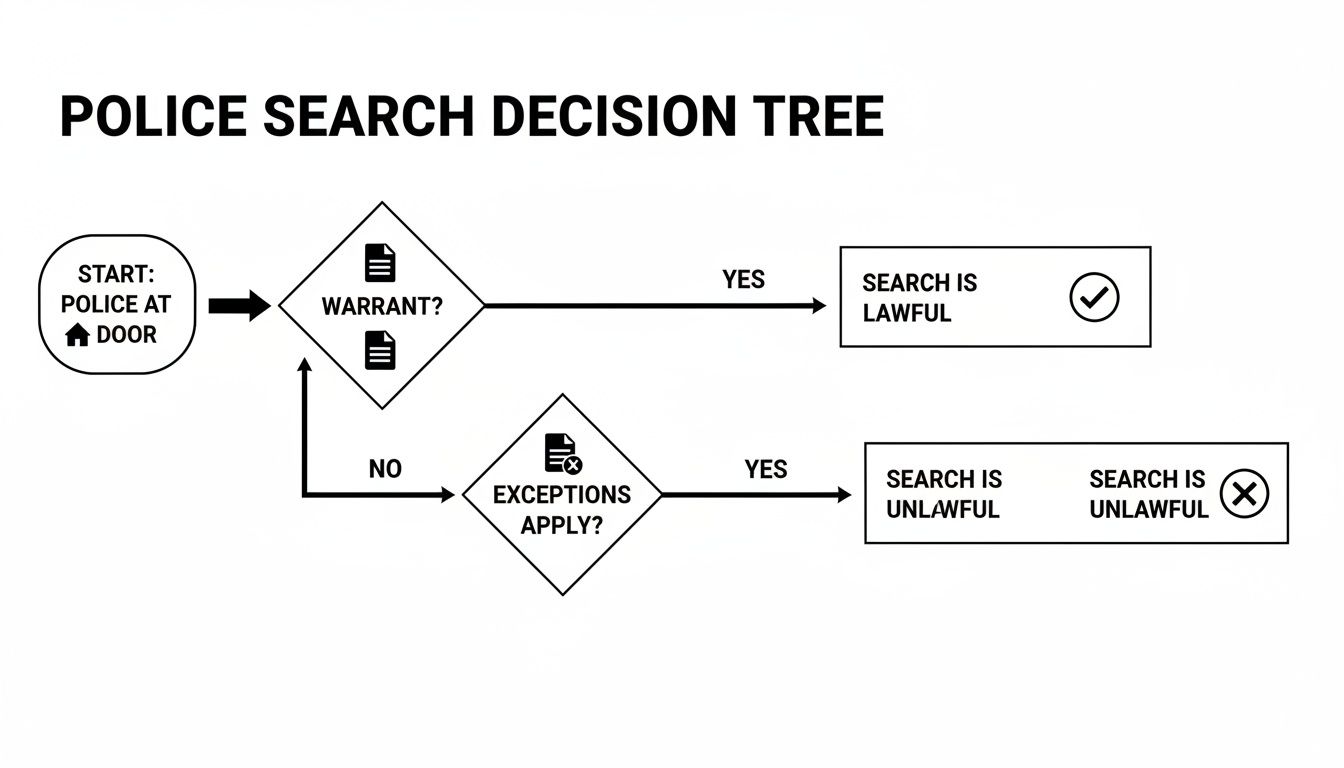
As you can see, not having a warrant isn't the end of the story. It simply opens up another path where these very specific exceptions come into play.
Giving Consent to a Search
The most straightforward way for officers to search your house without a warrant is if they are allowed in. This is what’s known as a consent search. If an officer asks, "Do you mind if we take a look inside?" and a person agrees, they have just waived their Fourth Amendment protections for that search.
Consent has to be given voluntarily, not because someone was forced or tricked. The line between a polite request and an intimidating demand can feel incredibly thin when law enforcement is on your doorstep. It is important to know that you have the right to calmly and clearly say "no."
The Plain View Doctrine
Another major exception is the Plain View Doctrine. This rule allows officers to seize evidence of a crime without a warrant if they see it from a place they are legally allowed to be.
For example, imagine police come to your door for a legitimate reason, like a noise complaint. If they look through your open doorway and see illegal drugs on the coffee table right in their line of sight, they can seize those items. That observation could then become the basis to get a warrant for a much deeper search.
The key here is that the officer must be in a lawful position when they see the evidence. They can't illegally trespass on your property to get a better vantage point and then claim the item was in plain view.
Exigent Circumstances and Emergencies
Sometimes, police are dealing with a genuine emergency where stopping to get a warrant could lead to immediate danger, evidence being destroyed, or a suspect escaping. These situations are called exigent circumstances, and they give officers a very narrow window to enter a home without a warrant.
These circumstances generally fall into three buckets:
- Preventing the Imminent Destruction of Evidence: If police have probable cause to believe that criminal evidence is about to be destroyed, they may enter to secure it. A classic example is hearing a toilet flushing over and over after they’ve knocked and announced they’re investigating drug activity.
- Providing Emergency Aid: Officers can enter a home if they have a reasonable belief that someone inside is hurt or in immediate danger. A clear cry for help or the sounds of a violent struggle would likely trigger this exception.
- Hot Pursuit of a Fleeing Suspect: If police are actively chasing a suspect who committed a serious crime and that person ducks into a house, officers can follow them inside to make an arrest. This common-sense rule prevents a suspect from using a private home as a safe haven to get away. You can learn more about the nuances of the various exceptions to the warrant requirement in our detailed guide.
Search Incident to a Lawful Arrest
When police legally arrest someone inside their home (usually with an arrest warrant), they are also allowed to conduct a limited search of the area immediately around that person. This is known as a search incident to arrest.
The purpose here is strictly about safety and evidence preservation: finding and removing any weapons the person could grab, and stopping them from destroying any evidence within their reach. This search is tightly limited to the person's "wingspan"—the area they can immediately control. It does not give officers a free pass to search the entire house.
So, if someone is arrested in their living room, police can’t then go search an upstairs bedroom under this specific exception.
Understanding Your Property Rights Beyond the Walls
For many folks in Georgia, from the sprawling lots in Forsyth County to the quieter neighborhoods of Milton and Roswell, "property" means more than just a house and a yard. It might include acres of woods, a back pasture, or a large field. This is where a surprising and often misunderstood concept comes into play—one that completely changes the rules on when police can search without a warrant.
It’s called the Open Fields Doctrine. This court-created rule carves out a major exception to the Fourth Amendment’s protection against unreasonable searches. Essentially, it says that certain areas of your private land don't get the same privacy protection as your home and the area immediately around it.
What Is Curtilage?
To really get a handle on the Open Fields Doctrine, you first need to understand the idea of curtilage. Think of curtilage as an invisible privacy bubble around your house. It’s the area so closely tied to your home life that it gets the same strong Fourth Amendment protection as your living room.
This "bubble" typically covers:
- Your immediate yard, both front and back.
- A detached garage or shed close to the house.
- A fenced-in area directly connected to your home.
The law views this space as part of your home, plain and simple. Police generally need a warrant to step foot on your curtilage, just as they would to walk through your front door. The lines aren't always perfectly clear, but the goal is to protect the spaces where you actually live your life.
The Open Fields Doctrine Explained
Now, everything outside that protected bubble of curtilage is what the law calls "open fields." And this is where the rules flip entirely. The name is a bit misleading because it doesn’t just mean a literal field. It can be any unoccupied or undeveloped area outside the curtilage, even if it’s on your private property.
We’re talking about places like:
- Private woods on your land.
- A large, unfenced pasture.
- Vacant lots or the far corners of a large property.
Under the Open Fields Doctrine, police can enter these areas and search for evidence without a warrant and without probable cause. The reasoning is that these areas don’t come with a "reasonable expectation of privacy" like your home does. Even posting "No Trespassing" signs or putting up fences usually won't stop law enforcement from entering these open fields.
For example, imagine police in Cobb County get a tip that stolen goods are stashed in the woods on a large private estate. They could potentially walk right into those woods to look for the items without ever getting a warrant. That's a world away from the strict rules they'd have to follow to search the actual house on that same property.
The Open Fields Doctrine is built on the idea that because these areas are often visible from the air or from a distance, a person can't reasonably expect them to be private from the government's eyes.
This can be a shock for landowners. And its reach is massive. A study from the Institute for Justice revealed that nearly 96% of all private property in the U.S.—an incredible 1.2 billion acres—is open to warrantless police searches under this doctrine. You can read more about these findings and how they affect property rights nationwide.
Practical Implications for Georgia Property Owners
If you live in areas like Alpharetta and Johns Creek, where properties can be large and varied, this distinction is critical. It makes it clear that when you ask if police can search without a warrant, the answer depends heavily on where on the property the search happens.
A search of your house and its immediate surroundings gets the highest level of protection, almost always demanding a warrant. But a search of a remote part of your land might require no legal justification at all. Knowing the boundary between your protected curtilage and unprotected open fields is key to understanding the real-world limits of privacy rights.
Searches by Other Government Agencies
When you think about who might knock on your door wanting a look inside, police are usually the first group that comes to mind. But the question of warrantless searches gets broader when other government agents are involved. These agencies have different missions, but they can still seek entry into your home, creating situations that feel an awful lot like a police search.
A big example is Child Protective Services (CPS). Their job is to ensure child safety, and that work often includes home visits. While their goal is protection, not criminal prosecution, a request to enter your home can feel just as intrusive as one from law enforcement. It's important to understand their role, because what they see or hear can sometimes spark a much wider investigation.
The Role of Child Protective Services
When CPS gets a report about potential child endangerment, their first step is often to investigate the child’s living situation. This usually means a caseworker visits the family’s home to see the environment for themselves. They'll likely ask to come inside to talk with parents and children and look around for safety hazards or signs of neglect.
This process is very different from a police investigation. CPS visits are considered civil or administrative actions focused on child welfare. Because of this, the urgent need to protect a child can lead caseworkers to ask for entry without a court order.
It's important to know that these home visits can have major consequences. What a caseworker observes during a home inspection can be used to build a case affecting parental rights or even lead to a referral to law enforcement if they suspect criminal activity.
Home Inspections and Your Rights
The sheer number of these non-police home inspections is staggering. A deep-dive investigation by ProPublica and NBC News found that every year, CPS agencies in the U.S. conduct home inspections involving roughly 3.5 million children. These visits often involve caseworkers looking through personal spaces like refrigerators and closets, all without a judge signing off. You can read the full investigation into these warrantless child welfare searches to get a sense of the scale of the problem.
What’s even more shocking is how rarely court orders are actually used. The same investigation discovered that these agencies get entry orders—their version of a warrant—in fewer than 94 cases a year across the entire country. That data drives home a crucial point: millions of home entries happen because a parent consents, not because a judge has reviewed the evidence and authorized it.
This reality puts a lot of families in a tough spot. You want to cooperate to show you have nothing to hide, but you're also being asked to give up your fundamental right to privacy in your own home.
Other Agencies and Administrative Searches
While CPS is a frequent example, other government bodies might also want to enter your home for what are called administrative searches. These are done to enforce regulations, not to investigate a specific crime.
Examples include:
- Code Enforcement: An officer from a city like Marietta or Roswell might need to inspect your property to make sure it complies with local building or health codes.
- Fire Inspectors: After a fire, or as part of a routine safety check in certain types of buildings, a fire marshal could need to inspect the premises.
- Probation Officers: If someone in your house is on probation, the terms of their supervision might include allowing warrantless searches of their residence by their probation officer.
In many of these situations, the standard for entry might be lower than the "probable cause" needed for a criminal warrant. But basic protections still apply. Unless there's a true emergency, these agents generally can't force their way into your home without permission or a proper administrative warrant from a court.
What to Do When Police Are at Your Door
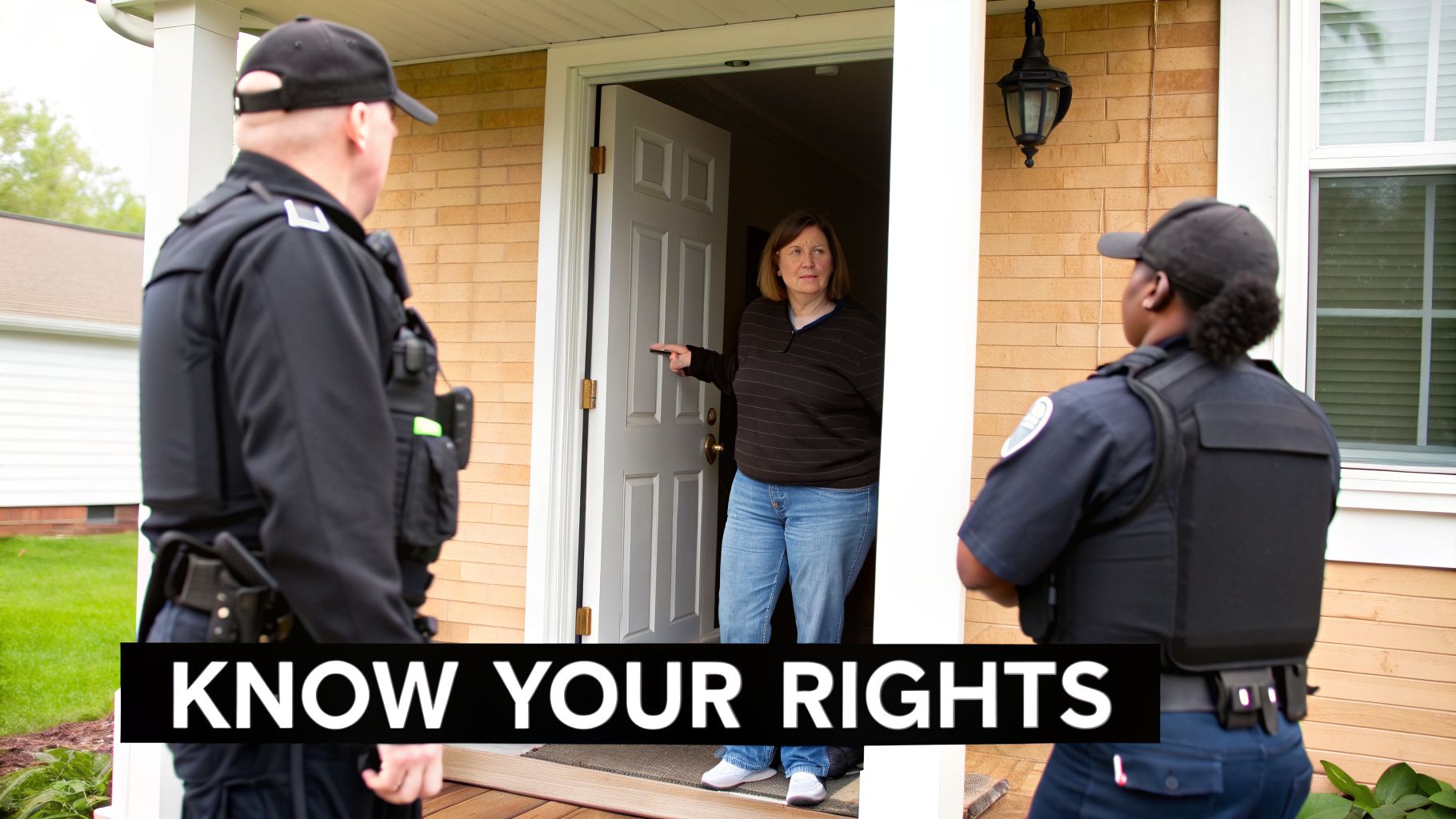
It’s a situation that can make anyone’s heart race: a knock on the door, and it’s the police. Whether you live in Alpharetta, Roswell, or anywhere in Forsyth or Cobb County, how you handle these first few minutes can be very important.
Knowing your rights and how to assert them can make a big difference. This isn't about being difficult or confrontational; it’s about being calm, clear, and in control of the interaction.
Stay Calm and Step Outside
First off, you are not required to open your door. But if you decide to speak with the officers, a practical move is to step outside and close the door completely behind you.
This simple act prevents officers from peering inside and potentially spotting something they could use to claim "plain view." Once you're outside, you can talk with them without giving them an unintentional look into your home. Always remain polite—respect doesn't cost you any of your rights.
Ask if They Have a Warrant
With the door shut behind you, the first and most important question can be, "Officers, do you have a warrant?"
Their answer tells you everything you need to know about what happens next. If they say yes, ask to see it. A real warrant is signed by a judge and must be very specific, detailing the exact place to be searched and what they are looking for. Read it over.
No matter what, never physically resist officers, even if you believe the search is not proper. Resisting can lead to new criminal charges. Any challenge to a search takes place in a courtroom, not on your front porch.
If the officers admit they don't have a warrant, they need either your permission or a valid exception to come inside.
How to Clearly Deny Consent
When the police ask for permission to enter without a warrant, you have every right to say no. The key is to be unmistakable.
A response could be a simple, firm, and calm statement: "I do not consent to a search."
That’s it. Repeat it if you have to. Don't get drawn into an argument or feel the need to justify your refusal. A straightforward denial is often the best approach.
- Do: State your refusal politely but firmly.
- Don't: Argue, make excuses, or get emotional.
- Do: Verbally repeat that you do not consent if they try to come in.
- Don't: Physically block their path or put your hands on an officer.
What Happens if They Enter Anyway
Sometimes, even after you've clearly said no, police might enter your home anyway, claiming an exception like an emergency.
If this happens, do not physically stop them. Instead, shift your focus to being a good witness. Pay close attention to everything they say and do. Where did they go? What did they look at or touch? If it's safe and you're able, have someone else watch or even record what’s happening.
A calm verbal refusal, followed by careful observation, provides important evidence for challenging the search later. By asserting your rights without becoming physically involved, you protect both your case and your safety.
How an Illegal Search Can Change Everything in Your Case

When the police cross the line and conduct a search that violates the Fourth Amendment, any evidence they uncover doesn't just vanish. The real question becomes whether the prosecution can even mention that evidence in court. This is where a seemingly small procedural error can become an incredibly powerful factor in a case.
If a judge agrees the search was unconstitutional, the evidence is labeled "fruit of the poisonous tree." It’s a powerful concept. It means that not only is the direct evidence thrown out, but so is anything else they found because of that initial bad search. Proving the tree was poisonous from the start is a key goal.
The Motion to Suppress: A Constitutional Shield
The main tool used to fight an unlawful search is a Motion to Suppress. It's a formal argument filed with the court asking the judge to exclude—or suppress—any illegally obtained evidence from the trial. The goal is simple: make sure the jury never sees or hears about evidence that was collected by trampling on constitutional rights.
A hearing is scheduled where an attorney will argue why the search was illegal, often putting the officers on the stand to question them about their actions and justifications. The prosecutor will fight back, trying to fit the search into one of the exceptions. In the end, the judge makes the final call on whether the evidence can be used. You can dive deeper into how this works by reading our guide on the Motion to Suppress Evidence.
A successful Motion to Suppress can completely change the direction of a criminal case. Without their key evidence, a prosecutor’s case can fall apart, often leading to reduced charges or even a full dismissal.
Why a Former Prosecutor's Insight Is an Advantage
Challenging a police search requires a deep understanding of not just the law, but of police procedure and the way prosecutors think. A defense attorney who has worked as a former prosecutor brings a unique advantage to the table. They’ve been on the other side. They know how officers are trained, how they write their reports, and where they tend to make procedural mistakes.
This firsthand experience helps them spot potential Fourth Amendment violations that other attorneys might miss, such as:
- An officer's report that sounds good on the surface but doesn't quite meet the strict standard for an exception.
- Contradictory statements from officers about why they felt the need to enter a home without a warrant.
- Situations where "consent" was given under pressure and wasn't truly voluntary.
That insider’s perspective is crucial. It allows an attorney to build a compelling argument for a Motion to Suppress by connecting the real-world actions of law enforcement directly to the constitutional protections in place.
Common Questions About Warrantless Searches
It's easy to get confused about when the police can search your house without a warrant. Let's break down some of the most common questions people have when facing this stressful situation.
What if I Didn't Consent and Police Find Something?
If officers search your home without your permission and turn up illegal items, that evidence doesn't just get thrown out automatically. For that to happen, a defense attorney has to file a "Motion to Suppress." This move argues that the search was unconstitutional.
The success of a suppression motion hinges entirely on the specific facts of your case. A judge will hear arguments from both the attorney and the prosecutor before deciding if the evidence was obtained illegally and whether it can be used against you.
Can My Roommate Consent to a Search of My Room?
This can be tricky. Generally, a roommate can only give consent for police to search the common areas you both share, like the kitchen or living room. They have no authority to allow a search of your private bedroom or other personal spaces.
However, these situations can get complicated fast, especially if there's a dispute over who controls which parts of the home. The specific details of your living arrangement matter a great deal in court.
What if Police Say They Have a Warrant but Won't Show Me?
You have the right to ask to see the warrant. If the officers refuse to show it to you or just push ahead with the search, do not physically resist. Safety has to come first.
Instead, you can clearly and calmly state, "I do not consent to this search." After that, pay close attention to everything that happens. An experienced attorney can later investigate whether a valid warrant even existed and if the police followed the proper procedures during the search.
A quick note on the Plain View Doctrine: This rule only applies when an officer is in a place they are legally allowed to be. If law enforcement uses technology like high-powered binoculars or thermal imagers to see things inside your home that aren't visible to the naked eye from a public street, it can be deemed an unconstitutional search. These are highly technical issues that are frequently challenged in court.
If you are facing criminal charges in Alpharetta, Cumming, or anywhere in Forsyth or Cobb County, understanding your rights is the first and most critical step. Brian Hansford Law has the experience needed to dissect every detail of your case, including the legality of any search that was conducted. To discuss your situation, visit challengemycharge.com.
