
The simple answer is no, a police officer can’t pull you over or stop you for no reason whatsoever. But here’s the thing: the bar for what counts as a valid reason is a lot lower than most people think. Grasping this difference is the first step to understanding your rights during a police encounter.
The Foundation of a Police Stop
When you see those flashing lights pop up in your rearview mirror or an officer walks up to you on the street, it’s only natural to wonder, “Why me?” The entire framework for these interactions is built on protecting you from the government just randomly interfering with your life. At its core, an officer needs a specific, factual reason to detain you, even for a moment.
That initial reason is a standard called reasonable suspicion. Think of it less like a hunch or a gut feeling and more like an educated guess based on facts the officer can see and explain. It’s the key ingredient that makes a brief detention lawful. Without it, an officer generally can’t order you to stop or prevent you from walking away.
Understanding the Different Standards
The amount of information or suspicion an officer has directly controls what they are allowed to do. These standards are like building blocks, with each level giving the officer more authority to intrude on your freedom.
Generally, these interactions fall into one of three buckets:
- Consensual Encounters: An officer can walk up and talk to anyone in a public place, just like you or I could. In this scenario, you haven’t been “stopped” in a formal sense, and you are completely free to walk away.
- Investigative Stops (Detentions): This is where reasonable suspicion kicks in. If an officer can point to specific facts that make them believe you are, were, or are about to be involved in criminal activity, they can briefly detain you to figure out what’s going on.
- Arrests: To actually arrest you, an officer needs an even higher level of proof called probable cause. This means they have enough solid evidence to make a reasonable person believe that a crime was committed and that you were the one who committed it.
This ladder of standards is crucial. It shows how an encounter can escalate from a simple conversation to a full-blown arrest.
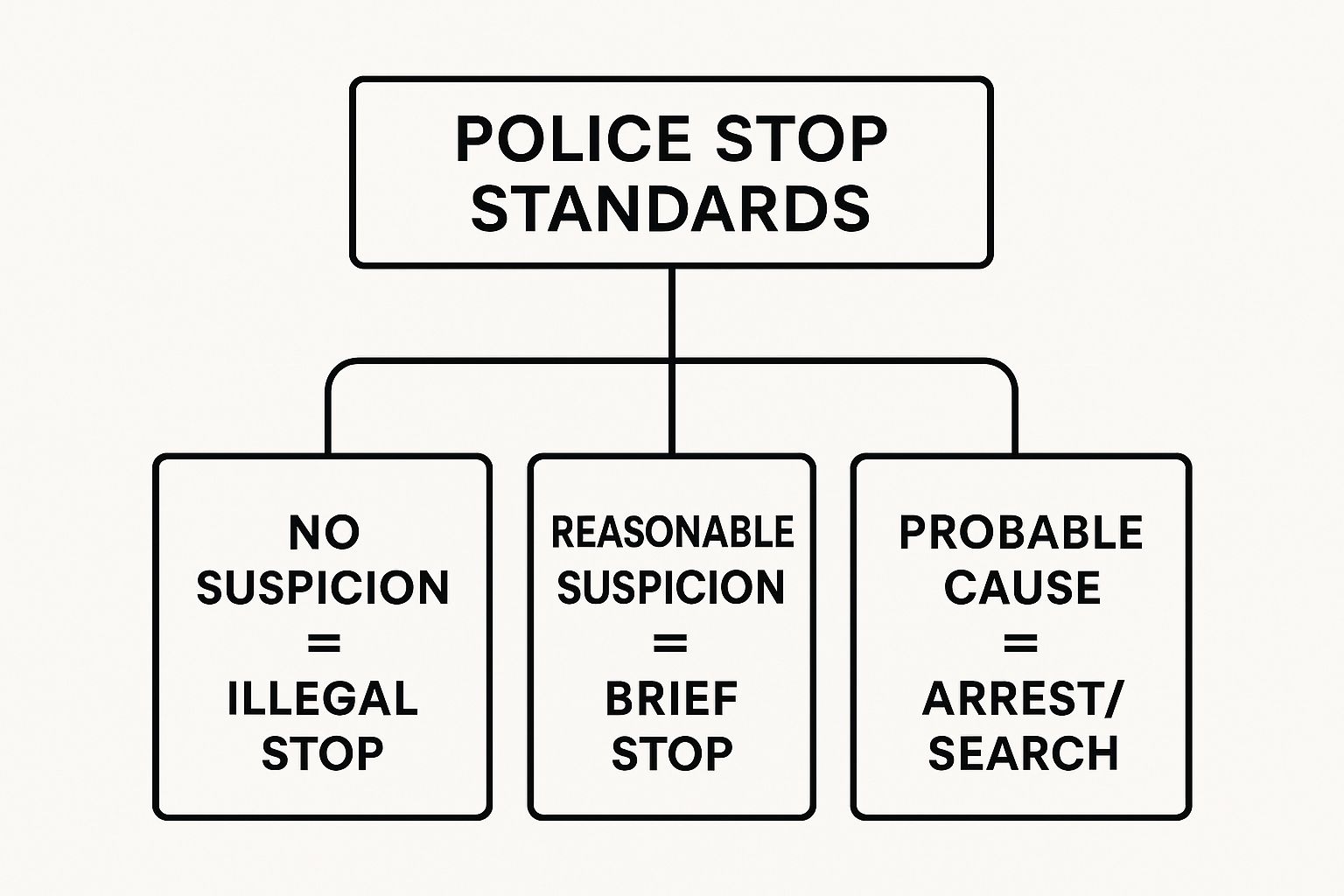
As you can see, every level of police interaction requires a matching level of justification. Knowing where you stand on this ladder is the key to knowing your rights.
To make it easier to understand these distinctions, here’s a quick breakdown of what each level of encounter means in the real world.
Police Encounters at a Glance
| Type of Encounter | Justification | What It Means for You |
|---|---|---|
| Consensual Encounter | None needed. | You are free to leave and don’t have to answer questions. |
| Investigative Stop / Detention | Reasonable Suspicion | You are not free to leave, but the stop must be brief. You may be required to identify yourself. |
| Arrest | Probable Cause | You are being taken into custody and are not free to leave. You have the right to remain silent and the right to an attorney. |
This table provides a snapshot of the landscape. Recognizing which type of encounter you’re in helps you understand what an officer can ask of you and what your rights are at that moment.
The Difference Between a Conversation and a Detention
It’s a common misconception that every time you talk to a police officer, you’re being formally “stopped.” But that’s not how it works. Knowing the crucial difference between a casual chat and an official detention is one of the most important things you can understand to protect your rights.
Think of a consensual encounter like this: it’s no different than a stranger on the street asking for directions. An officer can walk up, say hello, and ask you some questions. Just like with that stranger, you have every right to decline to answer and simply walk away. Nothing, spoken or implied, is forcing you to stay.

The entire dynamic flips the second that conversation becomes a detention. A detention, often called an investigative stop, isn’t voluntary. This happens when a police officer uses their authority—through words or actions—to make it crystal clear you aren’t free to leave. That’s a critical moment because as soon as you’re detained, your constitutional protections kick in.
Recognizing the Shift from Voluntary to Detained
So how do you know when that line has been crossed? There’s no magic phrase. Instead, a court looks at the “totality of the circumstances” to decide if a reasonable person in your situation would have felt free to just walk off.
Several clear signals tell you a consensual encounter has become a detention:
- Commanding Language: The officer’s tone changes, and they use words that demand compliance. Think “Stay right there” or “Don’t move.”
- Physical Obstruction: The officer blocks your path with their body or uses their patrol car to keep you from leaving.
- Use of Authority Signals: The blue lights on the patrol car flash on. This is a universal sign that you’re being officially stopped.
- Holding Your Property: The officer takes your driver’s license or passport and doesn’t immediately hand it back. By holding onto your essential documents, they are effectively preventing you from leaving.
These actions create a situation where you no longer feel you have a choice. At that point, it’s not a conversation anymore—it’s a detention.
The core question is whether a reasonable person would feel free to “terminate the encounter” and go about their business. If the answer is no, you are likely being detained, and the officer must have a valid reason—reasonable suspicion—for the stop.
Why This Distinction Matters
Grasping this difference is fundamental to knowing your rights. During a casual, consensual chat, you can refuse to answer questions and leave whenever you want, no explanation needed. An officer doesn’t need any reason at all to simply talk to someone in public.
But the moment they detain you, the rulebook changes. For that stop to be lawful, the officer must be able to point to specific, concrete facts that justify it. A hunch, a stereotype, or the fact that you “looked nervous” isn’t enough.
This is where the law draws a firm line. A detention requires a real reason, and that distinction is what protects you from being stopped and questioned without cause. It’s the boundary between a casual police presence and an official investigation.
What Reasonable Suspicion Looks Like in Practice
While the term “reasonable suspicion” might sound like jargon, it’s a very real-world standard that police officers have to meet before they can stop you. It’s the core principle that answers the question, “Can police stop you for no reason?” with a firm “no.” For any stop to be proper, an officer needs more than just a gut feeling or a vague hunch.
They must be able to point to “specific and articulable facts” that, when pieced together, would lead a logical person to suspect a crime is in the works. Think of it like this: an officer has to build a small, coherent case in their head—based on what they can see and know—before they can initiate a stop.
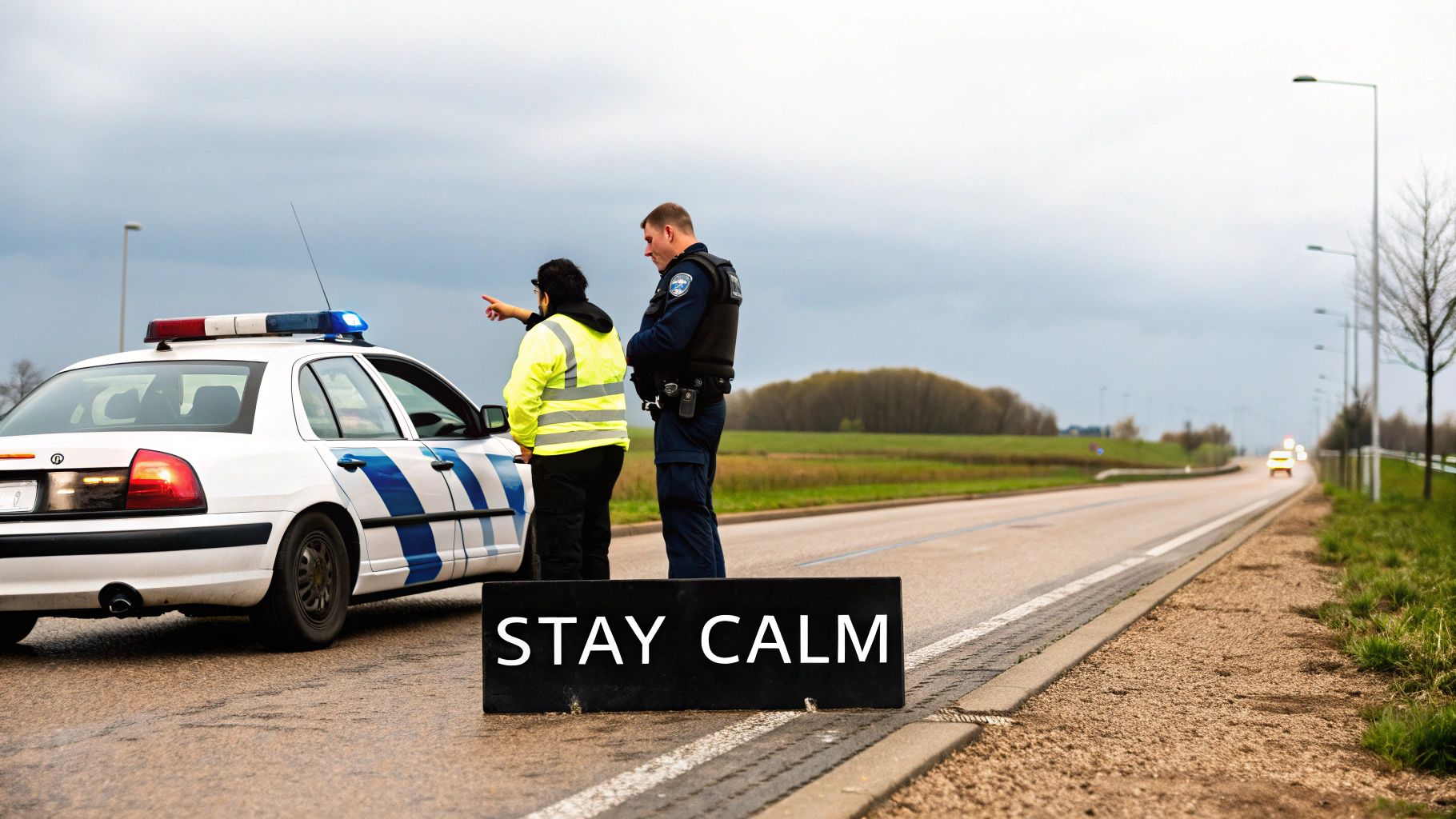
This standard is designed to be a crucial check on police power. It’s there to make sure that temporary detentions are grounded in observable evidence, not on stereotypes, personal bias, or an officer’s idle curiosity. It’s a foundational piece of policing that comes into play in countless interactions every single day.
Examples of Reasonable Suspicion in Action
To really get a feel for this, let’s look at a couple of real-world scenarios. The key is always connecting what the officer observes to a logical suspicion that a specific crime is happening.
-
Scenario 1: The Burglary Report: A dispatcher puts out an alert for a recent burglary. The suspect is described as a tall man in a red jacket and a black beanie. Just a few blocks from the scene, an officer spots someone who is a perfect match for that description. The person is walking quickly and keeps glancing over their shoulder. Here, the officer has specific, articulable facts—the matching description, the nearness to the crime scene, and the nervous behavior—that all add up to a justifiable stop.
-
Scenario 2: The Erratic Driver: It’s 2 a.m., and an officer sees a car weaving between lanes, braking suddenly for no reason, and almost clipping a curb. These are concrete, observable actions that strongly suggest a DUI. The officer absolutely has reasonable suspicion to pull the driver over and investigate if they are impaired.
In both of these examples, the officer could clearly explain exactly what they saw that made them suspect a crime was taking place.
Reasonable suspicion isn’t about being certain; it’s about probability. An officer doesn’t need proof that a crime has occurred, just enough observable facts to make it a reasonable possibility worth looking into with a brief stop.
What Does Not Count as Reasonable Suspicion
Just as important is knowing what doesn’t meet this bar. Certain things, by themselves, are simply not enough to justify stopping someone. An officer can’t properly detain you just because you:
- Are present in a “high-crime” area without doing anything suspicious.
- Seem nervous or happen to avoid making eye contact.
- Look like you’re “out of place” in a particular neighborhood.
- Fit a very generic description, like “a young man wearing a hoodie.”
These factors are far too broad and could apply to almost anyone. Without more specific evidence tying a person to a potential crime, a stop based on these flimsy grounds would almost certainly be deemed improper. This is where a key concept, the burden of proof, comes in—it’s on the state to prove the officer’s actions were justified by facts, not feelings.
This isn’t just a U.S. concept, either. Similar standards exist elsewhere to regulate police interactions. In England and Wales, for instance, police need “reasonable grounds for suspicion” for a stop and search. But even with these rules, the data shows challenges. In the year ending March 2023, there were 529,474 such stops. Statistics revealed that Black individuals were stopped at a rate of 24.5 per 1,000 people, a stark contrast to the 5.9 per 1,000 rate for white individuals, which continues to raise serious questions about fair and equitable enforcement. You can explore more about how these stop and search statistics are tracked on ethnicity-facts-figures.service.gov.uk.
Understanding How Traffic Stops Work
Seeing flashing lights in your rearview mirror is a universally stressful experience. It’s one of the most common ways people interact with law enforcement, but that doesn’t make it any less nerve-wracking. While the short answer to “can police stop you for no reason?” is no, the bar an officer has to clear for a valid traffic stop is surprisingly low.
At its core, a traffic stop hinges on an observable violation of a traffic law. This doesn’t mean you have to be driving recklessly. In reality, many completely proper stops start with something incredibly minor.
The Foundation of a Traffic Stop
An officer needs a legitimate, specific reason to pull you over, and that almost always comes from seeing a clear traffic infraction. Think of it as the officer needing just one concrete justification to flip on their lights.
That justification can come from a whole range of common violations:
- Moving Violations: This is the obvious stuff—speeding, rolling through a stop sign, making an illegal U-turn, or forgetting to signal a lane change.
- Equipment Violations: It could be something as simple as a burned-out taillight, a cracked windshield, or an expired registration tag on your license plate.
- Erratic Driving: If an officer sees a car weaving between lanes or driving in a way that suggests impairment, they have a solid reason to stop the driver and investigate a potential DUI.
Basically, any violation of the vehicle code, no matter how small, gives an officer the green light to pull you over. This is a critical point. A stop can be perfectly valid even if the initial reason seems trivial. For example, many cases involving speeding citations in Forsyth County begin with a straightforward, by-the-book stop for exceeding the posted limit.
How a Stop Can Broaden in Scope
Once an officer has lawfully stopped you for a traffic violation, the encounter isn’t locked into that single issue. The scope of the stop can expand if the officer develops new reasonable suspicion of other criminal activity while interacting with you.
Let’s say the officer walks up to your window to talk about that broken taillight. During that brief conversation, they might see or hear things that create new concerns.
An initial, valid reason for a traffic stop is the officer’s ticket to start the conversation. What happens during that conversation can create entirely new justifications for them to prolong the stop and investigate further.
For example, if the officer smells alcohol on your breath, notices your speech is slurred, or sees an open can of beer in the passenger seat, they now have a brand-new reason to suspect a DUI. Just like that, a stop that began as a simple equipment issue has evolved into a much more serious investigation.
The Role of Pretextual Stops
This brings us to the concept of a pretextual stop. This happens when an officer uses a minor traffic violation as a pretext—an excuse, really—to pull someone over because they have a hunch about a more serious, unrelated crime.
Imagine an officer suspects a driver is involved in drug trafficking but has no actual evidence. If they follow that car and see the driver fail to use a turn signal, they can pull them over for the traffic infraction.
As long as that initial violation was real and observable, the stop is generally considered proper, no matter what the officer’s underlying motive was. This is precisely why it’s so important to understand just how broad an officer’s authority is under traffic laws.
This issue of pretext is a huge part of the national conversation around policing and fairness. The Stanford Open Policing Project analyzed nearly 100 million traffic stops and found that police pull over more than 50,000 drivers every single day. Their data also showed that while Black drivers weren’t stopped more frequently overall, they were searched far more often—about 9% of stops involving Black drivers led to a search, compared to just 3-5% for white drivers. You can explore these findings and more on the Stanford Open Policing Project website.
How to Navigate a Police Encounter
Getting pulled over or stopped by the police is almost always a stressful experience. But knowing what to do—and what not to do—can give you a sense of control and help you navigate the encounter safely while protecting your rights. The main goal is always to get through the situation calmly and without making things worse.
First things first: stay calm. This is your most powerful tool. Any sudden movements or an agitated tone can instantly escalate things. If you’re in a car, the standard procedure is to turn off the engine, turn on your interior light if it’s dark, and place your hands on the steering wheel.
This simple act communicates that you aren’t a threat and helps set a non-confrontational tone. How you conduct yourself can shape the entire interaction, so a calm, respectful approach is the best way to start.
Your Rights and Responsibilities During a Stop
During any police encounter, it’s crucial to understand the line between what you are required to do and what you have the right to refuse. This knowledge is your best defense against unintentionally waiving your constitutional protections.
One of your most fundamental rights is the right to remain silent. You are not obligated to answer an officer’s questions about where you’re going, where you’ve been, or what you’re doing.
You also have the right to refuse consent for a search. If an officer asks to search you or your vehicle, you can—and should—state clearly and politely, “Officer, I do not consent to a search.” They might still conduct a search if they believe they have probable cause, but you haven’t given them permission to do so.
A very powerful question you can ask is, “Am I being detained, or am I free to leave?” The officer’s answer tells you whether this is a consensual conversation or an official investigative stop, which immediately clarifies the ground you’re standing on.
Identification Versus Interrogation
There’s a huge difference between providing your ID and answering probing, investigative questions. In Georgia, you are required to identify yourself if an officer has a reasonable suspicion that you are involved in criminal activity.
However, handing over your license doesn’t mean you have to answer questions about your private affairs. You can provide your identification while still exercising your right to remain silent on all other matters. Knowing this distinction is key to preventing self-incrimination.
Here’s a quick rundown of what to do:
- Stay Calm: Keep your voice even and your demeanor respectful.
- Keep Hands Visible: Don’t reach for anything without telling the officer what you’re doing first.
- Provide Identification: If required, show your ID, but remember you can remain silent about everything else.
- Decline Searches: Verbally refuse to consent to any searches of your car, your belongings, or your person.
- Record the Encounter: In most public spaces, you have a right to record police interactions, provided you don’t interfere with their duties.
It’s important to remember that stop-and-search powers are still a major point of contention. Data from England and Wales, for instance, revealed that despite millions of stops in recent years, the arrest rate from these encounters has actually gone down. More troublingly, Black individuals are stopped at a rate roughly seven times higher than white individuals. This disparity often fuels a deep sense of injustice and erodes trust between communities and law enforcement. You can read more on the human impact of these practices in the Justice Initiative’s report.
Common Questions About Police Stops
Even when you know the rules, a real-world police encounter happens fast and can be incredibly confusing. To make sense of what we’ve covered, let’s break down some of the most common questions people have during a police stop. The goal here is to give you clear, straightforward answers.
Can Police Ask for My ID Without a Reason?
This is a big one, and the answer really hinges on the type of situation you’re in. If it’s just a casual, consensual conversation—meaning you are completely free to walk away—you can absolutely decline an officer’s request to see your ID. It’s a voluntary chat, and you don’t have to participate.
But the moment you’re being formally detained, the game changes. In “stop and identify” states like Georgia, you are required to provide your name and sometimes your address if an officer has reasonable suspicion you’ve been involved in a crime. Refusing to identify yourself at that point can create a whole new set of problems.
What Is the Difference Between Being Detained and Being Arrested?
It’s easy to mix these two up, but they are very different in the eyes of the law. Knowing the distinction is key to understanding your rights as a situation unfolds.
-
Detention: Think of this as a temporary “pause” button. An officer can detain you based on reasonable suspicion to investigate something. You are not free to leave, but the stop has to be brief and directly related to whatever suspicion the officer has.
-
Arrest: An arrest is far more serious. It requires a higher level of proof called probable cause—enough facts for a reasonable person to believe you committed a crime. When you’re arrested, you are being taken into official custody.
A simple detention can quickly escalate into a full-blown arrest if the officer finds more evidence during the stop. To get a better sense of what comes next, our guide explains what happens when someone is arrested and walks you through the entire process.
The key takeaway is that a detention is a brief, investigatory hold based on suspicion, while an arrest is the formal act of taking someone into custody based on probable cause. They are not the same thing.
Do I Have to Answer an Officer’s Questions?
You have a powerful right to remain silent, and it’s one you should use. Generally, you are not required to answer an officer’s questions, particularly those that could incriminate you. This right applies whether you’re just talking, being detained, or under arrest.
Now, as we mentioned, you may have to provide basic identifying information if you’re formally detained. But beyond that? You can—and probably should—politely decline to answer questions about where you’re going, what you’re doing, or where you’ve been.
A simple, respectful “Officer, I am choosing to remain silent” is all you need to say. This right exists to protect you from accidentally saying something that gets twisted or used against you. It’s a cornerstone of our justice system.
Can I Record My Interaction with the Police?
With a smartphone in nearly every pocket, this question comes up all the time. The short answer is yes. You generally have a First Amendment right to record police officers carrying out their duties in a public place.
This right is a critical tool for accountability. However, there’s a major caveat: you cannot interfere with what the officers are doing. That means keeping a safe distance, not physically blocking them, and not acting in a way that could be seen as a threat.
While recording is generally protected, it’s smart to remember the main rule: record, don’t interfere. Your goal is to document the interaction, not become part of it.
Navigating the complexities of a police stop can be challenging, but you don’t have to face the aftermath alone. If you find yourself dealing with charges stemming from a traffic stop or any other police encounter, having experienced representation is essential. At Brian Hansford Law, we are dedicated to protecting your rights and ensuring your story is heard. For a confidential consultation to discuss your case, visit us at https://challengemycharge.com.
