
Yes, it is possible to appeal a plea bargain in certain, very specific situations. However, it's far more challenging than appealing a guilty verdict after a full trial. When a plea deal is accepted, most appeal rights are intentionally given up in exchange for a known outcome. This guide explains the limited circumstances where a path to appeal might exist.
Plea Bargains and the Limited Right to Appeal
A plea bargain can be thought of as a binding contract. A person agrees to plead guilty, and in exchange, the prosecutor agrees to a particular sentence or to reduce the charges. The entire system relies on these deals to resolve the vast majority of cases without going to trial. Finality is a key goal.
Because of this, courts intentionally restrict the ability to "take back" a plea. If everyone could change their mind, the system would grind to a halt and the certainty that makes plea deals work would vanish. This is why simply regretting a decision—what is sometimes called "plea remorse"—is never enough to get the deal thrown out.
Understanding the Waiver of Rights
When entering a plea, a person is formally waiving a bundle of fundamental rights that they would otherwise have at trial. This is a critical piece of the puzzle. These rights typically include:
- The right to a trial by a jury of their peers
- The right to cross-examine witnesses who testify against them
- The right to remain silent and not incriminate themselves
- The right to appeal most legal or factual issues in the case
This formal waiver is precisely why challenging a plea is so difficult. The person has already gone on record agreeing to the outcome. But the waiver isn’t bulletproof. There are exceptions carved out to protect against fundamental unfairness and constitutional violations.
A plea is more than just an admission of guilt; it is a formal contract with the court. The justice system is built on the idea that these agreements will be upheld, which is why challenging one requires showing a significant flaw in the process itself, not just dissatisfaction with the result.
Key Differences Between a Trial Appeal and a Plea Appeal
It's easy to get confused about the differences between appealing after a trial versus after a plea. They are fundamentally different legal actions with different standards and goals. This table breaks it down.
| Aspect | Appeal After a Trial Verdict | Challenge After a Plea Bargain |
|---|---|---|
| Primary Focus | Errors made by the judge, jury, or prosecutor during the trial (e.g., improper evidence, incorrect jury instructions). | Flaws in the plea process itself (e.g., was the plea coerced, was the lawyer ineffective?). |
| Guilt/Innocence | Can directly challenge the evidence and argue for innocence or that the state failed to prove its case. | Almost never about guilt or innocence. It’s about the validity of the agreement that was signed. |
| Core Question | "Did a legal error at trial lead to an unjust conviction?" | "Was the plea made knowingly, intelligently, and voluntarily?" |
| Common Grounds | Insufficient evidence, procedural errors, constitutional violations during trial. | Ineffective assistance of counsel, involuntary plea, prosecutorial misconduct, illegal sentence. |
As can be seen, a plea challenge isn’t a second chance to fight the charges. It’s an attempt to prove the deal itself was legally invalid from the start.
The Foundation of a Plea Challenge
A successful challenge to a plea bargain almost never has to do with whether someone was actually guilty or innocent. Instead, it attacks the legitimacy of the agreement.
The key questions become: Was the plea entered knowingly, intelligently, and voluntarily? Were constitutional rights violated along the way? These are the narrow doorways through which a potential appeal might pass. To get a better handle on this, it's helpful to understand the plea bargain pros and cons and why the courts protect these agreements so fiercely. In the sections that follow, we'll dig into the specific grounds that can form the basis for this kind of challenge in Georgia.
Valid Grounds to Challenge a Plea Agreement
Just having second thoughts about taking a plea deal isn't enough to get it thrown out. From the court's perspective, a plea agreement is a binding contract. To have a shot at successfully appealing a plea bargain, the challenge needs to be built on solid legal ground, showing that the process itself was fundamentally flawed.
It’s crucial to understand that these challenges aren't about proving innocence. They’re about proving the plea itself was legally invalid from the start. Let’s walk through the most common grounds people use to challenge a plea, with some real-world examples to show what they look like in practice.
An Involuntary or Unknowing Plea
The foundation of every valid plea is that it must be knowing, intelligent, and voluntary. If any of these three elements is missing, the deal may be vulnerable to a challenge. This is, by far, the most common reason people try to withdraw their plea.
So, what does this actually look like?
- Coercion or Threats: Imagine a person being told that if they don’t take a plea right now, a family member will also be charged with a crime, even if the evidence against them is weak. A plea made under that kind of extreme pressure isn’t considered truly voluntary.
- Misinformation on Consequences: Let's say a person is told by their lawyer that their sentence will be five years of probation. They agree. But the law for that specific charge actually requires a minimum of two years in prison. Because the person didn't understand the real consequences, their plea wasn't "knowing."
- Lack of Mental Capacity: If someone wasn’t mentally competent when they entered the plea—maybe they were in the middle of a severe mental health crisis or on prescribed medication that clouded their judgment—their ability to make a rational choice is called into question.
The legal system demands that a plea is a product of a defendant’s free will and rational choice. When that choice is tainted by outside pressure, false promises, or a critical lack of understanding, the entire agreement can be dismantled.
Ineffective Assistance of Counsel
Another major reason to challenge a plea is to argue that the lawyer’s performance was so poor that it violated the Sixth Amendment right to effective counsel. This is a very high bar to clear. A person must prove two things: that their lawyer's work was far below professional standards and that their poor performance is the direct reason the plea was taken.
Here are a few scenarios where this might apply:
- Failure to Investigate: A lawyer doesn't bother to interview a key alibi witness who could have proved their client was somewhere else when the crime happened. Feeling cornered and out of options, the person accepts a plea. That failure to conduct a basic investigation could be grounds for an ineffective assistance claim.
- Providing Incorrect Legal Information: An attorney incorrectly tells a non-citizen client that pleading guilty to a certain offense won't affect their immigration status. When that client is later served with deportation papers because of the conviction, they have a strong case that their counsel was ineffective.
- Not Communicating a Favorable Plea Offer: The prosecutor offers a really good deal, but the defense attorney never tells their client about it. The person ends up accepting a much harsher plea later on, completely unaware that a better option had been on the table.
Prosecutorial Misconduct
Though it's less common, misconduct by the prosecutor can invalidate a plea agreement. This involves actions that undermine the fairness of the justice system and may have pressured the defendant into pleading guilty. It's important to understand the scope of a prosecutor's power; one can read more about what prosecutorial discretion entails to see how their decisions shape a case.
Examples of prosecutorial misconduct could include:
- Making Unenforceable Promises: A prosecutor promises a specific sentence that they legally don't have the authority to deliver, tricking the defendant into pleading guilty based on a false promise.
- Hiding Exculpatory Evidence: The prosecution has evidence that points toward the defendant’s innocence (often called Brady material) but intentionally fails to disclose it. If the person had known about that evidence, they almost certainly would not have pleaded guilty.
The rules for plea bargaining vary quite a bit globally. Over the past three decades, the practice has exploded, with 101 out of 174 surveyed jurisdictions now having a formal process. But the right to appeal isn't uniform. In a country like Spain, for instance, plea deals are typically for minor charges and appeal rights are very limited. One can find more insights into these global plea bargaining trends in this detailed report on international legal economics.
Lack of Jurisdiction or an Illegal Sentence
Finally, a plea can be thrown out on more technical legal grounds. First, the court that accepted the plea must have had the legal authority, or jurisdiction, to handle that specific case. If it didn't, the entire proceeding is void from the start.
Second, if the sentence laid out in the plea deal is illegal—for example, it's longer than the statutory maximum for that crime—it can be challenged. A person cannot legally agree to a sentence that the law itself does not permit.
The Process of Withdrawing or Appealing a Plea
Deciding to challenge a plea agreement kicks off a structured process governed by some very strict rules and deadlines. It's not as simple as telling the court about a change of mind. The path forward really hinges on one critical factor: whether the sentence has been officially imposed yet.
The steps for withdrawing a plea before sentencing are completely different from those required to appeal after sentencing. Getting a handle on this distinction is the first and most important step. Each path has its own motions, deadlines, and procedural hoops that must be navigated with precision.
Motions to Withdraw a Plea Before Sentencing
The most direct way to back out of a plea is to file a "motion to withdraw" before the judge formally hands down the sentence. Georgia courts generally have more room to grant these motions because, from a legal standpoint, the case isn't officially closed. The core argument in this motion will almost always be that the plea wasn't made knowingly, voluntarily, or intelligently for one of the reasons covered earlier.
Picture this: someone accepts a plea after their lawyer incorrectly tells them they're eligible for probation. If they figure out the mistake before the sentencing hearing, a motion to withdraw would be filed immediately. That motion would lay out the bad information and argue that the agreement was based on a fundamental, and frankly unfair, misunderstanding.
Formally entering a plea often comes after several preliminary stages. For a better picture of what happens earlier in a criminal case, information is available in our guide on what happens at an arraignment hearing.
Post-Conviction Relief After Sentencing
If the sentence has already been pronounced, that door to a simple motion to withdraw is pretty much slammed shut. At this point, the conviction is final. The primary tool for challenging the plea now shifts to post-conviction relief, which usually means filing a petition for habeas corpus.
A habeas corpus petition isn't a direct appeal in the traditional sense. It's a brand-new civil case arguing that the imprisonment is illegal because a constitutional violation occurred during the plea process. This is the arena where claims of ineffective assistance of counsel are most often fought.
The moment a sentence is pronounced, the legal landscape changes. The focus shifts from asking a court to reconsider its acceptance of a plea to proving that a fundamental constitutional error occurred, rendering the entire conviction unlawful.
This infographic breaks down a simple decision tree for some of the common grounds for challenging a plea.
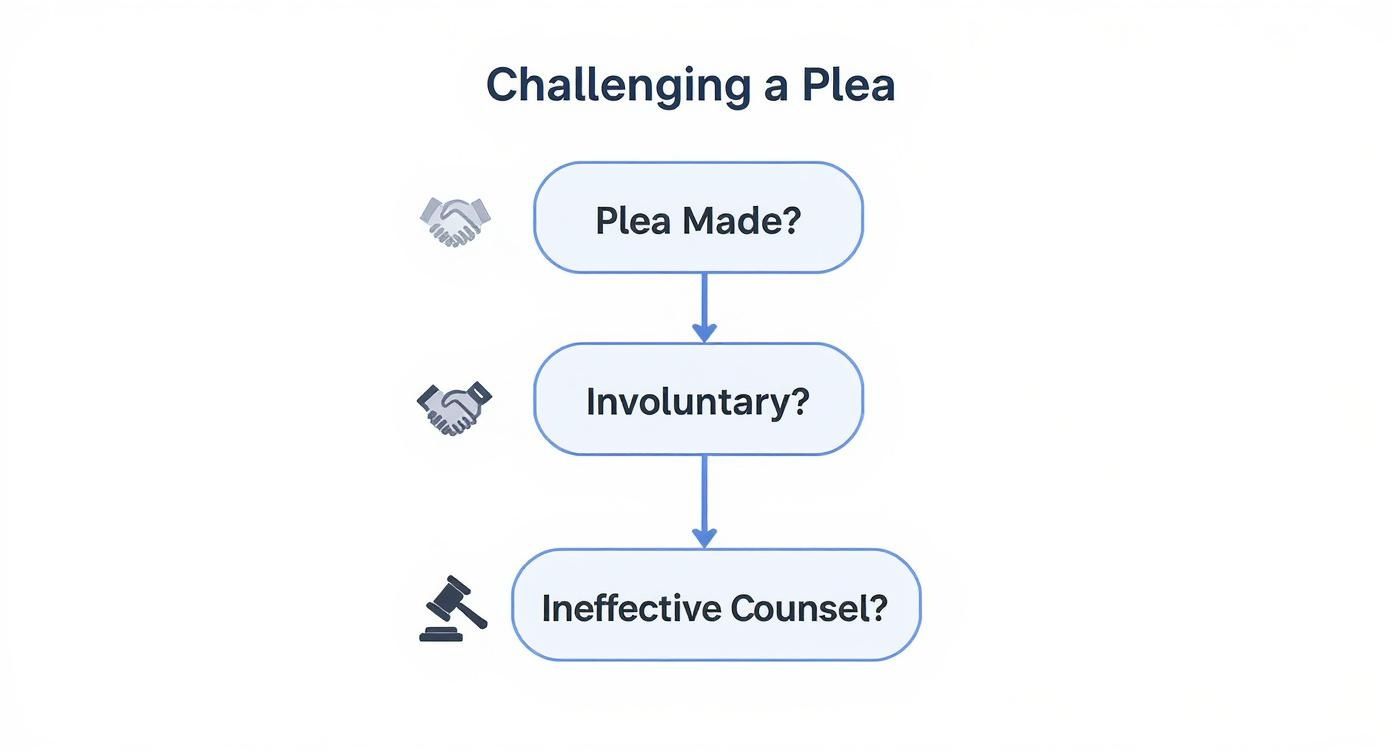
As can be seen, the flow often starts with examining whether the plea was truly voluntary and whether the legal counsel received was effective.
Key Procedural Steps and Critical Deadlines
No matter which path is taken, certain steps are almost always involved. Missing a deadline at any point can permanently block a case from ever being heard. The timeline is not flexible.
- Filing the Initial Motion: First, the correct legal document must be filed with the court that took the plea. This could be a Motion to Withdraw Plea or a Petition for a Writ of Habeas Corpus. This document has to clearly state the specific legal grounds for the challenge.
- Gathering Essential Documents: Strong arguments are built on evidence. This means getting all relevant documents, especially the official court transcript from the plea hearing. The transcript contains a word-for-word record of what was said by all parties and the judge, making it a critical piece of evidence.
- The Court Hearing: The court will schedule a hearing on the motion. Here, both sides present their arguments and evidence. It’s important to understand that the person challenging the plea often has to testify and face questions from the prosecutor about why they are now challenging a deal they previously accepted under oath.
Meeting deadlines is everything. For instance, a motion to withdraw a plea often must be filed within the same term of court that the plea was entered. In Georgia, a superior court term can be as short as two months. That leaves an incredibly narrow window to act. Waiting too long is one of the most common reasons these challenges fail before they even get off the ground.
Building a Case with Evidence and Documentation
Successfully challenging a plea agreement isn't about what a person says happened. It's about what can be proven. A court simply won't overturn a plea based on someone's word alone; it needs proof. This means methodically gathering every single piece of evidence that backs up the specific legal grounds for the appeal.
The argument, whether it’s claiming the plea was involuntary or that there was ineffective counsel, needs a rock-solid foundation of evidence. Just saying someone was pressured or misinformed won't cut it. The real work is in finding the documents and testimony that confirm that version of events and paint a clear picture for the judge. This is where research begins when figuring out if you can appeal a plea bargain.
Assembling Key Court Records
The most critical document in any plea challenge is the official court transcript from the plea and sentencing hearings. This is the word-for-word record of everything said in the courtroom. It shows the exact questions the judge asked, the answers given, and all the information presented on the record. It’s the ultimate source of truth.
Beyond the transcript, other crucial court documents include:
- The Plea Agreement: The written deal itself might have errors or confusing language that can be challenged.
- Motions Filed: Any motions filed before the plea, like a motion to suppress evidence, are part of the case history. The judge's rulings on them are just as important.
- Sentencing Orders: This is the final judgment from the court that makes the sentence and conviction official.
These documents are the official story of the case and the first place anyone will look. If there's a gap between what the transcript says and what really happened, that inconsistency can become the core of the challenge.
Documenting Attorney Communications
If the appeal is based on ineffective assistance of counsel, the spotlight turns to the interactions with the lawyer. Proving what they said—or failed to say—can be tough, but certain kinds of evidence are extremely persuasive.
Let's say a person took a plea because their lawyer told them a key witness identified them, but that turned out to be false. To prove this, one would need to dig up evidence of that conversation. That could be:
- Emails or Text Messages: Any written communication about case strategy, plea offers, or likely outcomes.
- Phone Logs: Records showing how often (or how rarely) the client and attorney actually spoke.
- Visitor Logs: If the person was incarcerated, these logs can prove when their attorney visited and for how long.
This kind of documentation transforms the argument from a "he said, she said" dispute into one based on tangible proof. The goal is to demonstrate that the legal advice received was flawed and that this bad advice directly pushed the person into accepting the plea.
A plea challenge often succeeds or fails based on the quality of its documentation. An affidavit from a family member who overheard a problematic conversation carries weight; an email from an attorney giving incorrect information can be definitive. Every piece of paper tells part of the story.
The Role of Affidavits and Witness Testimony
Sometimes, the most powerful evidence isn't on paper but comes from other people. An affidavit is a sworn, written statement that can be submitted as evidence, and it’s a vital tool for bringing in outside perspectives to support a claim.
For example, if a person felt pressured to accept a deal, a family member who was there during a tense meeting with the lawyer could provide an affidavit describing what they witnessed. If the argument is that the lawyer failed to investigate, a sworn statement from an alibi witness who was never even contacted can be incredibly compelling. These statements from other people add a layer of credibility that can often be the deciding factor for the court.
So, what happens after the judge rules on a plea appeal?
The court’s decision is a major fork in the road, but it’s almost never the final stop. Whether the appeal is won or lost, knowing what comes next is critical. The path forward looks completely different depending on the outcome.
If a Plea Challenge Is Successful
A successful challenge doesn't make the case vanish. What it does is vacate the plea, which is like hitting a giant reset button. The conviction is wiped, the sentence is gone, and the case file is sent right back to its pre-plea status.
That means the original charges—often the more serious ones that were dropped or reduced as part of the deal—are usually put right back on the table.
Once the case is reopened, a few things can happen:
- A New Plea Offer: The prosecutor might come back with a new deal. It could be better, worse, or about the same as the first one. It all depends on how the case looks now, with the passage of time and potential changes in evidence.
- Proceeding to Trial: If a new deal can't be agreed upon, the case gets put on the trial calendar. This is the chance to fight the original charges in front of a judge or jury.
- Case Dismissal: This is rare, but sometimes so much time has passed or a key witness or piece of evidence is no longer available. In those situations, the prosecution might decide they can no longer prove their case and dismiss the charges altogether.
The big takeaway here is that winning an appeal isn't a "get out of jail free" card. It’s a second chance to fight, but it comes with the very real risk of facing a harsher penalty if convicted at trial than what the original plea offered.
If a Plea Challenge Is Denied
If the court denies the motion to withdraw the plea or the habeas corpus petition, the original conviction and sentence stand. The plea agreement stays in place, and for that court, the matter is considered final. It can feel like hitting a brick wall, but there might still be options, though they definitely get tougher from here.
For people with cases in Forsyth County, Cobb County, or nearby areas like Alpharetta and Roswell, the next step involves understanding the higher courts. A denial from the trial court can sometimes be appealed to the Georgia Court of Appeals or even the Georgia Supreme Court. This means asking a higher court to look for legal errors in the trial judge's decision.
This next level of appeal isn't a do-over. The appellate court won't hear new evidence or re-try the facts. Instead, they will meticulously review the transcripts and records from the plea challenge hearing to decide if the trial judge applied the law correctly.
A denied plea challenge makes the original conviction stick, but it doesn't always have to be the end of the line. The fight just moves from the trial court to the appellate courts, where the focus shifts from the facts of the case to the legality of the judge's ruling.
It’s interesting to see how other places handle this. In Poland, for example, their plea bargain system allows everyone—the defendant, the prosecutor, and even the victim—to appeal the final judgment. Their process, which covers felonies with sentences up to 15 years, requires a judge's approval but keeps the door open for an appeal from all sides. One can learn more about these international plea bargain standards to see how different legal systems try to balance finality with fairness.
At the end of the day, dealing with the aftermath of a plea appeal requires a clear-eyed look at the new legal reality. Whether navigating reinstated charges after a win or planning a higher-level appeal after a loss, the stakes are just as high as ever.
Common Questions About Plea Bargain Appeals
When thinking about appealing a plea bargain, a lot of questions pop up. The process is full of legal nuances, and getting straight answers can bring some much-needed clarity. Here are some of the things people ask most often about challenging a plea agreement here in Georgia.
How Long Does a Person Have to Appeal a Plea Bargain in Georgia?
Georgia's legal system runs on a very tight clock. If a deadline is missed, the chance to challenge a plea could be gone for good. The exact amount of time available really depends on the legal action being taken.
For a motion to withdraw a plea, it generally must be filed within the same court term that the plea was entered. Court terms are different in every county and can be as short as two months, which doesn't leave much time to act. Other routes, like a habeas corpus petition, come with their own set of strict and unbending deadlines.
If a Plea Appeal Is Successful, Does That Mean a New Trial Is Automatic?
Not necessarily. A successful plea challenge doesn't just result in a new trial. What it does is vacate—or nullify—the plea agreement and the conviction that came with it. In a way, it resets the case back to where it was before the plea was taken.
After the plea is vacated, a few things could happen:
- The prosecution might come back with a different plea offer.
- The case could get put on the calendar for a full trial on the original charges.
- In some rare cases, if key evidence or witnesses are gone, the charges could get dismissed entirely.
The bottom line is that winning an appeal puts a person back at the starting line; it doesn't guarantee they'll cross the finish line a certain way.
What’s the Difference Between a Direct Appeal and Habeas Corpus?
These are two completely different legal paths. A direct appeal is all about spotting legal mistakes made by the judge that are right there in the official court record. But there's a catch: a standard part of almost every plea agreement is waiving the right to a direct appeal.
A habeas corpus petition isn't a typical appeal. It's a new civil lawsuit arguing that a person's confinement is illegal because a constitutional right was violated—for instance, they received ineffective assistance from their lawyer.
Because most people waive their appeal rights when they take a plea, a habeas corpus petition is the more common way to challenge a plea agreement after sentencing. It allows for new evidence to be brought in that wasn't part of the original court record, like a lawyer's emails or new witness statements.
Can Someone Appeal Just Because They Regret Their Plea?
No. Courts are very clear on this: "plea remorse" or just changing one's mind isn't a valid legal reason to throw out a plea. A plea is treated like a binding contract entered into knowingly and voluntarily in front of a judge.
To have a real shot, the challenge must be built on a provable legal flaw in the plea process itself. The focus has to be on objective problems, like:
- An involuntary plea, where the person was forced, threatened, or seriously misinformed.
- Ineffective assistance of counsel, meaning the lawyer's performance was so poor it violated the Sixth Amendment rights.
- Prosecutorial misconduct, like the prosecutor hiding evidence that could have proven innocence.
The success of any appeal depends on proving the process was fundamentally unfair, not that a person is unhappy with the result. Understanding these differences is crucial for anyone in Johns Creek, Cumming, or anywhere in Forsyth County who is considering this complex legal road.
Navigating the complexities of the criminal justice system requires experience and dedicated attention. At Brian Hansford Law, we are committed to providing robust representation grounded in over 25 years of legal practice. If you are facing criminal charges in Alpharetta, Roswell, or anywhere in Cobb County, explore how our firm can assist you by visiting us at https://challengemycharge.com.
