
You might be surprised to learn that, yes, you can absolutely get a DUI on a bicycle. It’s a question that comes up more often than you’d think. In many states, including Georgia, the law defines a “vehicle” in a way that includes bicycles, meaning you could face serious charges for riding one while impaired.
This isn't just some strange trivia; it's a reality that can have significant consequences for cyclists.
Understanding The Basics Of Bicycle DUIs
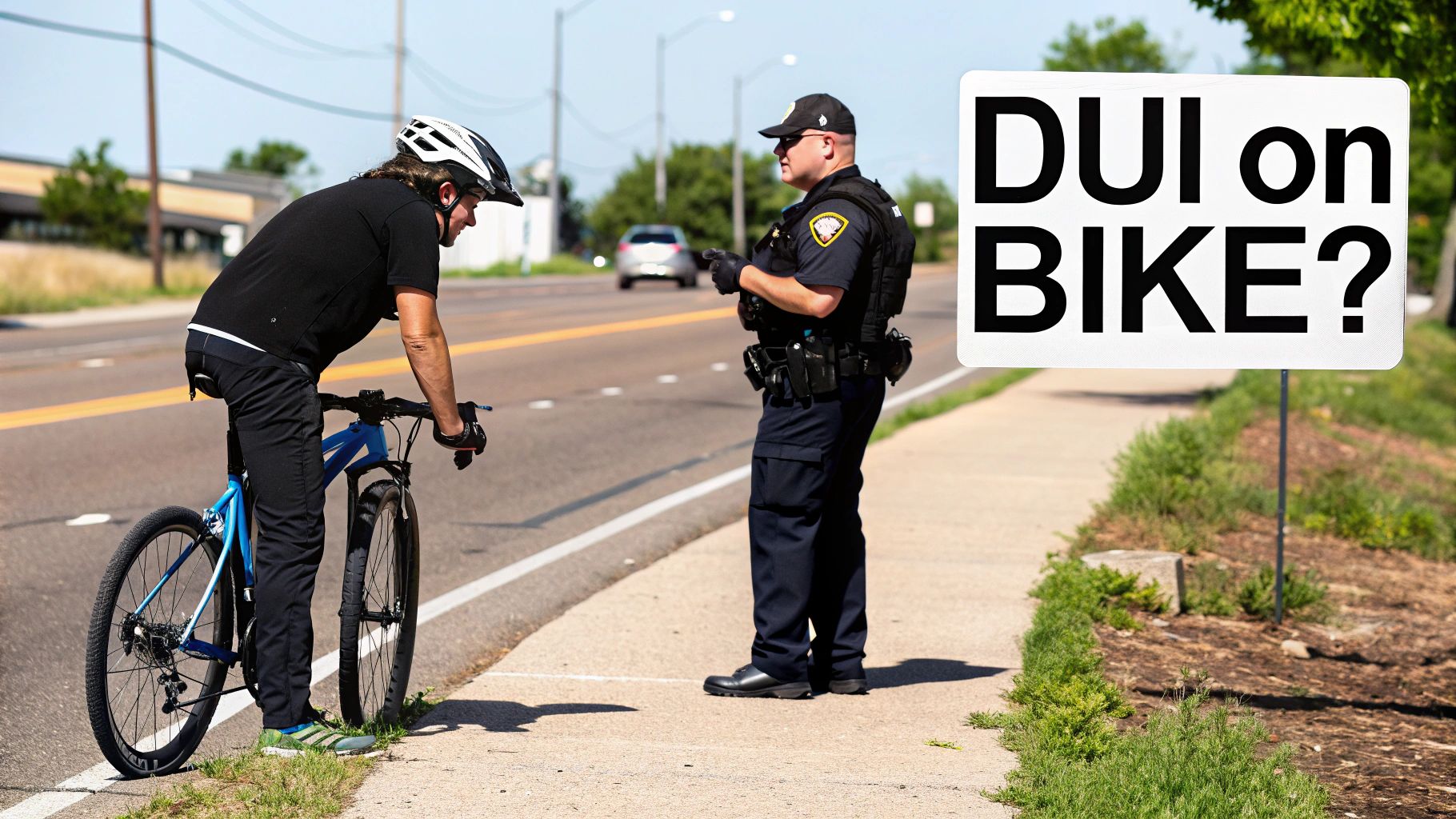
The heart of the issue comes down to how a state's law defines a "vehicle." While we all think of a car or truck, many statutes use much broader language that can cover just about anything used for transportation on a public road. A simple bike ride home after a few drinks can quickly escalate into a complicated situation because of this.
This isn't a new or uncommon thing. States like California, Florida, and Texas have laws that specifically apply DUI sanctions to cyclists, treating them much like drivers of motor vehicles in certain respects.
Bicycle DUI Key Concepts at a Glance
To make sense of these laws, it helps to break down the core ideas. The table below outlines the fundamental concepts that form the basis of most bicycle DUI statutes.
| Concept | Explanation for Cyclists |
|---|---|
| "Vehicle" Definition | Many laws define a vehicle as any device used for transportation, and this broad definition often sweeps in human-powered bikes. |
| Blood Alcohol Content (BAC) | The standard BAC limit of 0.08% that applies to motorists is often the same benchmark used for cyclists. |
| Public Safety | The goal is to prevent accidents by keeping anyone who is impaired off public roads, no matter what they're operating. |
| Potential Consequences | Penalties can include everything from fines and community service to, in some situations, even impacting your driver's license. |
At the end of the day, whether you’re behind the wheel of a car or on the handlebars of a bike, the law's focus is on public safety.
While the penalties might differ, the underlying principle is the same. If you find yourself facing charges, the first step is to understand the situation and your options. For more detailed information, check out our guide on criminal defense for DUI charges.
Why a Bicycle Is Often Considered a Vehicle
To wrap your head around how a simple bike ride can spiral into a DUI charge, you have to look at the road the way the law does. It’s not about engines or horsepower. It's about anything and everything that travels on public highways.
Think of it this way: the moment your tires hit the pavement, you're part of the traffic ecosystem. You’re expected to follow the same basic rules as every car, truck, and motorcycle out there. This shared space and shared set of rules is exactly why Georgia law, and many others, classify a bicycle as a vehicle.
The Broad Definition of a Vehicle
Most of us hear the word "vehicle" and immediately picture something with a motor. But statutory definitions are a different beast altogether—they're intentionally broad to cover all the bases.
In Georgia, the official code defines a "vehicle" as pretty much any device that can transport a person or property on a highway. This wide net is designed to include everything from a semi-truck to a horse-drawn buggy, and yes, your ten-speed bicycle.
The key takeaway here is that the law focuses on the act of transport on a public road, not whether there's an engine involved. If you're using something to get from point A to point B on a public road, you’re operating a vehicle in the eyes of the law.
This single classification is what pulls cyclists under the same umbrella of traffic laws that drivers must follow, including the ones about driving under the influence.
Sharing the Road Means Sharing the Rules
Once the law says your bike is a vehicle, you inherit most of the same responsibilities as someone behind the wheel of a car. This isn't just bureaucratic red tape; it's a fundamental concept for keeping the roads safe and predictable for everyone. Imagine the chaos if every type of "vehicle" played by its own set of rules.
This shared responsibility means cyclists must:
- Obey Traffic Signals: That means stopping for red lights and stop signs, just like a car.
- Signal Turns: You're expected to use hand signals to let others know where you're going.
- Ride With Traffic: Cyclists are required to travel in the same direction as the flow of traffic.
Because you share these duties, you also share the critical responsibility not to operate your "vehicle" while impaired. DUI laws are designed to protect everyone—pedestrians, drivers, and other cyclists—from the unpredictable and dangerous actions of an intoxicated person. This is why getting a DUI on a bike is a very real possibility in communities all over Georgia, from Alpharetta to Roswell.
How Bicycle DUI Laws Vary Across the States
So, can you get a DUI on a bike? The answer isn't a simple yes or no—it changes dramatically the moment you cross a state line.
The United States has a patchwork of laws on this. What’s perfectly acceptable in one state could get you arrested in the next. The confusion all comes down to how each state's code defines a "vehicle."
Some states, like Florida, use a very broad definition that explicitly includes bicycles. In those places, a cyclist is held to pretty much the same standard as a motorist, and a bike DUI is treated with similar gravity. But other states draw a clear line between motorized and human-powered transport, creating a completely different set of rules.
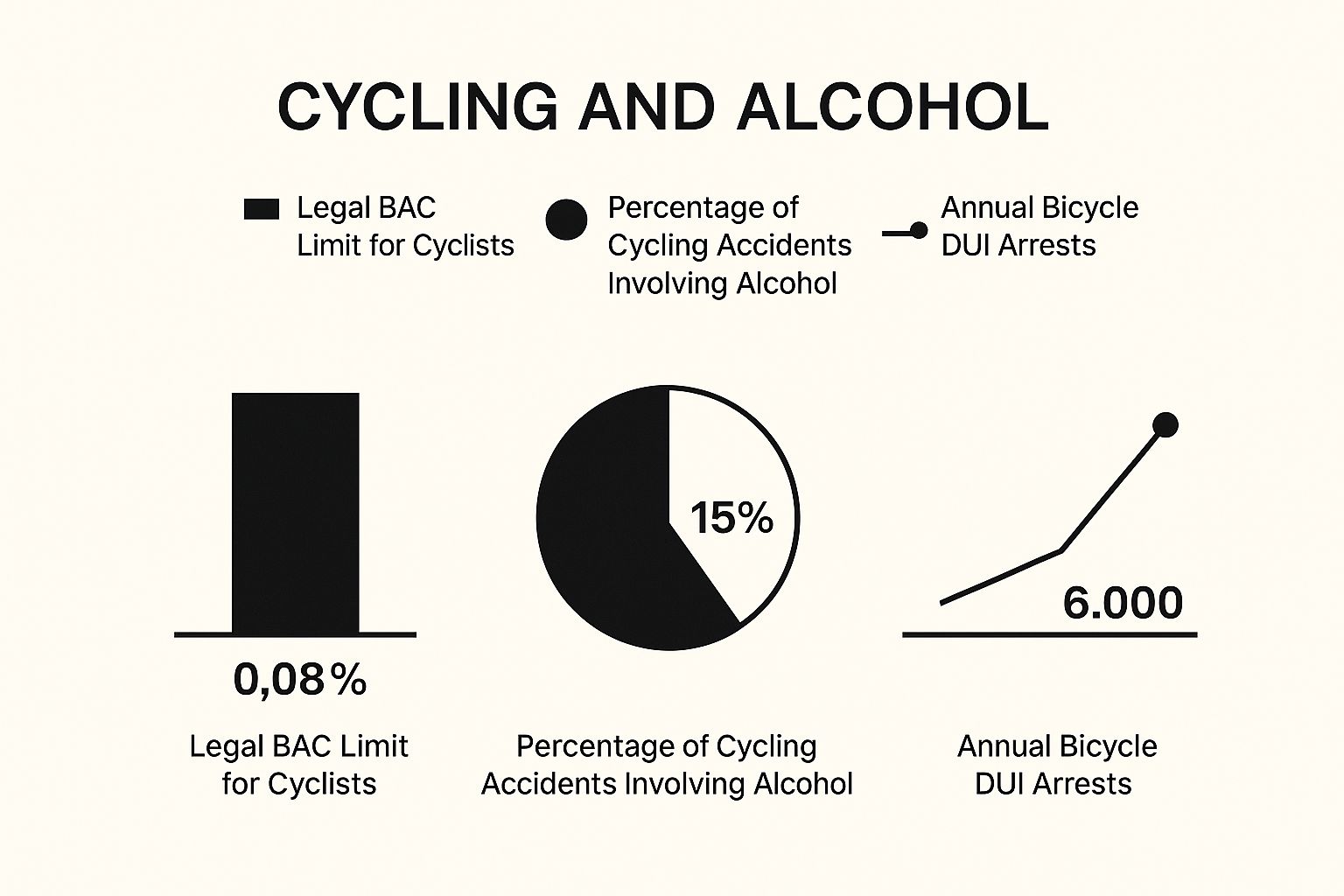
The data here makes one thing clear: even with a standard 0.08% BAC limit, thousands of cyclists are arrested every year for impaired riding. It's a serious issue for law enforcement nationwide.
This landscape can be broken down into a few key approaches you'll see from state to state.
State-by-State Approach to Bicycle DUIs
The core of the issue is whether a state considers a bicycle a "vehicle" for the purposes of its DUI laws. This single definition changes everything, from the charge itself to the potential penalties. Here’s a quick look at how different states handle it.
| State Example | Bicycle Classified as Vehicle for DUI? | Common Penalties |
|---|---|---|
| Florida | Yes | Fines, mandatory alcohol education, potential jail time, and driver's license suspension. |
| California | No (has a separate statute) | Fines (usually lower than a vehicle DUI) and a mark on your criminal record, but typically no license suspension. |
| Oklahoma | No | No DUI charge, but potential charges for public intoxication or reckless conduct. |
As you can see, your location is the single most important factor. The consequences for the exact same act can vary wildly depending on where you are.
States Where Bicycles Are Treated Like Cars
In a significant number of states, the law makes no distinction between a car and a bike when it comes to DUI. Florida and Colorado are prime examples where a bicycle is considered a vehicle for these purposes.
If you are stopped for cycling under the influence in these states, you could face penalties that mirror those for a traditional DUI. We're talking hefty fines, mandatory alcohol education programs, and even potential jail time. The thinking here is simple: if you're on a public road, you share the same responsibilities as everyone else.
States with Specific Bicycle DUI Statutes
Other states have carved out a middle ground. California, for instance, doesn't classify a bicycle as a "vehicle" under its main DUI statute. Instead, it has a separate law on the books making it illegal to ride a bicycle while under the influence.
The penalties under these specific statutes are often less severe than a standard motor vehicle DUI. A conviction might not automatically lead to a driver's license suspension, but it can still result in fines and a criminal record. This approach acknowledges the danger of impaired cycling without equating it entirely to driving a two-ton automobile.
States Where DUI Laws Don't Apply to Bicycles
Finally, you have states where DUI laws are written to apply exclusively to "motor vehicles." In a place like Oklahoma, you generally cannot be charged with a traditional DUI for riding a bicycle while intoxicated.
However, this doesn't mean you're in the clear. An officer can still charge you with other offenses, such as public intoxication or reckless conduct, if your behavior poses a danger to yourself or others.
This area of law is complex and, frankly, confusing. For instance, even in states with specific bike DUI laws, the question of chemical testing can come up. To get a better idea of how this works in Georgia, you can learn more about what happens if you refuse a chemical test in our detailed guide. Knowing these nuances is crucial, as what might apply in one state could be completely irrelevant in another.
Understanding the Consequences of a Bicycle DUI
When people ask, "can you get a DUI on a bike," the focus is usually on the arrest itself. But the real story is what happens after the arrest. While the consequences are typically less severe than a DUI in a car, they are far from trivial and can throw a major wrench in your life.
The penalties aren't just there to be punitive; they're rooted in very real public safety concerns. Decades of efforts to curb drunk driving have saved countless lives. Just look at the data: the National Highway Traffic Safety Administration (NHTSA) estimates that raising the legal drinking age to 21 saved around 32,000 lives in the years that followed. This shows just how seriously the law treats the impaired operation of any vehicle. You can dive deeper into these trends and see more DUI statistics at SandlawND.com.
Common Penalties You Might Encounter
So, you weren't behind the wheel of a two-ton truck. That doesn't mean you'll just get a slap on the wrist. A bicycle DUI conviction still carries a range of penalties meant to make you think twice next time. The exact consequences will depend on your state, but they generally follow a predictable pattern.
Here’s what you might be facing:
- Hefty Fines: Courts can and do impose fines that can run anywhere from a few hundred to several thousand dollars.
- Community Service: You’ll likely be ordered to complete a specific number of hours of community service.
- Mandatory Safety Programs: Many judges will require you to attend alcohol education classes or bicycle safety courses.
The goal of these penalties is to hold you accountable and drive home the point that a road is a road, no matter what you're riding.
The core idea behind these penalties is accountability. The law sees an impaired cyclist as a potential hazard not only to themselves but also to pedestrians and other drivers, and the consequences reflect that risk.
The Impact on Your Driver's License
This is the big one. It's the first question nearly everyone asks: "Will this affect my driver's license?" This is where things get tricky, because state laws diverge in a big way.
In some states, getting convicted for operating any vehicle under the influence—and yes, that includes a bicycle—can trigger an automatic suspension of your driver's license.
But in other places, like Georgia, the most serious penalties like a mandatory license suspension are often reserved specifically for offenses involving motor vehicles.
While that distinction is a huge relief for many, a bike DUI is not a get-out-of-jail-free card. The conviction will almost certainly end up on your criminal record, which can create all sorts of problems down the line with jobs, housing, or professional licenses. Even if you keep your license, that mark on your record is a serious consequence. If you're worried about that, it’s worth looking into whether you can ever get a DUI off your record.
The Bigger Picture: Impaired Cycling and Road Safety
To really get why these laws exist, we have to look past the statutes and into the real world. Asking "can you get a DUI on a bike?" isn't just a question about rules. It's a public safety issue, and the answer connects the rules of the road to the very real risks everyone faces out there.
When a cyclist is impaired, their ability to control the bike simply tanks. Their coordination gets sloppy, their judgment is clouded, and reaction times slow to a dangerous crawl. This isn't just a problem for the rider; it’s a hazard for pedestrians, drivers, and other cyclists trying to share the same space.
Why Impaired Cycling Is Everyone's Problem
Picture a busy road as a system where everyone—drivers, bikers, walkers—has to be predictable to keep things moving safely. An impaired cyclist throws a wrench into that system. They become a chaotic, unpredictable element. They might swerve into traffic without warning, blow through a stop sign, or just lose their balance and fall right into a car's path.
This isn't a local issue; it's a danger recognized across the globe. Study after study shows a direct line between alcohol use and traffic injuries, whether someone is behind the wheel of a car or on the handlebars of a bike. One major analysis found that alcohol was a factor in about 16.6% of non-fatal injuries for motor vehicle drivers worldwide. If you want to dig into the global data yourself, you can read the full research about traffic injury contexts on PMC.
The fundamental principles of safety apply to everyone on the road.
An impaired cyclist endangers far more than just themselves. They create unpredictable situations that force drivers into split-second defensive maneuvers and put pedestrians at risk of getting seriously hurt.
This is exactly why communities from Cumming to Marietta have these rules. The goal is to keep traffic flowing safely and in an orderly way for all of us. The laws are simply a reflection of our shared responsibility to look out for one another.
The Ripple Effect of One Bad Decision
A single choice to ride a bike while impaired can set off a chain reaction with devastating consequences. An accident caused by an intoxicated cyclist can easily lead to:
- Serious Injury or Fatality: For the cyclist themselves, a pedestrian they hit, or even a driver who swerves to avoid them and crashes.
- Emotional Trauma: For everyone involved in the incident, including the people who just happened to witness it.
- Financial Fallout: A DUI charge is just the beginning. Civil lawsuits and liability can quickly become a massive problem.
At the end of the day, laws around bike DUIs aren't there just to punish cyclists. They are a preventative tool meant to build a culture of responsible road-sharing. When we understand the "why" behind the rules, we can all do our part to make the streets safer for everyone.
Common Questions About Bicycle DUIs in Georgia
Even when you understand the basic law, bicycle DUI cases bring up a lot of specific, practical questions. The whole situation is unusual, leaving people trying to figure out the finer details. Here are the answers to some of the most common things people ask.
Will a Bicycle DUI Show Up on a Background Check?
Yes, in almost all cases, a conviction for a bicycle DUI is going to show up on a criminal background check. Even though the state might treat it less severely than a car DUI, it’s still typically classified as a criminal misdemeanor.
That means it becomes a part of your permanent record. When future employers, landlords, or even banks run a standard background screening, they could see that conviction. This is a big deal, as it can put up roadblocks to jobs and housing long after you've paid the fines.
Can I Refuse a Breathalyzer Test on a Bicycle?
This is where state laws, including Georgia's, get very specific. "Implied consent" laws are directly tied to the privilege of having a driver's license for a motor vehicle. Since you aren't operating a motor vehicle on a bike, refusing a breathalyzer may not trigger the same automatic license suspension that a driver would face.
But that doesn't mean refusing the test is a simple solution. The officer can still testify in court that you refused, and a prosecutor will likely argue that your refusal shows you knew you were under the influence. Plus, you can still be arrested based on everything else the officer observed—slurred speech, being unsteady on your feet, or the smell of alcohol.
While implied consent laws might not apply in the same way, refusing a test doesn't automatically mean the charge is dismissed. It simply changes the type of evidence that can be presented.
What About Electric Bikes or E-Scooters?
The explosion in popularity of e-bikes and e-scooters has made this whole issue more complicated. In Georgia, how these devices are classified is everything. An electric-assist bicycle might be treated just like a regular bike, but a self-propelled scooter could easily be defined as a "motor vehicle" under the law.
If the device you're on is considered a motor vehicle, you could be facing the exact same penalties as someone driving a car, including:
- Mandatory license suspension
- Higher fines and possible jail time
- Strict court-ordered programs
Because the laws around these new devices are still developing, a DUI on an e-bike or scooter can be much more severe and unpredictable. It's an area where the stakes are a lot higher than on a simple pedal bike.
Are the BAC Limits Different for Cyclists?
For the most part, no. In states that apply DUI laws to cyclists, the Blood Alcohol Content (BAC) limit is almost always 0.08%—the same as it is for drivers. The standard for impairment doesn't change just because you're on two wheels instead of four.
This makes sense when you think about the goal of the law, which is public safety. The law cares about your level of impairment and how it affects your ability to operate any vehicle safely on a public road, regardless of what that vehicle is.
Can I Get a Bike DUI on Private Property?
This is a less common question, but it’s a good one. DUI laws are written to apply to public highways and roads. If you are riding your bike while impaired entirely on your own private property—like in your backyard or down a long private driveway—it's very unlikely you'd be charged with a DUI.
However, the second you roll onto a public space, the rules change. That includes a sidewalk, a street, or even a parking lot that's open to the public. Law enforcement's jurisdiction kicks in where public access begins. As soon as you pedal off your property and onto a road, you're subject to all traffic laws, including those for impaired driving.
Navigating the complexities of any criminal charge can be overwhelming. The team at Brian Hansford Law has the experience to guide you through the process and explain your options. If you are facing charges in Cumming, Johns Creek, or anywhere in Forsyth County, contact us for a consultation.
