
Yes, you can absolutely be charged with and convicted of a DUI on private property in Georgia. The key legal issues usually aren't who owns the land, but whether you were in actual physical control of the vehicle and whether the area was accessible to the public.
That catches people off guard all the time. Someone pulls into a shopping center lot in Roswell, sits in the driver's seat to sober up, and a few minutes later sees blue lights in the mirror. Or a person moves a car a short distance in a driveway in Cumming and assumes it can't become a DUI because it never touched a public road.
That assumption is dangerous.
If you were arrested in Alpharetta, Johns Creek, Milton, Marietta, or anywhere in Forsyth or Cobb County, the private-property issue matters. But it usually matters as a defense issue, not as an automatic shield from prosecution. What matters now is whether the officer had a lawful basis to approach you, what facts the state is using to claim operation or control, and how quickly you act to protect your license and your record.
The Shocking Answer to a Common Question
A private-property DUI arrest usually starts with a very ordinary moment. You're parked after hours outside a restaurant. You're in an apartment complex lot. You're in a friend's driveway deciding whether to stay put or drive home. An officer approaches, starts asking questions, and the next thing you know you're facing a criminal charge.
That can happen in Georgia.
People often believe DUI law only applies on highways or public streets. In many jurisdictions, that isn't how these laws work. As explained in Nolo's discussion of DUI on private property, statutes written to apply anywhere "within the state" or in places "open to the public" often reach private parking lots, apartment-complex common areas, shopping-center lots, and some driveways.
Why this surprises so many drivers
The word private sounds protective. It suggests police have less authority and prosecutors have less power. Sometimes that is true on search-and-seizure issues. It is not automatically true on the DUI charge itself.
A parking lot behind a business in Marietta may still be accessible to customers, delivery drivers, or other vehicles. A road inside a neighborhood may still function like a traffic area. A driveway may raise different legal arguments, but it doesn't make the case disappear on its own.
Practical rule: "Private property" is not a magic phrase that defeats a DUI case.
What matters right away
If you're reading this after an arrest, focus on three things first:
- The contact with police: Why did the officer approach you in the first place?
- The control issue: What facts does the state have to argue you were operating or controlling the vehicle?
- The location issue: Was the property private and restricted, or was it a place other drivers commonly use?
Those details can decide whether a case in Alpharetta Municipal Court, State Court in Cobb County, or Forsyth County survives a defense challenge.
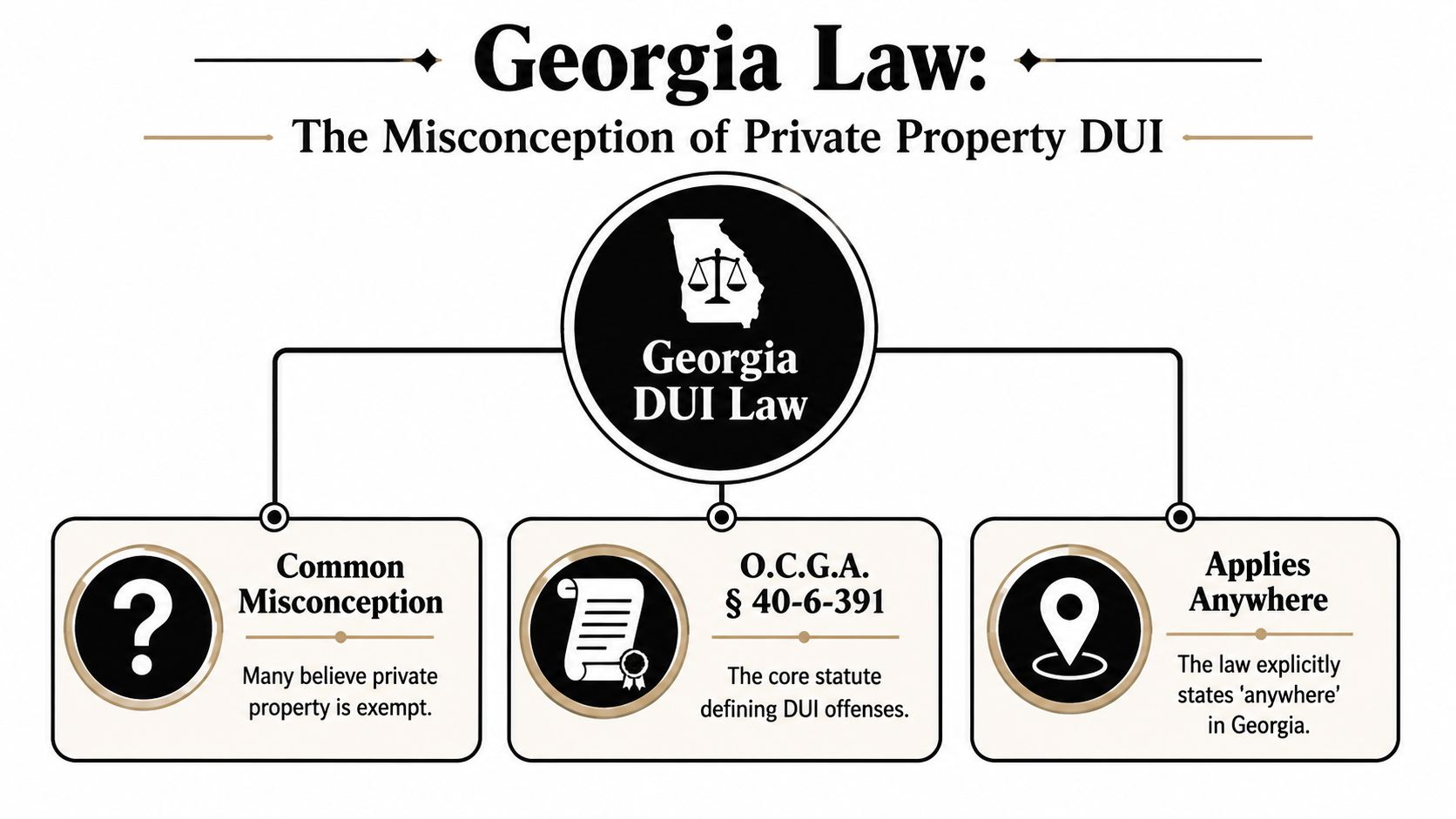
Georgia Law The Misconception of Private Property
A driver pulls into a parking lot off Highway 9 in Alpharetta, shuts the car off, and waits to sober up. An officer knocks on the window ten minutes later. The driver is shocked to learn that being off the road does not end the DUI risk in Georgia.
That misunderstanding causes real damage in court. Georgia DUI cases turn less on who owns the property and more on two legal questions: did the person have actual physical control of the vehicle, and was the location a place vehicles from the public could enter or use?
Actual physical control
In Georgia, the state does not always need a witness who saw the car moving. Prosecutors in places like Roswell Municipal Court or State Court in Cobb County often build these cases around control, not motion. If an officer finds you in the driver's seat with the keys available, the engine warm, or the vehicle positioned like it had just been driven, the state will argue you had the present ability to operate it.
That issue decides many private-property cases.
Officers usually focus on a short list of facts:
- Where you were sitting: Driver's seat facts are harder to explain away than a passenger seat or back seat position.
- Where the keys were: In the ignition, in your hand, or within reach gives the prosecutor a stronger control argument.
- Whether the engine was on: A running vehicle makes the state's theory cleaner, but a car can still create exposure even when it is off.
- How the vehicle was located: Parked crooked, partly in a lane, near an entrance, or recently arrived can matter.
- What you said: Casual statements like "I just pulled over" often do more damage than the field tests.
In Marietta and Forsyth County, this is one of the first pressure points I examine. If the officer never saw driving, the defense often turns on narrowing the timeline, challenging assumptions about recent operation, and showing the client had stopped using the vehicle as transportation.
Public access matters more than ownership
Private ownership does not end the analysis. A lot can be privately owned and still be open to the public for vehicle traffic. That is why shopping centers, apartment complexes, subdivision roads, restaurant lots, and business parking areas create so many Georgia DUI arrests.
The harder defense question is access. Was the area open for customers, guests, residents, delivery drivers, or general vehicle entry? Or was it gated, restricted, locked, posted, or otherwise closed to ordinary traffic?
That distinction matters in Alpharetta, Roswell, and Marietta because local courts often look closely at how the property functioned in practice, not just how it was labeled on paper. A secured employee lot at midnight presents a different argument than an apartment lot with open entrances and constant traffic.
Privacy arguments still have a place, especially on suppression issues involving police entry onto property. Questions about reasonable expectations of privacy on private property can affect whether the officer's investigation was lawful. They do not, by themselves, defeat the DUI charge.
A strong defense separates the issues. First, challenge actual physical control. Second, challenge public access. Third, examine whether the officer had lawful grounds to approach, detain, and investigate. That is the analysis many general DUI articles miss, and it is often where a private-property case is won or lost in North Metro Atlanta courts.
Where DUIs Happen Common Private Property Scenarios
Most private-property DUI cases don't begin with a dramatic chase. They begin in familiar places, where people wrongly assume they are safe from a DUI charge.
Apartment complex parking lots
A common scenario in Johns Creek or Sandy Springs is a driver pulling into an apartment complex lot and stopping there. The person may live there, may be visiting someone, or may have turned in to get off the road.
From the state's perspective, an apartment lot often looks like a vehicle-access area used by many people. If an officer finds someone in the driver's seat, prosecutors may argue the person was still operating or in control of the vehicle.
Shopping centers after closing
People are often surprised that a nearly empty lot can still create exposure. A closed shopping center in Marietta or Roswell feels private because the stores are shut down. Legally, the harder question is whether the lot remains open and accessible to vehicle traffic.
A lot with open entrances, regular traffic flow, and unrestricted access is very different from a locked and secured area.
Private driveways and neighborhood roads
A friend's driveway in Cumming or a residential road in Milton can raise tougher factual disputes. These cases often turn on exactly where the vehicle was, who had access to the area, and what the officer observed before making contact.
A gated or restricted area may offer stronger defense arguments than an open-access space. But the facts have to support it.
Sleeping it off in the car
This is one of the most misunderstood situations. Many drivers think sleeping in the car is always the responsible move. Sometimes it is. But it can still create serious legal risk if you stay in the driver's seat with facts that suggest control.
As noted in this New Jersey private-property DUI discussion, many DUI arrests on private property do not require the vehicle to be moving, and courts may look at circumstantial facts such as whether the engine was on and where the driver was sitting.
Here is what tends to hurt a defense in these cases:
- Engine running for heat or air: That fact gives prosecutors an argument that you had immediate control.
- Driver's seat position: Sitting behind the wheel is harder to explain away than being elsewhere in the car.
- Keys within reach: Easy access to the keys supports the state's theory.
- Statements to police: Saying "I was about to leave" can do major damage.
If you decided to sleep in your vehicle, the exact details matter. Seat position, key location, engine status, and your statements can all change the case.
Police Authority and Your Rights During the Stop
You pull into an apartment complex in Roswell, a store lot in Marietta, or a private drive near Alpharetta because you know you should not keep driving. A patrol car rolls up anyway. At that point, the case often turns less on what you intended and more on what the officer was legally allowed to do, what the officer observed before making contact, and whether the location was open to the public.
Georgia officers do not get unlimited authority just because the vehicle is on private property. They can approach a parked car to check on welfare or respond to a complaint. But once the encounter becomes a detention, the officer still needs a lawful basis for it. In practice, that issue matters in Forsyth, Cobb, and Fulton County courts because a weak stop can put statements, field sobriety exercises, and later chemical test evidence at risk.
What gives police the right to investigate
The first questions I examine are simple and fact-specific.
Why was the officer there?
If dispatch sent the officer because a property owner, security guard, or witness reported an impaired driver, the state will use that to justify contact. If the officer claims a welfare check, I want to know what facts supported that. If the officer says there was a DUI investigation from the start, the report should identify observations that existed before the detention, not after it.
These details often decide whether the stop holds up:
- Who called police, and what exactly was reported
- Whether the officer saw the vehicle move
- Whether the engine was running or the lights were on
- Whether the area was open for public use or restricted by gate, code, or signage
- Whether the officer entered deeper into private property without consent or a clear reason
For a broader explanation of detention standards, see when police can and cannot stop you without a proper legal basis.
Private property does not erase your rights
Drivers often assume they have no Fourth Amendment argument once police make contact in a parking lot or private driveway. That is wrong. The central question is whether this was a consensual encounter, a welfare check, or an investigatory detention supported by specific facts.
That distinction matters in local courts. In Marietta Municipal Court or State Court of Cobb County, for example, judges often focus on the officer's timeline. In Alpharetta or Roswell cases, I look closely at body camera footage, CAD notes, and property layout. A lot that any member of the public can enter creates a different argument from a gated subdivision road, secured apartment area, or private business yard closed after hours.
Testing issues in a private-property case
Private-property DUI arrests also create testing disputes that general articles usually miss. The officer may assume the same rules apply as they would on a public-road stop. A defense lawyer should not make that assumption.
Focus on the sequence. Was there a lawful detention before questioning? Did the officer request field sobriety exercises during a welfare check without clear signs of impairment? Was the arrest based on driving evidence, or only on what the officer saw after approaching a parked car? In a sleeping-driver case, prosecutors still have to connect intoxication to actual physical control at the relevant time.
Here is where I usually start:
| Issue | Why it matters |
| | |
| Reason for contact | A vague or shifting explanation can weaken the stop |
| Public access to the location | Open access helps the state. Restricted access may help the defense |
| Actual physical control at first contact | The state needs more than suspicion or hindsight |
| Statements made before arrest | Admissions often become the centerpiece of the case |
| Video, dispatch, and property records | These materials often expose gaps in the officer's version |
A private-property DUI defense is often built at the stop itself. If police overreached, entered an area without a solid basis, or turned a welfare check into a fishing expedition, that issue should be pressed early and hard.
How to Fight a Private Property DUI Charge in Georgia
A strong defense in a private-property DUI case usually turns on two pressure points in Georgia law. The state has to prove actual physical control of the vehicle, and in many cases it also has to justify treating the location as one covered by the DUI statute. In courts serving Alpharetta, Roswell, and Marietta, those issues often decide whether the case holds up or starts to unravel.
Attack the state's claim of actual physical control
Prosecutors often build these cases around appearance, not proof. A person is found in or near a vehicle, the officer smells alcohol, and the report starts reading as if operation is a given. That shortcut should be challenged.
Actual physical control is a fact issue. I look at where the client was seated, whether the keys were in the ignition or somewhere else, whether the engine was running, whether the vehicle could be driven at that moment, and whether anyone saw movement. A sleeping person in a parked car is not the same case as someone observed pulling through a lot.
In Forsyth County and Cobb County, I want the body camera, dispatch audio, and every early statement pinned down fast. Officers sometimes use loose phrases like "in control" or "operating" before the facts support either one. If the timeline is weak, or if the officer never saw driving at all, that gap matters.
Questions that often shape this defense include:
- Where was the client when police made first contact?
- Where were the keys?
- Was the engine on, off, or never checked carefully?
- Was the vehicle blocked in, disabled, or otherwise not readily operable?
- Did any witness see recent driving, or is the state asking the court to assume it?
Challenge whether the property was actually open to the public
Private property is not one category. A supermarket lot in Roswell is different from a gated apartment garage in Alpharetta. A business lot open to customers in Marietta is different from a fenced employee yard after closing.
That distinction gives the defense real room to work. If the area had a gate, keypad access, restricted signage, limited entry, or no ordinary public traffic, the "public access" issue should be developed with photographs, lease records, surveillance footage, and testimony from the property owner or manager. Prosecutors often describe a location in broad terms. Judges in local courts want the details.
This argument is especially useful when the officer assumed the entire property counted as publicly accessible without checking how the space was used that night.
Examine the police contact for suppression issues
A private-property DUI defense is often won or lost before the arrest. The first question is simple. Why did the officer approach in the first place?
A welfare check, a trespass complaint, a 911 call, and an officer-initiated encounter each raise different legal issues. If the contact turned from a welfare check into an investigative detention without clear facts supporting that shift, suppression may be on the table. The same is true if the officer entered an area with restricted access or relied on vague observations that do not line up with the video.
I also look closely at statements. In many private-property cases, the prosecution relies heavily on what the driver supposedly admitted, especially when no one saw the vehicle move. If the questioning started before the legal basis for detention was clear, that issue should be pressed.
Build the defense with local evidence, not generic arguments
These cases are fact-heavy. Generic internet advice does not help much in State Court in Cobb or Forsyth, and it does not help much in municipal courts around North Atlanta either. The defense has to be built around the property layout, the officer's exact observations, the timing of the encounter, and whether the state can prove control at the relevant moment.
Body camera footage, CAD logs, 911 recordings, photographs of gates and signage, tow records, and witness statements often matter more than the narrative in the arrest report. In practice, that is where many weak assumptions get exposed.
Brian Hansford Law handles criminal defense matters in Alpharetta and surrounding North Atlanta courts, including DUI-related cases.
A private-property DUI charge can be fought. The right defense usually is not broad. It is specific, document-driven, and tied to what the officer could prove in that location on that night.
Penalties for DUIs in Cobb Fulton and Forsyth County
A driver can be asleep in a parked car at an apartment complex in Marietta, or sitting behind the wheel in a shopping center lot near Roswell, and still face the same Georgia DUI penalties that apply on a public roadway. Once the State claims it can prove actual physical control and enough public access to support the charge, the exposure is real.
That is how these cases are treated in Cobb, Fulton, and Forsyth County. Courts serving Alpharetta, Roswell, Marietta, and Cumming do not dismiss the risk because the stop happened off-street.
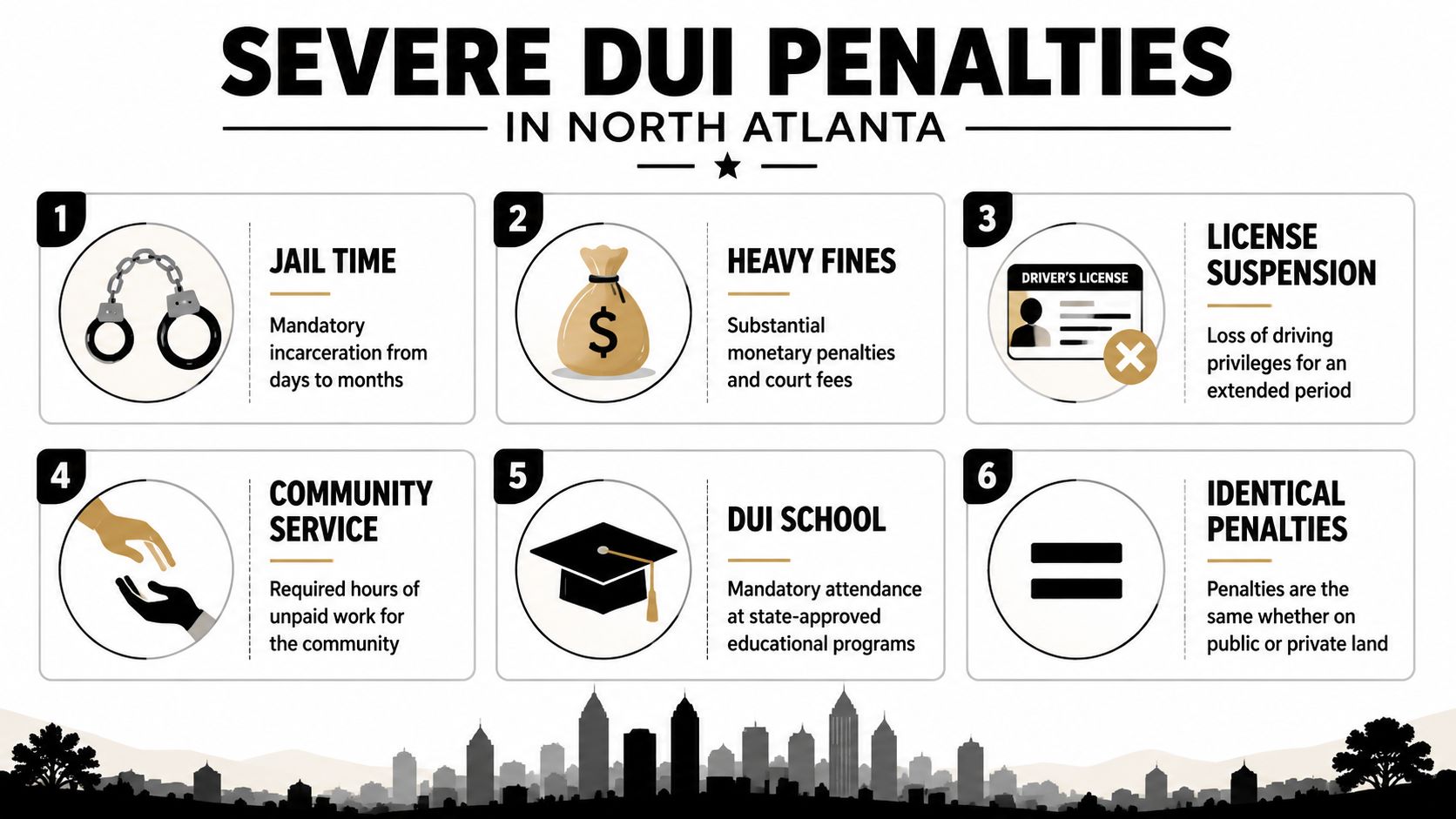
What the court is actually looking at
In practice, penalty exposure turns on two separate tracks. The criminal case can bring jail risk, probation, fines, DUI school, treatment conditions, community service, and a lasting record. The license side creates its own pressure fast, often before the court case is resolved.
For private-property cases, people often make a bad assumption. They believe a parking deck, private subdivision, or apartment lot will lead to a lesser outcome. Georgia courts generally do not treat it that way if the prosecution can show you were in actual physical control of the vehicle and the location was open enough to public use or vehicle traffic to fit the statute and the court's view of the facts.
The consequences clients usually feel first
The sentence on paper is only part of the problem. In Cobb and Forsyth especially, the practical fallout hits quickly.
- License consequences: Trouble getting to work, school, treatment, or court.
- Court conditions: Alcohol evaluation, classes, testing, reporting requirements, and probation terms.
- Financial strain: Fines, court costs, towing, ignition interlock in some cases, and higher insurance premiums.
- Record damage: Employment screenings, professional licensing issues, and repeat-offender treatment if there is another arrest later.
A private-property DUI can also be harder to explain than drivers expect. Judges in Marietta, Alpharetta, and nearby courts hear the "I was only sitting there" argument all the time. The issue is whether the State can prove control, impairment, and access under the facts of that location.
County-by-county reality in North Atlanta
Cobb County prosecutors tend to examine the officer's observations, video, and chemical test evidence closely. In Marietta-area cases, the defense often has to challenge the State's assumptions about why the driver was in the vehicle and whether the property was meaningfully open to public travel.
Fulton County cases, including matters arising around Alpharetta and Roswell depending on the court involved, often turn on how clean the proof is. If the officer found someone in a parked vehicle on private property, the prosecution still has to connect the dots. If they can, the penalty range is still serious.
Forsyth County courts do not treat these as technical throwaway cases either. A stop in a private lot in or near Cumming can still lead to standard DUI punishment, license consequences, and pressure to resolve the case quickly. Quick resolutions are not always smart resolutions.
If you were arrested, treat the penalty side and the defense side as urgent at the same time. The best next step is to review what to do after a DUI arrest in Georgia and get local advice before court dates and license deadlines start closing in.
Critical First Steps After a DUI Arrest
The first days after an arrest matter. People do the most damage to their case when they wait, talk too much, or assume they can explain everything later.
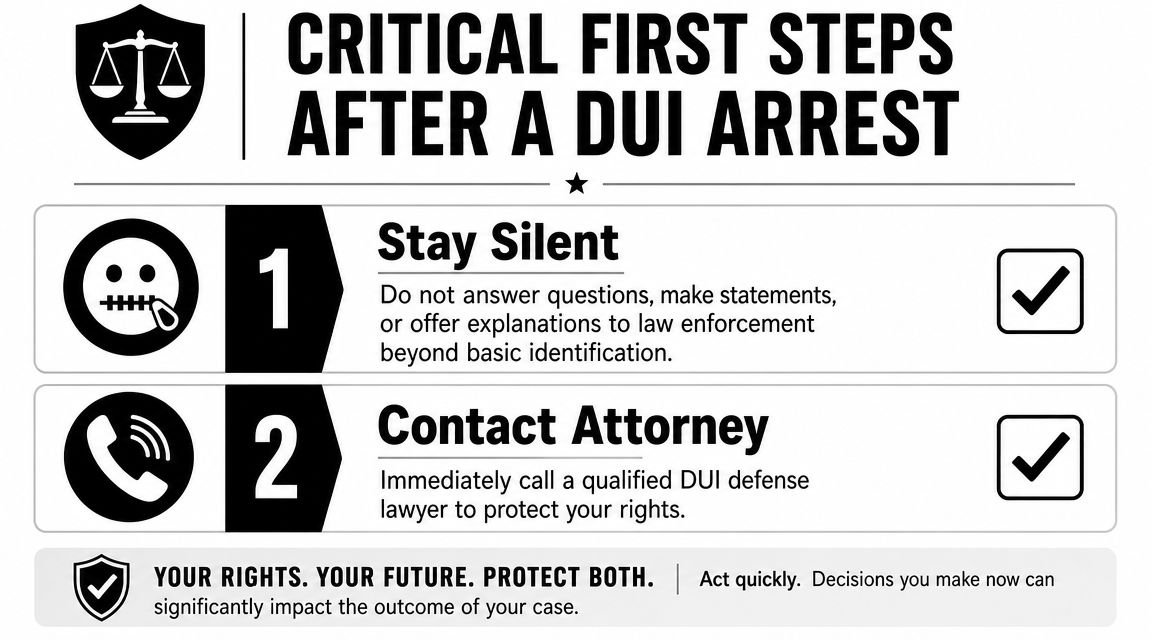
What to do immediately
- Stay silent about the facts: Give basic identifying information, but don't try to explain where you were, what you drank, or why you were in the vehicle.
- Write down the details: As soon as you can, make notes about the property layout, who called police, where the keys were, whether the engine was running, and what the officer said.
- Preserve evidence: Save receipts, rideshare records, text messages, parking records, and names of witnesses.
- Act on your license issue quickly: Georgia DUI cases involve strict deadlines, including a 30-day deadline connected to protecting your license after arrest. Missing that deadline can create a second problem on top of the criminal case.
- Speak with a DUI attorney fast: The earlier counsel gets involved, the better the chance of securing footage, identifying suppression issues, and protecting your court position.
For a more detailed breakdown, review what to do after a DUI arrest in Georgia.
What not to do
Don't call the officer to "clear things up." Don't post about the arrest. Don't tell friends facts you wouldn't want repeated in court. And don't assume the private-property detail will fix the case by itself.
A fast, disciplined response gives your defense the best chance.
FAQ About Georgia Private Property DUIs
Can you get a DUI in your own driveway in Georgia
Potentially, yes. The better question is whether the state can prove operation or actual physical control and whether the officer's entry and contact were lawful. A driveway case may create better defense arguments than a shopping-center lot, but it isn't automatically safe territory.
Can you get a DUI on private property if the car was off
You can still be charged, but the facts become more contested. If the car was off, keys weren't readily available, and there is little evidence of recent driving, the defense may have stronger arguments against actual physical control.
Is sleeping in the car enough for a DUI charge
It can be. Sleeping in the driver's seat with the engine running or keys easily accessible gives the prosecutor facts to argue control. Sleeping elsewhere in the vehicle may present a different argument, but every detail matters.
Is a gated community in Milton or Johns Creek truly private for DUI purposes
Sometimes yes, sometimes not. The answer depends on access restrictions, how traffic moves through the area, who is allowed in, and what evidence shows about actual use. "Gated" helps only if the facts show meaningful restriction, not just a label.
What if I was sitting in the driver's seat but wasn't driving
That is often the key fight. Prosecutors may still argue actual physical control based on seat position, keys, and surrounding circumstances. The defense should examine every fact instead of accepting the officer's conclusion.
Can police walk up to my car in a private parking lot
Sometimes they can. Whether they can detain you, investigate for DUI, or rely on what happens next is a more technical legal question. The difference between a consensual encounter, a welfare check, and a detention can be critical.
Are the penalties lower because it happened on private property
No. Courts generally do not treat a private-property DUI as a lesser form of DUI just because it happened off the road. The criminal, license, and insurance consequences can still be severe.
Do I need a DUI lawyer if this happened in Alpharetta, Roswell, or Marietta
Yes, if you want a real defense. These cases involve control, access, police authority, testing issues, and local court practice. A DUI attorney familiar with North Atlanta courts can identify issues that are easy to miss early on.
If you were arrested for DUI on private property in Alpharetta, Roswell, Johns Creek, Milton, Cumming, Marietta, or anywhere in Forsyth, Fulton, or Cobb County, talk with Brian Hansford Law as soon as possible. The firm handles criminal defense and DUI cases in North Atlanta, and a prompt review can help you assess license risks, court deadlines, and possible defenses tied to actual physical control, public access, and the legality of the police encounter.
