
It’s a question that comes up a lot after a night out: Is it smarter—and legally safer—to bike home instead of driving? The answer isn’t a simple yes or no. The entire issue comes down to how your state’s laws define one crucial word: “vehicle.”
So, can you get a DUI riding a bike? It depends. Some states treat a bicycle just like a car under their DUI statutes, while others only apply those laws to motorized vehicles.
The Big Question: Biking and DUIs
Think of it like this: each state has its own rulebook. In one state, pedaling home after a few drinks might lead to a DUI charge, just as if you were driving. In another, it might result in a lesser charge, like public intoxication. The consequences depend entirely on the legal playbook your state follows.
This isn’t a minor detail; it’s the central point that determines everything from the charges an individual might face to the long-term impact on their life.
The Deciding Factor: State Law
The single most important factor is whether a bicycle is legally classified as a “vehicle” under your state’s DUI laws. This one definition creates two completely different outcomes for cyclists.
- States Where Bicycles Are “Vehicles”: In these states, the law doesn’t care if your vehicle has a motor or pedals. If you’re operating it under the influence, you can be charged with a DUI, facing penalties similar to those for drunk driving.
- States Where Bicycles Are Not “Vehicles”: Here, the DUI laws are written specifically for motorized transport. While you can’t get a standard DUI, you’re not off the hook. You could still face other charges, like public intoxication or disorderly conduct.
The legal landscape for intoxicated cycling is a patchwork of state-specific statutes. Ultimately, the definition of “vehicle” is the deciding factor in what charges, if any, can be applied.
This is a critical distinction to understand. To make it clearer, here’s a quick summary of how states approach this issue.
Quick Overview of Bicycle DUI Possibilities by State Law Type
This table breaks down the different legal frameworks states use to handle intoxicated cycling, giving a snapshot of the potential charges an individual could face.
| State Law Approach | Is a Bicycle a ‘Vehicle’ for DUI? | Potential Charges |
|---|---|---|
| Bicycle = Vehicle | Yes, explicitly or implicitly. | Standard DUI/DWI, potentially with the same penalties as a car. |
| Bicycle ≠ Vehicle | No, the law applies only to motor vehicles. | Public intoxication, disorderly conduct, or other related offenses. |
| Ambiguous Laws | Unclear, depends on court interpretation. | Charges can vary widely based on case law and local enforcement. |
As you can see, there is no single rule that applies everywhere. It is important to know the specific laws where you live and ride.
This infographic helps visualize how that one legal definition—”vehicle”—steers the outcome.

The image shows a clear fork in the road. How a bicycle is legally classified from the start determines which path a case will follow. Keep in mind, the information here is for educational purposes and is not a substitute for guidance on a specific situation.
How States Define a ‘Vehicle’ for DUI Laws

To figure out if you can get a DUI on a bike, we have to look at the single most important word in the statute: “vehicle.” It sounds simple, but this one word is the foundation for every DUI charge. The entire outcome of an intoxicated cycling stop often comes down to how the state law is written.
Think about a “No Vehicles in the Park” sign. If the park rules define “vehicle” as something with a motor, your bicycle is fine. But if the rules say a vehicle is anything with wheels used for transportation, your bike is suddenly illegal. State DUI laws work the exact same way.
This tiny detail creates a huge difference in how police can respond. A broad definition can lump a bicycle into the same legal category as a car, while a narrow one draws a clear line between them.
The Two Main Approaches to Defining a Vehicle
When it comes to DUI laws, states generally fall into two camps. Their approach is what determines whether someone can be charged with a DUI for riding a bike while impaired. This distinction isn’t an accident; it’s a deliberate choice in legislative language that sets up the entire legal framework for cyclists.
- The Broad Definition Approach: Some states define a “vehicle” as pretty much any device used for transportation on a public road. The language is intentionally vague and doesn’t require the device to be motorized. Under this model, a bicycle, propelled by human power, fits the description perfectly.
- The Motor-Centric Approach: Other states take a much more limited view. Their laws specifically define a “vehicle” as a “motor vehicle.” This is a critical distinction. It means the device must have an engine to fall under the DUI laws, which naturally excludes a traditional bicycle.
This fundamental difference is why you might hear conflicting stories from friends in different parts of the country about getting a DUI on a bike.
In Florida, for example, a bicycle is legally considered a “vehicle,” meaning the state’s DUI laws apply to cyclists just as they do to drivers. This broad definition makes a bicycle DUI a real possibility.
On the other hand, a state with a motor-focused law offers a completely different outcome.
Wording Matters: A Legal Deep Dive
Let’s look at how the actual text of a law creates these different realities. The precise phrasing chosen by lawmakers is what truly matters in court.
For instance, a state might define a vehicle as “every device in, upon, or by which any person or property is or may be transported or drawn upon a highway.” That language is so general it could include skateboards, scooters, and definitely bicycles. There’s no mention of a motor, so the source of power is irrelevant. This is what allows for a bicycle DUI charge in states like Colorado and Florida.
In sharp contrast, Texas law applies its DWI statute specifically to the operation of a “motor vehicle.” Because a bicycle isn’t motorized, a person can’t be charged with a traditional DWI for riding one while impaired. Instead, they might face a different, often less severe charge like public intoxication.
- Broad Definition States: Can lead to standard DUI charges for cyclists.
- Motor-Centric States: Generally prevent standard DUI charges but allow for alternative charges.
This legal distinction is the pivot point for everything that follows, from the initial police stop to the final court proceedings. The single word “motor” can change everything, highlighting why knowing the specific laws in your area, whether it’s Cumming or Alpharetta, is so important. Ultimately, whether a bicycle is seen as a simple toy or a full-fledged vehicle in the eyes of the law is decided by these carefully chosen words.
Alright, let’s break down how this actually works in the real world. We’ve talked about the legal difference between a “vehicle” and a “motor vehicle,” but what matters is how a state’s specific DUI statute is written. It’s this wording that determines whether you can get a DUI for riding a bike.
In many places, this isn’t some gray area. The laws are surprisingly clear and lead to very real consequences for cyclists.
Several states have laws on the books—and a history of enforcing them—that make a bicycle DUI a genuine risk. In these jurisdictions, a bicycle is legally considered a vehicle when it comes to operating under the influence. That means cyclists are held to a similar standard as motorists. This often catches people off guard who think that choosing their bike over their car is a foolproof way to avoid a DUI charge after a few drinks. In certain states, that assumption is flat-out wrong and can lead to serious trouble.
States with Clear Bicycle DUI Laws
In some parts of the country, the law explicitly lumps bicycles in with cars for DUI purposes. These states use a broad definition of “vehicle” that doesn’t require an engine, putting bicycles squarely under their DUI statutes.
For example, Florida is well-known for classifying bicycles as vehicles. What that means is the same DUI laws that apply to a car also apply to a bike. A cyclist in Florida can be arrested, charged, and face penalties nearly identical to a driver’s, including steep fines and even a suspended driver’s license.
Colorado is another state where the law is clear. Its statutes are written to include bicyclists in DUI enforcement, and the penalties can mirror those for driving a car while impaired. This can mean fines, community service, and even jail time.
Here are a few other states where a bicycle DUI is a real possibility:
- Ohio: The state’s broad definition of “vehicle” is enough to include bicycles, subjecting cyclists to OVI (Operating a Vehicle under the Influence) charges.
- Pennsylvania: Just like Florida, Pennsylvania law treats bicycles as vehicles, meaning standard DUI laws apply.
- Oregon: The state’s DUI laws apply to any “vehicle,” a term that has been legally interpreted to include bicycles.
These examples show that the answer to “can you get a DUI on a bike?” is a definite “yes” in several states.
Understanding the Consequences
The penalties for a bicycle DUI are just as varied as the laws themselves. While they might not be as harsh as a car-related DUI in some cases, they are far from trivial. A conviction can still leave a lasting mark on a person’s record.
Common consequences can include:
- Significant Fines: These can run from a few hundred to several thousand dollars.
- Mandatory Education Programs: Courts often order offenders to attend alcohol awareness or traffic safety classes.
- Driver’s License Suspension: This is a big one. Even though a car wasn’t involved, a conviction can lead to the suspension of your driver’s license. The logic is that the offense is against your privilege to operate any vehicle on public roads.
- A Criminal Record: A bicycle DUI is still a criminal offense that will show up on background checks for jobs, housing, and loans.
This isn’t just an issue in the United States. The rules for cycling under the influence (CUI) vary wildly across the globe. In Germany, for instance, a blood alcohol concentration (BAC) of 1.60 g/kg can get you a hefty fine. In Spain, the fines start at €500. A study in Korea found that 11.7% of adults admitted to riding a bike while intoxicated, proving that CUI is a global concern with very different legal answers. You can find more global CUI statistics in this comprehensive study.
The most surprising consequence for many is the hit to their driver’s license. The court’s reasoning is that an intoxicated person operating any vehicle, motorized or not, poses a danger to the public.
Ultimately, from Cumming to Alpharetta and everywhere in between, it’s the specific local statute that dictates the outcome. The definition of a “vehicle” remains the cornerstone of any bicycle-related intoxication charge.
Alternative Charges for Intoxicated Cycling
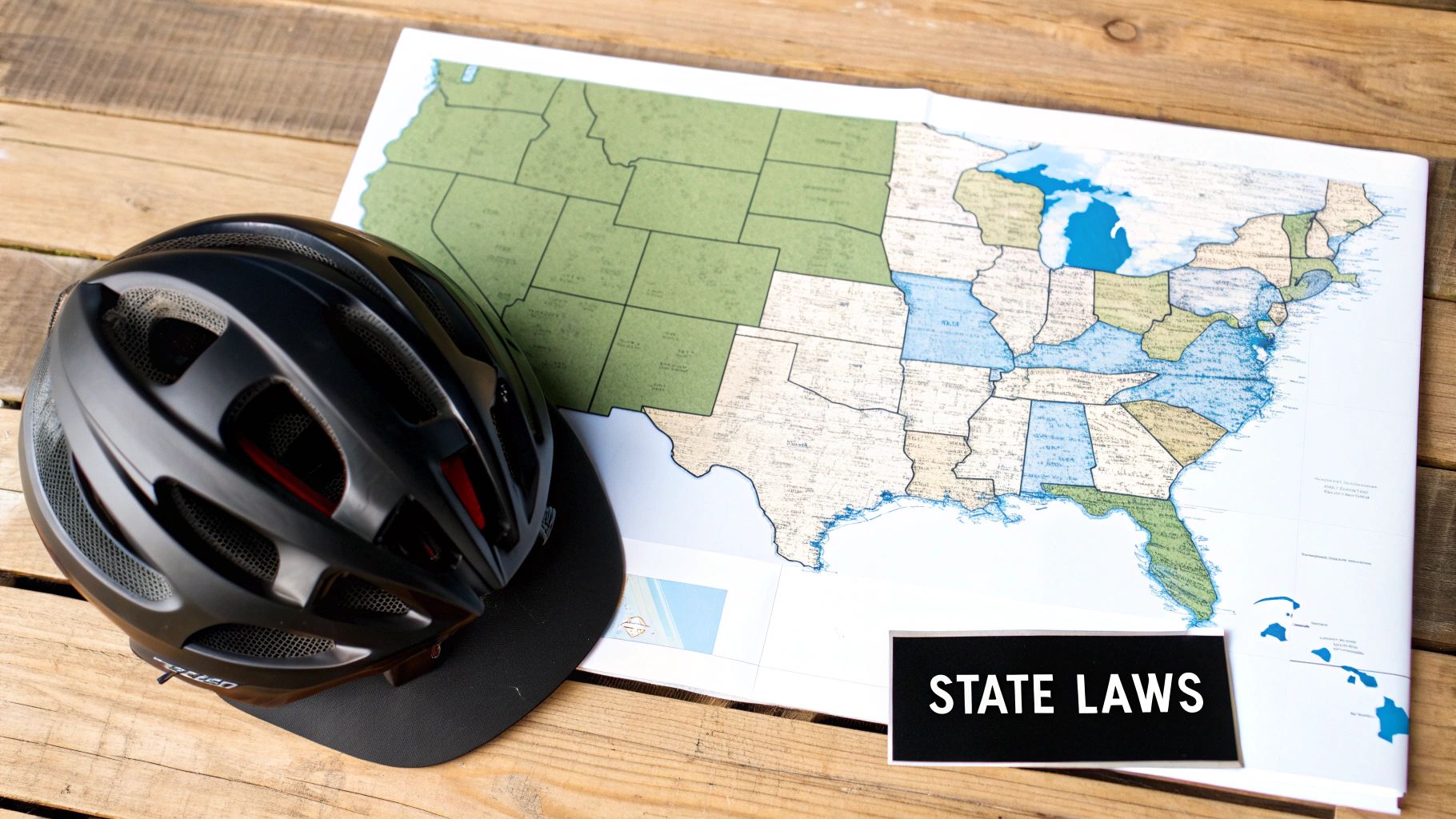
So your state’s DUI laws only apply to motor vehicles. You might think that gives you a free pass to ride a bike home after a few drinks, but that’s a common and costly mistake.
Just because you can’t be charged with a traditional DUI doesn’t mean you’re immune to legal trouble. Law enforcement still has plenty of tools to address unsafe behavior on the road, and they won’t hesitate to use them.
This is a critical point many people miss. They assume no DUI means no problem, but that oversight can land them in the back of a police car with a different set of charges—charges that still come with serious penalties. From Georgia to Texas, officers can and will use other statutes to charge an intoxicated cyclist who poses a risk to themselves or the public. It’s a procedural safety net; if one law doesn’t quite fit the situation, there may be another one that will.
Common Charges Beyond a Bicycle DUI
When a DUI charge is off the table, police typically pivot to a handful of other common offenses designed to handle dangerous or disruptive public behavior. The exact charge will always depend on the specific actions and local ordinances.
The most common alternative is public intoxication. This is pretty straightforward: if a person is visibly under the influence in a public place and appears to be a danger to themselves or others, they can be arrested. A cyclist swerving down a street in Roswell or Marietta is a textbook example.
Other charges could include:
- Disorderly Conduct: This is a catch-all for disruptive, offensive, or dangerous behavior. An intoxicated cyclist who is yelling at pedestrians, weaving onto sidewalks, or otherwise causing a scene could easily face this charge.
- Reckless Endangerment: If impaired riding creates a substantial risk of serious physical injury to someone else, this charge may apply. Think about blowing through a stop sign at a busy Alpharetta intersection or riding against the flow of traffic.
The point is, the absence of a specific bicycle DUI law is not a get-out-of-jail-free card.
Comparing the Penalties
While these alternative charges are generally less severe than a full-blown motor vehicle DUI, they are far from trivial. The penalties can still disrupt a person’s life, cost a significant amount of money, and result in a criminal record.
A public intoxication charge might seem minor compared to a DUI, but it’s still a criminal offense. A conviction will appear on background checks, potentially impacting job opportunities and personal reputation.
Let’s break down how the consequences stack up. A car DUI often means an automatic license suspension, thousands in fines, and possible jail time, even for a first offense. The penalties for alternative charges are usually lighter, but still serious enough to take notice.
| Consequence | Typical Car DUI | Alternative Charge (e.g., Public Intoxication) |
|---|---|---|
| Fines | Often starting at $1,000 or more | Usually ranges from $100 to $500 |
| Jail Time | Possible, even for a first offense | Less common, but possible for repeat offenses |
| Driver’s License | Almost certain suspension | Generally no impact on a license |
| Criminal Record | Yes, as a serious traffic offense | Yes, as a misdemeanor |
The bottom line is clear. While someone might avoid a license suspension by being on a bike, they can still walk away with fines, community service, and a criminal record that follows them for years.
What to Expect During a Bicycle DUI Stop
It’s an unsettling experience, but knowing what happens during a police stop can take some of the mystery out of the process. If an officer suspects a person is impaired while on a bike, the stop will usually follow a predictable path, from their initial reason for pulling them over to potential field sobriety tests.
First things first: an officer can’t just stop someone for no reason. They need what’s called reasonable suspicion. This means they have to see something that suggests intoxication or a traffic law violation.
Reasons an Officer Might Initiate a Stop
Police are trained to look for specific signs of impairment that give them grounds to pull a cyclist over. Usually, it comes down to erratic or unsafe riding that puts the rider or others at risk.
Common reasons for a stop include:
- Swerving or Inability to Ride Straight: This is probably the most obvious red flag for any officer.
- Ignoring Traffic Signals: Blowing through a red light or a stop sign is a clear traffic violation that will get you noticed, fast.
- Riding Without Lights at Night: Most places, including Forsyth County and Cobb County, have laws requiring bike lights at night. Missing them is an easy excuse for a stop.
- Riding on the Wrong Side of the Road: Pedaling against traffic isn’t just illegal—it’s incredibly dangerous and a sure way to attract police attention.
Any one of these actions gives an officer the justification to pull someone over and start asking questions. What happens next really depends on the interaction. For a deeper dive into what occurs during any traffic stop, you can learn more from our article about what to expect when being pulled over.
Field Sobriety and Chemical Tests
Once stopped, if the officer still suspects impairment—based on things like slurred speech, the smell of alcohol, or just general coordination—they might ask the person to perform Standardized Field Sobriety Tests (SFSTs). These are the same roadside tests seen in car DUI stops, though they might be slightly adjusted for someone on a bike.
These tests are designed to check balance, coordination, and the ability to follow directions. Think of the one-leg stand or the walk-and-turn test. After that, an officer may ask for a preliminary breath test on a handheld breathalyzer.
The whole concept of “implied consent”—the rule that says drivers must submit to chemical testing—gets very complicated with cyclists. Those laws are almost always tied to the privilege of operating a motor vehicle. Whether they apply to a bike rider is a gray area that changes drastically from state to state.
Saying no to a test doesn’t just make the situation go away. In some states, a refusal can be noted by the officer and brought up later in court.
This isn’t just a U.S. issue, either. In Germany, where riding a bike after a few beers is a serious problem, the laws are very strict. In 2018 alone, 4.4% of cyclists involved in accidents were found to be impaired. German law can hit a cyclist with criminal charges if their BAC reaches 1.60 g/kg, and penalties can kick in for a BAC as low as 0.30 g/kg if the rider is visibly impaired.
Potential Consequences of a Bicycle DUI

If a person is charged with an offense for cycling while intoxicated, the initial stop is just the first step. The aftermath can unravel into a series of consequences that look very different depending on the specific charge and a state’s laws.
It all starts with a court appearance, where the formal charge—whether it’s a full-blown DUI or a lesser offense like public intoxication—is presented. From that point, the penalties can range from a simple fine to much more serious outcomes that disrupt daily life.
Even if a BUI seems minor compared to a car DUI, the consequences should not be underestimated. They can create a ripple effect, hitting finances, freedom, and even future opportunities.
Financial and Administrative Penalties
The most immediate hit is almost always financial. Fines for a bicycle-related offense can run from a few hundred dollars up to $2,500 in some cases. It might be less than a car DUI, but it’s still a significant and unexpected bill for most people.
On top of fines, a judge might order attendance at mandatory alcohol education or traffic safety programs, and the individual will be footing the bill. These classes take up time and add another layer of expense to the situation.
But for many, the most shocking penalty is the potential impact on their driver’s license.
In states where a bicycle is legally defined as a “vehicle,” a DUI conviction can lead to the suspension of your driver’s license—even though you weren’t anywhere near a car. The offense isn’t just about driving; it’s against the legal privilege to operate any vehicle safely.
This is a critical point to understand. Losing driving privileges can create huge hurdles for getting to work, attending school, or just managing everyday life. You can learn more about how a DUI charge impacts a license in our detailed guide on license suspension after a DUI.
Potential Consequences Comparison: Car DUI vs. Bicycle DUI
To really grasp the difference in severity, it helps to see the potential outcomes side-by-side. While a bicycle DUI is a serious matter, the penalties for a car DUI are almost always tougher because of the greater danger motorized vehicles pose to the public.
This table gives a general overview, but remember that specific penalties can vary based on the details of a case and local laws.
| Consequence | Typical Car DUI | Typical Bicycle DUI or Related Charge |
|---|---|---|
| Fines | $1,000 – $10,000+ | $100 – $2,500 |
| License Impact | Mandatory suspension or revocation | Possible suspension in some states |
| Jail Time | Common, even for a first offense | Rare, but possible in certain cases |
| Criminal Record | Yes, as a serious driving offense | Yes, often as a misdemeanor |
| Insurance Rates | Significant increase, SR-22 may be required | Generally no direct impact on auto insurance |
As you can see, the consequences still exist, but they are often less severe than those associated with a traditional DUI.
Long-Term Effects on Your Life
Beyond the immediate legal penalties, a conviction can follow a person for years. A criminal record, even for what seems like a minor offense, shows up on background checks. This can create very real obstacles when applying for jobs, seeking professional licenses, or even trying to rent an apartment.
The personal and professional stigma tied to any alcohol-related offense can be damaging. It’s another reason why understanding the laws around biking under the influence is so important before a decision is made to pedal home after a few drinks.
Frequently Asked Questions About Cycling DUIs
When you start digging into the rules about cycling under the influence, a lot of specific questions pop up. It’s important to understand these nuances because they clarify how different situations get handled—from the type of bike you’re on to whether a driver’s license is at risk. Here are some answers to the most common questions.
Can a Bicycle DUI Affect My Driver’s License
This is a critical point, and the answer is all over the map depending on the state. In states where a bicycle is legally defined as a “vehicle” for DUI purposes, a conviction can absolutely lead to the suspension of a driver’s license. From the court’s perspective, the offense is against the privilege to operate any vehicle, not just a car.
However, in states that treat intoxicated cycling as a lesser offense, like public intoxication, it usually won’t touch a driving record. It all comes down to the specific wording in the local laws.
What About Electric Bikes or E-Scooters
Electric bikes and e-scooters are almost always treated differently, and the reason is simple: they have a motor. In nearly every state, any vehicle with a motor—no matter how small—falls under standard DUI laws.
This means getting caught while impaired on an e-bike or e-scooter is far more likely to be treated like a traditional DUI than riding a regular pedal bike. As these devices have become more popular, the laws have scrambled to keep up, but the presence of a motor is the key factor.
Am I Required to Take a Breathalyzer if Stopped on a Bike
“Implied consent” laws—the ones that require you to take a chemical test if an officer suspects a DUI—are generally tied to the operation of a motor vehicle.
In states where a bicycle is not considered a motor vehicle, a person might not face the automatic license suspension that a driver would for refusing a test. However, that refusal can still be noted by the officer and used as evidence in court.
How implied consent laws apply to cyclists is a very specific and state-by-state issue. A conviction for any offense can have long-term consequences, so it’s vital to understand the options. For anyone wondering about the aftermath, you can explore information on whether you can get a DUI off your record in our detailed guide. It provides good context on how different charges are handled down the road.
Facing a charge in Cumming, Alpharetta, or the surrounding areas can be overwhelming. The team at Brian Hansford Law is dedicated to explaining the process and outlining your options. For more information, visit us at https://challengemycharge.com.
