
Yes, you absolutely can get arrested for underage drinking. It’s a common and dangerous myth that getting caught is just a slap on the wrist. In places like Georgia, an underage drinking charge kicks off a formal process that can follow you for years to come. These cases are typically handled as Minor in Possession (MIP) offenses.
The Reality of an Underage Drinking Arrest
Many young adults are stunned to see how fast a party or a casual hangout can escalate into a serious problem. The law is brutally simple: if you are under 21, it is illegal in most states to possess, consume, or even try to buy alcohol. Period.
Think of an MIP charge like getting a DUI as a brand-new driver. It’s not a simple ticket you pay and forget about. This is the start of a formal criminal case, one with consequences that can derail your education, career, and future.
Understanding Minor in Possession (MIP)
Minor in Possession, or MIP, is the most frequent charge related to underage drinking. It’s a surprisingly broad term that covers a lot more than just being caught holding a beer. You can be cited or arrested for MIP in a few different ways:
- Actual Possession: This is the most obvious one. An officer sees you physically holding an alcoholic beverage.
- Constructive Possession: This is where it gets tricky. You don't have to be holding a drink. If alcohol is found in your car, next to your bag at a party, or anywhere under your control, you can be charged.
- Internal Possession: The drink might be long gone, but if you show signs of consumption—like smelling of alcohol or failing a breathalyzer—that’s enough for a charge in many jurisdictions.
The law isn't just about ownership; it's about control and consumption. Simply being in the wrong place at the wrong time can be enough to get you arrested, which is why it’s so critical to understand these risks.
It's also worth remembering that avoiding alcohol is the norm for young people. The 2023 National Survey on Drug Use and Health found that only 33.1% of people aged 12 to 20 reported drinking alcohol in the past year. That means nearly two-thirds of your peers are making the choice to stay sober. You can learn more by checking out the latest underage drinking statistics in the United States.
Common Scenarios That Can Lead to an Arrest
An MIP charge can happen in situations that seem harmless at first glance. It’s important to recognize these common traps.
| Scenario | What It Means | Common Outcome |
|---|---|---|
| Traffic Stop | An officer pulls over a car for a minor violation and sees alcohol in plain view or smells it on the driver/passengers. | Arrests for everyone in the car under 21, even if only one person was drinking. |
| Party Raid | Police are called to a loud party due to a noise complaint and find minors consuming alcohol. | Officers may issue citations or make arrests on the spot, charging anyone who appears to be under 21. |
| Fake ID Attempt | A bouncer or store clerk spots a fake ID and calls the police. | Arrest for attempting to purchase alcohol as a minor and potentially charges for possessing a fraudulent ID. |
| Public Intoxication | A minor is visibly intoxicated in a public space, drawing attention from law enforcement. | Arrest for MIP and possibly public drunkenness, even if no alcohol is physically present. |
Recognizing these scenarios is the first step toward avoiding a charge that could disrupt your entire future.
What to Expect During an Underage Drinking Arrest
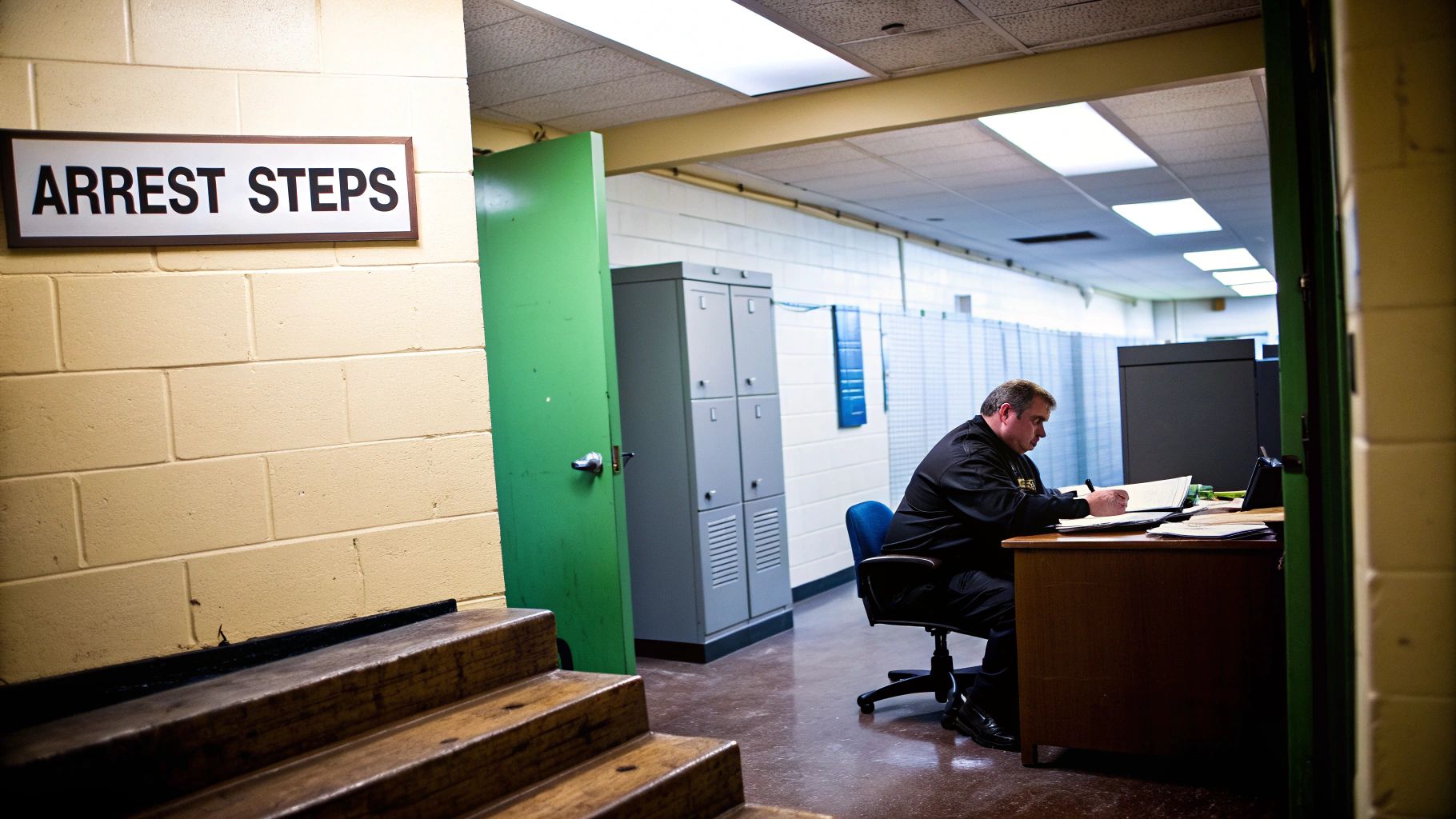
It’s an intimidating and confusing moment. Understanding what happens during an arrest for underage drinking can strip away some of that fear and uncertainty. The process usually kicks off with a direct encounter with law enforcement—maybe at a traffic stop, a house party, or just out in public.
It all starts with something called probable cause. This is just a term for an officer having a reasonable belief that a crime has been committed. For underage drinking, probable cause could be as simple as an officer seeing you with alcohol, smelling it on your breath, or noticing you're acting intoxicated.
At this stage, you might just be detained for a few questions while the officer figures things out. It's important to know the difference: being detained means you aren't free to leave, but you haven't been formally arrested yet. If the officer's suspicions are confirmed, things can escalate to a full-blown arrest.
The Arrest and Booking Process
Once an officer decides to make an arrest, you are officially taken into custody. This isn't just a conversation anymore; you're being charged with a crime. From there, you'll be transported to a local police station or a juvenile detention center for booking.
The booking process is much more administrative than what you see in the movies. It’s really just an information-gathering exercise for the police department. During booking, an officer will typically:
- Record your personal details (name, address, date of birth)
- Take your photograph, which is your mug shot
- Collect your fingerprints for their records
- Conduct a search of you and your belongings
This entire procedure creates a formal, official record of the arrest. Even if the charges are eventually dropped, that arrest record can stick around unless you take specific steps to have it restricted or expunged. Getting a clear picture of what happens when someone is arrested helps put the seriousness of the situation into perspective.
After booking, the police will almost always contact your parents or guardians. Since you're a minor, this isn't optional—it's a required part of the process in most places. They’ll be told about the charge and where you are.
From that point, you'll either be released to your parents with a notice to appear in court on a future date, or you might be held until a hearing can be set up. What happens often depends on the specifics of the situation and whether you have any prior offenses. This initial chain of events—from the first police contact to the call home—is what sets the stage for all the proceedings to come.
How Everyday Situations Lead to Arrests

It’s surprising how quickly a totally normal social gathering can spiral into a serious problem. Most people ask, "can you get arrested for underage drinking?" thinking of some dramatic, high-stakes bust. The reality is, the answer usually comes at a weekend party or during a simple drive home.
These arrests almost never happen the way they do in the movies. They start in very familiar, seemingly harmless settings. A perfect example is a noise complaint at a house party. When police show up, they aren't just there to ask you to turn the music down. If they see alcohol in plain sight and people who look like they might be minors, that’s all the probable cause they need to start investigating. From there, it's a short step to citations or arrests for everyone under 21 who is present.
When You Don't Have to Be Holding a Drink
One of the biggest misunderstandings about underage drinking laws is the concept of constructive possession. This single idea is responsible for a huge number of arrests, and it catches a lot of young people off guard.
In simple terms, constructive possession means you can be charged even if you’re not physically holding an alcoholic beverage.
Think of it this way: you’re a passenger in a friend’s car, and there are a couple of open beer cans on the floor. In that scenario, everyone in the car could potentially be charged. The law may assume that because the alcohol is within your reach and general control, you are legally in "possession" of it. This isn't just about cars, either. It applies in all sorts of situations:
- In a Vehicle: Just being in a car where alcohol is present, even if it’s not yours.
- At a Party: Sitting at a table where there are open containers nearby.
- In a Public Park: Being part of a group with alcohol in a shared cooler or backpack.
The key takeaway is that proximity and access can matter just as much as physically holding a drink. You don't have to be the one drinking to face a Minor in Possession charge.
From Social Events to Legal Troubles
Traffic stops are another common flashpoint. An officer might pull a car over for something minor, like a broken taillight or speeding. But if they smell alcohol or spot containers inside the car, the situation instantly escalates. What started as a simple traffic ticket can become a criminal investigation for every single underage person in the vehicle.
It’s also crucial to understand that providing alcohol to friends, even if you’re also a minor, can open up a whole new set of problems. An adult furnishing alcohol can face serious charges, and minors sharing with other minors can also complicate their situation significantly. You can read more about how this works in our guide on contributing to the delinquency of a minor.
A study that tracked a court handling these types of offenses painted a clear picture: the typical person charged was a 17-year-old male from a middle-class background who was still in high school. What’s truly alarming is that over 50% of those charged already had previous run-ins with the justice system, showing just how easily these situations can become a repeating cycle. You can find more details in this study on young people and drinking charges.
Understanding the Penalties for Underage Drinking
Getting convicted for underage drinking brings on a lot more than just a fine and a stern lecture. What happens in a case really boils down to a few key things: age, whether there have been prior offenses, and the specific details of what went down—like if driving was involved or a fake ID was used.
The system doesn’t see every case the same way. A first-time mistake is usually handled much differently than a second or third one. For a first offense, a court often wants to focus on education and making sure it doesn't happen again. But with repeat charges, they may see a pattern, and the penalties can get a whole lot more serious.
So where are these arrests actually happening? The data might surprise you.
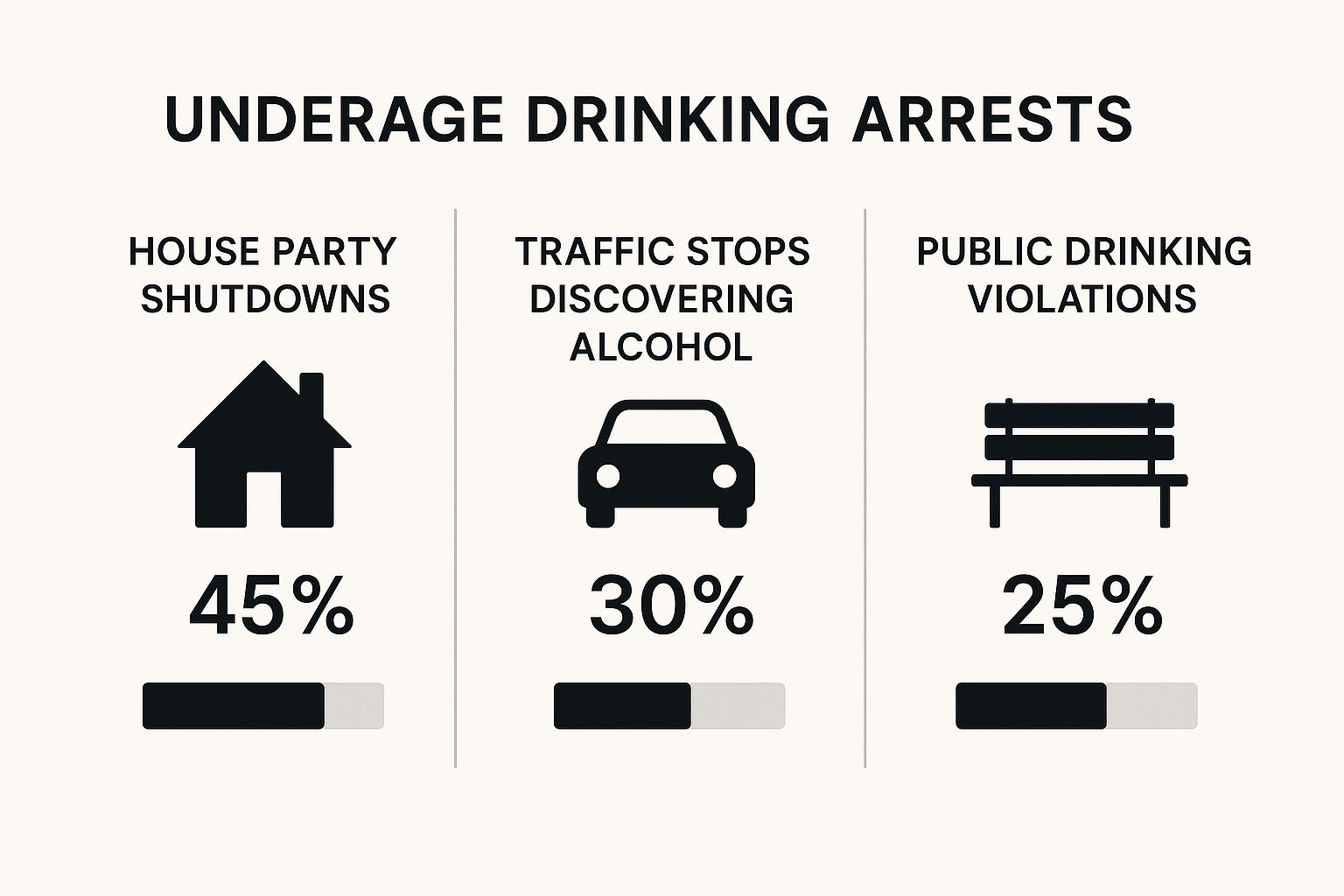
This shows that nearly half of all underage drinking arrests happen at social get-togethers. It’s a clear sign that what feels like a private party can quickly become a problem.
Common Penalties You Might Face
While no two cases are identical, courts tend to use a similar set of penalties for underage drinking. It’s important to realize how one charge can throw a wrench into your life, affecting everything from your driver's license to your personal freedom.
These consequences aren't just for punishment's sake; they're meant to prevent it from happening again. Some of the most common penalties include:
- Driver’s License Suspension: For most young people, this is a major headache. A conviction almost always means you'll lose your driving privileges for a mandatory period.
- Mandatory Alcohol Education: Courts will often order completion of a state-approved alcohol and drug awareness program. These classes cost money and take up a lot of time.
- Court-Ordered Community Service: You could be required to complete a certain number of community service hours, which can easily clash with school, work, or other obligations.
- Probation: This can mean checking in regularly with a probation officer and following a strict set of rules, like curfews or submitting to random drug and alcohol screenings.
The penalties are designed to be more than just an inconvenience. They are structured to make individuals think seriously about the choices they’ve made and to ensure they understand the risks involved with underage alcohol consumption.
First Offense vs. Repeat Offenses
The jump in penalties between a first-time charge and a subsequent one can be pretty dramatic. The system usually offers a bit of a break for a first mistake, but that leniency can disappear quickly if it becomes a habit.
This table gives you a clear look at how things can escalate.
Comparing Penalties for Underage Drinking Offenses
| Penalty Type | Potential First Offense Consequence | Potential Second or Subsequent Offense Consequence |
|---|---|---|
| Fines | Typically ranges from $300 to $1,000 plus court costs. | Fines increase significantly, often exceeding $1,000, plus additional fees. |
| License Suspension | A mandatory suspension, usually for 6 months. | A longer suspension period, often for 12 months or more. |
| Community Service | Usually requires 20-40 hours of service. | The required hours increase, sometimes to 80 hours or more. |
| Probation | A period of probation with specific conditions to follow. | Stricter and longer probation terms, with less tolerance for any violations. |
| Jail Time | Unlikely, but possible depending on the circumstances. | The possibility of jail time increases substantially with each new offense. |
Seeing these escalating penalties side-by-side makes it crystal clear why handling a first charge properly is so critical for protecting your future.
What Factors Influence the Outcome?
Not every encounter with law enforcement over underage drinking ends the same way. The question "can you get arrested for underage drinking?" doesn't have a simple yes or no answer because every situation is shaped by a unique set of variables. It's a bit like a weather forecast—multiple conditions come together to produce the final result.
Two of the biggest factors are an individual's behavior and the setting of the incident. An officer's discretion can play a massive role here. If a person is respectful and cooperative, they might just get a warning. But being argumentative or dishonest can quickly escalate things toward an arrest. The context matters, too; a small, quiet get-together may be viewed very differently from a huge, out-of-control party that has neighbors calling in noise complaints.
The Role of Location and Local Policies
Where the incident happens is critically important. A minor caught with alcohol in a public park might face a very different response than someone at a private home. If other illegal activities are going on—like drug use or property damage—it will almost certainly lead to a more severe outcome for everyone involved.
Different jurisdictions also have their own ways of handling these cases. Some counties may prioritize diversion programs for first-time offenders. These programs often let a minor complete certain requirements, like alcohol education classes or community service, and in return, the charges get dismissed. Other areas might enforce a stricter, zero-tolerance policy, making an arrest and formal charges far more likely, no matter the circumstances.
The specific details of each situation are what ultimately determine the final result. Things like a prior record, the officer's actions, and even the local court's philosophy all contribute to whether it ends with a warning, a citation, or an arrest.
Globally, how underage drinking laws are enforced varies dramatically. In many European countries, cultural attitudes are more relaxed, and the penalties are less severe. For instance, data from the European School Survey Project on Alcohol and Other Drugs (ESPAD) showed that abstinence among 15- to 16-year-olds ranged from 9% in Greece to 36% in Iceland, which reflects a wide range of cultural norms.
In the U.S., however, the risk of arrest is much higher, especially when the drinking happens in public or is combined with another offense. You can learn more about these global underage drinking trends and enforcement differences to see just how much location matters.
The Long-Term Impact of a Conviction
Think an underage drinking charge is over and done with after your court date? Think again. A conviction, even for a misdemeanor, doesn't just fade away. It creates a permanent record that can follow you for years, casting a long shadow over your future.
That record can pop up at the worst possible times, especially during background checks. These days, background checks are standard practice for almost every major step in life, and a conviction can throw a serious wrench in your plans.
How a Conviction Affects Future Opportunities
When a potential employer, a college admissions board, or even a landlord runs your name, an underage drinking conviction is a huge red flag. It’s hard to believe, but that one mistake could be the deciding factor in some of the biggest decisions of your life.
Here are a few specific ways a conviction can create problems down the road:
- College Admissions and Scholarships: Most applications ask if you have a criminal history. Answering "yes" could lead to a rejection letter or the loss of a scholarship you were counting on.
- Housing Eligibility: Landlords run background checks to screen tenants. A criminal record might be all it takes for them to deny your rental application and move on to the next person.
- Future Career Paths: Many professional careers, like teaching, nursing, or anything requiring a security clearance, are often completely off-limits if you have a criminal record.
Protecting your future is one of the biggest reasons to take these charges seriously from day one. A single bad night shouldn't be allowed to slam the door on your career and educational goals.
This is exactly why so many people look into clearing their name. While getting a record sealed or restricted is sometimes an option, the process can be complicated and there's never a guarantee of success. To get a better idea of what's involved, you can check out our guide on how to get your criminal record expunged.
Ultimately, the best strategy is to handle the charge correctly right from the start. That’s the most effective way to safeguard your future.
Frequently Asked Questions About Underage Drinking
When you're dealing with the complexities of underage drinking laws, a lot of specific questions can come up. Here are some direct answers to the most common concerns, helping to clear up situations you might find yourself in. Understanding these details is a huge part of protecting your future.
Can I Get in Trouble at a Party if I Am Not Drinking?
Absolutely. It is entirely possible to face charges even if you haven't had a single drop of alcohol. This is because of a concept called constructive possession.
Here's how it works: if you are near alcohol and in a position where you could control it—maybe it's sitting next to you in a car or on a table you're gathered around at a party—an officer might decide you are in possession. Simply being in a place where underage drinking is happening puts you at risk. Depending on the situation, police could question you or even charge you right along with everyone else.
What Is a Diversion Program?
A diversion program is an alternative route in the justice system, usually offered to first-time offenders. Instead of going through the traditional court process that could end with a criminal conviction, a person agrees to complete a specific set of requirements.
Typically, these requirements include things like:
- Attending alcohol education classes
- Putting in a certain number of community service hours
- Staying out of trouble for a set period of time
If the program is completed successfully, the charges are usually dismissed. This is an incredibly important opportunity to keep a conviction off a permanent record.
A diversion program is essentially a second chance. It's designed to educate, not just punish, giving you a way to move forward without the lifelong baggage of a criminal conviction.
Will My Parents Be Notified if I Am Arrested?
In almost every single case, yes. When a minor (anyone under the age of 18) is arrested or taken into custody, law enforcement is generally required to notify their parents or guardians.
This isn't optional; it's a standard procedure meant to protect the minor's rights and make sure their guardians know what's going on. That phone call home is an unavoidable part of the process.
An underage drinking charge can feel like the end of the world, and it can be difficult to face alone. A professional with experience can explain your options and help protect your future. If you or your child needs guidance in Alpharetta, Forsyth County, or the surrounding areas, consider contacting a professional for a consultation. It is important to navigate the system properly and fight for the best possible outcome. Find out more at https://challengemycharge.com.
