
Yes, you absolutely can get drug tested at court. The short answer is that Georgia courts have the authority to order a drug test at various points in a criminal case, and it's a common requirement for people involved in the justice system here in Forsyth, Cobb, and surrounding counties. This isn't just a random action; it's a tool judges use to ensure people are following court orders and to monitor their behavior while a case is active.
Understanding When and Why a Court Can Order a Drug Test
If you have a court date in Cumming, Alpharetta, or Johns Creek, the possibility of a drug test is very real. From a procedural standpoint, a judge's order for a drug test is considered a "search" under the Fourth Amendment. However, courts have consistently found that the government's interest in keeping the public safe and making sure a defendant complies with court orders outweighs an individual's privacy in these specific situations.
That doesn't mean the court's authority is unlimited. A drug test order is almost always tied to specific conditions of a case, like pretrial release, probation, or a diversion program. Think of it as part of a contract made with the court: in exchange for staying out of jail or getting a more lenient sentence, an individual agrees to play by certain rules—and staying drug-free is often one of them.
When Court-Ordered Drug Testing Typically Occurs
Here's a quick look at the most common stages of the process where a judge might require a drug screening.
| Legal Stage | Reason for Testing | Common in These Cases |
|---|---|---|
| Pretrial Release/Bond | To ensure public safety and compliance while out on bond. | DUI, drug possession, violent crimes. |
| Probation or Parole | To monitor compliance with sentencing conditions. | Nearly all probation sentences. |
| Diversion Programs | To verify sobriety as part of rehabilitation. | DUI Court, Drug Court, Mental Health Court. |
| Sentencing | To inform the judge's decision on an appropriate sentence. | Cases where substance abuse was a factor. |
Each of these stages has a different reason for testing, from assessing risk before trial to tracking progress after a conviction.
Common Scenarios Explained
The demand for a drug test can pop up at almost any point. Here are some of the most frequent situations seen in local courts:
- Pretrial Release or Bond Conditions: As a condition of bond, a judge can order random drug tests to make sure a person is not using illegal substances while their case is pending. This is especially true for DUI or drug possession charges.
- Probation or Parole: For anyone serving a sentence on probation, regular and random drug testing is almost always a standard condition. It's the primary way a probation officer monitors whether the rules are being followed.
- Diversion or Accountability Programs: Specialized courts, like DUI Court or Drug Court, are built around rehabilitation. Frequent, mandatory testing is a core part of the program to verify sobriety and progress.
- Sentencing Phase: A judge might order a test right before sentencing to help figure out the most appropriate penalty, especially if substance abuse played a role in the crime someone was charged with.
A court-ordered drug test is a search, but the system often justifies it based on the specifics of a case. The central issue is the balance between the court's interest and an individual's personal rights.
Ultimately, the goal is to manage risk and promote accountability. Whether in Milton, Roswell, or Marietta, the local courts use testing as a direct way to enforce their orders. To dive deeper into the ideas behind searches and privacy, you can learn more about the expectation of privacy in our detailed article.
When a judge in Forsyth County or East Cobb orders a drug test, it’s never a random decision. There’s a specific goal in mind, one tied directly to the integrity of the justice system: ensuring public safety, verifying compliance with the court's rules, and tracking progress when rehabilitation is part of the equation.
Think of it as a system of checks and balances. The court might grant a degree of freedom—like letting someone stay out of jail on bond—but in return, it needs proof that the individual is holding up their end of the deal. Drug testing is the most direct way for a judge to confirm abstention from illegal substances, a common condition for release or probation. It's all about managing risk and keeping everyone accountable.
The Authority for Testing
So, where does a judge get the power to order these tests? It comes from the court's inherent authority to set conditions for bond, probation, and sentencing. For example, if someone is facing a DUI in Roswell or a drug possession charge in Marietta, the judge's primary concerns are preventing re-offense and ensuring appearances at court dates. Ordering sobriety checks is seen as a perfectly reasonable step to meet those goals.
This authority is even more pronounced in Georgia’s specialized accountability courts, like Drug Courts, DUI Courts, and Veterans Courts. These programs are built on a foundation of intense supervision and rehab, not just punishment.
In these programs, frequent and random drug testing isn't just a condition; it's a core component of the entire therapeutic process. It creates the structure and accountability needed to support long-term recovery and reduce the odds of future criminal behavior.
This framework gives the court a hands-on way to manage a case, making informed decisions based on solid proof of how a person is actually doing.
Accountability and Rehabilitation
For many people, especially those in diversion programs in places like Johns Creek and Milton, drug testing becomes a way to prove they’re making a positive change. A steady record of clean tests can be a powerful tool during sentencing, showing the judge a serious commitment to rehabilitation. It’s tangible proof of taking the court's orders to heart.
This whole approach is part of a larger shift in the justice system toward addressing the root causes of criminal behavior, like substance abuse. This system relies on a massive network of screening services. In fact, the global drug testing market, which is deeply connected to criminal cases in Forsyth County and cities like Alpharetta and Roswell, is booming. It was valued at USD 15.07 billion in 2025 and is projected to hit USD 21.50 billion by 2032, with North America holding a dominant 39.7% share. This growth is driven by court-mandated testing in response to high substance abuse rates—where 46.5% of U.S. drug users report cannabis use and 36.5% use opioids or meth. You can learn more about the rise of treatment courts and their reliance on testing.
At the end of the day, a court-ordered drug test is a tool used to balance an individual's liberty with the community's safety. It’s a way for the judicial system to monitor compliance, support rehabilitation, and make smart, data-driven decisions that will directly impact the outcome of a case.
Pretrial Release and Bond Conditions
Imagine someone has been arrested and is finally granted bond. They are out of jail, but not exactly free. The judge has released them on what are called bond conditions—a set of rules that have to be followed perfectly while the case is ongoing. For cases involving DUI or drugs, a very common condition is to stay completely away from illegal substances.
So how do they enforce that? By ordering random drug screenings. A person could get a call with very little notice telling them to report to a testing facility. The court’s goal is simple: they want to make sure the individual is not getting into more trouble while their case is pending. It’s a way to protect the community and ensure future court appearances, whether in Alpharetta, Cumming, or Marietta.
Probation and Parole Supervision
Once a case is over and it results in a conviction, a judge might sentence someone to probation instead of more jail time. Probation means being supervised in the community, and it comes with a strict rulebook. For almost everyone on probation in Forsyth or Cobb County, sobriety is a non-negotiable term.
The probation officer is the one tasked with making sure the rules are followed, and drug testing is their main tool for doing it. The tests can be scheduled ahead of time or happen completely at random. A positive test is a direct violation of probation, which can lead to serious trouble—including having probation revoked and being sent to jail to finish out the sentence.
Think of it this way: both bond and probation are forms of conditional freedom. The court is trusting an individual to stay out of jail, but that freedom depends entirely on them following their rules. Sobriety is often the most important rule of all.
Accountability Courts: DUI and Drug Court Programs
Georgia has created special courts, often called accountability courts, to handle specific types of cases. DUI Court and Drug Court are two of the most common. These are intense, treatment-oriented programs meant as an alternative to jail for people whose issues are tied to substance abuse. If someone gets into one of these programs in Johns Creek or Milton, expect frequent, mandatory drug testing.
In these courts, testing isn’t just about making sure the rules are followed—it’s a key part of the recovery process itself. Participants often get tested multiple times a week. The constant feedback helps build structure and accountability, which are critical for getting clean. Passing a test is a step forward, while a failed test leads to immediate consequences designed to get a person back on the right path.
Child Custody and Family Law Cases
While most people think of drug testing in the context of criminal cases, it also comes up a lot in civil court—especially in family law. During a heated child custody dispute, it’s not uncommon for one parent to accuse the other of having a substance abuse problem that puts the child at risk.
When that happens, a family court judge has the authority to order one or both parents to take a drug test. The results of that test can have a huge impact on who gets custody and what visitation looks like. The court’s only concern here is the best interest of the child, and that means ensuring they are in a safe and drug-free home. It’s a clear example of how court-ordered testing is used to protect vulnerable people, not just to punish certain behaviors.
Understanding the Types of Drug Tests Courts Use
When a court in Georgia orders a drug test, it's never a one-size-fits-all situation. The kind of test used really depends on what the court is trying to figure out. Is a judge in Forsyth County checking for very recent drug use before a hearing, or is a probation officer in Cobb County trying to establish a long-term pattern of sobriety? Each testing method provides a different piece of the puzzle.
Understanding these differences is important, because the results can directly impact a case. Think of it like a detective picking the right tool for the job—a magnifying glass is great for tiny details, while a drone gives you the big picture. Courts in Alpharetta, Roswell, and Milton do the same thing, selecting tests based on their specific goals for a case.
This chart shows how drug testing fits into various court scenarios, from bond conditions to family law matters.
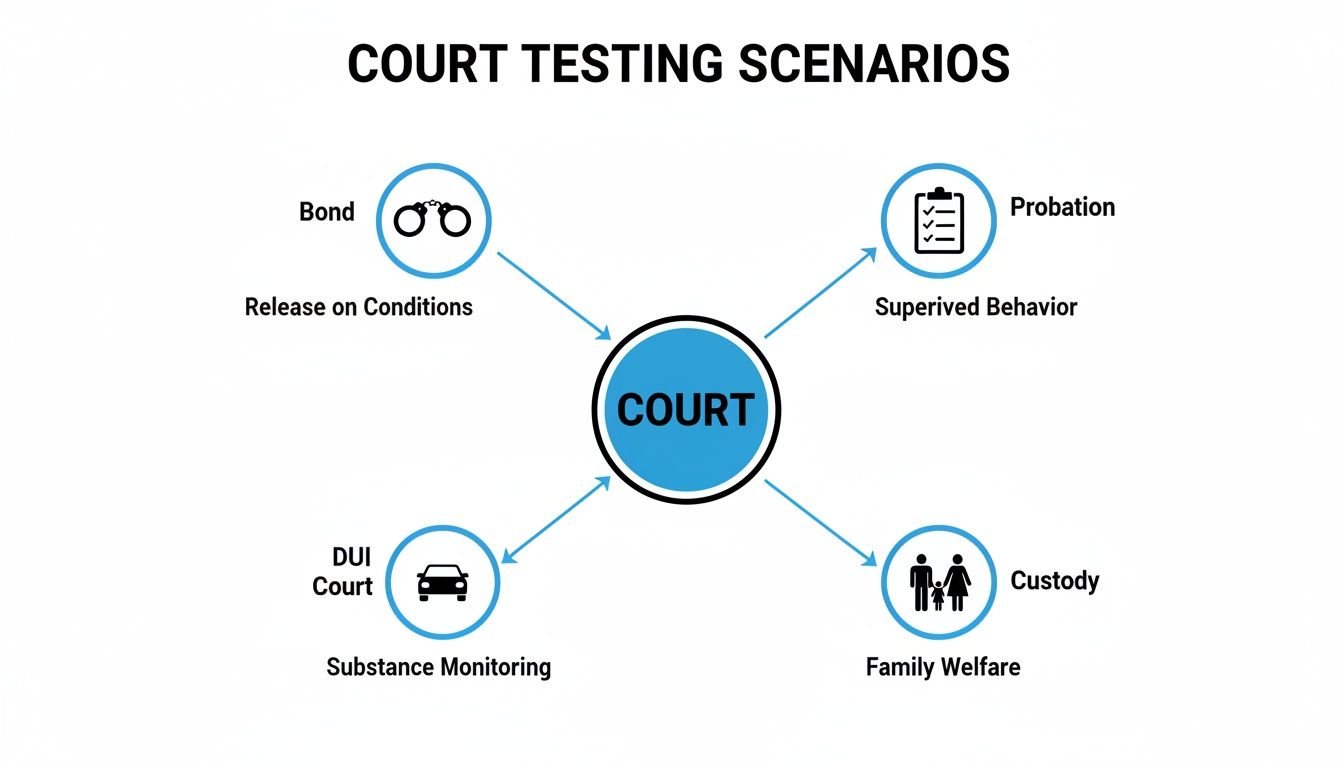
As you can see, the need for testing cuts across all sorts of proceedings. Each one has its own focus on accountability and public safety. Let's break down the most common methods a person is likely to run into.
Urinalysis: The Go-To for Routine Screening
The most common drug test ordered by courts from Marietta to Johns Creek is the good old urine test, or urinalysis. Why? It’s relatively inexpensive, not too invasive, and gives back results pretty quickly. This makes it the perfect tool for routine probation checks and the random screenings often required for people out on bond.
A urine test doesn't look for the drug itself but for its metabolites—the leftovers the body creates after processing a substance. This is a critical point: it shows recent use, but it doesn't prove someone is impaired at the exact moment of the test. The detection window varies a lot depending on the drug, how often someone uses it, and their own metabolism.
For example, a urine test can typically spot substances like cocaine or heroin for a few days after use. But for a regular marijuana user, THC metabolites can hang around and stay detectable for 30 days or more. That creates a much longer look-back period that can really complicate things.
Hair Follicle Tests: The Long-Term Record
When a court needs to see the big picture of someone's drug use history, the hair follicle test is the gold standard. This method is often seen in high-stakes situations, like a heated child custody battle in East Cobb or for someone in a long-term sobriety program who needs to prove they've stayed clean.
As hair grows, it traps drug metabolites from the bloodstream, creating a timeline of use. A standard test uses a small sample of hair from the scalp to look back approximately 90 days. It's nearly impossible to hide a pattern of use from a hair test, which is why it's such a powerful tool for judges making decisions that require a deep understanding of a person’s behavior over time.
Blood and Saliva Tests: Pinpointing Recent Use
Unlike urine or hair tests that show past use, blood and saliva tests are all about the here and now. They are designed to detect active impairment or very, very recent substance use.
-
Blood Tests: These are the most accurate but also the most invasive. A blood test measures the actual drug in the system, not just the byproducts. This is why law enforcement prefers it to confirm intoxication right after a DUI arrest. The catch? Its detection window is incredibly short, often just a few hours to maybe a day or two.
-
Saliva (Oral Fluid) Tests: A lot less invasive than a blood test, saliva testing is becoming more common for roadside checks and other situations where immediate use is the main question. It can detect drugs used within the last 1-3 days and is great at identifying substances shortly after they were consumed.
To make it clearer, here’s a quick comparison of how these common tests stack up.
Comparison of Common Court-Ordered Drug Tests
The table below breaks down the different testing methods, how long they can detect substances, and where you're most likely to see them used in the Georgia court system.
| Test Type | Detection Window | Commonly Used For |
|---|---|---|
| Urinalysis | 2-30+ days, depending on the substance and usage frequency. | Routine probation check-ins, bond conditions, pretrial supervision, and random screening. |
| Hair Follicle | Approximately 90 days. | Child custody cases, long-term sobriety monitoring, and situations requiring historical proof of abstinence. |
| Blood Test | A few hours to 2 days. | DUI investigations (to prove impairment at the time of arrest), post-accident testing. |
| Saliva Test | 1-3 days. | Roadside DUI screening, workplace testing, and situations where very recent use is suspected. |
Each test gives the court system a different lens to look through. By having these options, judges and probation officers can choose the right tool to monitor compliance and make informed decisions based on the specific facts of a case.
What Happens If You Fail or Refuse a Drug Test?
Let's be blunt: failing or refusing a court-ordered drug test is a serious mistake with immediate, negative consequences. Whether in a courthouse in Alpharetta, Marietta, or anywhere in between, refusing to provide a sample is almost never the right move. Why? Because courts don’t see a refusal as a neutral act. They see it as an admission of guilt—the equivalent of a failed test.
This means the judge isn't going to give the person the benefit of the doubt. Instead, they'll proceed as if the individual tested positive for a prohibited substance. That assumption kicks off a cascade of potential penalties that can completely upend a case.
Immediate Fallout You Can Expect
The court’s reaction to a failed or refused test is usually swift. The specific consequences depend on where someone is in the process, but none of them are minor. The judge's response will also be influenced by whether this is a first slip-up or part of a pattern of not following orders.
Here are some of the most common outcomes:
- Bond Gets Revoked: If someone is out on bond, a failed test gives the judge every reason to revoke it on the spot. The person could be taken into custody directly from the courtroom and sent right back to jail to wait for their case to be resolved.
- A Harsher Sentence: A positive drug test sends a clear signal to the judge: the court's orders aren't being taken seriously. This can poison their perception, leading to a much tougher sentence than might have been received otherwise.
- Probation Violations: For anyone on probation, a failed test is a clear-cut violation of their supervision terms. This will likely trigger a warrant for their arrest and a probation revocation hearing, where they could be ordered to serve out the rest of their original sentence behind bars. To understand just how severe this can be, read our guide on what happens when you violate probation.
These aren't just slaps on the wrist; they are designed to enforce the court’s authority and ensure compliance with its mandates.
Impact on Diversion and Treatment Programs
The stakes are even higher for someone in a specialized program like DUI Court or Drug Court in Forsyth or Cobb County. These accountability courts are built on a foundation of absolute sobriety and strict compliance. A failed drug test isn't just a minor error—it's a direct violation of the program's entire purpose.
A positive drug screen in an accountability court almost always results in immediate sanctions. That could mean more community service, tighter supervision, or even a few days in jail to get a person's attention. Repeated failures will get someone kicked out of the program, period.
Getting removed from a diversion program doesn't just put a person back at square one. It sends them back to the traditional court system to face the original charges, but this time without the chance for the program's more forgiving outcomes. They are now looking at a likely conviction and the maximum penalties the law allows.
In essence, failing a drug test throws away the second chance these programs offer. It tells the court that the rehabilitative path isn't working, leaving them with only one option: punishment. This is why it is absolutely critical to understand and follow every single court-mandated testing requirement from day one.
How a Criminal Defense Attorney Can Help Navigate Testing Requirements

Facing court-ordered drug testing can feel like walking a tightrope. One misstep, and the consequences can be severe. This is where a skilled criminal defense attorney can become an important ally, guiding an individual through the complex rules and fiercely protecting their rights.
A person shouldn't have to navigate this alone. An experienced lawyer first makes sure the individual understands every requirement—what they have to do, when, and why. That clarity is crucial, because a simple misunderstanding can easily be mistaken for a willful violation. Attorneys explain the specific terms of bond or probation so there are no surprises, especially when a person can get drug tested at court with very little notice.
Challenging Test Results and Procedures
A good attorney does more than just explain the rules; they scrutinize the entire testing process. If there's a positive result that the individual knows is wrong, a lawyer can dig in and investigate what happened.
Attorneys often question several key aspects of the test:
- Chain of Custody: Was the sample handled correctly from the moment of collection all the way to the lab? Any break in this chain can introduce doubt.
- Scientific Validity: Was the testing equipment calibrated properly? Were the lab’s procedures followed to the letter? Mistakes happen.
- Potential False Positives: Could a prescription medication or even certain foods have caused an inaccurate result? It's more common than you think.
By examining these details, an attorney can build a strong case to challenge a questionable result and protect someone from unfair consequences.
Having a professional advocate means someone is looking out for a person's best interests, ensuring procedures are fair and that their side of the story is heard. They work to hold the system accountable every step of the way.
Negotiating Alternatives and Seeking Favorable Outcomes
Perhaps the most critical role an attorney plays is in negotiation. A positive test doesn't automatically mean a person is going to jail. An experienced lawyer can open a line of communication with the prosecutor and the judge to argue for a second chance.
This might mean negotiating for entry into a treatment program instead of incarceration or advocating for less severe sanctions. Anyone trying to figure out how to find a good criminal lawyer needs someone with a proven track record in the local courts of Forsyth County, Alpharetta, and Marietta.
This proactive approach is essential. In the U.S., court-ordered drug screening is a huge part of the justice system, especially in the nearly 4,000 specialized treatment courts now operating. These programs have success rates averaging 60% and offer a real path away from harsh penalties. An attorney can help position a person to take advantage of these rehabilitative opportunities, turning a setback into a step toward a better future.
Court-Ordered Drug Testing: Answering Your Questions
It’s a common question: "Can the judge really make me take a drug test right there at the courthouse?"
The short answer is yes. Georgia judges have the authority to order drug and alcohol testing as a condition of bond or probation. It's a tool they use to manage risk and make sure the rules are being followed while a case is pending.
-
Can they test me on my court date? Absolutely. A judge can order a person to submit to a test immediately following a hearing, especially if testing is already part of their bond or probation conditions.
-
What if it's a false positive? This does happen. Initial screenings can sometimes show a false positive due to certain foods or prescription medications. If this happens, a person has the right to request a more accurate confirmation test, like a GC-MS test, to verify the results.
-
How long will the testing last? That’s entirely up to the judge. The order could last until the case is resolved, or it could continue for the entire length of a probation sentence.
-
What happens if I just don't show up for a test? Missing a scheduled test is treated the same as refusing one—and courts almost always consider a refusal to be an admission of a positive result. This will likely trigger a bond revocation or a probation violation warrant.
Local Courts Have Their Own Procedures
How testing is handled can vary from one courthouse to another. Courts in Forsyth County, East Cobb, and Cobb County might have slightly different protocols.
For example, judges in municipal courts like Alpharetta, Marietta, and Roswell will often specify exactly which labs must be used or provide a very rigid testing schedule.
The bottom line is that any individual must read every word of the judge's written order. If anything is unclear, asking an attorney immediately can help make sure a test isn't accidentally missed.
Pro Tip: Always get testing requirements in writing from the court. A clear, written order eliminates confusion and helps maintain compliance.
Refusing or missing a test is a serious misstep. The court will view it as a positive test, which often leads directly to a hearing to revoke bond or violate probation.
What to Do After a Test
If a person tests positive, the first thing they should do is call a criminal defense attorney in their area, whether that's Johns Creek, Milton, or Cumming.
An experienced lawyer can dig into the testing procedures, look for errors that could invalidate the result, and argue on a person's behalf for alternatives like treatment programs instead of jail time.
Key Things to Remember
- Yes, a judge can order someone to take a drug test as part of their bond or probation.
- False positives happen in about 3% of cases, but they can be challenged with a confirmation test.
- Local rules matter. Courts in places like Alpharetta, Roswell, and Marietta have specific requirements, so it's important to understand the written order.
If you're dealing with court-ordered testing, don't leave things to chance. Contact Brian Hansford Law to get clear guidance and protect your rights anywhere in North Georgia. https://challengemycharge.com
