
A routine stop in Roswell or Johns Creek can turn fast. An officer says you were weaving, asks you to step out, puts cuffs on you, and suddenly you're in the back of a patrol car trying to understand what just happened. By the time you're released, the practical questions hit all at once. Will this affect your license, your job, your security clearance, your family, your court date?
That reaction is normal. So is the next question: can you sue for false arrest?
Sometimes, yes. But not every arrest that feels unfair becomes a viable lawsuit. Charges being dropped later doesn't automatically mean the arrest was unlawful. The key issue is usually probable cause. If the officer had legal authority to arrest you based on the facts known at the time, a lawsuit is much harder. If the officer did not, you may have a real claim under federal law, Georgia law, or both.
For people dealing with DUI arrests, drug possession charges, reckless driving cases, theft allegations, or other criminal accusations in Alpharetta, Cumming, Milton, Roswell, Marietta, and across North Atlanta, speed matters. The criminal case has to be handled correctly. The civil claim has to be preserved early. And the evidence that proves what happened often disappears first.
Your Rights After an Unlawful Arrest
If you were arrested during a traffic stop and the whole thing felt disconnected from reality, start with this: you still have rights after the arrest. That includes the right to challenge the criminal case and, in the right circumstances, the right to pursue damages for false arrest.
A false arrest claim usually begins with one question. Did law enforcement have probable cause to arrest you when they made the decision to take your freedom away? If the answer is no, the arrest may have violated the Fourth Amendment and Georgia tort law.
That distinction matters because a bad arrest can do damage long before a case is dismissed. Since 1989, the National Registry of Exonerations has documented 3,696 exonerations, and those individuals lost an average of over 9 years behind bars, according to the National Registry summary collected here. False arrest cases don't always involve wrongful convictions, but that data shows how serious unlawful arrests can become when no one stops the case early.
What people usually get wrong
Many people assume, "If the prosecutor dropped my case, I can sue." That's not always true.
An arrest can still be legally supported even if the case later falls apart. Witnesses change their stories. Lab results don't come back as expected. Video clears the accused. A prosecutor decides the case can't be proven beyond a reasonable doubt. None of that automatically proves the arrest lacked probable cause at the start.
Practical rule: Focus first on what the officer knew, what the officer claimed to know, and what records exist to test that claim.
If you're also trying to understand whether police followed proper custodial procedures, this plain-English guide to Miranda rights in Georgia helps separate interview issues from arrest issues. They overlap, but they aren't the same claim.
For readers comparing civil case strategy more broadly, some of the same early evaluation principles show up in these insights for plaintiff personal injury firms. The overlap is practical: preserve evidence fast, identify weak documentation, and build the timeline before memories harden into polished reports.
Understanding the Legal Elements of a False Arrest Claim
A false arrest case works a lot like a four-part test. If one required part is missing, the claim usually fails.
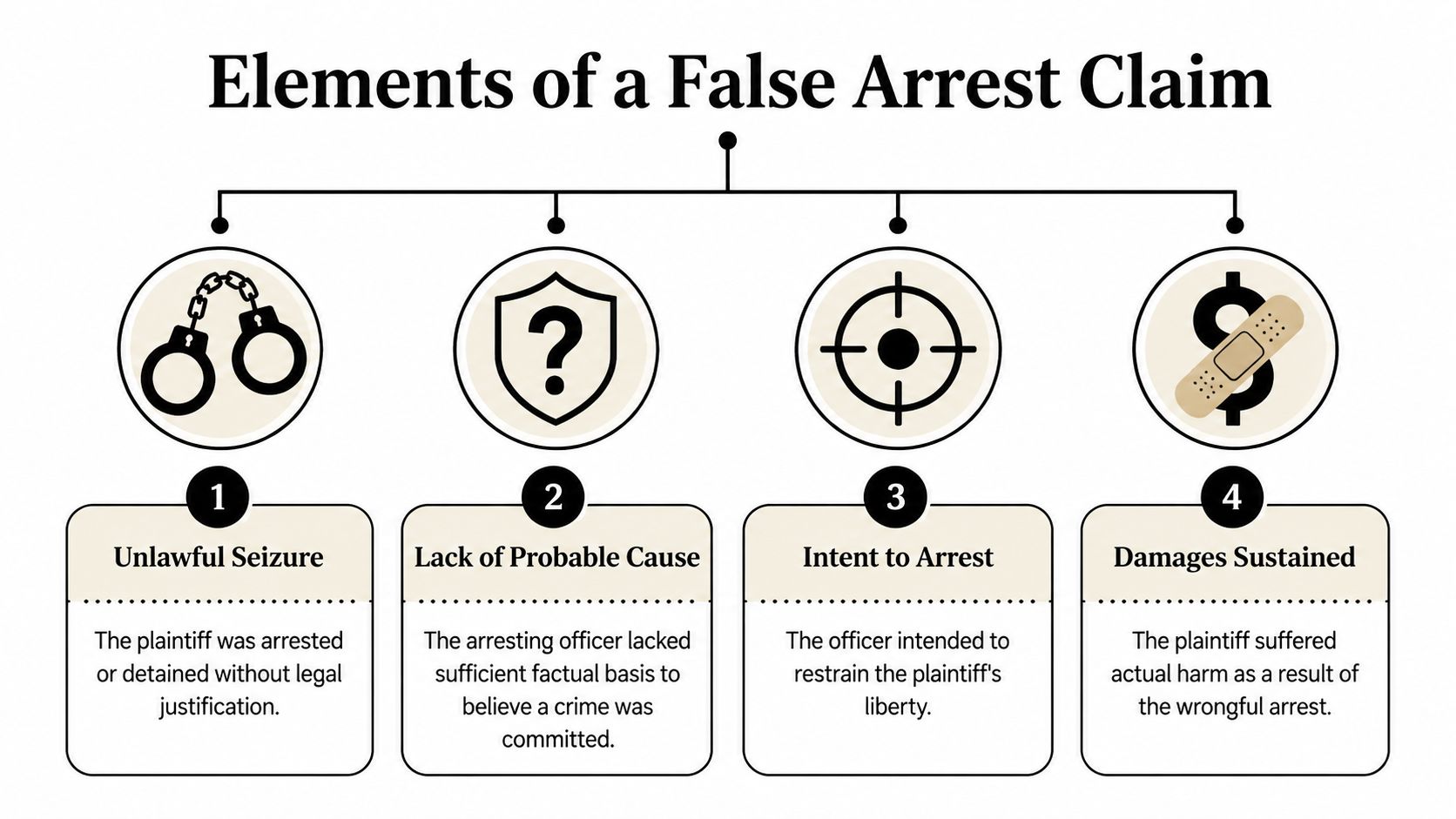
The four elements
To get a false arrest claim off the ground, the plaintiff generally has to show:
Intentional confinement
The officer or other defendant restrained you. An arrest is the clearest example, but a forced detention can qualify too.Awareness of the confinement
You knew you were not free to leave. If you were handcuffed, placed in a patrol car, booked into jail, or otherwise physically restrained, this element is usually straightforward.No consent
You didn't agree to the confinement. That sounds obvious in most arrests, but it's still part of the legal framework.No lawful authority Most cases are won or lost on this element. The arrest must have been unsupported by a valid warrant, probable cause, or other legal basis.
Why probable cause controls almost everything
Probable cause doesn't require proof beyond a reasonable doubt. It doesn't even require proof that a crime occurred. It requires enough facts for an officer to reasonably believe a crime was committed and that you committed it.
That is why false arrest cases are harder than many people expect. The officer's lawyer doesn't have to prove a perfect investigation. They only need to show the arrest was legally justified based on the information available at the time.
Still, the burden doesn't stay in one place. In a false arrest claim, once the plaintiff shows intentional confinement without consent, the burden shifts to the law enforcement defendant to affirmatively prove probable cause, as explained in Justia's discussion of false arrest and the burden of proof.
If the paperwork is thin, the bodycam is inconsistent, and the dispatch timeline doesn't match the report, probable cause starts to look less like a fact and more like a reconstruction.
A practical checklist for real cases
When I evaluate a potential false arrest claim, I don't start with abstract outrage. I start with the record.
Arrest report quality
Is it specific, or does it rely on vague phrases like "appeared suspicious" or "matched the description"?Witness support
Did any witness identify you, or did the officer fill in gaps later?Timeline problems
Was the decision to arrest made before the officer gathered the facts they now rely on?Video evidence
Do bodycam, dashcam, store surveillance, or phone video support the report or contradict it?Warrant issues
If there was a warrant, was it valid and properly based on sworn facts?
These cases are built from details. In DUI, traffic ticket, drug possession, misdemeanor, and felony defense work, the small gap often matters most. A few missing facts can be the difference between a lawful arrest and an unconstitutional seizure.
Federal vs Georgia Law for False Arrest Lawsuits
If you can sue for false arrest, the next issue is where and under what legal theory. In practice, the main options are a federal civil rights claim under 42 U.S.C. § 1983 and a Georgia state tort claim based on false arrest or false imprisonment principles.
The choice isn't academic. It affects who you can sue, what defenses you'll face, and how the case is litigated.
Side by side comparison
| Attribute | Federal Claim (42 U.S.C. § 1983) | Georgia State Tort Claim |
|---|---|---|
| Legal basis | Violation of federal constitutional rights, usually the Fourth Amendment | State tort law based on unlawful detention or arrest |
| Core question | Whether the officer violated a constitutional right by arresting without probable cause | Whether the detention occurred without lawful authority |
| Typical defendants | Individual officers, and in some cases municipalities under specific theories | Officers, agencies, municipalities, or private actors depending on facts and immunity rules |
| Major obstacle | Qualified immunity often dominates the case | Sovereign immunity, official immunity, and state procedural barriers can control |
| Proof focus | Constitutional violation plus causation and defendant-specific liability | Unlawful restraint and lack of legal authority under state law |
| Damages | Can include civil rights damages if liability is established | Can include tort-based damages if state law allows the claim to proceed |
| Procedural pressure point | Federal pleading standards and immunity motions early in the case | Notice rules, state immunities, and local procedural requirements |
What this means on the ground
For a person arrested in Fulton County, Cobb County, or Forsyth County, federal court can offer a powerful path because it directly addresses the constitutional issue. But it often invites an immediate qualified immunity fight. Officers will argue that even if they made a mistake, the law wasn't clearly established enough to make them personally liable.
A Georgia state claim can be useful too, especially where the facts support a straightforward unlawful detention theory or involve non-police actors such as store security. But state-law claims can trigger their own immunity problems and notice requirements, especially when a city or county is involved.
That's why the criminal case often becomes the first battlefield. If the arrest was unsupported, a defense lawyer may attack it through suppression practice before any civil filing happens. For readers dealing with the criminal side first, this overview of a motion to suppress evidence in Georgia explains how courts evaluate unlawful police conduct in the underlying case.
Strategy is rarely one-size-fits-all
Some people need to clear a DUI or drug charge first and preserve the civil case second. Others need both tracks reviewed at once because evidence in one proceeding affects the other.
A strong false arrest case usually begins as a strong records case. The law matters, but the timeline, the footage, and the officer's own words matter more.
If you're asking can you sue for false arrest after charges were dropped, after a reckless driving arrest, or after a mistaken identity arrest in North Atlanta, the right answer depends less on labels and more on the exact route law enforcement used to justify the seizure.
Common Defenses Police Use Against False Arrest Claims
The hardest part of these cases isn't outrage. It's the defense strategy waiting on the other side.

Police departments and their lawyers don't usually defend a false arrest case by saying, "Yes, we got it wrong." They defend by saying one of three things: the officer had probable cause, the officer reasonably believed he had probable cause, or the officer is immune even if the arrest was mistaken.
Qualified immunity
Qualified immunity is a defense often discussed but frequently misunderstood. In practical terms, it protects officers from many federal lawsuits unless the plaintiff can show the officer violated a clearly established right.
That standard is a major barrier. According to the verified data provided, qualified immunity remains a significant obstacle, and reported success rates in counties like Cobb and Forsyth have been under 5% in the past year, as discussed in this Avvo summary on suing for wrongful arrest.
What does that mean in plain English? It means the court may dismiss the case even when the arrest looks wrong if prior case law doesn't make the illegality sufficiently clear under similar facts.
The probable cause fallback
Even when the officer's report looks shaky, the defense often argues that some legal basis existed at the moment of arrest.
They may point to:
- Traffic-stop observations such as odor, driving behavior, or field interactions in a DUI arrest
- Witness statements that were later discredited but arguably supported the arrest at the time
- Dispatch information that led the officer to believe the suspect matched a description
- Possession-related facts in drug or theft cases, even if later testing or investigation changed the picture
This is why innocence and false arrest are not the same thing. You can be innocent and still lose a false arrest lawsuit if the court finds the officer had enough facts to arrest you at the time.
Good-faith and documentation defenses
Officers also benefit when records were created promptly and consistently. Even bad decisions can look more defensible when the paperwork appears polished and complete.
That's where experienced counsel matters. A lawyer challenging the arrest has to compare the arrest report against dispatch logs, booking entries, bodycam footage, CAD timelines, witness accounts, and any later testimony. Inconsistencies are often the key.
The question isn't whether the officer can tell a story. The question is whether the records support it from the first minute to the last.
A realistic lawyer should tell you this upfront. Some false arrest cases are strong on emotion and weak on proof. Others look ordinary until the video and timing records expose that probable cause was added after the fact.
What Compensation Can You Recover in a Lawsuit
When a false arrest case succeeds, compensation is supposed to address what the arrest cost you. That can include money you lost, harm that doesn't show up neatly on a receipt, and in the worst cases, punishment aimed at especially egregious conduct.

Economic losses
These are the most concrete damages.
A successful claim may seek compensation for lost wages, legal fees tied to the fallout from the arrest, and other direct financial harm. If the arrest caused you to miss work, lose a contract, spend money on bond-related costs, or incur defense expenses because of an arrest that should never have happened, those losses matter.
Human harm that doesn't come with a bill
False arrest damages also include injuries that are real but harder to quantify.
That usually means emotional distress, humiliation, reputational damage, and the loss of freedom itself. For many clients, this is the most serious part. A night in jail, public booking, family disruption, school consequences, and damage to your name can outlast the court date.
Some of the strongest damages evidence doesn't come from dramatic testimony. It comes from ordinary records. Missed work notices, school discipline files, therapy records, intake forms, and emails explaining why an employee was put on leave.
Punitive damages in the right case
Punitive damages aren't available in every case. They come into play when the conduct was especially malicious or outrageous.
The broader point is this: a lawsuit is not just about reimbursement. It's also about accountability. As noted in this discussion of damages available in false arrest lawsuits, successful claims can involve emotional distress, lost wages, reputational harm, legal fees, and in egregious cases punitive damages. The same source also stresses that strict deadlines and notice requirements can control the case before it really starts.
What affects case value
No honest lawyer should promise a number at the intake stage. Case value depends on liability, documentation, available defendants, immunity issues, and the quality of the damages proof.
A well-documented short detention can beat a poorly documented longer ordeal. A dismissed DUI in Alpharetta with strong bodycam contradictions may be more valuable than a more serious charge with weak evidence of unlawful arrest. Facts decide these cases.
Critical Steps to Take Immediately After a Wrongful Arrest
If you believe the arrest was unlawful, what you do in the next hours and days matters more than is commonly understood.
Georgia timing rules are unforgiving. To preserve a federal false arrest lawsuit, the verified data states that the statute of limitations for a §1983 claim is two years from the arrest date under O.C.G.A. § 9-3-33, and critical evidence such as bodycam footage may be deleted if it isn't requested promptly, as summarized in this discussion of Georgia false arrest deadlines and evidence preservation.
What to do in the first few days
Start with your own record before anyone else's version hardens.
Write the timeline immediately
Put down the stop location, time, officer names, badge numbers if known, what was said, when you were cuffed, who searched you, whether a witness was present, and when you were released. Use your phone notes app, email yourself, or handwrite it. Do it now, not next week.Preserve every document
Keep bond paperwork, citations, towing paperwork, property receipts, booking records, court notices, and discharge papers. Screenshot texts from family or coworkers that show the practical fallout.Save physical evidence
Photograph injuries, torn clothing, vehicle damage, or anything showing force or the conditions of the stop.
Protect evidence before it disappears
People often make avoidable mistakes.
Identify cameras early
Gas stations, apartment entrances, neighboring businesses, school zones, and doorbell cameras may have captured the stop.Get witness names while memories are fresh
A passenger, bystander, store clerk, or rideshare driver may remember details no report includes.Stay off social media
Don't post your version online. Don't argue with commenters. Don't upload the bodycam clip with editorial captions if your lawyer hasn't reviewed it.Request legal help fast
Delay is expensive in these cases because footage retention windows can be short.
"The evidence most likely to win your case is often the first evidence to disappear."
If you're still dealing with the criminal side and need a plain-language overview of the process, this guide on what happens after an arrest in Georgia is a useful place to start.
Don't sabotage the criminal case
This point gets overlooked. You can believe the arrest was unlawful and still hurt yourself by mishandling the criminal case.
Show up to court. Follow bond conditions. Don't contact alleged victims or witnesses if the case forbids it. Don't assume a civil claim will rescue a neglected defense. In many DUI, reckless driving, speeding ticket, drug possession, and misdemeanor cases, the criminal file creates the record the civil side later uses.
A disciplined response works better than an emotional one. Preserve evidence. Keep quiet publicly. Get legal advice early.
How a North Atlanta Defense Attorney Can Fight for You
A false arrest issue rarely stands alone. It usually arrives attached to a DUI charge, reckless driving case, speeding ticket, license suspension problem, drug arrest, theft allegation, or another criminal accusation that needs immediate defense.
That overlap is where an experienced North Atlanta criminal defense attorney adds real value. A lawyer with courtroom experience in Alpharetta, Roswell, Johns Creek, Milton, Cumming, Marietta, and the surrounding counties can evaluate two tracks at once. First, how to beat or reduce the criminal charge. Second, whether the arrest itself creates a viable civil claim.
A former prosecutor brings a useful perspective here. Prosecutors know what officers are trained to say, what gaps get patched in supplemental reports, and which weaknesses matter most at a suppression hearing or in early negotiations. That insight can be critical when reviewing bodycam footage, dispatch timelines, witness statements, and warrant materials for signs that probable cause never existed.
Local court knowledge matters too. False arrest litigation doesn't happen in a vacuum. The practical realities of Fulton County, Forsyth County, Cobb County, Cherokee County, and Gwinnett County can affect how quickly records are obtained, how police witnesses present, and how aggressively the criminal case should be challenged before any civil filing is made.
For someone searching for a DUI lawyer in Alpharetta, a reckless driving lawyer in Roswell, a traffic ticket attorney in Johns Creek, a drug possession lawyer in Cumming, or a misdemeanor defense attorney near me, the first priority is usually immediate protection. Keep the license. Protect the record. Avoid avoidable admissions. Preserve the evidence. Then decide whether can you sue for false arrest is the right second fight.
If you were arrested in Alpharetta, Cumming, Johns Creek, Milton, Roswell, Marietta, or anywhere in North Atlanta and need immediate help with the criminal case while preserving a possible false arrest claim, contact Brian Hansford Law for a free, confidential consultation. Brian Hansford is a former prosecutor with over 25 years of experience defending DUI, traffic, drug, misdemeanor, and felony cases in Georgia.
