
So, can you actually travel while you're on probation?
The short answer is yes, you often can. But—and this is a big one—you can never just pack a bag and go without getting explicit permission first.
Think of it this way: being on probation is like having a conditional hall pass instead of being stuck in the classroom. You've got more freedom than someone who is incarcerated, but your movements are still tracked and require a green light before you go anywhere.
The Basic Rules of Traveling on Probation
When a person is on probation, they are generally considered to be under a form of legal custody. Their location is a key part of their compliance. Even a quick drive from Alpharetta over to Marietta could technically be a violation if the sentence conditions limit them to a specific county. Understanding this is the first and most important step to making it through probation without any accidental slip-ups.
This isn't just a local Georgia rule; it's a standard across the country. A recent analysis of probation conditions in 55 different U.S. jurisdictions found that 57% of them flat-out forbid out-of-state travel without getting authorization ahead of time. This shows just how common and serious these travel restrictions are for the millions of people on community supervision. You can learn more about how different states handle these travel limitations and why they are so widespread.
Supervised vs. Unsupervised Probation
One of the biggest factors that will decide how much flexibility an individual has is the type of probation they're on. The rules for someone in Forsyth County on supervised probation are going to be completely different from someone on unsupervised probation over in Cobb County.
- Supervised Probation: This is what most people have. An individual is assigned a Probation Officer (PO) and must report to them on a regular basis. Any and all travel requests, especially for trips outside their county or the state of Georgia, have to go through the PO. They're the gatekeeper.
- Unsupervised Probation: This type is much less restrictive. An individual doesn't have a specific PO they need to check in with. While that usually means more freedom to travel within Georgia, one should never assume they can just leave the state without permission. The original court order is the final word, and it might still have specific rules against out-of-state travel.
At the end of the day, remember that probation is a privilege the court granted, not a right. Every single condition, including travel, is there to ensure accountability. Ignoring those boundaries can turn a simple vacation into a massive legal headache.
No matter where a person lives—Cumming, Roswell, or Johns Creek—the process always starts with one non-negotiable step: pull out the probation order and read it carefully. That document is the rulebook. It lays out all the "dos and don'ts" of the sentence and will state if permission is needed for in-state travel, out-of-state travel, or both. Before even thinking about making plans, that paperwork is the first thing to check.
Understanding Specific Probation Travel Restrictions
Probation isn't a one-size-fits-all sentence. Think of it less like a standard penalty and more like a custom agreement with the court. Just as every criminal case is unique, the travel restrictions that come with probation can be dramatically different from one person to the next.
One person’s probation order might let them travel freely anywhere in Georgia, while another person could be forbidden from leaving their home county without getting explicit permission first. This is why the first and most important step is to treat the sentencing documents as a personal rulebook. It lays out the exact boundaries one has to live within, and making assumptions is a gamble that can't be afforded.
Before even thinking about making plans, it is necessary to read—and re-read—the conditions of the sentence. That document is the final word on what can and can't be done.
Decoding the Language of Your Probation Order
Probation orders are legal documents, and sometimes the language can be a bit dense. But almost every order will have a section detailing the "special conditions" or "standard conditions" of supervision. This is where the rules about movement will be spelled out.
Keep an eye out for specific phrases that define the travel limits. One might see things like:
- "Do not leave the county of residence without permission." This is a very common one. A simple daily commute from a home in Alpharetta (Fulton County) to a job in Marietta (Cobb County) would require getting pre-approval from a probation officer.
- "Do not leave the State of Georgia without prior written permission." This clause generally means travel is allowed within the state, but crossing the state line for any reason is a violation unless there is formal permission in hand.
- "You are restricted to the Northern District of Georgia." Federal probation often uses judicial districts as boundaries, so knowing exactly where those lines are is critical to staying in compliance.
These aren't suggestions; they are legally binding commands from a judge. The seriousness of the original charge often dictates how strict these travel conditions are. For a closer look at this, one can learn more about the differences between felony and misdemeanor probation in Georgia, since that distinction plays a big role in the level of supervision and the restrictions one might face.
A probation order is like a contract signed with the court. Violating a travel clause is the same as breaking a key term of that contract, and it can land a person in serious trouble, no matter what their intentions were.
Real-World Scenarios and How Rules Apply
Let’s walk through a few practical examples to see how these rules play out for people living in the North Fulton and Cobb County areas.
Scenario 1: The Daily Commuter
An individual lives in Milton (Fulton County) but their job is in East Cobb (Cobb County). If their probation order says they can't leave their county of residence, that daily drive is a violation. They would have to work with their probation officer to get ongoing permission for work-related travel.
Scenario 2: The Family Emergency
An individual lives in Roswell and gets a call that a close family member in Alabama is critically ill. Even in a legitimate emergency, they can't just jump in the car and go if their order forbids out-of-state travel. The correct step is to contact their probation officer immediately, explain what’s happening, and be prepared to provide proof.
Scenario 3: The Weekend Getaway
Someone on probation in Cumming wants to visit friends in Savannah for the weekend. If their court order doesn't say anything about in-state travel, this might be okay. But if it requires them to report any overnight stays away from home, they would still need to notify their officer ahead of time.
Each of these situations drives home a crucial point: the specific probation order is the only guide that matters. What’s perfectly fine for one person can be a serious violation for another, which makes it absolutely essential to know the unique rules inside and out.
How to Properly Request Permission for Out-of-State Travel
Knowing it's possible to ask to travel on probation is one thing; understanding how to do it the right way is what may result in a "yes." The process is more than just asking nicely. It takes preparation, clear communication, and knowing who has the final say—the probation officer or the judge. Think of it like applying for a special pass; all the right information must be provided to the right person.
For anyone on probation in places like Johns Creek, Roswell, and the surrounding Atlanta metro, the first move is always figuring out who to ask. Does the probation officer have the authority, or is it necessary to go directly to the court? This single question determines the entire approach.
This decision tree breaks down the basic steps for figuring out travel rules, which always starts with the original probation order.
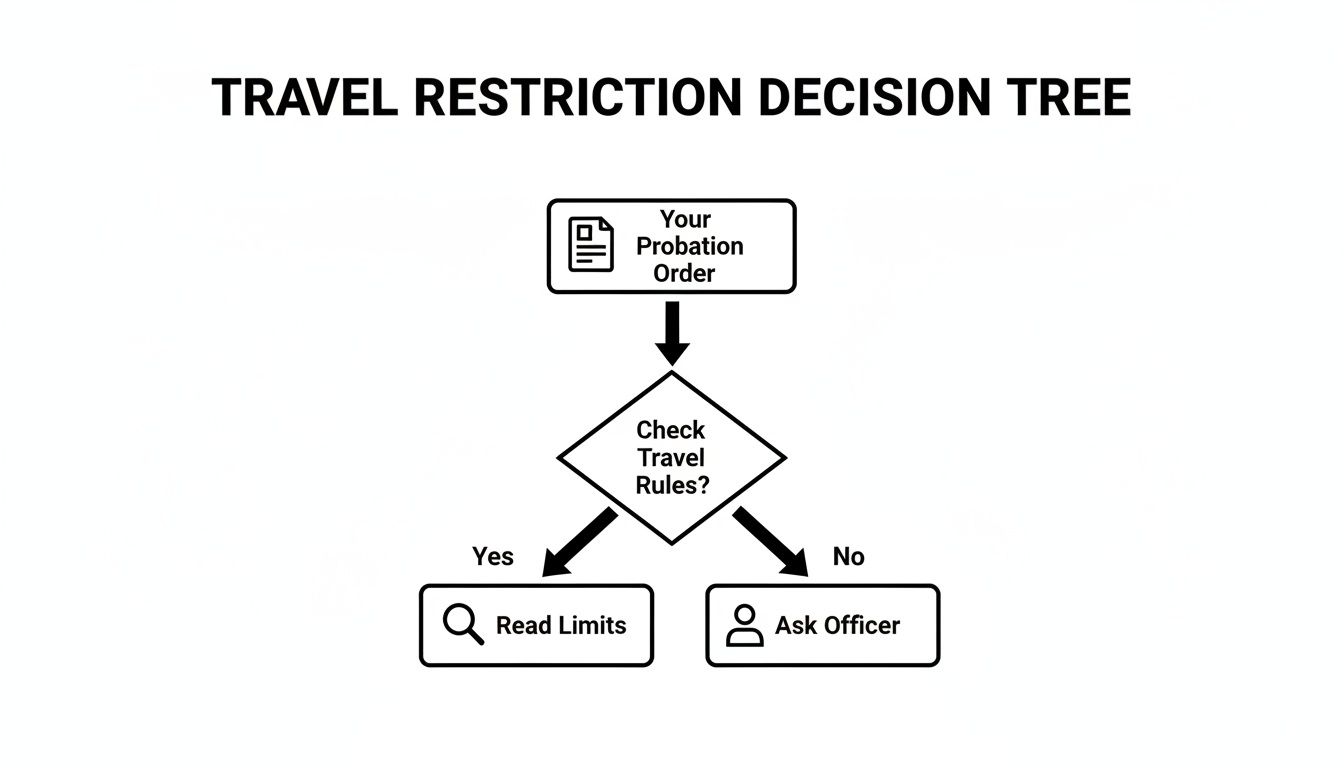
As the chart shows, the probation documents lay the groundwork, but the officer is the direct line for getting clarification and, hopefully, permission.
The Role of Your Probation Officer vs The Court
Most of the time, the probation officer (PO) is the gatekeeper for travel requests. For short trips with a clear, legitimate purpose—like a work trip or a family wedding—a PO can often grant permission on their own. Their authority isn't unlimited, however.
In certain cases, the decision has to go up the chain to the court. This usually happens when:
- The travel is for a long period of time.
- The trip is international (which is very rarely approved).
- The original sentencing paperwork explicitly states only a judge can approve travel.
- The probation officer says "no," and there is an interest in appealing their decision.
If court approval is needed, it means filing a formal legal motion. This is a much bigger step and requires putting together a strong, compelling case for the judge to review.
The Interstate Compact for Longer Stays
What if it's not just a quick trip? If there are plans to move to another state or stay for an extended time (usually over 45 consecutive days), a simple travel permit isn't going to work. This is where a system called the Interstate Compact for Adult Offender Supervision (ICAOS) comes into the picture.
Think of ICAOS as a formal transfer agreement between states. It’s the official process that allows Georgia to hand off supervision to another state, ensuring the individual remains monitored and compliant with their probation terms no matter where they live.
This process isn't fast. It involves an application, an investigation by the state one is moving to, and their official acceptance of the case. One absolutely cannot just move and then check in; the entire transfer must be approved before going.
The Pre-Request Checklist
Before even thinking about calling a PO, get the facts straight. Being prepared shows responsibility and that probation is being taken seriously. Frankly, it also makes it a lot easier for an officer to say yes.
Get this information together first:
- Exact Travel Dates: Be specific. When does the trip start, and when does it end?
- Destination Address: Provide the full street address of where the stay will be—not just the city and state.
- Reason for Travel: Explain why the travel is needed. Is it a family wedding, a required work conference, or a medical procedure? Be ready to show proof, like an invitation or a letter from an employer.
- Mode of Transportation: How will the travel occur? If flying, have the flight numbers ready.
- Contact Information: Give them a phone number where the individual can be reached while they're away.
Having this information ready from the start shows respect for the process and dramatically improves the chances of a quick, smooth approval. It turns a vague question into a concrete, well-defined plan they can actually work with.
The Serious Consequences of Traveling Without Permission
Ignoring the travel restrictions in a probation order isn't just bending the rules—it's a direct violation of a judge's command. Think of a probation sentence as a contract with the court. Deciding to travel without getting the green light is like tearing up a key part of that agreement, and the fallout can be severe enough to void the whole deal.

Even a quick, seemingly innocent trip across county lines—say, from Cumming in Forsyth County over to Marietta in Cobb County—counts as a technical violation if approval wasn't obtained first. That one bad decision can trigger a domino effect of legal troubles far more serious than the original charge.
The Immediate Legal Fallout
When a probation officer finds out that unpermitted travel has occurred, they don't just issue a warning. More often than not, they are required to report the violation directly to the court, which sets a number of serious outcomes in motion.
The first step is usually a bench warrant for arrest. This means any police officer can take the individual into custody at any time, whether it’s during a routine traffic stop or by showing up at their front door.
Once arrested, an individual will likely be held in jail without bond until a probation revocation hearing can be scheduled. This hearing isn't a new trial; the judge's only job is to decide whether the rules of probation were broken.
Long-Term Repercussions of a Violation
The damage from unauthorized travel goes well beyond the initial arrest. At a revocation hearing, a judge has a few options, and none of them are good. They can:
- Reinstate and Modify Probation: The judge could allow the probation to continue but add much stricter conditions, like more frequent drug tests, mandatory counseling, or even an ankle monitor.
- Extend the Probation Term: The original sentence could get longer, keeping the individual under court supervision for months or years beyond the original end date.
- Revoke Probation Entirely: This is the worst-case scenario. If probation is revoked, the judge can order the individual to serve the original jail or prison sentence that was suspended at the beginning of the case.
The court sees unauthorized travel as a serious breach of trust. A simple decision to take a trip can erase all the progress made, activating a suspended jail sentence and turning a probation misstep into significant time behind bars.
This isn’t some rare event. A national study by the Prison Policy Initiative found that over 1 in 10 people sent to state prison each year are there for breaking supervision rules, not for committing new crimes. That includes violations like leaving the county without permission. One can learn more about how common these rules are by reading the full report on prisonpolicy.org.
The High Stakes of a Seemingly Small Choice
The risks tied to unauthorized travel are just too high to ignore. A random traffic stop in another state, a phone call from a concerned family member, or even a tagged photo on social media can be all it takes to alert a probation officer. To understand the full legal process, take a look at our detailed guide on what happens when you violate probation.
Ultimately, following the rules is about protecting one's own freedom. No weekend getaway is worth risking a probation revocation and a potential jail sentence. The proper channels for requesting travel permission are there for a reason. Always choose the path of caution and clear communication.
Navigating International Travel While on Probation
If trying to travel across state lines on probation is a headache, going abroad is a whole other level of complicated. For most people under court supervision, international travel isn’t just difficult—it's usually flat-out prohibited by the sentence. The court’s main priority is keeping the individual accountable and within its reach, and a trip to another country is seen as a massive risk.
Even in those rare cases where a Georgia court signs off on an international trip, that’s just one hurdle cleared. A lot of people think a valid U.S. passport and a judge's permission are all they need. The truth is, the most important decision-maker in this equation isn't in Georgia at all; it's the immigration officer in the country one wants to visit.
The Destination Country Has the Final Say
Every country has its own set of rules about who gets to cross its borders, and a criminal record can easily make someone “inadmissible.” This means even with a plane ticket and a permission slip from a probation officer in Cumming or East Cobb, an individual could be turned away at customs and put on the next flight home. It’s a harsh reality that many people overlook.
Getting a judge's permission to travel abroad is like getting a hall pass from a teacher. It lets you leave the classroom, but it doesn't mean the principal at another school has to let you on their campus. The destination country always holds the final authority.
This isn't just a theoretical problem; it is known to happen. For instance, Canada will routinely deny entry to someone with a single U.S. DUI conviction. The United Kingdom might refuse entry if the sentence was for more than 12 months in prison, even if that sentence was suspended. On top of that, for certain offenses, U.S. federal law demands that travel plans be reported at least 21 days before departure, complete with a full itinerary. One can learn more about how different countries screen visitors, but the bottom line is, it’s a gamble.
Strict Federal Requirements for Specific Offenses
Beyond the rules set by other countries, specific U.S. federal laws create another layer of red tape for certain individuals. These aren't just guidelines—they are mandatory requirements with serious consequences if ignored.
For example, anyone required to register as a sex offender has strict notification duties before traveling internationally. They are required to report detailed travel plans to the U.S. Marshals Service well ahead of their trip. This isn't a simple heads-up; it includes:
- Complete Itinerary: A day-by-day breakdown of the entire trip.
- Country List: Every single country to be entered, even for a layover.
- Travel Details: Flight numbers, dates, and times for both departure and return.
- Overseas Contact Information: The addresses and phone numbers of where the stay will be.
Failing to follow these federal rules is a separate crime in itself, completely independent of any probation violation. It just goes to show that international travel while on probation is an extremely risky and complicated venture, rarely approved and almost always discouraged.
How a Criminal Defense Firm Can Help with Probation Issues
Trying to understand the dense, formal language of a probation order can feel like putting together a puzzle in the dark. The rules are often complicated, and a simple mistake can have serious consequences. This is where having an experienced criminal defense firm on one's side can make all the difference, whether located in Alpharetta, Milton, or anywhere in Forsyth County.
First and foremost, a lawyer can act as an interpreter. They can review the specific terms of probation, cut through the legal jargon, and provide a clear, straightforward explanation of the exact travel limitations. Just taking this one step can help avoid an accidental violation that puts freedom at risk.
Taking Formal Action When Necessary
Sometimes, getting permission to travel involves more than just a quick chat with a probation officer. If a PO denies the request, or if the trip itself requires a judge's approval, it will be necessary to file a formal motion with the court.
This is not a DIY project. An attorney can be essential for several reasons:
- Preparing a Compelling Motion: They know how to draft a formal request that clearly explains why travel is needed, includes all the necessary supporting documents, and makes a persuasive case to the judge.
- Court Representation: If the judge wants a hearing, a lawyer can be there to speak for the individual, answer any questions the court might have, and argue on their behalf.
- Addressing Probation Violations: If an individual is ever accused of traveling without permission, a lawyer can represent them at the revocation hearing. They can challenge the evidence and fight for a fair outcome.
Having a knowledgeable professional in one's corner ensures the request is presented correctly and that the individual is prepared for whatever comes next. Finding the right representation is a critical first move, and one can get more information on how to find a good criminal lawyer in our detailed guide.
Navigating the justice system isn't something one should have to do alone. A skilled criminal defense firm provides the clarity and support needed to handle complex probation issues, from securing travel permits in Cumming to defending against violation allegations in Cobb County.
Ultimately, a defense firm is an advocate. They make sure an individual's voice is heard and their rights are protected. They can manage the process so the focus can be on what really matters: successfully finishing probation and moving forward.
Common Questions About Probation and Travel
When on probation, the rules can feel like a maze, especially when it comes to something as simple as traveling. A lot of "what if" scenarios come up. Let's break down some of the most frequent questions people have while trying to navigate court supervision.
What If I Have a Family Emergency? Can I Travel?
Yes, in most cases, travel for a true family emergency is possible, but the key is how it's handled. It is absolutely necessary to contact the probation officer immediately. Do not leave first and plan to ask for forgiveness later. That's a surefire way to get a violation.
Probation officers are human. They can be understanding when a real crisis hits, and they often have the ability to expedite a travel pass for a verifiable emergency. Be ready to show proof, like a note from a hospital, a letter from a doctor, or contact information for a funeral home. Approval isn't guaranteed, but being upfront and honest right away is the best approach.
How Does Supervised vs. Unsupervised Probation Affect Travel?
The type of probation changes the game entirely. Supervised probation means there is a dedicated officer to report to. Any and all travel requests, especially for leaving the state, must go through them. No exceptions.
Unsupervised probation is a different story. It generally has far fewer restrictions, and it might not be necessary to get pre-approval for a quick trip within Georgia. However, one should never assume they have a free pass to leave the state. The original court order is the ultimate authority, and it can still have specific travel limitations, even if there isn't a supervising officer to check in with. Always go back and read the fine print of the sentence.
Does My Probation Officer Have to Say Yes to My Travel Request?
No, they don't. A probation officer has the discretion to deny a travel request for a number of reasons. They might say "no" if there is a history of not following the rules, if fines and fees are behind, or if they just aren't comfortable with the purpose of the trip.
If a probation officer denies a request, that isn't necessarily the end of options. The next move could be to petition the court directly by filing a formal motion. It’s a more involved legal process, but it’s a valid path forward if the travel is truly important.
How Far Ahead Should I Ask for Permission to Travel?
The more notice that can be given, the better. For any out-of-state travel, a good rule of thumb is to put in a request at least 30 days in advance. This gives the officer plenty of time to review the file, check compliance history, and get all the necessary paperwork handled without rushing.
Last-minute requests almost never go over well. They can be denied simply because there isn't enough time to process them. Planning ahead shows that probation is being taken seriously and the process is being respected, which goes a long way in getting a request approved.
Understanding the specific conditions of a sentence is crucial, but the process can feel overwhelming. If you have questions about probation terms or need help filing a court motion in Alpharetta, Cumming, Johns Creek, or the surrounding Forsyth and Cobb County areas, Brian Hansford Law is here to help. With over 25 years of experience, we can provide the clarity you need. Contact us to discuss your situation.
