
Getting your car insurance sorted out after a DUI can feel like navigating a minefield. It almost always means you’re looking at significantly higher premiums and a whole new set of rules from your insurer. Once you have a conviction in Georgia, you’re immediately flagged as a high-risk driver, which kicks off a series of financial and administrative headaches you'll need to handle to stay legally on the road.
The Financial Shockwave of a DUI on Your Insurance

A DUI conviction delivers an immediate and often jarring financial blow, and your auto insurance premium is where it hits hardest. Insurers across Georgia, from Roswell to Marietta, see a DUI as a major red flag. It tells them the risk they take to cover you has just gone way up. As a result, your rates are pretty much guaranteed to climb—dramatically.
The real shock often comes with that first insurance renewal notice after the conviction. Imagine you're driving home after a night out in Alpharetta, and blue lights flash in your rearview mirror. The initial charge is stressful enough, but the secondary financial fallout can linger for years.
National data shows a single DUI can cause the average auto insurance rate to skyrocket by 74%. That’s an extra $1,470 per year, on average, tacked onto your bill. For perspective, a speeding ticket might only cause a 21% bump, while an at-fault accident could lead to a 41% increase. A DUI is in a whole different league.
The table below breaks down what this looks like with some of Georgia’s common insurers.
Average Annual Car Insurance Cost Increases In Georgia After A DUI
The numbers don't lie. A DUI conviction fundamentally changes how insurance companies calculate your risk, and your premiums will reflect that. This table illustrates just how steep the increase can be for a driver with full coverage.
| Scenario | Average Annual Premium | Insurer Example (Post-DUI Annual Premium) | Percentage Increase |
|---|---|---|---|
| Driver with Clean Record | $2,000 | N/A | 0% |
| Driver After One DUI | $3,470 | Progressive: $2,875 | 44% |
| Driver After One DUI | $3,470 | Allstate: $3,650 | 83% |
| Driver After One DUI | $3,470 | GEICO: $4,200 | 110% |
As you can see, the exact increase varies, but it’s always substantial. Some carriers are more forgiving than others, which is why shopping around becomes so critical after a conviction.
Why Do Rates Jump So Much?
Insurance companies are all about assessing risk. A clean driving record suggests you’re a low-risk driver, which earns you lower premiums and those "safe driver" discounts. A DUI completely flips that script.
Insurers now see a driver with a documented history of high-risk behavior. Statistically, that means you're more likely to be involved in future accidents and file claims. This new risk profile affects your policy in a few ways:
- Loss of Discounts: Kiss those "good driver" or "claims-free" discounts goodbye. They’re usually the first things to go.
- Surcharges Applied: A hefty surcharge, directly linked to the DUI offense, will be added to your base premium.
- Reassignment to a High-Risk Pool: Some standard insurance carriers might even drop your policy at renewal. This forces you to find coverage from companies that specialize in high-risk or "non-standard" insurance, which always comes with a higher price tag.
The financial consequences go far beyond court fines. The long-term spike in insurance premiums is one of the most significant and lasting economic impacts of a DUI conviction, affecting your budget for years.
What is an SR-22 Certificate?
On top of the premium hikes, you'll likely have to deal with an SR-22 certificate. It’s not an insurance policy itself. Instead, it’s a document your insurer files with the Georgia Department of Driver Services (DDS) to prove you're carrying the state's minimum required liability coverage.
The state requires an SR-22 for drivers whose licenses have been suspended or revoked for serious offenses like a DUI. It’s basically the state's way of keeping an eye on you to make sure you stay insured.
If your policy lapses for any reason—even a missed payment—your insurance company is generally required to notify the state. This will almost certainly trigger another license suspension. Keeping that SR-22 active is a non-negotiable step toward getting your license back and staying compliant. These are just some of the less-obvious drunk driving consequences that create administrative hurdles, setting the stage for the practical steps you'll need to take to get back on the road.
Understanding the SR-22 Filing Process in Georgia

For most drivers in Forsyth or Cobb County, the term "SR-22" is completely foreign. That is, until a DUI makes it an unavoidable reality. It’s critical to understand that an SR-22 is not a type of insurance policy.
Think of it as a certificate of financial responsibility. Your insurance company files this document directly with the Georgia Department of Driver Services (DDS). Its only purpose is to prove you're carrying the minimum liability car insurance required by state law. It’s basically a monitoring system, ensuring you stay insured after being labeled a high-risk driver.
The SR-22 requirement almost always follows a license suspension from a serious offense like a DUI. If your policy lapses for any reason—even just a late payment—your insurer has to immediately tell the DDS. That notification, an SR-26 filing, will almost certainly get your license suspended all over again.
How to Get an SR-22 Filed in Georgia
Navigating this process for the first time can feel like a maze, but it’s a structured procedure. Your first move is to contact your current auto insurance provider. You’ll have to let them know about your conviction and your new SR-22 requirement.
Be prepared: not all insurance companies will file an SR-22. Some carriers will simply refuse to cover a driver with a recent DUI and will cancel or non-renew your policy. If that happens, your job is to find a new insurer specializing in high-risk or "non-standard" policies. These companies are used to working with drivers in your exact situation.
Once you find a willing provider, they do the heavy lifting. The process usually involves:
- Paying a one-time filing fee: This isn't the expensive part. The fee is usually small, often just $15 to $50, paid directly to your insurer.
- Purchasing a qualifying policy: You must have an active policy that meets Georgia's minimum liability standards.
- Filing with the DDS: Your insurer submits the SR-22 form to the state, confirming your coverage is active.
Georgia's Minimum Liability Coverage Requirements
To comply with the SR-22 mandate, your insurance policy has to meet or exceed Georgia's minimum liability limits. These are the absolute bare-bones amounts of coverage you can legally carry.
These minimums are often referred to as 25/50/25:
- $25,000 for bodily injury liability for one person.
- $50,000 for bodily injury liability for all people in a single accident.
- $25,000 for property damage liability for one accident.
Remember, these are just the minimums. While they satisfy the state's mandate, they might not be nearly enough to cover the costs if you're ever in a serious accident.
The real pain of an SR-22 isn't the small filing fee. It’s the substantially higher insurance premiums that come with being classified as a high-risk driver. Expect your rates to jump significantly once the DUI and SR-22 are on your record.
What if You Don't Own a Car?
A common question that arises is from people who got a DUI while driving someone else's car and don't own a vehicle themselves. Even without a car, the state will likely still require you to file an SR-22 to get your driving privileges back.
In this scenario, you'd get what’s called a non-owner SR-22 policy. This type of policy gives you liability coverage whenever you drive a borrowed or rented car. They're generally cheaper than a standard auto policy because they aren't tied to a specific vehicle.
You’ll typically need to maintain the SR-22 for three years from the date your license is eligible for reinstatement. It is absolutely vital to maintain continuous coverage for that entire period to avoid more trouble with the DDS and to finally work toward removing that high-risk label from your record.
Finding and Comparing High-Risk Insurance Policies
After a DUI, your relationship with insurance companies changes fundamentally. You're no longer shopping in the standard market; you've entered the world of high-risk, or "non-standard," insurance. This requires a completely new game plan for finding a policy that keeps you legally on the road without breaking the bank.
Your goal is to find an insurer who not only accepts drivers with a recent DUI but is also experienced with the SR-22 filing process in Georgia communities like Cumming and Johns Creek. Your current provider might offer to file an SR-22, but they may also jack your rates so high it's no longer a realistic option. In many cases, they’ll simply non-renew your policy, forcing you to look elsewhere anyway.
This is why you have to shop around. Don’t just take the first quote you get. It's important to gather multiple quotes from different companies to see what the market really looks like for your situation.
Where to Look for High-Risk Insurers
Finding companies willing to work with you is the first hurdle. The good news? Many insurers specialize in exactly this area. They understand the complexities of SR-22 filings and are set up to handle your situation.
Your search should include a mix of national carriers known for their high-risk policies and smaller, independent agencies that might offer more flexibility.
- National Non-Standard Carriers: Companies like The General, SafeAuto, and Progressive are well-known for providing coverage to drivers with DUIs or other serious violations. They have the process down pat for filing SR-22s.
- Independent Insurance Agents: An independent agent can be a great resource in this process. They work with multiple insurance companies and can do the comparison shopping for you, saving you a ton of time and hassle. They often have relationships with carriers who are more forgiving of a DUI on your record.
Get organized from the start. A simple spreadsheet to track the companies you contact, the quotes you receive, and any important policy details will make your life a lot easier.
Asking the Right Questions
When you start talking to potential insurers, the price is important, but it's not everything. You're looking for a reliable partner for the next few years. Be upfront and honest about your DUI—they’re going to see your driving record anyway.
Here are the critical questions to ask:
- Do you file SR-22 certificates in Georgia? This is a deal-breaker. If they don’t, move on.
- What’s the one-time fee for filing the SR-22? It's usually a small administrative cost, typically $25 to $50, but it’s always good to confirm.
- What are the exact premium costs? Ask for a breakdown for monthly, semi-annual, and annual payment plans. Sometimes paying in full upfront can save you a little cash.
- Are there any discounts I can still qualify for? Forget the safe driver discounts for now. But you might still get a break for things like vehicle safety features, bundling with renters insurance, or completing a defensive driving course.
- What happens if a payment is late? You need to know their grace period. A lapsed policy means your insurer is required to file an SR-26 form, which cancels your SR-22 and triggers another license suspension. This is a headache you absolutely want to avoid.
Finding car insurance after a DUI isn't about getting the cheapest rate—it's about finding the best value. A slightly more expensive policy from a reliable company with good customer service can save you from a world of trouble down the road.
Evaluating Policies Beyond the Price Tag
Just grabbing the lowest premium is a classic mistake. It is important to look at what you’re actually getting for your money. Drunk driving statistics are a sobering reminder of why insurers take DUIs so seriously. According to the NHTSA, alcohol-impaired crashes contribute to nearly 10,000 deaths annually in the U.S., which is about 28% of all traffic fatalities. This is the risk they see, and it’s why average premiums can jump by over 80% nationally after a DUI. Some insurers will even increase rates by as much as 145%. You can learn more about how a DUI impacts car insurance rates and see detailed data breakdowns.
When you're comparing quotes, look at the whole package:
- Coverage Limits: Does the policy only offer Georgia’s state minimums (25/50/25), or can you purchase higher limits for better protection?
- Customer Service Reputation: Check online reviews. How does the company handle claims? Are they responsive and easy to get ahold of?
- Payment Flexibility: Do they have different payment schedules that fit your budget? Is their online payment system easy to use?
Making a smart, informed decision right now will help you navigate the next few years with confidence. It ensures you stay legally insured while you work on rebuilding your driving record and putting this behind you.
Proven Strategies to Lower Your Insurance Premiums
Let's be direct: your car insurance premium is going to be painfully high after a DUI. There's no way around that initial shock. But it doesn't have to be a permanent financial nightmare. You actually have more control than you might realize.
While there’s no magic wand to make those high rates disappear overnight, you can start taking specific, proactive steps to bring them down. This is a gradual process of rebuilding trust with insurers, and it starts now. The small, strategic moves you make today can lead to significant savings over the three to five years a DUI typically stays on your insurance record.
Take Proactive Educational Courses
One of the first things you can do to show insurers you’re serious is to enroll in a state-approved educational course. In Georgia, completing a DUI Alcohol or Drug Use Risk Reduction Program (often called DUI School) is usually a mandatory part of the process anyway.
But don't stop there. Voluntarily completing a defensive driving course can also work in your favor. Insurers see this as a huge positive. It tells them you're actively working to become a safer, more responsible driver. Many companies will even offer a small discount for it, which helps chip away at that DUI surcharge.
Adjust Your Policy and Coverage
A close look at your policy documents can reveal some immediate ways to save money. You're required to maintain Georgia's minimum liability coverage for your SR-22, but other areas are more flexible. One of the simplest moves is to increase your deductible.
Your deductible is what you pay out-of-pocket for a collision or comprehensive claim before your insurance kicks in. Bumping it up from, say, $500 to $1,000 can lower your monthly premium. The key is to make sure you actually have that higher amount stashed away in an emergency fund, just in case.
It feels a bit counterintuitive to agree to pay more upfront, but a higher deductible shows the insurer you're willing to share more financial risk. This simple change can result in a noticeably lower payment.
Another powerful strategy? Bundle your policies. If your renters or homeowners insurance is with another company, get a quote to combine it with your auto policy. Insurance companies love multi-policy customers and often reward them with substantial discounts—sometimes up to 25%.
Long-Term Financial and Driving Habits
Beyond the policy itself, other factors play a big role in your rates. The most important one is simple: maintain a perfect driving record from this moment forward. Every single year you go without a ticket or an accident helps prove the DUI was an isolated mistake, not a pattern.
Something you might not expect to matter is your credit score. Insurers in Georgia often use a credit-based insurance score to predict risk. By paying your bills on time and managing your debt responsibly, you can slowly improve your credit score, which can eventually lead to better insurance rates.
Here's a breakdown of some of these strategies to help you decide where to focus your efforts.
Actionable Steps To Reduce High-Risk Insurance Costs
| Strategy | Potential Impact on Premium | Effort Level | Key Consideration |
|---|---|---|---|
| Complete Defensive Driving Course | Small to Moderate Discount | Low | Make sure the course is approved by your specific insurer to qualify for a discount. |
| Increase Your Deductible | Moderate Reduction | Low | You must have enough savings to comfortably cover the higher deductible if you file a claim. |
| Bundle Insurance Policies | Significant Discount | Medium | Requires getting quotes and potentially switching your other insurance policies. |
| Improve Credit Score | Gradual Reduction Over Time | High | This is a long-term strategy that requires consistent financial discipline. |
Taking these steps won't erase the DUI from your record, but it puts you back in control of your financial recovery. Each positive action you take helps chip away at the high cost of car insurance after a DUI.
The Long-Term Impact of a DUI on Your Insurance Rates
After a DUI conviction, one of the first questions people ask is, "How long will this follow me?" When it comes to your insurance, the answer is unfortunately measured in years. The immediate rate hike is just the first shock; the financial sting can last long after your court case is closed.
This extended pain comes down to the insurance company's "lookback period." This is simply the amount of time an insurer will dig into your driving history to set your premium. For a serious offense like a DUI, that window is typically three to five years.
During that entire period, you're squarely in the high-risk category, and your rates will absolutely reflect it.
A DUI doesn’t just disappear from your insurance company's memory. Nationwide, premiums jump by an average of 85% to 96% after a conviction, and they stay that high for the full lookback period. While a Georgia DUI might technically stay on your official driving record for a decade, insurers are most focused on the last three to five years. In the first couple of years, expect the maximum surcharges—often between 90-110%—which are directly tied to that SR-22 filing that locks in your high-risk status.
Navigating the Years After a Conviction
Your insurance journey post-DUI is predictable, even if it's frustrating. The first two years are almost always the most expensive. The conviction is fresh, the SR-22 is active, and to an insurer, you represent the highest possible risk.
From there, getting back to more affordable rates depends entirely on you.
- Years 1-2: Prepare to pay the highest premiums you've ever seen. Your main job is perfect compliance. That means maintaining your SR-22 without a single lapse and, most importantly, keeping a completely clean driving record. No tickets, no accidents, nothing.
- Years 3-5: As you start building a new history of safe driving, you'll slowly see some relief. Each year you go without an incident makes you a slightly better risk. Around the three-year mark, some insurers might begin to ease up on the surcharges. This is also when your mandatory SR-22 period often ends.
Once you’ve successfully completed the required term (usually three years in Georgia), you can finally start the process of getting rid of the SR-22. This is a huge milestone.
How to Finally Remove the SR-22 and Lower Your Rates
The SR-22 doesn't just fall off your policy on its own; action is needed. First, it is a good idea to confirm with the Georgia Department of Driver Services (DDS) that all state requirements have been met and you are eligible to have the filing removed.
Once the state gives the all-clear, you must call your insurance provider and tell them to remove the SR-22 from your policy. This is a crucial step. As long as that form is attached to your account, you're paying high-risk rates. Removing it is the signal to the insurance world that you've done your time.
This is your chance to get back to being a standard driver. With the SR-22 gone and a few years of clean driving behind you, you can finally shop for insurance on a much more level playing field.
The infographic below shows a few key strategies you can use to manage and lower your insurance costs while you wait out that lookback period.
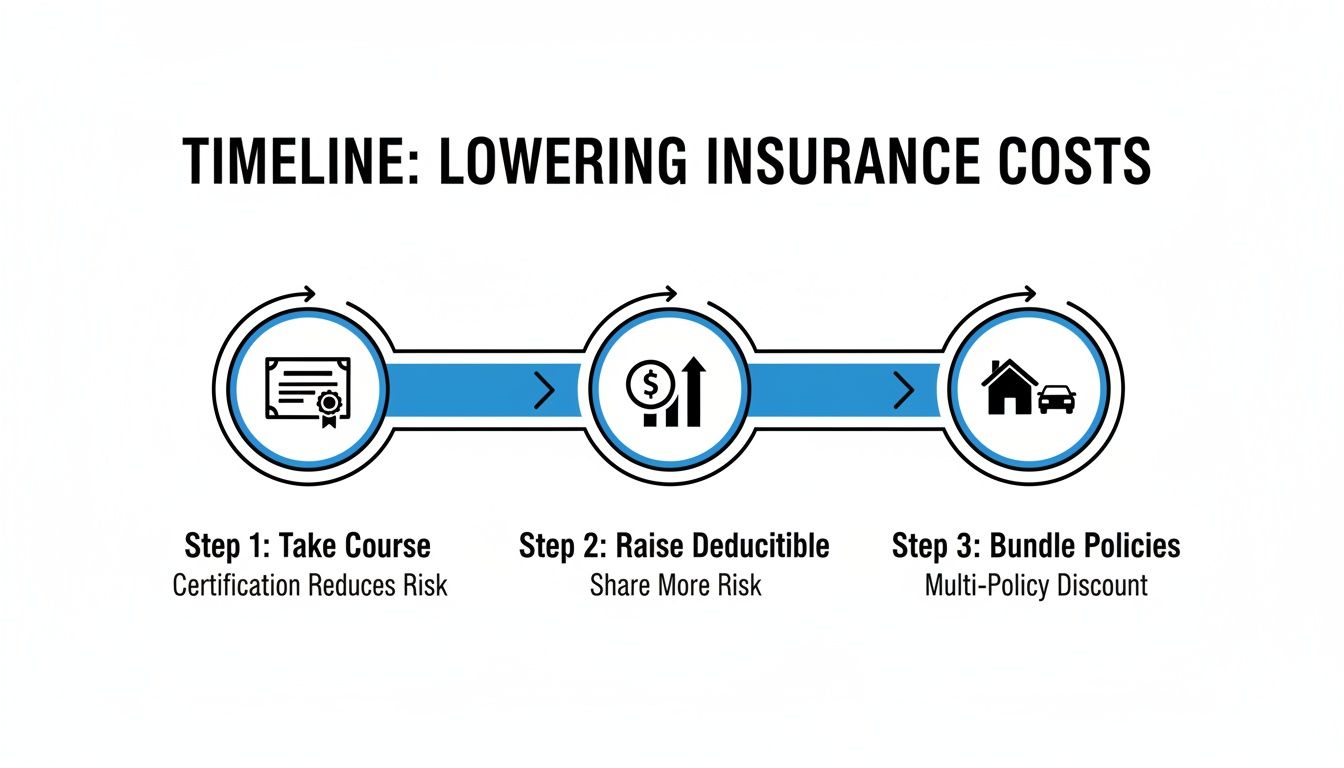
This timeline highlights proactive steps you can take, like completing approved courses or adjusting your policy details. It’s a good reminder that you still have some control over the financial damage. The question of does a DUI stay on your record forever has different answers for your criminal record versus your insurance history, and taking these steps helps you close the insurance chapter that much faster.
Answering Your Questions About DUI Car Insurance
Figuring out car insurance after a DUI conviction in Georgia can be confusing. It's a tough situation, and most people have the same kinds of questions about what to do, how to follow the rules, and how to manage insurance costs. Let's get straight to the answers for some of the most common questions we hear.
Getting these details right is key to getting back on the road legally and avoiding more headaches down the road.
Should I Tell My Insurance Company About My DUI?
This is a question on everyone's mind, and the simple answer is yes, you'll have to. You don't need to call them the day after your arrest, but the conviction will eventually appear on your driving record. Insurance companies pull these records at every renewal period, so they will find out.
More importantly, Georgia will likely require you to get an SR-22 certificate, and you can't do that without your insurer's help. Trying to hide a DUI just doesn't work. It often leads to your policy being canceled for non-disclosure when they discover the truth. It's always better to face it head-on and start figuring out your options right away.
What Happens If My Insurance Lapses While an SR-22 Is Required?
Letting your car insurance lapse when you have an active SR-22 requirement is a massive mistake. The second your coverage ends—even for one day because of a late payment—your insurance company is required by law to file an SR-26 form with the Georgia Department of Driver Services (DDS).
That SR-26 form immediately cancels your SR-22. The DDS gets notified instantly, which triggers an automatic suspension of your driver's license. To get it back, you'll be dealing with more fees, more paperwork, and you might even have to restart the entire SR-22 probation period from the beginning.
Keep your coverage continuous. No exceptions. A simple mistake like a missed payment can set you back to square one. Set up automatic payments with your bank or insurer to make sure this doesn't happen.
Can I Get Insurance If My License Is Already Suspended?
Yes, you can—and in fact, you must. Proving you have car insurance is one of the first things you have to do to get your license reinstated in Georgia after a DUI suspension. Insurance companies are very familiar with this process.
You'll have to buy a new policy and have the insurer file the SR-22 form with the DDS before they will even think about reinstating your driving privileges. If you don't own a car, you can get what's called a non-owner insurance policy. This gives you the liability coverage the state requires and allows the SR-22 to be filed, proving you meet Georgia's financial responsibility laws.
How Long After a DUI Will My Rates Go Down?
This is a waiting game, so you'll need some patience. Your rates aren't going to drop overnight. Insurers in Georgia will look back three to five years for a major violation like a DUI, and you'll be paying higher premiums that entire time.
The highest rates are almost always in the first two years after the conviction. If you keep your driving record completely clean from that point forward—no tickets, no accidents—you might see your rates start to slowly come down after the third year. Once the DUI is more than five years old, most insurers will stop factoring it into your premium, and you can get back to standard rates and good driver discounts.
Dealing with the aftermath of a DUI charge is about more than just insurance—it's about building a strong legal defense to protect your future. At Brian Hansford Law, we know what's at stake and fight to lessen the impact on your record, your license, and your life. If you're facing charges in Cumming, Alpharetta, or anywhere in the surrounding Georgia communities, call us for a consultation. Find out how we can help at https://challengemycharge.com.
