
When a person is charged with a felony, it can feel like the ground has vanished from beneath their feet. It's an incredibly serious accusation, one that carries the weight of potential prison time—more than a year, in fact. Those first few hours can be a blur of confusion and fear, leaving individuals and their families desperate for answers about what comes next.
What Happens in the First 24 Hours

The moments immediately following an arrest are absolutely critical. This short window of time, from the second a person is detained to their first court appearance, sets the stage for the entire case. Knowing what to expect can help cut through the stress and uncertainty.
It all starts with a trip to the local jail for booking. This isn't like what is often seen on TV; it's mostly administrative. Officials will record personal information, take belongings for safekeeping, and of course, take fingerprints and a mugshot.
The most important thing to understand during booking is the right to remain silent. Anything said can and will be used against a person in court. Staying quiet is not an admission of guilt—it's one of the most fundamental protections available.
The Initial Court Appearance
After a person has been booked, the next major step is the initial court appearance, which is often called a "first appearance" or "arraignment." This has to happen pretty quickly, usually within 24 to 72 hours of an arrest.
This hearing isn't a trial. No one is there to decide if a person is guilty or innocent. Instead, the judge has three main jobs:
- State the charges: The judge will formally read the charges and explain the individual's rights.
- Decide on bond: This is a major part of the hearing. The judge will determine if the person can be released from jail while the case is pending and, if so, under what conditions.
- Appoint a lawyer if needed: If an individual cannot afford to hire an attorney, the court will appoint a public defender to represent them.
Getting a handle on these early steps is crucial. For a deeper dive into the specifics, a person can review our detailed guide on what happens when someone is arrested.
Understanding the Bond Process
The judge's decision on bond is a pivotal moment. It’s not a random choice. The judge looks at several key factors: the seriousness of the charge, the individual's ties to the community (like a job or family), and any prior criminal history.
There are a few possible outcomes. A judge can deny bond altogether, set a specific cash amount, or grant an "O.R. bond" (own recognizance), which is basically a promise to show up for future court dates without having to post any money.
This initial phase is where many people get stuck in the system. National data from mid-2023 showed that local jail populations were around 664,800, and a huge percentage of those individuals were people held pretrial, simply waiting for their case to move forward. It highlights just how important that initial bond hearing really is.
Understanding Georgia's Felony Classes
When people hear the word "felony," it’s easy to paint all such crimes with the same broad brush. But the reality in Georgia is far more nuanced. Not all felonies are created equal, and the state has a specific system for classifying them.
Georgia law establishes a clear hierarchy for these offenses. They range from the most severe crimes, which can carry life sentences or even the death penalty, down to lower-level offenses with less harsh—but still life-altering—consequences. Understanding where a charge lands in this structure is one of the first steps in understanding the situation.
The important thing to remember is that a felony's classification is set by Georgia law. The potential penalties are not based on someone's opinion; they are defined directly in the state statutes.
How Georgia Classifies Felony Offenses
Unlike some states that use a straightforward "Class A, B, C" system for everything, Georgia's method is a bit different. Many felony offenses have their potential sentences written directly into the specific law that defines the crime.
For other felonies that don't have a sentence specified in their statute, the state provides a default classification. This means the landscape is quite varied. For example, trafficking a large amount of cocaine will have a completely different statutory penalty range than an aggravated assault charge.
If a person is facing a felony charge, the first piece of information to understand is the exact statute they are accused of violating. This is what indicates the official classification and, more importantly, the minimum and maximum penalties on the table.
Common Examples Across the Spectrum
To put this in perspective, let’s look at how different offenses are treated. The system is designed to punish crimes based on the level of harm they cause to people and the community.
Here’s a general breakdown of how offenses are often categorized:
- Most Serious Felonies: This category includes crimes like murder, armed robbery, and kidnapping. These carry the heaviest penalties, including life in prison or even the death penalty, reflecting their extreme gravity.
- Serious Felonies: This next tier includes offenses like aggravated assault, many drug trafficking crimes, and arson. While they may not automatically carry a life sentence, they involve the potential for a very long time in prison.
- Lower-Level Felonies: These charges are still incredibly serious but generally have lower sentencing ranges. Examples include theft of property over a certain value ($1,500), possession of certain controlled substances, or forgery.
It's also crucial to know that Georgia has tough laws for repeat offenders. Prior convictions can dramatically increase the potential sentence for a new felony, a practice often called recidivist sentencing.
For a clearer picture, the table below provides a simplified overview of Georgia's felony classifications.
Georgia Felony Classes and Potential Penalties
This table provides an informational overview of the different felony classifications in Georgia and their corresponding statutory sentencing ranges. This is for educational purposes only.
| Felony Class | Examples of Offenses | General Sentencing Range |
|---|---|---|
| Capital Felonies | Murder with aggravating circumstances | Life without parole or death penalty |
| Life Felonies | Armed Robbery, Kidnapping | Mandatory minimums, up to life in prison |
| Serious Felonies | Aggravated Assault, Drug Trafficking | 1 to 30+ years in prison |
| General Felonies | Grand Theft, Burglary, Forgery | 1 to 10 years or more, depending on specifics |
Again, this is a general guide. The specific facts of a case and a person's criminal history play a huge role in the ultimate outcome.
Navigating the Criminal Court Process
Once a person is officially charged with a felony, the legal system kicks off a formal, multi-stage journey. This process can feel painfully slow and confusing, but each step serves a very specific purpose in moving the case from an accusation toward some kind of resolution. Getting a handle on this roadmap is crucial for anyone facing the court system in Georgia.
After an initial appearance, the first major court date is usually the arraignment. This is a formal hearing where the accused stands before a judge and hears the official charges as outlined in the indictment or accusation. At this point, a plea is required—almost always "not guilty" at this stage, but "guilty" or "no contest" are also options.
The Preliminary Hearing Stage
Before a prosecutor can even take a case to a grand jury, many people are entitled to a preliminary hearing, which might also be called a probable cause hearing. This can be seen as an early, critical checkpoint.
During this hearing, the prosecutor has to present just enough evidence to convince a judge that there's probable cause to believe a crime was committed and that the accused was the one who committed it. It's not a trial to determine guilt. It's really just a screening process. If the judge finds enough probable cause, the case moves forward. If not, the charges could be dismissed right then and there, though the prosecutor might still try to get a grand jury indictment later.
The Role of the Grand Jury
In Georgia, for any felony case to proceed to trial, it typically has to be presented to a grand jury. This is a group of citizens who hear evidence only from the prosecution in a completely private session. Their job isn't to decide guilt but simply to determine if there's enough evidence to formally indict (charge) someone with a crime.
- A "True Bill" of Indictment: If the grand jury agrees there is sufficient evidence, they issue what's called a "true bill," and the case officially moves forward.
- A "No Bill": If they decide the evidence is weak, they return a "no bill," and the charges are usually dropped for good.
It's important to remember this process is entirely one-sided. Only the prosecutor presents evidence. The defendant and their attorney are not present and cannot challenge what is being said.
Uncovering the Facts in Discovery
After an indictment, the case finally enters the discovery phase. This is the information-gathering stage where the prosecution and defense exchange all the evidence they have. The prosecution is legally required to turn over everything—police reports, witness statements, body cam footage, lab results, and any physical evidence.
This exchange is the bedrock of a fair process. It lets the defense team see the strength (or weakness) of the prosecutor's case, spot potential constitutional violations, and start building a real strategy.
Discovery can be a long haul, often involving forensic analysis, tracking down and interviewing witnesses, and deep dives into legal research. Court delays, which have become far more common since the pandemic, can stretch this phase out even longer. People can learn more about how COVID-19 impacted the court systems and continues to create backlogs.
Pre-Trial Motions and Plea Negotiations
As the evidence comes to light during discovery, both sides may file pre-trial motions. These are formal requests asking a judge to rule on a specific legal issue before a trial ever begins. Common motions include asking the judge to suppress evidence that was illegally obtained or to dismiss charges entirely based on a lack of credible evidence.
At the same time, plea negotiations are almost always happening in the background. The hard reality is that a huge majority of felony cases are resolved through a plea agreement, not a dramatic courtroom trial. The system is simply overwhelmed with cases.
The infographic below shows the steps involved in the sentencing process, which is a critical part of both plea deals and trial outcomes.
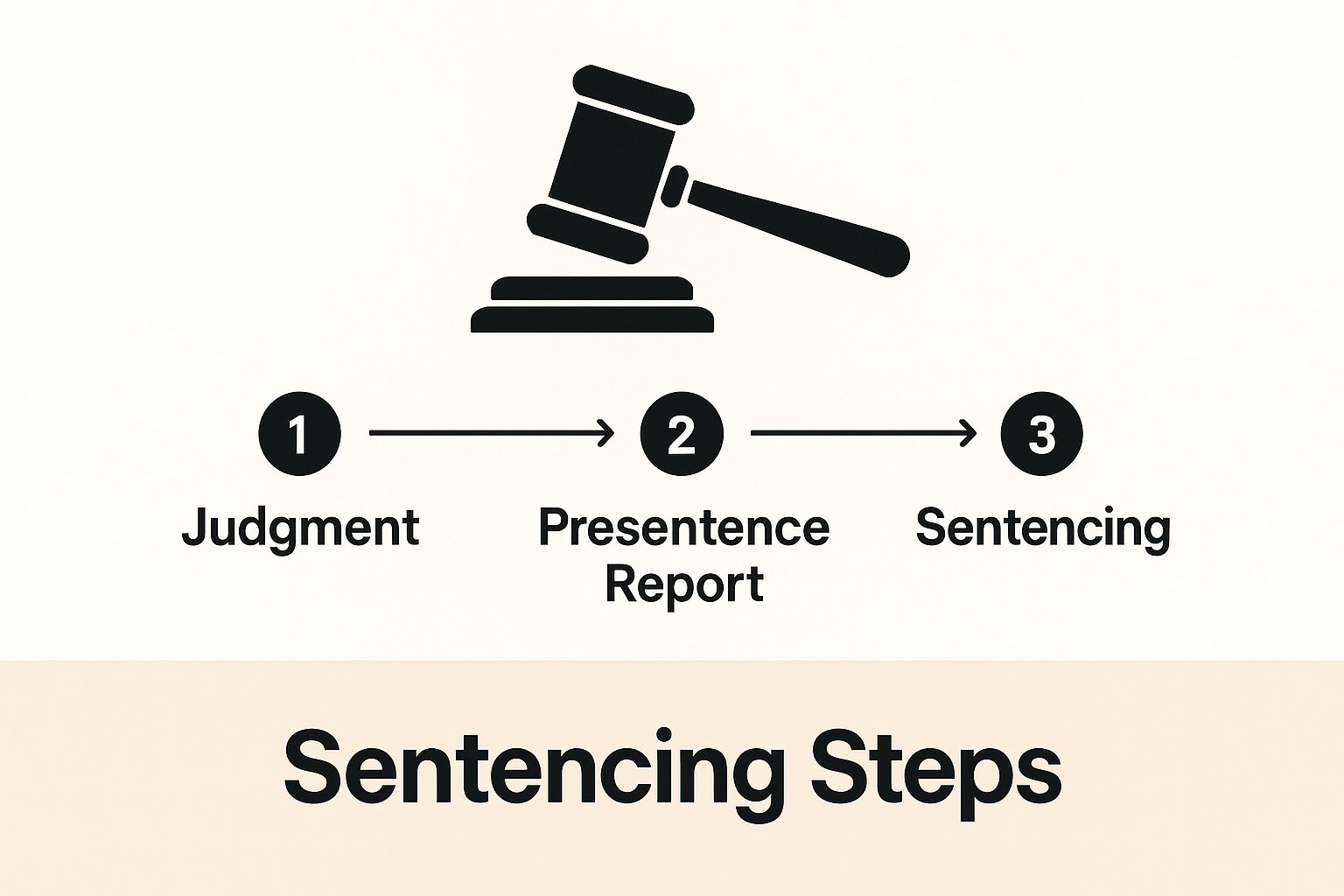
This visual breaks down how sentencing possibilities hang over every stage of the criminal court process, shaping decisions from the very beginning.
The sheer scale of the system is hard to comprehend. Over five million people are currently under some form of supervision by the criminal legal system in the United States, with nearly two million people incarcerated in prisons and jails. This is a massive increase from the early 1970s, largely driven by changes in sentencing laws. To truly grasp the numbers, one can discover more insights about mass incarceration trends. Each step in the process, from arraignment to a potential plea, is one small part of this incredibly complex system.
How Felony Cases Are Typically Resolved
Once someone is charged with a felony, there isn't one single path the case will follow. It can be thought of more like a road with several potential forks. Every case is unique, driven by its own specific facts, and how it ends up depends almost entirely on the strengths and weaknesses of the evidence.
To figure out the best path forward, a defense strategy often begins with a deep dive into the prosecutor's case. Every piece of it is scrutinized—from the initial police report and witness statements to any forensic evidence and body camera footage. The goal is to find inconsistencies, procedural errors, or constitutional rights violations that might have happened during the investigation or the arrest.
This isn't just about poking holes. It's about building a counter-narrative, a different version of events that can be supported with separate evidence or witnesses. The objective is to challenge the prosecution's story and create reasonable doubt.
Dismissal of Charges
One of the best-case scenarios is getting the charges dismissed entirely. While it's not the most common outcome, it does happen, and for good reasons. A dismissal means the case is over before it ever gets to a trial or plea deal.
So, how can charges be thrown out?
- Evidence Gets Suppressed: If a judge rules that key evidence was obtained illegally—maybe from an unlawful search or a coerced confession—it cannot be used in court. If that evidence was the cornerstone of the prosecution's case, they may have no choice but to drop it.
- Lack of Probable Cause: At a preliminary hearing, the judge might decide the prosecution simply has not shown enough evidence to establish probable cause that the accused committed the crime.
- Witness Problems: Sometimes, the prosecution’s key witnesses become unavailable. Other times, their credibility is so damaged during cross-examination that their testimony becomes worthless.
A dismissal is a full stop. It ends the case completely.
Resolution Through a Plea Agreement
The reality is that the vast majority of felony cases in Georgia—and everywhere else—are resolved through a plea agreement, often called a plea bargain. This is a negotiated deal between the defense and the prosecution where an individual agrees to plead guilty, but usually to a lesser charge or for a specific, agreed-upon sentence.
A plea agreement takes the uncertainty and high stress of a trial off the table. For the prosecutor, it's a guaranteed conviction. For the defendant, it provides a predictable and often much less severe outcome than what might be faced with a guilty verdict at trial.
For example, someone facing a serious felony might agree to plead guilty to a lower-level felony that carries a much shorter potential sentence. Or, they might plead to the original charge in exchange for the prosecutor recommending probation instead of prison time. It's important to remember, though, that the judge always has the final say on accepting any plea agreement.
The Path to a Trial
If the case isn't dismissed and a plea deal can't be reached, the final stop is a trial. This is where both sides present their cases in front of a judge or a jury, who will decide the outcome.
A trial is a very structured and formal process with several distinct stages:
- Jury Selection: A panel of citizens is chosen to hear the evidence and render a verdict.
- Opening Statements: Both sides give a roadmap of the evidence they plan to present.
- Presentation of Evidence: The prosecutor presents their case using witness testimony and physical evidence. The defense attorney gets to cross-examine every single one of their witnesses.
- Defense's Case: After the prosecution rests, the defense team has the chance to present its side, with its own witnesses and evidence (though it is not required to do so).
- Closing Arguments: Each side sums up their case and tries to persuade the jury.
- Jury Deliberation and Verdict: The jury goes into a private room to deliberate. They must reach a unanimous decision of "guilty" or "not guilty."
A trial is where the evidence is truly put to the test. The prosecutor has the massive burden of proving guilt beyond a reasonable doubt. If they can't meet that incredibly high standard, the jury must return a "not guilty" verdict. This is called an acquittal, and a person can never be tried for that same crime again.
The Long-Term Consequences of a Felony Charge
Being charged with a felony creates ripples that extend far beyond the courtroom, touching nearly every aspect of a person's life for years. Even if the case ends without a conviction, the public record of the charge itself can throw up significant hurdles.
The true weight of a felony charge isn’t just the potential sentence—it's the lasting shadow it casts on personal freedom, opportunities, and reputation.
These consequences don't wait for a conviction to kick in; they start the moment charges are filed. The stress can strain relationships with family and friends, and the social stigma is a heavy burden to carry. It's a challenging new reality that can shape a person's future in profound and often unexpected ways.
Professional and Financial Hurdles
One of the most immediate and damaging consequences of a felony record is its effect on a career. Many employers run background checks as a standard part of their hiring process. A felony charge, especially a conviction, can automatically disqualify a person from entire industries.
- Licensing Restrictions: Fields like healthcare, education, finance, and government often have strict rules that bar individuals with felony records from getting professional licenses.
- Job Application Disclosures: Most applications require the disclosure of any felony convictions, putting applicants at an immediate disadvantage against others right out of the gate.
- Limited Career Paths: Even in fields without strict licensing, the competition for jobs is fierce. A felony record can easily become the deciding factor that closes a door.
Beyond finding a job, securing safe and stable housing becomes a major challenge. Landlords and property management companies frequently run background checks on potential tenants. A felony record is often grounds for an automatic denial, severely limiting housing options and sometimes forcing people into less desirable living situations.
It’s a domino effect. Without a steady job, paying rent is tough. Without a stable address, finding a job is even harder. This cycle can trap people in a state of financial instability that’s incredibly difficult to escape.
The Loss of Fundamental Civil Rights
In Georgia, like in most states, a felony conviction means losing certain fundamental rights that most citizens take for granted. This loss of civic participation can feel deeply alienating and serves as a constant, painful reminder of the conviction.
The right to vote is suspended while a person is serving their sentence, which includes any period of probation or parole. The right to own or possess a firearm is also permanently stripped away for anyone convicted of a felony. On top of that, serving on a jury is no longer an option, further disconnecting individuals from the civic process.
Broader Societal and Global Context
The challenges faced by those with felony records aren't isolated incidents—they're part of a much larger system. Globally, felony charges are closely linked to incarceration trends that reveal deep systemic issues. A recent report highlights persistent problems inside prisons, like overcrowding and poor healthcare, which directly affect those serving sentences for felony offenses. One can read the full report on global prison trends to get a better sense of the international scope of these issues.
This broader context shows that the consequences are not just personal but are embedded in societal structures. That's why understanding every part of the situation, from the initial charge to the potential long-term outcomes, is so critical.
For instance, successfully completing probation is a key step for many, and it's vital to grasp the conditions involved. Interested parties can learn more about the differences between felony and misdemeanor probation in our article for specific information on that topic. Understanding these details helps paint a much clearer picture of the road ahead when a person is facing a felony charge.
Common Questions About Georgia Felony Charges
When a person is first charged with a felony, it’s natural for a flood of questions to arise. The legal jargon is confusing, the process feels overwhelming, and the stakes are incredibly high. Getting clear, straightforward answers is the first step toward understanding the road ahead.
This section will tackle some of the most common questions people have when they find themselves in this situation. The goal here is to provide solid, general information so people can get a better handle on how the system actually works.
What Is the Difference Between a Felony and a Misdemeanor?
The simplest way to think about the difference between a felony and a misdemeanor in Georgia is to look at the potential punishment. A misdemeanor is a less serious crime, and a conviction usually means up to 12 months in a county jail and a fine that won't exceed $1,000.
A felony, on the other hand, is a much more serious offense. A conviction for a felony means facing a sentence of one year or more in a state prison. Beyond prison time, felonies carry heavy long-term consequences that misdemeanors just don't, like losing certain civil rights.
Can a Felony Charge Be Dropped or Reduced?
Absolutely. It's entirely possible for a felony charge to be dismissed by the prosecutor or knocked down to a lesser offense. This happens for all sorts of reasons as a case moves forward.
For instance, new evidence might emerge that pokes holes in the prosecution's story. Sometimes, procedural errors are found in how the arrest or investigation was handled. A prosecutor might also agree to reduce a felony to a misdemeanor as part of a plea deal. Every case is different, and the outcome always comes down to the unique facts, the evidence, and the legal arguments that are made.
The key thing to remember is that the initial charge is just the starting point. The legal process has many checkpoints where the strength of the state's case gets tested, which can lead to charges changing or getting dismissed long before a trial is ever on the horizon.
What Does a Grand Jury Indictment Mean?
In Georgia, for most felony cases to move forward to trial, they first have to go before a grand jury. This isn't a trial jury. It’s a group of citizens who meet privately to hear the evidence presented only by the prosecutor. Their job isn't to decide if a person is guilty or innocent.
The grand jury has one single task: to decide if there is enough probable cause to believe that a crime was committed and that the accused person is the one who likely did it.
- If they find there's enough evidence, they issue a "true bill" of indictment. This is the formal document that officially allows the case to proceed to trial.
- If they don't see enough evidence, they return a "no bill," and the charges are usually dropped right then and there.
This whole process is designed to be a check on the prosecutor's power, making sure a case has at least a basic level of evidence behind it before someone has to face a trial.
How Does First Offender Status Work in Georgia?
Georgia has a unique law called the First Offender Act, and it’s a big deal. It’s designed for certain people who have never been convicted of a felony before. It offers a path to complete a sentence without having an official conviction go on their permanent criminal record.
If a judge grants a person first offender status, they must successfully complete all the terms of their sentence—which could be probation or even prison time. If they do, the case is officially discharged. This can help a person avoid some of the worst long-term problems of a felony conviction, like major barriers to getting a job. But it's not automatic. It’s a one-time opportunity that a judge has to approve based on the case and the individual's background.
Navigating the complexities of a felony charge requires a deep understanding of the system. At Brian Hansford Law, we bring over 25 years of experience, including time as a former prosecutor, to protect your rights. If you or a loved one is facing a criminal charge in Georgia, contact us to see how we can help. Learn more by visiting https://challengemycharge.com.
Article created using Outrank
