
The call usually comes fast and with very little explanation. A school resource officer, a detective, or a juvenile intake officer tells you your son or daughter has been arrested. Then you hear the words that change everything: felony, Superior Court, adult charges, district attorney.
Most parents think juvenile court means counseling, supervision, and a chance to correct course. In some Georgia cases, that’s not what happens. A child can be pushed into a system built for punishment, public prosecution, and life-changing consequences. If you’re in Alpharetta, Roswell, Johns Creek, Milton, Cumming, Marietta, or anywhere in Fulton, Forsyth, or Cobb County, the first hours after that call matter.
Families often make the same early mistakes. They let the child explain the case to police. They assume the court will “see this was just a kid’s mistake.” They wait to learn whether adult court is really on the table. Waiting is dangerous in these cases. The transfer fight often starts before parents understand that a transfer fight exists.
Your Child's Future Is on the Line
A parent may start the day worrying about school, curfew, or a bad group of friends. By evening, that same parent is trying to understand whether a teenager will be handled in juvenile court or face the adult criminal system. The emotional shift is brutal. Fear turns into urgency because the consequences are immediate and long-term.

What parents usually face in the first day
The facts are often incomplete. Police may have a statement from another teenager, a social media screenshot, or a rushed accusation tied to a fight, robbery allegation, weapon allegation, or group incident. Parents are left trying to answer questions they aren't equipped to answer on their own.
The first legal issue isn't always guilt or innocence. It may be where the case will be heard and who gets to make that decision. That one issue can shape bond, procedure, exposure to punishment, and whether the child carries an adult record.
Practical rule: If law enforcement wants to talk, your child shouldn't try to “clear things up” alone. A teenager who thinks they're helping often gives the state the statement it uses to justify harsher treatment.
Why the stakes are so high
Charging juveniles as adults expanded sharply in the era shaped by the debunked superpredator myth. A later review noted that 32,359 people are serving sentences in adult prisons for crimes committed as youth, and that racial disparities remain severe, including Maryland data showing 80% of youth charged as adults between 2009 and 2024 were Black. That discussion appears in this report summary on automatic charging youth as adults.
For a parent, those numbers matter for one reason. They show this isn't a rare theoretical risk. Adult treatment of children has had lasting consequences across the country, and once a case starts moving in that direction, every decision becomes more consequential.
The good news is that many cases can still be fought intelligently. A transfer isn't always automatic. Prosecutors don't always see the full picture at the start. Judges don't always hear mitigation unless the defense presents it clearly and early.
Georgia's Three Paths to Adult Court for Juveniles
Parents need a clean framework. In Georgia, a juvenile case can reach adult court through three different routes. The route matters because it affects what the defense should challenge first, who has the power, and where strategic advantage lies.
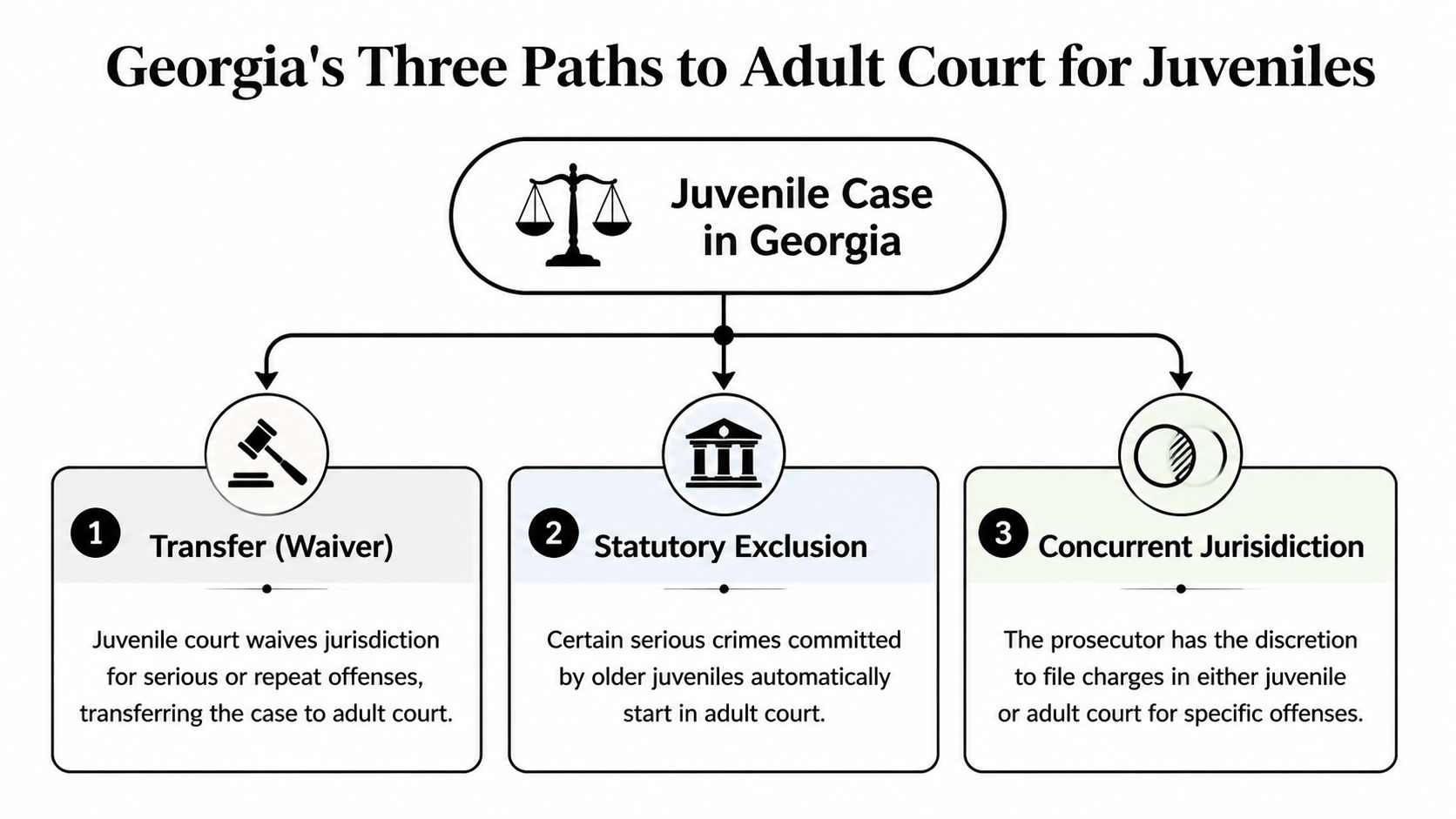
Transfer by a judge
This path is often called waiver or judicial transfer. The case starts in juvenile court, but the state asks the juvenile judge to give up jurisdiction so the child can be prosecuted as an adult.
The judge doesn't decide that question in a vacuum. The court may look at the seriousness of the allegation, prior history, and whether the child is seen as someone the juvenile system can still help. Such considerations highlight the importance of defense preparation. School records, counseling history, family support, treatment options, and a real plan for supervision can all become critical.
Automatic adult court for certain offenses
Some allegations place a child into adult court from the start under statutory exclusion. Parents usually experience this as a shock because there may be no hearing at the beginning where anyone asks what services, treatment, or structure the child needs.
That’s one reason these cases are so dangerous. The starting point is already adult court, which means the defense often has to work backward and look for ways to return the case to a more appropriate setting when the law allows.
Prosecutorial discretion
The third path is the one many families understand the least. In some situations, the prosecutor has meaningful power to decide whether to push the matter toward adult treatment. That decision can turn on local practice, office policy, and the individual attorney handling the file.
If you want a plain-English explanation of that power, this overview of prosecutorial discretion in criminal cases is a useful starting point.
A transfer case is never just about the charge on paper. It's about who controls the decision, when that decision gets made, and what information the decision-maker sees before momentum builds against the child.
Why local practice matters
Families often assume the law alone answers everything. It doesn't. In one county, a prosecutor may treat a teenage group offense as proof the child belongs in adult court. In another, the same facts may lead to a closer review of background, role, and amenability to treatment.
That local reality matters in North Atlanta. A family in Fulton County may face a different prosecutorial culture than a family in Forsyth or Cobb. The statute sets the frame. Human decision-makers shape the outcome inside it.
Juvenile vs Adult Court The Critical Differences
When parents ask why fighting transfer matters so much, the answer is simple. Juvenile court and adult criminal court are built for different purposes. One is more capable of dealing with adolescence, family instability, trauma, and rehabilitation. The other is designed to determine guilt and impose punishment under adult rules.
The systems are not interchangeable
Nationally, youth confinement has fallen dramatically. The Sentencing Project reports that the number of youth confined in all facilities has dropped by over 70% in the last 25 years, a shift tied to stronger recognition of adolescent development, and it notes that judges in juvenile court are trained to consider factors like childhood trauma and development when making transfer decisions in ways adult prosecution often does not in this policy brief on automatically charging youth as adults.
That point shows up in court every day. A juvenile judge is more likely to ask, “What happened to this child, and what intervention fits?” Adult court is more likely to ask, “What charge can the state prove, and what sentence applies?”
Side by side comparison
| Feature | Juvenile Court | Adult Criminal Court |
|---|---|---|
| Primary purpose | Rehabilitation, supervision, treatment | Punishment, conviction, sentencing |
| View of the child | Developing adolescent with capacity for change | Defendant charged under adult criminal rules |
| Decision focus | Family background, school, trauma, services, development | Evidence of guilt, offense level, sentencing exposure |
| Privacy | More protective than adult criminal proceedings | Adult cases are generally more public |
| Long-term record impact | Better opportunities to limit future damage in many cases | Greater risk of a lasting adult criminal record |
| Sentencing environment | Structured around youth-specific interventions | Exposure to adult penalties and adult correctional consequences |
Mental health often changes the defense
A teenager's impulsivity, unstable mood, or poor judgment may not be simple defiance. In some cases, the family has been seeing warning signs for years but hasn't had a diagnosis or effective treatment plan. When that history exists, the defense should develop it carefully and present it in a credible way.
For parents trying to understand how a serious mental health condition can look different in children than in adults, this expert resource on childhood bipolar can help frame the conversation before any psychological evaluation is arranged in the legal case.
A broader walkthrough of what happens in juvenile court in Georgia can also help families understand why keeping a case there is often worth fighting for aggressively.
The Lifelong Impact Penalties and Collateral Consequences
The immediate fear is jail or prison. The longer problem is what follows a young person after the case ends. An adult conviction can block ordinary milestones that most families take for granted.

A conviction doesn't end with the sentence
The Urban Institute notes that once a child is convicted in the adult system, the charge often remains on their record permanently, and that barriers to jobs and housing for young people with convictions can increase the risk of recidivism in this discussion of prosecuting young people as adults.
That means the case can keep resurfacing long after court supervision ends. Job applications ask about convictions. Landlords run background checks. Schools and licensing boards may ask questions that a juvenile adjudication would have handled differently.
The practical fallout families should expect
Some consequences emerge subtly. Others hit all at once.
- Employment barriers: Entry-level jobs, professional licenses, and background-screened positions may become harder to obtain.
- Housing obstacles: Private landlords and management companies often screen out applicants with criminal histories.
- Education disruption: College plans can be delayed or derailed while the family deals with court, detention, and record issues.
- Civil consequences: Depending on the conviction, rights and future legal status can be affected in ways a teenager won't appreciate at the time.
- Immigration exposure: For some families, the criminal case creates risks far beyond the sentence itself.
Parents should think about the future version of this case. What will this file look like when the child is applying for a job, an apartment, military service, or graduate school years from now?
Why early defense changes long-term outcomes
The defense isn't only trying to win at trial. It is trying to shape the charge, the forum, the record, and the future. Sometimes the best result is dismissal. Sometimes it is reduction. Sometimes it is keeping the matter in juvenile court so the child has a realistic chance to grow out of one terrible episode without carrying adult-system damage forever.
Building a Strong Defense in Forsyth and Fulton County Courts
Good juvenile defense starts before the state defines the child by the accusation. In transfer and adult-charge cases, the defense must build a competing narrative early, one grounded in facts, context, and credible mitigation.
What actually helps
A serious defense usually includes several tracks moving at the same time.
- Immediate silence and case control: Stop informal statements to police, school officials, and investigators. Loose explanations from a frightened teenager often become the backbone of the prosecution.
- Rapid record collection: Get school files, attendance records, discipline history, counseling records, and any prior evaluations quickly. Delay gives the state more time to frame the child as a finished product instead of a developing teenager.
- Family mapping: The court needs to know who is in the home, who can supervise, what structure exists, and what support can be put in place now.
- Role analysis: In group offenses, teenagers don't always play the same role. One planned it. One followed. One showed up late. One panicked. Sorting that out matters.
- Treatment planning: Judges are more receptive when the defense offers a real plan, not vague promises that the family will “handle it.”
Brain science is not a slogan
In transfer fights, adolescent development evidence can be powerful when presented correctly. Verified legal commentary on juvenile transfer strategy notes that effective defense in Georgia can include reverse waiver motions and challenges to direct-file style decisions using expert testimony on adolescent brain science, including evidence about impulse control deficits and maturity issues, as discussed in this overview of juveniles charged as adults and defense strategy.
That doesn't mean every teenager gets excused because of age. It means age matters to judgment, foresight, susceptibility to peer influence, and the ability to weigh consequences under stress. Courts need that evidence tied to the actual child, not delivered as a generic lecture.
The county matters more than families expect
The same police report can land differently depending on where it is prosecuted. Fulton County cases can involve a very different courtroom rhythm than Forsyth County cases. Cobb County may have its own practical expectations about preparation, presentation, and how quickly the state pushes key decisions.
That is where local strategy matters:
- Know the prosecutor's habits. Some prosecutors are open to detailed mitigation packets early. Others respond only after formal litigation starts.
- Know the judge's concerns. One judge may focus on school failure and supervision. Another may focus on violence allegations and community safety.
- Know the local process. Deadlines, hearing practices, and how chambers react to emergency requests can shape what relief is realistic.
The strongest transfer defense usually doesn't rely on one argument. It combines legal objections, factual weaknesses, expert support, and a practical supervision plan the court can trust.
For families in Cumming, Alpharetta, Roswell, Johns Creek, Milton, East Cobb, and Marietta, that means hiring counsel who regularly appears in those courts and understands how local prosecutors use discretion. Brian Hansford Law handles criminal defense matters in North Atlanta and can assess whether the early focus should be on transfer opposition, charge reduction, suppression issues, or long-term damage control.
After the Verdict Restricting a Record and Reclaiming a Future
Even after a bad result, the legal work may not be over. Families often assume a conviction or adjudication means the record will follow the child forever in the same way. That isn't always true. Georgia treats juvenile and adult records differently, and those differences matter.
Juvenile outcomes and adult convictions are not the same
A juvenile adjudication may offer better options for limiting public visibility and reducing future harm. An adult conviction is usually harder to clean up and can carry lasting consequences that don't disappear just because the sentence is completed.
That’s why record issues should be part of the defense from the beginning, not an afterthought. Plea decisions, court findings, and final paperwork can affect what relief may be available later.
What families should do next
Start with documents. Get the final disposition, sentencing paperwork, probation terms, and any compliance records. Then have a lawyer review the exact outcome rather than relying on memory or what someone at court informally said.
A practical first step is learning the difference between confidentiality in juvenile matters and later access to records. This explanation of whether juvenile records are sealed in Georgia gives families a starting point for that analysis.
A realistic approach helps most
Parents should avoid two mistakes. The first is assuming nothing can be done. The second is assuming every record can be erased quickly.
What works is a case-specific review that asks:
- What court entered the outcome
- Whether the result was juvenile or adult
- Whether the person completed every condition
- What filing or petition may be available
- How the record affects work, school, housing, or licensing right now
Hope matters here, but precision matters more.
How Brian Hansford Law Provides Immediate and Local Defense
When a child may be charged as an adult, generic advice isn't enough. Families need someone who understands Georgia criminal practice, local court culture, and how prosecutors in North Atlanta make decisions under pressure.
Research on juvenile transfer policy highlights a major practical problem. There is virtually no public guidance on how individual prosecutors in counties like Cobb and Forsyth exercise their unfettered discretion in juvenile transfer cases, and understanding those local tendencies can be a real advantage, as discussed by the Petrie-Flom Center's summary of trying and sentencing youth as adults.
That gap is exactly why local defense matters in places like Alpharetta, Roswell, Johns Creek, Cumming, Marietta, and surrounding North Atlanta courts. A former prosecutor with long experience in criminal court doesn't just know the statutes. He knows how charging decisions are framed, what arguments get traction in real hearings, and what details prosecutors often use to justify a harder line.
Brian Hansford brings more than 25 years of legal experience and former prosecutor insight to criminal defense matters in this region. In a juvenile case with adult-court risk, immediate counsel can help preserve silence, gather mitigation, identify weaknesses in the state's proof, and push for the forum and resolution that protect the child's future as much as possible.
The families who act fastest usually put themselves in the strongest position. That doesn't guarantee a perfect result. It does give the defense a chance to shape the case before the prosecution's version hardens.
If your child is facing serious charges in Alpharetta, Roswell, Johns Creek, Milton, Cumming, Marietta, Fulton County, Forsyth County, or Cobb County, speak with Brian Hansford Law as soon as possible. A prompt, confidential consultation can help you understand whether adult court is a risk, what deadlines matter now, and what steps may protect your child's future.
