
When you or someone you care about is facing criminal charges in Alpharetta, the entire situation can feel like a confusing and frightening fog. That feeling intensifies when a mental health or cognitive condition is involved. This is when a critical legal issue called "competency to stand trial" becomes paramount. If you are facing charges in Alpharetta, you must act quickly to protect your rights.
In simple terms, competency is about whether a defendant currently has the mental ability to understand what is happening in court and can help their own lawyer prepare a defense. The legal process in Fulton County moves fast, and navigating it without a clear understanding of your rights is a significant risk. If you have concerns, do not speak to law enforcement. Call Brian Hansford for a confidential consultation immediately.
Why This Matters in Your Alpharetta Case
If you've been arrested in Alpharetta, Johns Creek, or Milton, and there are genuine doubts about your mental state, the legal process can seem impossible. It is vital to know that questioning someone's competency is not an admission of guilt. It is a fundamental protection guaranteed by the U.S. Constitution to ensure a fair trial.
A person simply cannot be legally tried, convicted, or sentenced if they lack a rational and factual grasp of the court proceedings. In the Fulton County court system, the entire case must pause until this question is resolved.
Protecting Your Rights in the Alpharetta & Fulton County Courts
Raising the issue of competency is a specific legal strategy. It can be initiated by the defense attorney, the prosecutor, or even the judge in the Alpharetta Municipal Court or Fulton County Superior Court if they observe behavior suggesting a person does not understand what is happening.
The court must determine if the defendant can:
- Understand the specific criminal charges filed against them.
- Grasp the different roles of the judge, North Fulton prosecutors, and their own defense attorney.
- Communicate clearly with their lawyer to help build a defense.
- Make informed choices about their case, such as whether to accept a plea deal offered by the prosecution.
It is crucial to understand this is not an insanity defense. An insanity defense concerns a person's mental state at the time of the alleged crime. Competency is about the defendant’s mental state right now, during the court process. As a seasoned criminal defense attorney in Alpharetta, I know this distinction and how to use it strategically in the North Fulton legal system to protect my clients.
Raising a competency issue is a protective measure. It is designed to shield a vulnerable person from the overwhelming power of the state, ensuring a trial is a fair contest where the defendant can actually participate in a meaningful way.
For families in Roswell, Sandy Springs, or Cumming, watching a loved one struggle to comprehend their own legal case is heartbreaking. The moments after an arrest are critical. To understand the initial steps, you can read our guide on what happens when you get arrested in Georgia.
Attempting to navigate this process without an experienced lawyer who practices daily in North Fulton courts is a serious risk. An attorney who knows local procedures, timelines, and how to effectively present a competency motion to judges here is essential. This is a time for calm, strategic action, not guesswork.
The Legal Standard for Competency in Alpharetta Courts
When we discuss a client's "competency to stand trial" in a Georgia courtroom, we are not just talking about general intelligence or mental health. The court uses a specific, two-part test, whether the case is in Alpharetta, Dunwoody, or anywhere else in the state. This standard comes directly from a landmark U.S. Supreme Court case, Dusky v. United States.
The entire evaluation hinges on what a person can do right now. To be found competent, a defendant must have both:
- A rational and factual understanding of the charges and court process they are facing.
- The ability to consult with their lawyer with a reasonable degree of rational understanding.
It’s a practical test, not a theoretical one. Let's break down what that means in a North Fulton courtroom.
Part 1: Do You Understand the Proceedings?
The first part of the test is about awareness. Can the person facing charges truly grasp the reality of their situation? In a Roswell or Sandy Springs courtroom, this is not about knowing complex legal jargon. It's about the fundamentals.
A competent defendant should be able to understand:
- The charges against them (e.g., “I am accused of a DUI by the Alpharetta Police Department”).
- Who is in the courtroom—the judge, the Fulton County prosecutor, and their own defense attorney.
- The potential consequences of a conviction, such as jail time, fines, or probation.
- The general purpose of the proceedings, including options like plea deals or pretrial diversion programs.
If a severe mental health crisis or a cognitive impairment obstructs this basic understanding, their competency is immediately in question.
Part 2: Can You Assist in Your Own Defense in Alpharetta?
Simply understanding the process isn’t enough. The second part of the legal standard is just as crucial: a defendant must be able to work with their lawyer. For a case in Johns Creek or Milton, this means having the mental capacity to participate in building a defense strategy.
This includes being able to:
- Tell their attorney the relevant facts of the case.
- Listen to their lawyer’s advice and consider it rationally.
- Make critical decisions, like whether to accept a plea offer or go to trial.
- Testify clearly and coherently if they choose to take the stand.
Here is a quick comparison of what competency looks like in a Fulton County courtroom.
Competent vs. Incompetent in a Fulton County Courtroom
| Key Ability | A Competent Defendant Can… | An Incompetent Defendant May Struggle To… |
|---|---|---|
| Understanding Charges | Articulate the nature of the accusation (e.g., "theft"). | Confuse the charges or not understand why they are in court. |
| Courtroom Roles | Identify the judge, prosecutor, and their own lawyer. | Believe the prosecutor is on their side or not recognize their attorney. |
| Case Facts | Recount the events leading to their arrest. | Provide a jumbled, delusional, or completely irrelevant narrative. |
| Decision-Making | Weigh the pros and cons of a plea deal. | Be unable to make a rational choice between options. |
| Attorney-Client Trust | Communicate and build a working relationship with their lawyer. | Exhibit extreme paranoia or be unable to trust their attorney's advice. |
This table shows the standard is functional. It’s about a person's present ability to navigate the legal process, not their past or future potential.
A common misconception is that a mental health diagnosis—like anxiety, PTSD, or depression—automatically means someone is incompetent. That is simply not true. The real question for the court is whether the condition is so severe that it prevents a person from meeting both parts of the legal test.
Someone can have a diagnosed mental illness and still be perfectly competent to stand trial. The legal inquiry is narrow and functional. The state has the job of proving a defendant is competent. You can learn more in our guide on the burden of proof in criminal cases. As your defense attorney, my role is to show the court exactly how a specific condition directly impairs these fundamental abilities.
The Court Process for Competency in Fulton County
When questions about a defendant's mental fitness arise in an Alpharetta court, the case follows a specific, court-ordered procedure: the competency evaluation. For defendants and their families, this can be an intimidating time, but understanding the process provides clarity.
It begins with a formal motion. This is a legal request filed with the court, asking for the defendant's competency to be officially evaluated. Any of the main parties can make this request:
- Your Defense Attorney: If I have a good-faith belief you cannot understand the charges or assist in your own defense, I have a professional duty to raise the issue.
- The Fulton County Prosecutor: The State can also ask for an evaluation if they observe behavior that raises red flags.
- The Judge: A judge in the Alpharetta Municipal Court or Fulton County Superior Court can order an evaluation if they have serious doubts about a person's ability to proceed.
Once the motion is granted, the court appoints a qualified, neutral forensic psychologist or psychiatrist. This expert's job is not to provide therapy; it's to give the court a professional opinion on whether the defendant meets Georgia's legal standard for competency.
The Forensic Evaluation in North Fulton
The evaluation involves a series of clinical interviews and sometimes psychological tests. The expert will meet with the defendant to assess their grasp of the court process, their charges, and their ability to think and communicate rationally. These evaluations may occur in a clinical office or at the jail if the person is in custody.
This is a critical moment where having an experienced Alpharetta defense attorney is invaluable. My job is to protect your rights during this evaluation. I can also provide the psychologist with important background information, like medical records or personal observations, to give a fuller picture and support our concerns about competency.
The entire evaluation is focused on two core components of Georgia’s standard.
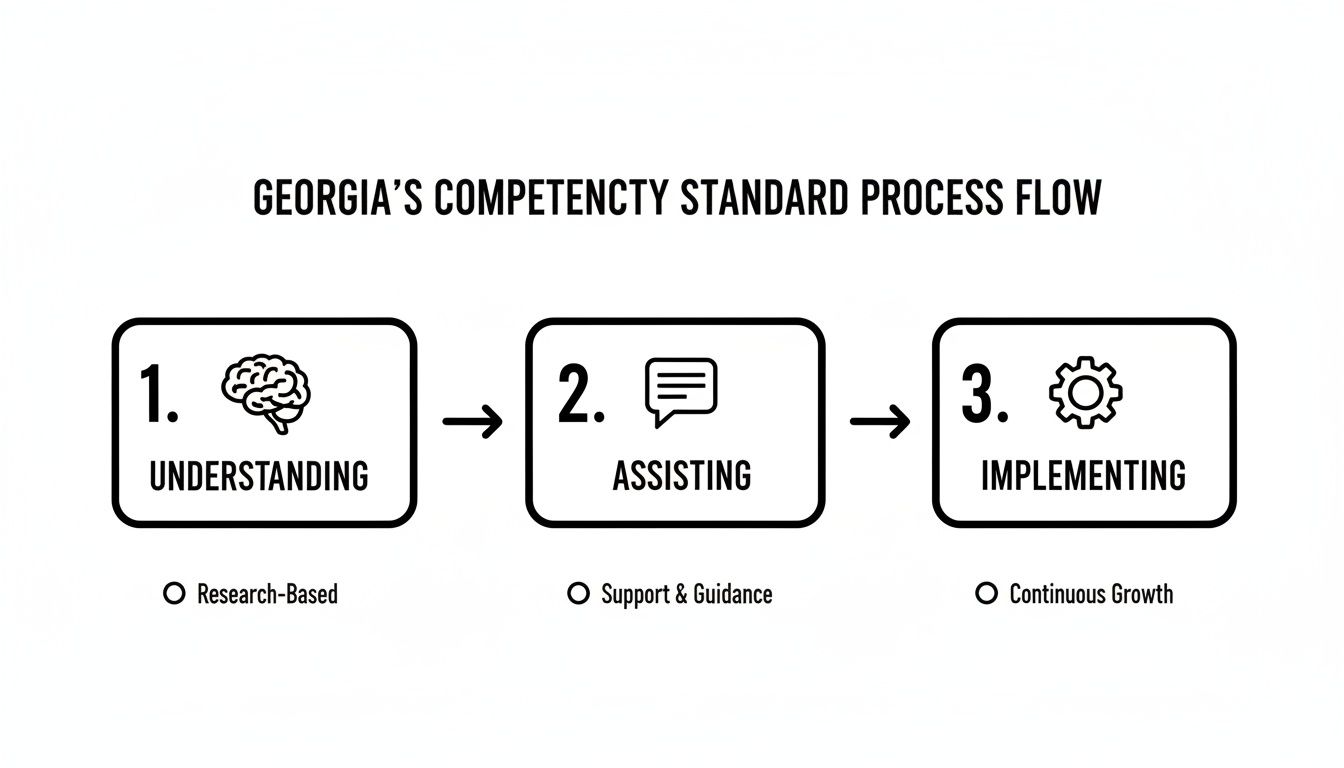
The standard is practical, focusing on whether a defendant can both understand proceedings and work with their lawyer. After the assessment, the psychologist writes a detailed report for the court explaining their findings.
Navigating Delays in the Fulton County System
It's a reality across the country: competency evaluations strain the justice system. While older estimates put the number at around 60,000 evaluations each year, recent research suggests it's closer to 120,000 to 200,000 annually. The sheer volume creates backlogs and delays—a problem we see right here in Fulton County and surrounding areas like Cumming and East Cobb.
This is where a local attorney makes a difference. Knowing the specific procedures in courts from Sandy Springs to Alpharetta allows an attorney to anticipate and navigate potential delays, pushing to keep the case moving and advocating for the client's rights while the system works.
Once the expert’s report is filed, the court schedules a competency hearing. At this hearing, the judge reviews the report, hears arguments from the defense and the prosecution, and makes the final decision. This entire evaluation runs parallel to the main criminal case. To see how this fits into the bigger picture, review our overview of the steps in the criminal justice process.
Ultimately, the goal is a fair process. A skilled attorney acts as your guide and protector, ensuring every step is managed correctly with your best interest at the forefront.
Why Choose Brian Hansford for Your Case in Alpharetta

When a question about competency to stand trial arises, the entire case changes. It becomes a delicate mix of law and psychology. Navigating this requires more than general criminal defense knowledge. It demands a local attorney who knows the specific courts, judges, and prosecutors in Alpharetta and the greater North Fulton area.
Hiring an attorney unfamiliar with the North Fulton judicial circuit puts you at a real disadvantage. So much of what happens depends on local court procedures—things you only learn by being in those courtrooms daily.
Deep Knowledge of the Alpharetta Legal Landscape
As an attorney who is regularly in the Alpharetta Municipal Court and Fulton County State Court, I understand how the local system truly operates. This local knowledge shapes every part of the strategy:
- Filing the Motion: Knowing a specific judge’s views can inform the timing and wording of a competency motion to give it the best chance of success.
- Choosing an Evaluator: A local lawyer often knows the forensic psychologists the court appoints and can prepare you for what to expect.
- Arguing the Report: I understand how to frame a psychologist’s findings in a way that resonates with a particular judge, whether in Alpharetta or at the Fulton County Superior Court.
This familiarity helps avoid critical mistakes and ensures your case is presented effectively from the start.
A Former Prosecutor’s Strategic Advantage
My background as a former prosecutor gives my clients a unique edge. I know exactly how the state prepares its case and how prosecutors in Fulton County approach competency challenges. This allows me to anticipate their strategy and build a proactive defense to counter it.
An attorney’s job is to be your shield. When competency is at issue, that means protecting your constitutional rights during evaluations, challenging the state’s evidence, and fighting to ensure you are not forced into a trial you cannot understand.
For families in Alpharetta, Johns Creek, or Milton, having an attorney who has worked on the other side is a powerful asset. Your defense is not just a reaction—it is built on a deep understanding of the opposition's playbook.
Fighting for You at Every Stage in Alpharetta
A dedicated Alpharetta attorney does more than file paperwork. I will actively fight for your rights through the entire competency process. This includes arguing for the least restrictive settings for evaluations, challenging any delays that could violate your rights, and never losing focus on the ultimate goal: protecting your future and your record.
If you have concerns about your own or a loved one’s competency to stand trial, you cannot afford to wait. Deadlines in Fulton County move quickly. Call me, Brian Hansford, now for a confidential consultation. Protect your rights with a calm, strategic, and protective local attorney by your side.
Frequently Asked Questions About Competency to Stand Trial in Alpharetta, GA
Facing criminal charges is stressful enough without the added confusion of mental health concerns. Here are direct answers to common questions I hear from clients and their families in Alpharetta and throughout North Fulton.
Q: Does having anxiety mean I am incompetent to stand trial in Alpharetta?
A: Not necessarily. In Alpharetta and Fulton County courts, a diagnosis alone does not determine competency. The critical question is whether your condition—be it severe anxiety or another issue—is so debilitating that it prevents you from understanding the charges against you and assisting your lawyer. My focus will be on showing how your specific symptoms impact those legal abilities.
Q: If found incompetent in Fulton County, are my charges dismissed?
A: Not immediately. A finding of incompetency pauses your criminal case. The court’s focus shifts to restoring your competency, usually through treatment at a state facility. Your case is put on hold. However, if it's later determined that your competency cannot be restored within a reasonable time, I can then file a motion to have the charges dismissed.
Q: How long does competency restoration take for a case near me?
A: The timelines can be frustratingly long. The process to get an evaluation ordered by a judge in Alpharetta Municipal Court can take weeks. If restoration is ordered, the wait for a bed in a Georgia state hospital can last for many months due to severe backlogs. This is why you need an attorney to constantly monitor the case and fight against unconstitutional delays.
Q: Will raising competency make me look guilty to the Alpharetta court?
A: No. Competency is a constitutional right ensuring a fair trial. Raising the issue is a protective legal strategy, not an admission of guilt. Judges and prosecutors in the Fulton County court system view it as a standard legal procedure. As your attorney, I have an ethical duty to raise the issue if I have a good-faith doubt about your ability to participate in your own defense.
Q: What is the difference between an insanity defense and incompetency in Georgia?
A: These are two completely separate legal concepts. Competency to stand trial is about your mental state right now—your ability to understand the court proceedings today. The insanity defense is about your mental state at the time the alleged crime was committed—whether you knew right from wrong back then. An experienced Alpharetta defense attorney can advise you if either applies.
If you or a loved one is facing criminal charges in Alpharetta, Roswell, or anywhere in North Fulton and there are concerns about mental health and competency, do not wait. Brian Hansford Law has the local knowledge and strategic experience to protect your rights in the Fulton County court system. Call now to request a confidential case review at https://challengemycharge.com.
