
Being accused of conspiracy to commit a felony in Alpharetta, GA, is deeply unsettling. It can feel like you are being held responsible for a crime that never actually happened, and you might be worried about how a charge like this could affect your family, your job, and your future. The Alpharetta Police Department and Fulton County prosecutors take these charges seriously, and so should you.
If you or a loved one is facing an investigation or arrest, your first move is critical. Do not speak with law enforcement without legal representation. Deadlines in the Fulton County court system move quickly. Call Brian Hansford Law immediately for a confidential case review to understand your rights and protect your record.
Why This Matters in Alpharetta, GA
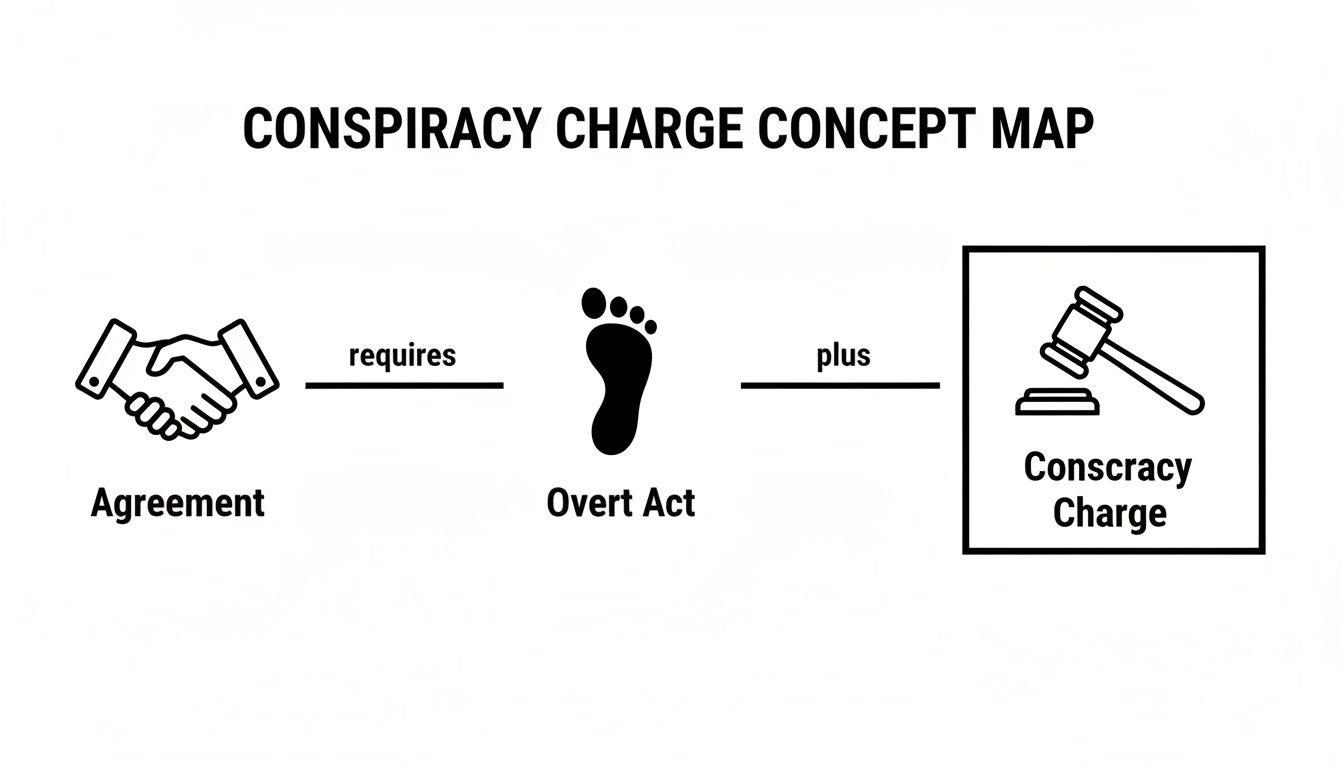
Prosecutors in Fulton County often use conspiracy charges as a powerful tool. A conspiracy charge allows them to bring a case even when the evidence for the main felony is thin or non-existent. They don't have to prove the crime was completed. All they need to show is that you planned to commit a felony with someone else and that one of you took a single step toward making it happen. That’s the entire basis for a conviction under Georgia law (O.C.G.A. § 16-4-8).
This is why residents of Alpharetta, Johns Creek, and Roswell find themselves facing serious charges for actions they believed were innocent. An experienced local criminal defense attorney knows how to challenge the prosecution’s narrative and defend your freedom.
The Charge Breakdown: What Prosecutors Must Prove
For prosecutors in the North Fulton court system to secure a conspiracy conviction, they have to prove two specific elements beyond a reasonable doubt. Understanding these elements is the first step toward building a strong defense strategy in Alpharetta.
| Element | What It Means In Fulton County Courts |
|---|---|
| The Agreement | Prosecutors must show you knowingly and voluntarily agreed with at least one other person to commit a specific felony. This doesn't require a formal contract. The "agreement" can be pieced together from text messages, overheard conversations, or just coordinated actions that suggest a shared criminal goal. |
| The Overt Act | This is any tangible step taken to advance the plan. Critically, the act itself doesn't have to be illegal. It could be something as simple as buying a tool in Cumming, making a phone call from a Roswell Starbucks, or driving a specific route through Johns Creek. Prosecutors will work to frame that simple act as part of a criminal plot. |
The prosecution's case hinges on proving both the agreement and the overt act occurred. If they can’t solidly establish both, their case falls apart. This is often where an experienced Alpharetta defense attorney can create the most leverage.
An arrest for conspiracy often pulls you into a complex legal fight that may involve a grand jury. It is crucial to understand what happens at a grand jury hearing to be ready for the road ahead. Trying to navigate these allegations on your own is a huge risk. You need a defense attorney who has dealt with these tactics before in local courts like the Alpharetta Municipal Court and Fulton County Superior Court.
What Counts as an "Agreement"?
An agreement doesn’t have to be a formal contract. In the eyes of the law, an agreement can be a simple conversation, a text message exchange, or even just coordinated actions that suggest a shared criminal purpose.
North Fulton prosecutors often build their entire case on this kind of circumstantial evidence. They’ll take bits and pieces—phone records, witness statements, security footage—and weave them into a story of a criminal plan. For instance, if you and a friend were seen near a Roswell business a few times before it was burglarized, the District Attorney might argue that your presence proves you were both in on a conspiracy.
This is where a good defense is critical. We challenge these assumptions by providing the innocent context or proving there was no true "meeting of the minds" to commit a crime.
What Is an "Overt Act"?
The overt act is the second piece of the puzzle, and this is where many people in areas like Johns Creek and Sandy Springs get into trouble without even knowing it. An overt act is any step, no matter how small or legal, that one person in the alleged conspiracy takes to advance the plan.
Look at how easily a prosecutor could frame these perfectly legal actions as part of a criminal conspiracy:
- Buying everyday items: Purchasing tools at a hardware store in Cumming could be spun as preparing for a robbery.
- Renting a storage unit: Getting a unit in Milton might be framed as setting up a stash house for stolen goods.
- Making a phone call: Simply calling or texting someone from anywhere in the North Atlanta area could be twisted into evidence of coordinating a drug deal.
The action itself is not the crime. The prosecution’s goal is to convince a jury that the action was done with criminal intent as part of the broader agreement. Because the law is so flexible, it is important to understand the full range of potential criminal charges in Georgia to see what you might be up against.
Without an experienced legal advocate, you risk having your life turned upside down because your actions were taken out of context. A skilled Alpharetta defense attorney knows how to pick apart the state's evidence and show the jury the real, innocent story.

Defense Strategy: How We Fight Conspiracy Charges in Alpharetta
Just because you’ve been accused of conspiracy to commit a felony doesn’t mean you’ll be convicted. As a former prosecutor, Brian Hansford knows exactly where to find the weak spots in the state's case and how to build a defense that protects your future. A real defense isn't about just responding to the state's claims; it's about tearing apart their story before a jury ever hears it.

Our method is built on years of experience in courtrooms across North Fulton. We don’t use cookie-cutter arguments. Instead, we develop a powerful defense tailored to the exact facts of your situation.
Proving No Agreement Existed
The heart of any conspiracy charge is the "agreement." A North Fulton prosecutor has to prove, beyond a reasonable doubt, that you and at least one other person made a mutual, intentional plan to commit a crime. This is a very high standard, and it's often the first place we attack. We scrutinize the evidence to show a jury that what the prosecution claims was a criminal pact was really something innocent, like:
- Just Talk or Bragging: Idle chatter is a long way from a concrete criminal plan.
- Guilt by Association: Simply knowing or being around someone who broke the law doesn’t make you a co-conspirator.
- Misunderstanding the Intent: We work to establish that you were never a willing participant in their plan.
Challenging The Overt Act
The state must also prove that at least one person took an "overt act" to move the conspiracy forward. Our job is to break the connection between that action and the supposed criminal plot by showing it was perfectly innocent. That drive you took through a Sandy Springs neighborhood wasn't "casing a target"—it was your usual route home. That hardware purchase in Cumming wasn't for "burglary tools"—it was for a weekend home project.
Arguing Withdrawal From The Conspiracy
Under Georgia law, if you chose to completely and voluntarily pull out of the conspiracy before the overt act happened, you may not be found guilty. Using this defense requires showing that you clearly told your alleged co-conspirators you were out and made a real effort to stop the crime. It's a nuanced argument that demands a deep knowledge of Georgia case law—the kind of nuance that is sometimes missed in cases that border on an example of entrapment.
Negating Criminal Intent
Finally, a conspiracy conviction requires specific intent. The prosecution must prove you actually intended for the underlying felony to occur. We directly challenge this by demonstrating you never had that state of mind, a common scenario in white-collar cases we see in courts serving Alpharetta, Milton, and Johns Creek.
U.S. Sentencing Commission data from 2023 showed that 65% of conspiracy defendants received sentences averaging 87 months. Your future shouldn't hang on how a prosecutor decides to interpret a text message. You can read more on the complexities of criminal conspiracy charges. If you are facing a conspiracy charge in Alpharetta or anywhere in North Fulton, you need an attorney who can dismantle the state’s evidence, piece by piece.
The Court Process in Fulton County
If you are arrested for felony conspiracy in Alpharetta, Roswell, or anywhere in North Fulton, your case will likely be handled in the Fulton County court system, either at the Alpharetta Municipal Court for initial proceedings or directly in Fulton County Superior Court for more serious matters.
The process typically begins with a bond hearing, where a judge decides whether to grant you release pending trial. This is a critical early stage where having an experienced attorney is vital. From there, the case moves through pretrial motions, evidence discovery, and potential plea negotiations. Deadlines move quickly, and what happens in these first few days can set the tone for your entire case. Navigating this process, from bond hearings to potential trials, requires a criminal defense attorney near me who understands the local procedures.
We regularly represent clients in Alpharetta, Milton, Johns Creek, Roswell, Sandy Springs, and Cumming. We know the local prosecution patterns and how to best position your case from day one.
Why Choose Brian Hansford in Alpharetta?
Of all the decisions you’ll make when facing a felony conspiracy charge, choosing the right attorney is the most critical. This is especially true when your case is in the Fulton County Superior Court. You need a defender who is deeply invested in your case and knows the local legal system from the inside out. Brian Hansford has spent his entire 25-year career in criminal law, first as a prosecutor and now as a criminal defense attorney.
That dual perspective is a powerful advantage. We don’t have to guess what the North Fulton District Attorney’s Office might be thinking—we can anticipate their next move because we've built these exact types of cases in the past. We know the pressure points, where evidence is likely to be weakest, and the tactics they use to make innocent actions look like a criminal plot.
This kind of boots-on-the-ground experience in Alpharetta is invaluable. Whether the Alpharetta Police Department is handling the investigation or a county-wide task force is involved, we have the local knowledge to effectively navigate the system for you.
You need more than just a lawyer. You need a strategist who sees the entire board and thinks several moves ahead. My commitment is to protect your rights, your reputation, and your future with the kind of focused, personal attention that larger firms simply can't provide.
Frequently Asked Questions for an Alpharetta Conspiracy Charge
A conspiracy charge can be confusing and alarming. Here are direct answers to common questions we hear from clients in Alpharetta and throughout North Fulton County.
Q: What are the penalties for conspiracy to commit a felony in Georgia?
A: Under Georgia law (O.C.G.A. § 16-4-8), the punishment for conspiracy is up to half the maximum prison time for the underlying felony. For serious felonies tried in Fulton County courts, this can mean years in prison. It is a severe charge that demands an immediate defense from an experienced attorney.
Q: Can I be charged in Alpharetta if the crime was planned for another city?
A: Yes. If the agreement was made in Alpharetta or if any "overt act" to further the plan happened in Fulton County, the North Fulton prosecutor has the authority to bring charges here. This is why you need an attorney who is a veteran of the Alpharetta Municipal Court and Fulton County court system.
Q: Am I responsible for what others in the alleged conspiracy did?
A: You can be. Georgia’s conspiracy law allows the court to hold you responsible for foreseeable criminal acts of co-conspirators, even if you weren't there. This is a major reason why you should never speak to law enforcement without an experienced lawyer like Brian Hansford by your side.
Q: What is the first step after a conspiracy arrest in Roswell or Johns Creek?
A: If arrested for a felony conspiracy in Roswell or Johns Creek, your case will likely go to Fulton County Superior Court. The process begins with a bond hearing, and timelines are short. The most important first step is to contact a skilled Alpharetta criminal defense attorney immediately to protect your rights.
Q: How can a lawyer defend me against a conspiracy charge in Alpharetta?
A: A strong defense involves challenging the prosecution's evidence. We can argue no true "agreement" existed, the "overt act" was innocent, you withdrew from the plan, or you lacked criminal intent. In Alpharetta, a local attorney who knows the Fulton County courts can effectively dismantle the state’s narrative.
If you are facing a conspiracy charge in Alpharetta, Milton, or anywhere in North Fulton, your choice of attorney is the most important decision you will make. Contact Brian Hansford Law today for a confidential case review. Protect your rights and your future. Call now.
