
When you're dealing with the court system, things don't always move in a straight line. Sometimes, a scheduled court date needs to be pushed back. This official postponement is known as a continuance in court. A judge has to approve it, but it’s a critical tool that gives everyone involved the time they need to get their ducks in a row.
Understanding a Continuance in Court and Its Impact
Getting a notice for a court date in Cumming, Alpharetta, or anywhere in Forsyth County can be nerve-wracking, so the thought of a delay might seem even more stressful. But a continuance isn't a setback. Think of it as hitting the pause button to make sure every part of a complex process is handled correctly. It’s a common and often strategic part of navigating the court system.
This guide will break down what a continuance in court really is and why one might be necessary. The information here is designed to help you understand how the courts work, but it’s no substitute for professional guidance tailored to a specific situation.
Who Is Involved in a Continuance
When a court date gets postponed, several key players are involved. Each has a specific job in requesting, opposing, or granting the continuance. Knowing who does what can help demystify what’s happening behind the scenes. For a bigger picture, you can learn more about the criminal court process in Georgia and see how all these pieces fit together.
A continuance is not a sign of weakness or guilt. Instead, it is a procedural tool that acknowledges the complexities of a case and allows the justice system the necessary time to function correctly and fairly for everyone involved.
Ultimately, the judge makes the final call. They have to weigh the reasons for the delay against the court's need to keep cases moving forward. The table below outlines who is involved and what they do.
Key Roles in a Court Continuance Request
This table breaks down who is involved in the process of requesting and granting a court continuance and what their typical role is.
| Participant | Role in the Continuance Process |
|---|---|
| Defendant | The person facing charges. While they might want to get things over with quickly, the extra preparation time from a continuance is often a major benefit. |
| Defense Attorney | This is usually the person requesting the continuance. They might need more time to gather evidence, interview witnesses, negotiate with the prosecutor, or simply handle a scheduling conflict. |
| Prosecutor | The lawyer representing the state. They might agree to the continuance (consent) or object to it, arguing against delays that could potentially weaken their case or inconvenience witnesses. |
| Judge | The final decision-maker. The judge listens to the arguments, evaluates the reasons for the request, and decides whether to grant or deny the motion to continue the court date. |
Each of these roles is crucial, and the interaction between them determines whether the case will pause or proceed as scheduled.
Why Would a Continuance Be Necessary in a Criminal Case
Knowing what a continuance is is a good first step, but the more important question is usually why one is needed in the first place. A continuance in court is rarely about just stalling; it’s a strategic move an attorney makes to guarantee a fair fight and build the strongest possible defense. The reasons are almost always practical and tied directly to the messy, complicated nature of a criminal case.
Think of it this way: if you hired a mechanic to figure out a complex engine problem, you wouldn't want them to rush the job and just start replacing parts. An attorney needs that same deliberate approach to properly examine every piece of the prosecution's case before deciding on the best way forward.
Giving Time for Thorough Discovery Review
One of the most common reasons for a continuance is simply needing more time to handle discovery. Discovery is the formal process where the prosecution is legally required to turn over all its evidence. This isn't just a single document; it can be a mountain of material.
- Police reports and officer notes detailing every step of the investigation.
- Body camera and dashcam footage that shows what actually happened.
- Witness statements and recorded interviews.
- Lab results, like blood alcohol content (BAC) reports in a DUI case.
- Photographs and surveillance videos from the scene of the incident.
Going through all this evidence properly is a meticulous job. An attorney has to comb through everything, looking for inconsistencies, weaknesses in the state's argument, and the threads needed to weave together a defense strategy. Rushing this critical process would be a huge disservice to the person whose freedom is on the line.
Locating Witnesses and Securing Experts
Another key reason for a continuance is when a crucial person isn't available. A defense is only as strong as the testimony and evidence supporting it. Sometimes, more time is needed to get the right people in the right place.
For instance, an essential witness who can provide a solid alibi might be out of state or otherwise unavailable for the scheduled court date. A continuance gives the attorney the time needed to make arrangements for their testimony.
Other times, an expert witness is non-negotiable. In a DUI case, this might be a toxicologist who can challenge the reliability of a breathalyzer test. It takes time to find the right expert, hire them, and get them prepared to testify. A continuance makes that possible.
A continuance isn't just a pause button. It's a critical period of intense, behind-the-scenes work. It provides the time needed to transform a jumble of raw facts and evidence into a clear and compelling defense.
While continuances are essential for a fair defense, they are also the biggest reason for case delays nationwide. Courts aim to resolve 75% of felonies within 90 days, but repeated continuances can push cases far beyond those standards. For people in metro Atlanta areas like Forsyth County or Cobb County, these delays can mean more uncertainty, more missed work for court dates, and living under bond conditions for longer. The goal is always to use a continuance purposefully to build the case, not just to kick the can down the road. You can read more research on the effects of continuances in criminal case management to see the balance attorneys must strike.
Allowing for Deeper Investigation
Finally, a continuance gives the defense a chance to conduct its own independent investigation. A good defense attorney never just takes the prosecution's evidence at face value. They have to dig deeper.
This often involves:
- Visiting the scene of the alleged crime to get a real-world sense of the layout.
- Interviewing new witnesses that the police may have missed or ignored.
- Hiring a private investigator to find new facts or poke holes in the state's version of events.
This investigative work is fundamental to protecting a person's rights. It ensures every possible angle is explored and that any exculpatory evidence—evidence that points toward innocence—is found and brought to the court's attention. Each of these steps takes time that the original court schedule just doesn't account for, making a continuance a vital tool for justice.
The Strategic Role of Continuances in Plea Negotiations
A continuance might seem like a simple delay—just pushing a court date back for practical reasons like tracking down a witness or sorting through a pile of evidence. But in the world of criminal defense, its real power is often felt far from the courtroom itself. For most people facing charges, postponements are a critical tool in plea negotiations, the behind-the-scenes discussions that ultimately resolve the vast majority of criminal cases.
It’s a common misconception that every case ends with a dramatic courtroom trial. The reality is, that’s incredibly rare these days. Plea agreements are now the standard way criminal charges are handled, which makes the negotiation phase a very important part of the defense process.
A continuance transforms time into leverage. It creates the necessary space for a defense attorney to analyze the prosecution's case, identify its weaknesses, and use that information to negotiate from a position of strength, not desperation.
This is where a continuance in court becomes one of the most valuable strategic assets. That extra time isn't about waiting around; it's about actively working the case. That period can be used to build a compelling argument for reduced charges, alternative sentencing, or even a full dismissal.
Creating Leverage for a Better Deal
Time has a funny way of changing the dynamics of a negotiation. A continuance gives a defense attorney the breathing room to methodically chip away at the prosecutor's confidence. When new evidence is uncovered or inconsistencies in police reports are found, it can dramatically shift the prosecutor's willingness to make a deal.
For instance, a delay might give an attorney the time needed to:
- Locate a new witness whose testimony directly contradicts what the state is claiming.
- Obtain an expert report that calls into question the accuracy of a breathalyzer test or other forensic evidence.
- File legal motions to get evidence thrown out because it was gathered improperly.
Every one of these actions pokes another hole in the prosecution's case. As their chances of winning at trial get slimmer, their incentive to offer a more favorable plea agreement gets bigger. A continuance provides the runway to make these game-changing moves happen.
Aligning Strategy with a Changing System
Understanding the power of negotiation is absolutely key, especially when you look at how courts actually operate today. Trials have become a statistical longshot. Federal data shows that the share of defendants who went to trial plummeted from 7% in 1998 to just 2% in 2018. Over that same time, cases resolved by a guilty plea jumped from 82% to 90%.
State courts are no different. In some of the country's largest states, fewer than 2% of criminal cases are ever decided by a jury. For anyone facing charges in places like Alpharetta, Cumming, or Roswell, this means the time gained from a continuance is almost always used to strengthen a position for a plea deal—not to prepare for a trial that is statistically unlikely to ever happen. You can read more about the decline of trials in American courts on Judicature.Duke.edu to get a better sense of this trend.
This reality highlights just how crucial it is to have a skilled negotiator on your side. When a continuance is requested, it's not just about kicking the can down the road; it's an investment of time to improve the terms of a potential plea bargain. Of course, it's just as important to understand the finality of that decision, so be sure to learn more about whether you can appeal a plea bargain in our related article.
Ultimately, a strategic delay is often the first and most important step toward securing a resolution that protects your future.
How to Ask for a Continuance in Georgia Courts
Knowing why a continuance might be needed is one thing, but understanding the actual process is where strategy comes into play. You can't just walk up to a judge and ask to move a court date. In Georgia, it’s a formal process, one that requires a legitimate, well-argued reason for any delay.
It all starts when defense attorneys spot a real need for more time. Maybe the prosecution just dropped a mountain of evidence, or a crucial witness is suddenly unavailable. Whatever the reason, that need has to be translated into a formal request.
This whole process boils down to a key strategic decision: is the extra time better spent negotiating a plea or gearing up for a full-blown trial?
This decision tree shows that fork in the road often faced when thinking about a continuance.
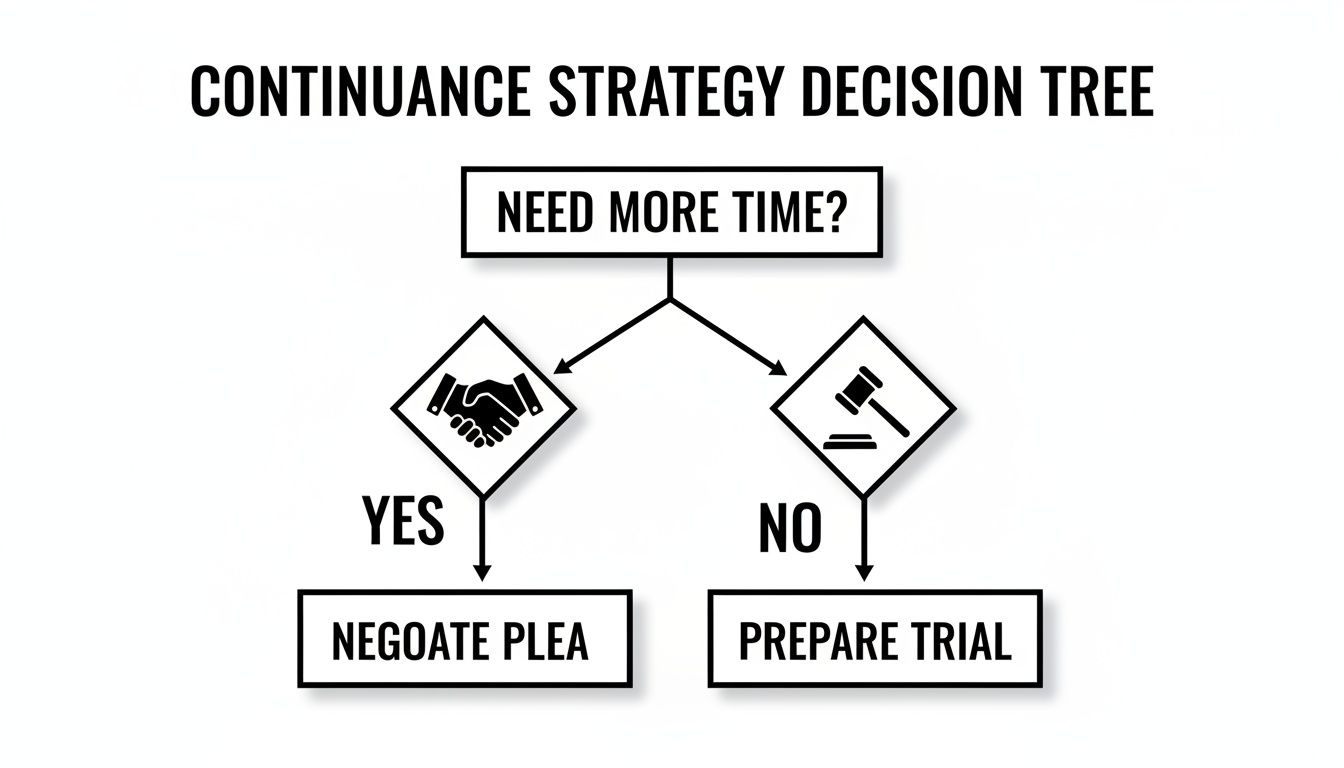
Ultimately, how the extra time gained from a successful continuance is used depends entirely on whether the goal is a plea deal or preparing to fight it out in the courtroom.
Filing the Formal Motion
The main tool used to ask for a postponement is a Motion for Continuance. This is a formal written document that is filed with the court clerk. It’s the official way of telling the judge and the prosecutor that there's a need to push back the court date.
A good motion is both specific and persuasive. It has to lay out exactly why more time is needed and how it's essential for a fair case. Just saying "we need more time" won't cut it. The reason has to be solid.
A Motion for Continuance is really a formal argument on paper. It tells the judge a story—not just that a delay is needed, but why justice can’t be served without it. And it has to be based on the specific facts of a case.
For instance, the motion might state something like: "The Defense respectfully requests a continuance of the upcoming trial date to allow for adequate time to review voluminous discovery, including over 15 hours of body camera footage, recently provided by the State." That kind of specific detail shows the judge the practical problem being faced. For a deeper look at the mechanics, our guide on how to ask for a continuance in court breaks down the steps.
Arguing for the Delay in Court
Filing the motion is just the first step; it doesn't mean it's automatically approved. The judge will usually hear arguments from both sides. This might happen in a quick hearing or right before things get started on the originally scheduled court date.
During this hearing, the defense will present the arguments from the motion, explaining in person why the continuance is critical. The prosecutor gets their turn to respond. Sometimes they agree to the delay, but often they'll object, claiming it’s unnecessary or hurts their case.
The final call belongs to the judge. They decide based on a standard called "good cause." The judge has to weigh the reasons against the court's need to keep cases moving. If a legitimate, substantial reason for the delay has been shown, they will almost always grant the continuance.
Local Practices in North Georgia Courts
While the official process is the same across Georgia, local courthouse culture matters. A lot. The way a judge in Forsyth County considers a continuance request can be very different from a judge in Marietta or Roswell. Some are more flexible with first-time requests, while others demand a much stronger justification right from the start.
This is where having an attorney who practices daily in these local courts—like in Cobb County, Alpharetta, and Johns Creek—becomes a huge advantage. Knowing the tendencies of specific judges allows the Motion for Continuance to be framed in the most effective way possible, which seriously boosts the chances of getting it approved. That kind of local knowledge is absolutely critical.
Potential Downsides and Opposing a Continuance
While a continuance in court can be an essential tool for building a strong defense, it's not a one-size-fits-all solution. Like any strategic decision, asking for more time comes with real trade-offs. Understanding these potential downsides is key to making a truly informed choice.
For the person facing charges, the most immediate negative is simply having to live with the case hanging over their head for longer. Every delay prolongs the uncertainty, which can create a significant amount of emotional and mental strain. This isn't just a passive waiting game; it actively disrupts life.
The Personal Cost of Delays
When a case gets pushed back, the consequences can ripple through every part of your world. The constant stress of an unresolved legal problem can strain relationships, impact a job, and take a toll on overall well-being.
Beyond the emotional burden, there are very practical issues to think about:
- Employment Issues: Having to request more time off work for rescheduled court dates can put you in a tough spot with an employer. Some bosses are less understanding about repeated absences.
- Extended Bond Conditions: If you're out on bond, a continuance means you're stuck living under those restrictions for a longer period. This could involve curfews, travel limitations, or regular check-ins that chip away at your freedom.
- Financial Strain: The longer a case drags on, the more expensive it can become—not just in professional fees but also in lost wages from missed work and other related costs.
Why the Prosecution Might Object
The defense attorney isn't the only one with a stake in the court's calendar. The prosecution has its own reasons for wanting to keep a case moving forward, and they will often formally object to a request for a continuance. Their opposition usually boils down to their duty to resolve cases efficiently and preserve the strength of their evidence.
A prosecutor's main worry often centers on their witnesses. As time passes, a witness's memory can fade, making their testimony less sharp or compelling on the stand. In some situations, a witness might move away or become unavailable for other reasons, which could seriously weaken the state's case.
The state's interest in a speedy resolution is not just about clearing dockets. It's about preserving the integrity of their evidence and ensuring witness testimony remains as fresh and reliable as possible.
Prosecutors are also under immense pressure to manage heavy caseloads. Unnecessary delays create backlogs that slow down the entire system. Because of this, they'll often argue that a request for a continuance lacks "good cause" unless a very clear and unavoidable reason is presented.
Weighing the Decision: Pros and Cons of a Continuance
Deciding whether to seek a continuance is a careful balancing act. One must weigh the potential benefits of having more prep time against the very real costs of delay.
This table breaks down the trade-offs from the defendant's perspective to help see the full picture.
| Potential Advantages (Pros) | Potential Disadvantages (Cons) |
|---|---|
| More time to review evidence and build a strong defense strategy. | Prolonged stress, anxiety, and uncertainty about the case outcome. |
| Opportunity to locate and prepare key defense witnesses or experts. | Potential for the prosecution's witnesses' memories to fade over time. |
| Increased leverage for negotiating a more favorable plea agreement. | Extended time under restrictive pretrial bond conditions. |
| Allows time for an attorney to file and argue important motions. | Possible negative impact on employment due to multiple court dates. |
Ultimately, there is no single right answer. The best course of action depends entirely on the specific facts of a case, which is why discussing it thoroughly with an experienced professional is so critical.
Navigating the Court Process in North Georgia
When you're facing a criminal charge, just understanding how the court system works can feel overwhelming. A key part of the process is something called a continuance in court. It’s not a sign of trouble or a setback; think of it as a strategic timeout. It's a standard, often vital tool used to make sure a case is handled fairly and to allow the time needed for proper preparation.
Requesting a continuance is a calculated decision designed to protect a person's rights and put them in the best position for a positive outcome. The extra time isn't just about waiting—it’s about working. That period can be used to dig into evidence, negotiate with prosecutors, and build a stronger defense. While any delay can be frustrating, a well-timed continuance is often the move that opens the door to a more favorable result.
Your Trusted Advocate in Local Courts
Facing criminal charges in Alpharetta, Cumming, or anywhere in North Georgia can feel isolating, but you don't have to go through it alone. Having a guide who knows the local landscape—the specific judges, the prosecutors, their tendencies—is critical. At Brian Hansford Law, we’ve spent years in these exact courtrooms, representing people just like you.
We proudly serve individuals and families in:
- Alpharetta
- Cumming
- Roswell
- Marietta
- Johns Creek
- Milton
- Forsyth County
- East Cobb
- Cobb County
Navigating the complexities of the court system requires more than just legal knowledge; it requires local experience. We are committed to providing a defense that is both powerful and personalized to the court you are in and the unique facts of your case.
If you're dealing with a criminal charge and have questions about what comes next, including whether a continuance in court is the right move for your situation, don't wait. Contact Brian Hansford Law today for a consultation. Let our experience start working for you.
Frequently Asked Questions About Court Continuances
The court system can be confusing, and when a date gets pushed back, it’s only natural to have questions. When the topic of a continuance in court comes up, a lot of the same concerns are raised. Let's clear the air on some of the most common ones.
How Many Times Can My Case Be Continued?
There’s no magic number here. In Georgia, a judge can grant as many continuances as they see fit, as long as there is "good cause" for each delay.
A first request for a solid reason—like an attorney just received a mountain of new evidence from the prosecution—is usually granted without much fuss. But as requests stack up, judges naturally get more skeptical. Their job is to keep the docket moving. A skilled lawyer knows how to build a strong, legitimate case for why more time is needed, every single time.
Do I Have to Appear in Court for a Continuance?
It really depends on the court and the judge. In some places, like certain courts in Forsyth or Cobb County, an attorney can often handle the request beforehand, and you won’t have to show up.
In other situations, you absolutely have to be there. This is almost always the case if the continuance is requested on the day your trial was supposed to start. Your attorney will give you crystal clear instructions on whether or not your attendance is mandatory for any court date.
A common misconception is that a continuance means something is wrong with the case. In reality, it is a standard procedural tool that confirms the defense team is being diligent, not that a case is weak.
Will a Continuance Make Me Look Guilty?
Absolutely not. Requesting a continuance in court doesn't signal guilt to anyone. It's a routine part of the system that judges and prosecutors see every single day.
Think of it this way: asking for more time shows that a defense team is committed to preparing a thorough, rock-solid defense. That’s a fundamental right. The court sees it as a procedural move tied to ensuring a fair trial, not as any kind of comment on the facts of the case itself.
What Is the Difference Between a Continuance and a Reset?
People often use these words interchangeably, but in the courthouse, they mean slightly different things.
- Continuance: This is the official term for postponing a major court date, like a trial or a big hearing. It requires a specific, argued reason and has to be formally granted by the judge.
- Reset: This is a much more informal term. It’s often used to describe the simple act of scheduling the next court date after a routine hearing has wrapped up.
Basically, a continuance is a formal pause button that has to be justified, while a reset is just putting the next appointment on the calendar.
If you're facing criminal charges in North Georgia and have more questions about how the court process works, you're not alone. Brian Hansford Law has the local experience to guide you through every step. Contact us today to discuss your case by visiting https://challengemycharge.com.
