
A lot of people who search for information about copyright infringement cases aren't thinking about federal court. They're thinking about a photo on a business website, music used in a promo video, a shared file library, a design mockup, or content an employee posted without checking rights first.
Then the problem changes fast.
What starts as a demand letter can turn into a federal investigation, a subpoena, seizure concerns, or a criminal inquiry that feels nothing like a traffic case in Alpharetta, a DUI arrest in Roswell, or a drug possession charge in Cumming. If you live in North Atlanta, that shift can be disorienting. It is generally understood what a speeding ticket lawyer does. Very few know what happens when copyright issues move into the federal system.
People make expensive mistakes when they talk too much, hand over devices too quickly, assume “I didn't mean to” ends the matter, or treat a federal accusation like a business dispute that will go away if they apologize.
It won't.
An Unexpected Federal Accusation
A business owner in Alpharetta gets an email from a photographer's lawyer on Monday. By Friday, a hosting company has asked questions about stored files, a marketplace account is frozen, and someone mentions federal agents. That is how these cases often start. Subtly, then all at once.
For clients used to local court problems in North Atlanta, this feels unfamiliar from the first contact. A DUI in Roswell, a suspended license case in Alpharetta, or a drug charge in Cumming follows a system people at least recognize. A federal copyright accusation does not. The paperwork is different, the stakes are different, and early mistakes can follow you into a federal investigation.
Why the accusation feels so severe
The pressure starts before anyone files formal charges. Copyright claims can bring demands for money, demands to preserve evidence, and demands for access to business records, devices, accounts, and platform data. In some cases, the first real problem is not the underlying copying. It is the response. A rushed email, a defensive call, deleted files, or a casual explanation to investigators can do more damage than the original complaint.
That is one reason businesses should treat their ownership and licensing practices seriously from the start. This guide to securing creative assets gives a useful business-side overview. Once the issue has shifted toward subpoenas, search warrants, or a criminal referral, the focus changes to exposure, evidence, and defense.
Federal copyright problems also create a kind of pressure many people have never dealt with. The allegation may sound technical, but the government can frame it in very plain terms. Profit. Distribution. Repeat conduct. False records. Concealment. If agents or prosecutors believe the conduct was willful and tied to commercial gain, the case stops looking like a routine business dispute and starts looking like a federal criminal matter with prison exposure, fines, forfeiture risk, and a permanent record.
Practical rule: If a complaint mentions willful conduct, commercial advantage, uploads, distribution, repeat infringement, account records, or server logs, treat it like a serious criminal exposure issue immediately.
The first bad move to avoid
Many people assume there is no criminal risk unless someone is arrested on the spot. That assumption gets clients in trouble.
In federal cases, investigators often build the file first and speak later. They may contact a host, payment processor, cloud provider, employee, contractor, or former business partner before they contact you. By the time the accusation reaches your desk, the government may already have documents, account records, or witness statements.
The right response is disciplined. Preserve records. Stop informal explanations. Do not delete files, messages, cloud folders, invoices, drafts, or project histories. Do not consent to device access or interviews before defense counsel has assessed the exposure. And do not assume that changing a file, compressing it, reposting it, or running it through software solves the legal problem. In federal court, those facts usually become evidence questions, not easy excuses.
Understanding What Makes Copying a Legal Issue
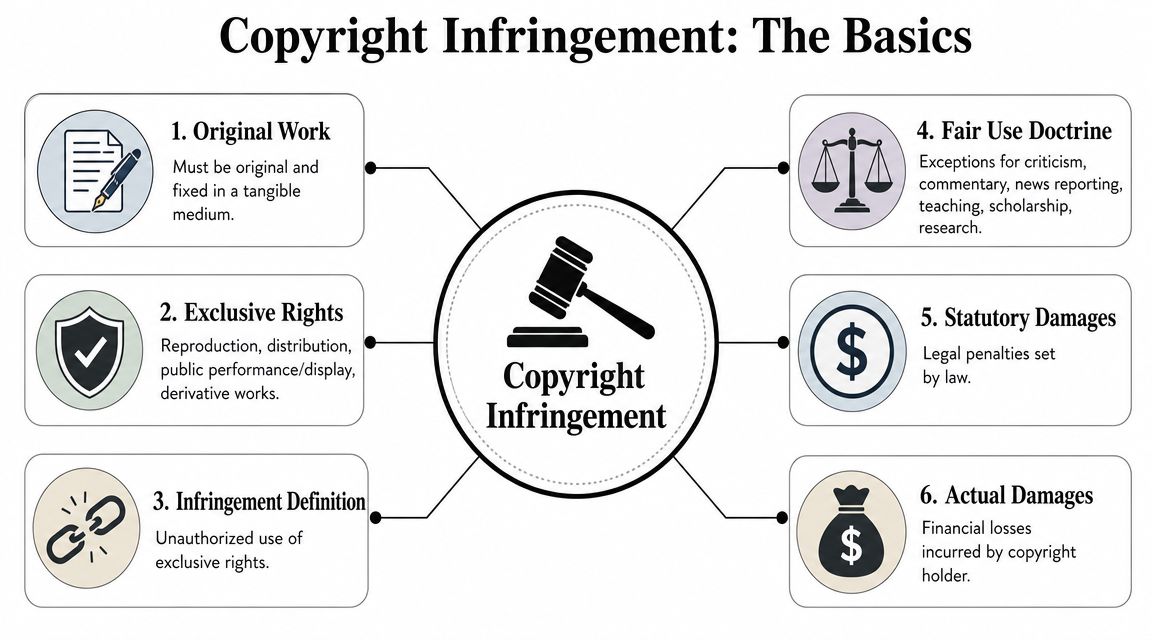
Federal copyright cases often start with a basic misunderstanding. A business owner in Alpharetta reuses a photo pulled from a vendor folder. A contractor in Cumming uploads licensed footage into a shared drive, then another employee republishes it in ads. Nobody thinks of it as theft. In court, the first question is much narrower: who had the right to copy, distribute, display, or reuse that material, and what permission existed?
The core question is control, not just copying
Copyright law gives the owner a set of exclusive rights. In practice, that means legal trouble can arise from reproducing a work, posting it, sending it to customers, building it into a product, or storing and redistributing it through internal systems without permission. Physical copies are only part of the problem. Federal cases now regularly involve cloud folders, cached files, duplicated media libraries, software outputs, and shared platforms that make unauthorized use easy to trace.
That is why these matters can overlap with broader white collar crime allegations involving fraud, records, and financial motive. The copying issue may be the entry point. The surrounding emails, invoices, account access, and business use often shape the risk.
Intent usually is not the first fight
A lot of clients come in focused on motive. They tell me they were not trying to steal anything, were not selling the content, or assumed material found online was fair to use. Those facts may matter later, especially if the government is trying to prove a criminal mental state. They do not automatically answer the threshold question of infringement.
As Washington University's overview of noteworthy copyright cases explains, courts have recognized infringement in non-commercial settings and have even addressed subconscious copying. That surprises people who are used to state court cases where intent often takes center stage early. In a copyright investigation, the paper trail usually matters first. What was used, where it came from, what license existed, who approved it, and how it was distributed.
The common client explanations are familiar:
- I found it online. Public access does not equal permission.
- I was not making money from it. Lack of direct sales does not end the inquiry.
- My employee or freelancer handled that. Delegation does not erase exposure for a business or decision-maker.
- Software changed the file. Editing, compression, resizing, or AI processing does not automatically create a defense.
A weak early position gets weaker fast when internal messages show people knew there was a licensing problem and used the material anyway.
Prevention matters because the records matter
The best early review is practical. Track where content entered the system, who approved it, what license covered it, whether the license matched the actual use, and where the file was later stored or republished. That is boring work. It is also the kind of work that keeps a civil claim from turning into a criminal referral once investigators start comparing usage to records.
If your company creates ads, product listings, training materials, or AI-assisted content, a practical guide to securing creative assets can help tighten intake and permission practices before a dispute starts.
In defense terms, the takeaway is simple. The legal issue usually begins with unauthorized use. The serious exposure grows from what the records show after that.
When Copyright Infringement Becomes a Federal Crime
A business owner in Alpharetta uses unlicensed images across product pages, ignores two takedown notices, and keeps selling. An app developer in Cumming builds a tool that copies and redistributes protected files at scale, then leaves messages showing everyone knew there was a licensing problem. Those facts do not read like the copyright disputes people expect to see in civil court. They read like the start of a federal investigation.
The issue that changes the case
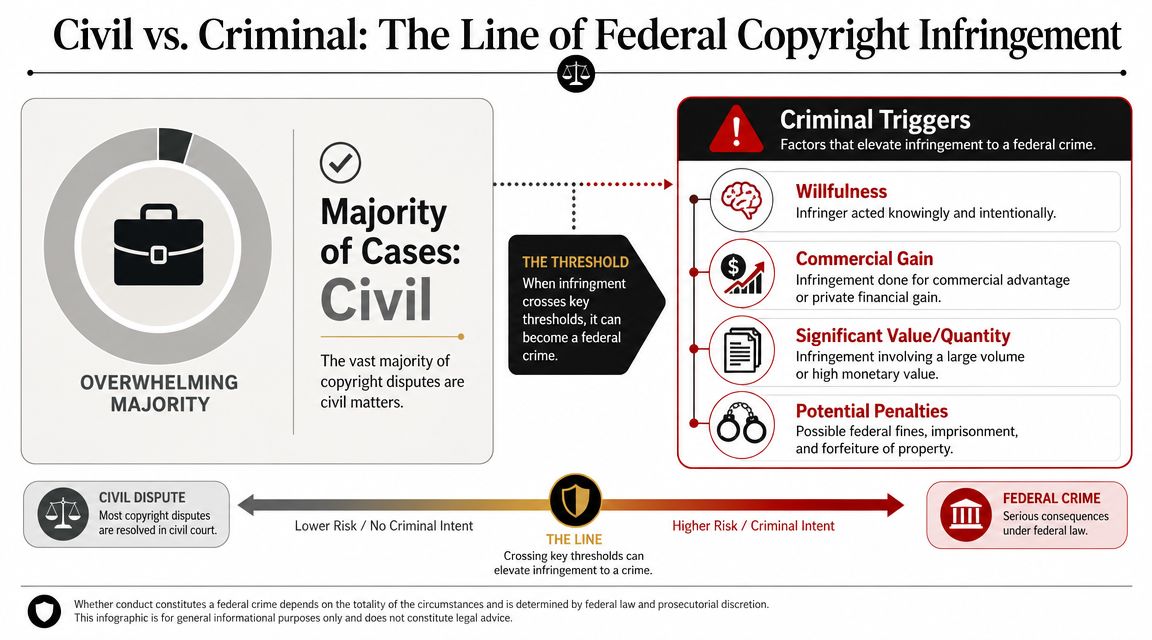
In a criminal case, the government usually focuses on willfulness. Prosecutors are not just asking whether protected material was used without permission. They are trying to prove the person knew what they were doing, understood the risk, and kept going anyway.
That proof often comes from ordinary business records. Emails. Slack messages. Prior complaints. Platform warnings. Payment records. File naming conventions. Technical settings that show repeated copying was built into the process. For someone used to defending a DUI or drug case in state court, this is a different kind of evidence fight. The government is building an intent case document by document.
Federal prosecutors also tend to look for facts that move the case out of the realm of mistake:
- Repeated infringement after notice
- Private financial gain or commercial advantage
- Large-scale copying or distribution
- Use of systems, servers, or accounts designed to reproduce or share protected works
- Steps taken to hide the source, volume, or ownership of the material
When those facts are present, the case can start looking less like a business dispute and more like a federal fraud-style prosecution. That is why copyright allegations are often treated as a form of white-collar criminal conduct rather than a niche intellectual property problem.
Why this catches people off guard
Many defendants never saw themselves as doing anything criminal. They thought they were reposting content, using material a contractor supplied, running a monetized channel, or building a tool that users controlled. In federal court, those explanations may help, but they do not end the inquiry.
The hard question is whether the government can frame the conduct as intentional and profit-driven. If it can, exposure changes fast. Prison, forfeiture, probation conditions, seizure of devices, reputational damage, and business interruption all become real concerns. For a professional or business owner in North Atlanta, that can do more damage than the underlying copyright claim.
The practical defense point
Early defense work matters here because the same facts can be read two ways. A prosecutor may call it willful infringement. The defense may be able to show license confusion, poor internal controls, vendor mistakes, lack of direct knowledge, or a system that was reckless but not criminally intentional. That distinction matters.
I look closely at who made the decisions, what warnings were received, who controlled the accounts, how the files moved, and whether the client understood the rights problem at the time. In many cases, the best defense is not a speech about creativity or internet culture. It is a disciplined attack on willfulness, financial motive, and personal knowledge.
Federal copyright charges are rare compared with the volume of civil disputes. But when they appear, they are serious, document-heavy cases, and they need to be treated with the same urgency as any other felony investigation.
Navigating the Federal Criminal Court Process
A business owner in Alpharetta gets a call from a federal agent about files, accounts, or platform records. A content creator in Cumming learns a subpoena has gone to a payment processor or hosting company before anyone knocked on the door. That is often how these cases begin. They do not usually start like a state misdemeanor in local court.
The case usually starts before you know it exists
Federal agents often build these cases with discretion. They gather platform records, bank or payment data, domain information, emails, storage records, device evidence, and witness statements. By the time a target realizes there is a problem, prosecutors may already have a working timeline and a theory about who knew what.
That timing matters because people who would never casually talk to police about a DUI stop or drug investigation sometimes make damaging statements in a federal intellectual property case. They assume it is a business dispute. The government may be treating it as a felony investigation.
If prosecutors decide to seek charges, they may present the matter to a grand jury. For a basic overview of what happens at a grand jury hearing, start there. The practical point is simpler. The defense usually does not get a full chance to test the evidence at that stage.
What the federal sequence usually looks like
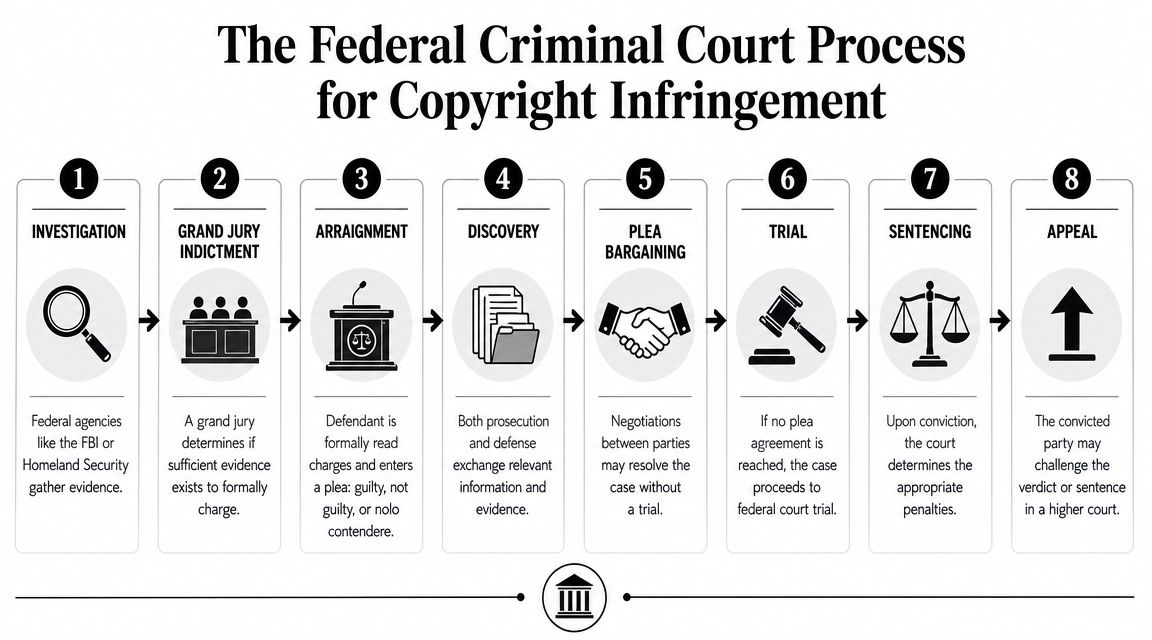
A federal copyright case often follows this pattern:
Investigation
Agents collect records, issue subpoenas, review account activity, and interview witnesses. Search warrants may target devices, cloud storage, business records, or communications.Grand jury and indictment
Prosecutors present evidence and ask for formal charges. Many defendants first learn the case is serious when an indictment is returned or an arrest warrant is issued.Initial appearance and arraignment
A federal magistrate judge addresses identity, release conditions, counsel, and the charges. Conditions can affect travel, computer access, contact with witnesses, and business operations.Discovery review
The defense gets access to the government's evidence under federal rules and protective orders. In these cases, that can mean large volumes of digital material, contracts, licensing records, server logs, messages, and expert analysis.Pretrial motions and negotiations
At this stage, defense strategy starts to shape the case in a concrete way. The issues may include search warrant challenges, suppression of statements, attribution of online activity, authorship, licensing scope, valuation, and whether the government can tie the conduct to one person rather than a loose group of employees or users.Trial or negotiated resolution
Some cases should be tried. Others are better handled through a plea strategy built around limiting exposure, protecting a business, and reducing sentencing risk.
Federal court requires a different kind of defense planning
People used to state court in Fulton, Forsyth, Cobb, or Gwinnett often expect a familiar rhythm. Federal court is more document-heavy, more structured, and less forgiving of delay. Deadlines matter. So do offhand emails, deleted messages, and inconsistent explanations.
I treat these cases as records cases first. The government will try to build intent from documents, account access, warnings, payment trails, and digital history. Defense counsel has to do the same work, faster and more carefully, to identify who controlled the accounts, what permissions existed, what the client understood at the time, and where the government's timeline breaks down.
One bad early decision can narrow the defense.
Waiting to see whether the problem stays civil is often a mistake. If agents are involved, if subpoenas have gone out, or if a grand jury is in play, the case already sits in a very different category than the local charges many people know from state court.
Common Defenses and Mitigation Strategies
An accusation is a starting point, not a result. In copyright infringement cases with criminal implications, defense work usually turns on narrowing what happened, why it happened, and whether the government can prove the mental state it needs.

The strongest defenses are factual, not emotional
The most effective defense themes are usually concrete:
Lack of willfulness
The government may be able to show use, but not knowing criminal conduct. Poor recordkeeping is not the same thing as deliberate infringement.License or permission
Many cases hinge on contracts, invoices, vendor terms, scope-of-use language, and who had the authority.Independent creation
Similarity alone doesn't prove copying if the work was created independently.Fair use
This is highly fact-specific and often misunderstood. It can be powerful, but it's not a slogan you paste onto bad facts.Technical mismatch
In digital cases, the system may have processed, indexed, or transmitted data without creating the kind of legally significant copy the government alleges.
AI cases require technical defense, not buzzwords
AI-related claims are already testing bad assumptions. According to the Copyright Alliance's analysis of AI copyright infringement litigation, courts are rejecting the argument that copied works become non-infringing solely because they are stored as mathematical representations. In the Stable Diffusion litigation, a court order stated that this did not defeat an infringement claim.
That point matters because a modern defense can't stop at “the model only learned patterns.” Counsel may need to examine ingestion pipelines, training data handling, retention, output behavior, and whether the system was designed in a way that reproduces protected expression.
Mitigation can matter even when the facts are rough
When evidence is strong, the defense still has work to do. Mitigation may include:
- Immediate preservation and cleanup without spoliation. Stop ongoing use, but do it correctly.
- Showing poor compliance instead of criminal purpose. Prosecutors care about how the story fits intent.
- Identifying who did what. Decision-making authority matters.
- Organizing the technical record early. Sloppy digital evidence hurts defendants.
- Negotiating from facts, not panic. Fast admissions rarely improve a federal case.
Some clients want a magic phrase that makes copyright disappear. There isn't one. Effective work is more disciplined: control the evidence, challenge willfulness, test the government's technical assumptions, and avoid making the case worse with casual explanations.
Criminal Charges vs Civil Lawsuits
A copyright dispute can start with a demand letter and end with a federal agent at your door. Those are different problems, and treating them the same is a serious mistake.
A civil lawsuit is filed by the rights holder. The goal is money, an injunction, or both. A criminal case is brought by the United States, and the stakes change fast. Now the issues include charging decisions, search warrants, statements to investigators, bond conditions, sentencing exposure, and a permanent federal record.
That distinction matters for people in North Atlanta who are used to seeing criminal cases through a state-court lens. A DUI in Alpharetta Municipal Court or a drug case in Forsyth County follows one set of rules and expectations. A federal copyright prosecution does not. The procedure is different, the investigation is usually slower and more document-heavy, and a bad early decision can shape the entire case before you ever get to court.
Criminal vs. Civil Copyright Cases at a Glance
| Aspect | Criminal Case | Civil Lawsuit |
|---|---|---|
| Who brings it | The U.S. government | The copyright owner or rights holder |
| Main objective | Conviction, punishment, deterrence | Money damages, injunctions, other civil remedies |
| Burden of proof | The government must prove the charge beyond a reasonable doubt | The plaintiff has a lower burden than in a criminal case |
| Intent | Willfulness is often a central fight | Liability may be alleged even if intent is disputed |
| Possible consequences | Prison exposure, criminal fines, supervision, forfeiture issues | Damages, attorney's fees in some cases, injunctions, litigation costs |
| Property risk | Devices and business systems may be seized, searched, or held as evidence | Copies and related materials may still be targeted, but punishment is not the goal |
| Defense focus | Protect rights, limit statements, challenge intent, test the government's proof, handle federal procedure | Contest ownership, copying, damages, and the scope of any court order |
One practical point gets missed all the time. In a civil case, a lawyer may focus on settlement value and business interruption. In a criminal case, counsel also has to think like a white-collar criminal defense lawyer. The defense has to account for subpoenas, device imaging, witness exposure, and whether a client or employee has already said something the government will later call an admission.
The overlap between the two paths creates its own danger. A company may be sued first, respond casually, and only later realize those emails, declarations, or internal chats can be used in a criminal investigation. I have seen clients assume they are just handling a business dispute when they are effectively building the government's timeline for them.
Civil exposure threatens your bank account and operations. Criminal exposure threatens your liberty, your record, your professional licenses, and your influence in every conversation that follows.
How a North Atlanta Criminal Defense Lawyer Can Help
Federal cases may be filed outside the local state-court system you know, but your life is still here. Your job is here. Your family is here. Your business records, devices, employees, and witnesses may be in Alpharetta, Roswell, Johns Creek, Cumming, Milton, Marietta, or elsewhere across North Atlanta.
That local reality matters.
A defense lawyer handling a federal copyright investigation needs to do more than recite intellectual property concepts. The work includes controlling communication with investigators, reviewing how digital evidence was collected, evaluating willfulness, preserving favorable records, and dealing with the case as a white-collar criminal matter. That's the same reason clients facing fraud, embezzlement, or records-based prosecutions look for focused white-collar crime defense rather than general legal help.
The right lawyer also understands how to talk to people who didn't expect to be in federal court at all. Many clients are far more familiar with a DUI stop, a license suspension issue, or a misdemeanor calendar than with federal subpoenas and prosecutors. They need direct advice, quick decisions, and a defense strategy that starts before the government locks in its version of the facts.
If there's one practical takeaway, it's this. Don't treat a federal copyright problem like a customer service dispute, and don't treat it like an ordinary state charge. It has its own rules, its own risks, and very little room for improvisation.
If you're dealing with a copyright accusation that may involve federal criminal exposure in Alpharetta, Roswell, Johns Creek, Milton, Cumming, Marietta, or the surrounding North Atlanta area, Brian Hansford Law offers free, confidential consultations. Brian Hansford brings over 25 years of legal experience, including service as a former prosecutor, and defends clients facing high-stakes criminal and white-collar allegations with the urgency these cases demand.
