
You sit down with a defense lawyer after a DUI arrest in Alpharetta, a drug possession charge in Cumming, or a reckless driving citation in Roswell. You close the door and assume the room is sealed. That instinct is mostly right. Attorney-client privilege exists so you can speak plainly about bad facts, mistakes, and fear without worrying that your own lawyer will become a witness against you.
But that protection isn't absolute.
One of the fastest ways people damage their own case is by misunderstanding what privilege covers. A lawyer is there to defend you against charges, protect your license, challenge weak evidence, and guide you through court. A lawyer is not a safe channel for planning how to hide evidence, pressure a witness, move assets, or clean up a new problem connected to the case.
That line matters in North Georgia courtrooms. It matters in Fulton County, Forsyth County, Cobb County, Cherokee County, and Gwinnett County. It matters whether you're looking for a DUI lawyer in Johns Creek, a speeding ticket lawyer in Milton, a misdemeanor defense attorney in Marietta, or a felony defense lawyer near you after an arrest. If you're dealing with court deadlines, a looming license suspension, or the stress of an active criminal investigation, you need to understand the crime fraud exception before you say the wrong thing for the wrong reason.
When Attorney-Client Privilege Is Not Absolute
A worried client usually asks some version of the same question: “Can I tell you everything?”
For past events, the answer is generally yes. If you drank before driving in Sandy Springs, if police searched your car in Duluth, or if you're trying to figure out how to fight a traffic ticket in Alpharetta, your lawyer needs the truth. Good defense work starts with facts, not spin.

The problem starts when a conversation shifts from defense to assistance with new wrongdoing. That's the plot twist people miss. Privilege protects legitimate legal advice. It doesn't exist to make a lawyer part of a cover-up.
The comfort people expect
Most clients come in thinking privilege works like a locked room. In many ways, that's the right idea. You should be able to tell your DUI attorney what happened before the stop, what you said to police, whether field sobriety tests were given, and what you're worried the prosecutor will claim.
You should also expect your lawyer's office to treat sensitive information with care. If you're interested in broader best practices for managing client confidentiality, that discussion helps explain why law offices build systems around privacy, access control, and careful communication.
The moment the risk changes
The danger isn't confessing a past act to your lawyer. The danger is asking the lawyer to help with an ongoing or future act.
A simple example shows the difference. Saying, “I had been drinking before I drove in Roswell,” is the kind of information a DUI lawyer needs. Saying, “How do I keep the State from finding the damaged car before court?” creates a very different problem.
Practical rule: A defense lawyer can protect you while you face charges. A defense lawyer can't be used as a shield for a new scheme.
That issue often surfaces when people receive legal papers or a demand to turn over information. If you're already anxious about whether someone can force testimony or documents, it helps to understand what a subpoena means before you react impulsively.
In Georgia criminal defense, especially around DUI, drug, traffic, and theft cases, this doctrine matters because many clients are dealing with stress in real time. Stress leads to bad questions. Bad questions can create avoidable legal exposure.
What Is the Crime-Fraud Exception in Georgia
The easiest way to understand the crime fraud exception is this: your lawyer's office is a vault for discussing the past, not a workshop for building future misconduct.
That distinction is the heart of the rule. The law wants clients to speak openly with counsel about completed events so lawyers can give real advice. The law does not protect communications if a client seeks legal help to carry out or advance a crime or fraud.
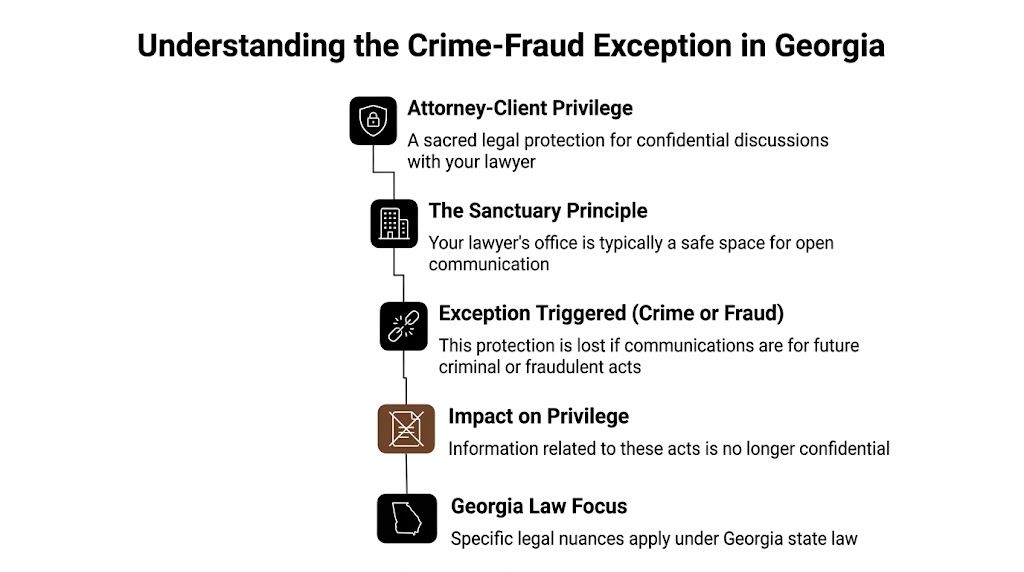
The vault and the workshop
If you were arrested for DUI in Cumming and you tell your lawyer, “I had two drinks and I panicked during the stop,” that is exactly the kind of confidential communication privilege is meant to encourage.
If you ask, “Can you tell me the safest way to get rid of the bottle before police come back with a warrant,” you've moved from the vault into the workshop. The question is no longer about defending a charge. It's about using legal advice to help a wrongful act.
That is where the crime fraud exception enters.
The legal test is stricter than people think
The rule is not loose or casual. The crime-fraud exception to attorney-client privilege operates under a strict two-part legal standard that requires courts to demonstrate both that the client was committing or intended to commit a crime or fraud, and that the attorney's assistance was obtained in furtherance of that criminal or fraudulent activity. The party trying to break privilege must show “a reasonable basis to suspect” both parts, and mere suspicion that privileged communications contain evidence of wrongdoing is not enough, as explained in McGuireWoods' discussion of the crime-fraud exception.
That matters for worried clients because prosecutors don't get to say, “We think something bad is in those conversations, so turn everything over.” They need more than curiosity.
Here is the practical breakdown:
- First part of the test: The client must have been committing, or intending to commit, a crime or fraud.
- Second part of the test: The communication with the lawyer must have been used to further that wrongdoing.
- What doesn't qualify: A conversation that only reveals a past act, without seeking help to continue or conceal it.
A lawyer can hear ugly facts. What triggers the exception is using the lawyer's advice as a tool in the misconduct.
Why this distinction protects honest clients
People often fear that if they admit something bad, their lawyer can be forced to repeat it in court. That's not how this works. The doctrine is aimed at abuse of the attorney-client relationship, not ordinary defense preparation.
For someone hiring a DUI attorney in Roswell, a reckless driving lawyer in Milton, or a drug possession lawyer in Johns Creek, the practical rule is simple. Be candid about what already happened. Don't ask your lawyer how to tamper with what happens next.
A lot of confusion comes from the phrase “crime fraud exception” itself. It sounds as if any communication touching a criminal charge is exposed. That isn't the standard. The issue is not whether the subject matter is criminal. The issue is whether the communication was meant to help commit, continue, or conceal wrongful conduct.
How Georgia Courts Apply the Exception to Criminal Cases
Georgia lawyers often work with federal concepts in this area because the broad structure is familiar. But in state court practice, especially in common criminal cases, the local picture is less neatly mapped out than people assume.
That uncertainty matters if you're facing a misdemeanor in municipal or state court, or a more serious case in superior court in North Atlanta. A client with a DUI in Alpharetta or a drug charge in Forsyth County usually wants a yes-or-no answer about privilege. Georgia law does not always give one that cleanly.
Georgia follows familiar principles, but the details are thinner
A major issue in this area is that Georgia's adoption under O.C.G.A. § 24-5-501 lacks detailed appellate precedents, especially regarding in-camera reviews for common offenses like DUI or drug charges. That gap leaves clients and lawyers with fewer Georgia-specific guideposts in the everyday cases people face in local courts, as discussed in this analysis of Georgia state court application.
In practical terms, that means a judge in Fulton County, Cobb County, or Gwinnett County may look to familiar common law reasoning, but there may not be a deep stack of Georgia appellate decisions answering every version of the problem.
That doesn't make privilege weak. It means local judgment and careful lawyering matter more.
What a judge usually wants to see
A prosecutor can't rummage through defense communications because they suspect the defendant is dishonest. Courts still require a real showing before they intrude. The threshold is often described in legal terms such as a prima facie showing, but clients usually understand it better this way: the State needs credible, non-privileged facts that point to actual misuse of the lawyer-client relationship.
That requirement is one reason defense counsel spends so much time attacking the foundation of the State's request. If the government's theory depends on guesswork, leaps, or broad accusations, the court should stop the inquiry before it reaches private communications.
In court, “we think there may be something there” should never be enough.
Why local procedure affects defense decisions
The practical challenge in Georgia is that misdemeanor and traffic-related cases often move quickly. A person who needs a traffic ticket attorney in Marietta or a license suspension lawyer near Milton is often dealing with hearings, deadlines, officer testimony, and documents on short notice. When a privilege issue gets raised in that setting, speed can become the enemy.
That is one reason experienced lawyers focus early on the chain of evidence, the purpose of each communication, and whether the State can connect the conversation to an alleged future act. Questions about admissibility of evidence often overlap with these disputes because the prosecution still has to show the court why any challenged material should be seen at all.
A second local reality is that Georgia criminal cases often involve mixed facts. A DUI might also involve an accident. A theft case may overlap with a business dispute. A juvenile matter may involve family conflict. Those mixed facts can tempt prosecutors to stretch the doctrine beyond its proper use.
A disciplined defense response keeps the judge focused on the narrow question. Was this a legitimate consultation about an existing legal problem, or was legal advice being used to push wrongful conduct forward? That framing can make all the difference.
Common Scenarios That Can Trigger the Exception
Clients usually understand the rule once they hear it applied to real facts. The pattern is consistent. Talking about a completed event is one thing. Asking for help with concealment, witness pressure, false evidence, or another wrongful act is something else.
Courts have recognized that the exception can reach frauds, torts, breaches of fiduciary duty, cover-ups, subornation of perjury, and sham litigation, but the key remains the same. The legal advice must be used to facilitate or conceal the wrongful act, not solely to discuss it, as explained in this Yetter Coleman overview.
DUI and hit-and-run fallout
A Roswell driver meets with a DUI lawyer after an arrest. Protected communication sounds like this: “I drank before driving, I touched the curb, and I told the officer I was nervous.”
An at-risk communication sounds like this: “Can you help me figure out how to repair the car before investigators photograph the damage from the crash?”
The first statement is defense preparation. The second seeks help concealing evidence tied to ongoing exposure.
Drug possession and witness pressure
A young adult in Johns Creek is charged with possession after police stop a vehicle. The client tells the lawyer, “The drugs were in the console, and my friend is the one who handed me the bag.” That is the kind of frank discussion a defense attorney needs.
The problem begins when the client asks, “What can I say to my friend so he won't come to court?” A request for guidance on witness intimidation, even if framed indirectly, puts privilege at risk.
Theft, fraud, and moving money
A Marietta client charged with theft or fraud may need to explain account activity, text messages, and business records. That is ordinary and necessary.
The conversation becomes dangerous if the client asks how to move money, hide assets, or create a false paper trail before records are subpoenaed. In many white-collar and mixed civil-criminal cases, the cover-up creates its own set of consequences.
Traffic cases that seem minor, but aren't
People make a serious mistake when they assume this issue only belongs in felony court. A person looking for a speeding ticket lawyer in Alpharetta or a reckless driving lawyer in Sandy Springs may think the stakes are low because the original charge feels manageable.
But the exception concerns the new use of the communication, not the label on the original case. If someone asks a lawyer how to get rid of dash cam footage, pressure a passenger to change a statement, or submit false documents to avoid a license consequence, the misdemeanor posture of the case won't make that conduct harmless.
A small case can become a big case if the client turns defense planning into obstruction planning.
A quick way to self-check your question
If you're not sure whether a planned conversation is safe, ask yourself:
- Am I describing what already happened? That is usually where privilege does its best work.
- Am I asking how to avoid detection for something I still plan to do? That is where the risk spikes.
- Am I trying to shape evidence, influence testimony, or hide property? Those are danger signals.
- Would this sound bad if a judge heard it out loud? If yes, stop and rethink the question.
That self-check won't replace legal advice, but it can stop a panicked client from crossing a line.
Protecting Your Communications with Your Defense Attorney
The safest approach is also the most effective one. Tell your lawyer the full truth about the past, then let the lawyer build the defense. Don't ask for help with new misconduct, cleanup work, witness pressure, or evidence games.
That advice matters even more because the rule isn't applied identically everywhere. Every state recognizes the exception, but its scope varies, and applicability “almost always turns on the particular facts of each case,” which is why local legal advice matters so much, as explained in this Nolo discussion of state-by-state variation.
What good client communication looks like
Strong defense representation depends on candor. A DUI attorney can't evaluate a stop, a blood test issue, or a field sobriety challenge if the client hides key facts. A drug possession lawyer can't assess search issues if the client leaves out where an item was found. A misdemeanor defense attorney can't prepare for trial if the story changes every week.
But honesty is not the same thing as asking a lawyer to solve a new illegal problem.
Attorney Communications Protected vs At-Risk
| Protected Communication (Discussing the Past) | At-Risk Communication (Planning for the Future) |
|---|---|
| “I had been drinking before I drove in Milton.” | “How do I avoid the police finding the open container they didn't seize?” |
| “The officer found pills in my backpack during the stop.” | “What should I text my friend so she takes the blame?” |
| “I said something stupid during questioning.” | “Can you help me line up a false explanation before court?” |
| “My license is suspended and I'm scared about what happens next.” | “How can I keep driving without getting caught before the hearing?” |
| “There are bank records that look bad for me.” | “How do I move the money so the records don't matter?” |
Rules that work in real cases
- Be complete about the past: Your lawyer can only protect what your lawyer understands.
- Ask for legal options, not illegal tactics: “What are my defenses?” is a safe question. “How do I hide this?” is not.
- Don't test hypotheticals that mirror a plan: Clients sometimes disguise intent as theory. Judges and prosecutors notice.
- Let your lawyer control contact strategy: If a witness, co-defendant, officer, or investigator is involved, don't freelance.
- Pause before texting sensitive details: Conversations with counsel need care in timing, wording, and medium.
The best attorney-client relationship is built on blunt facts, not clever workarounds.
This is one area where restraint helps. If you're upset, embarrassed, or afraid of jail, your instinct may be to fix things fast. Slow down. A rushed message or impulsive question can create a problem your lawyer then has to spend time containing.
How the Crime-Fraud Exception Impacts Defense Strategy
When prosecutors raise the crime fraud exception, they are usually trying to do more than win an argument over privilege. They are trying to widen the field. If they can convince a judge that a communication falls outside protection, they may gain access to material that changes motion practice, plea advantage, witness examinations, or trial preparation.
That is why defense counsel treats these disputes as strategic fights, not side issues.
How the courtroom battle usually unfolds
The process is demanding. First, the party invoking the exception must present prima facie evidence of a crime or fraud. If that threshold is met, the judge may review the material in camera. Mere allegations are not enough, and the structure is designed to prevent fishing expeditions, as summarized in this EDRM explanation of the two-step process.
A good defense response usually focuses on three points:
- The State has not shown enough to justify breaching confidentiality.
- The communication was about legal advice concerning past events, not future wrongdoing.
- The alleged link between the communication and the misconduct is too weak or too speculative.
What defense lawyers do to push back
This fight often looks similar to other pretrial evidence battles. The prosecutor files a motion. The defense challenges the factual basis, narrows the issue, and presses the judge to enforce the legal threshold carefully. In some cases, the larger logic resembles motion work around what a suppression hearing is, because the court is deciding whether the State can cross a line before using contested material.
The important point for clients is that an accusation does not equal a ruling. Judges still have to evaluate the claimed basis for piercing privilege. A defense lawyer who understands local courts, local prosecutors, and local habits of proof is in a much better position to keep a broad accusation from turning into a damaging order.
Urgent Questions about the Crime-Fraud Exception
People usually don't ask academic questions about this doctrine. They ask because they're scared. They already said something, they're thinking about saying something, or they just realized their case may involve more risk than they thought.

Does this only apply in major felony cases
No. It can matter in serious felony prosecutions, but it can also matter in misdemeanor and traffic-related cases if the communication is tied to ongoing wrongful conduct.
A DUI in Fulton County, a reckless driving charge in Cobb County, or a drug possession case in Forsyth County can all raise this issue if someone tries to use legal advice to conceal evidence, shape testimony, or continue a scheme.
What if I already said something I shouldn't have
Stop talking about that subject until your lawyer advises you how to proceed. Don't repeat it by text. Don't explain it to family. Don't try to “fix” it with a follow-up message. People often make the damage worse by elaborating.
Your lawyer needs the exact context, the exact wording if you remember it, and the timing. Those details matter. So does whether the statement described a past act, a possible future act, or a direct request for help.
Can I still be honest with my lawyer
Yes. You should be honest with your lawyer. That is not the problem.
The safer rule is this: be completely honest about what already happened, what police know, what evidence may exist, and what you're worried the State will argue. Don't ask for advice that would help you commit, continue, or cover up a wrongful act.
What if I was just venting and not serious
Intent matters, but context matters too. Courts look closely at what the client was trying to do with the communication. A frustrated statement is different from a real effort to get tactical help for concealment or obstruction.
That said, people under stress often communicate badly. If a message can be read as a request for help with future wrongdoing, don't assume everyone will read it charitably.
Can the exception apply if the lawyer did nothing wrong
Yes. The focus is not always on whether the lawyer knowingly joined misconduct. The danger can arise from the client's attempt to use the lawyer's advice or services in furtherance of the conduct.
That is another reason not to test the boundary with “hypothetical” questions that are really action plans.
Does this affect my DUI defense, license case, or ticket case right away
It can. Privilege disputes can complicate pretrial strategy, delay motion practice, and give prosecutors another path to seek information. In a fast-moving case involving a looming suspension, court date, or compliance issue, that distraction can cost time you need for the actual defense.
What should I do today if I'm worried about this
Take these steps immediately:
- Write down the timeline: Note when the communication happened and what prompted it.
- Preserve messages: Don't delete texts, emails, voicemails, or call logs.
- Stop discussing the topic with others: Friends and family are not protected channels.
- Get local advice quickly: Georgia-specific judgment matters in this area.
- Focus on defense, not cleanup: Let your lawyer handle the legal response.
If you're uncertain whether a statement crossed the line, assume it needs legal review now, not later.
If you're searching for a DUI lawyer in Alpharetta, a traffic ticket attorney in Roswell, a drug possession lawyer in Cumming, or a misdemeanor defense attorney near Johns Creek, the urgency is real. The earlier a defense lawyer can assess the communication, the more options you usually preserve.
If you're facing DUI, traffic, drug, theft, or other criminal charges in Alpharetta, Roswell, Johns Creek, Milton, Cumming, Marietta, or the surrounding North Atlanta area, Brian Hansford Law can help you act quickly and protect your position. The firm handles high-stakes criminal defense matters with the perspective of a former prosecutor and the focus of a dedicated defense practice. If you need fast guidance on privilege issues, court deadlines, license risks, or your next move after an arrest, reach out for a confidential consultation now.
