
When you're faced with a criminal charge, your world can feel like it's spinning out of control. The first, most immediate instinct for many is to grab their phone and search for a "criminal defense lawyer near me." That's a good start, but finding the right local lawyer—one who can genuinely protect your future—is about more than just a quick search.
This guide is about moving past that initial panic and building a smart, targeted list of attorneys who know the local courts inside and out.
Starting Your Search for a Local Criminal Defense Lawyer
Finding a qualified lawyer can feel like a monumental task, especially when you're already stressed. It's not just about typing a few words into a search bar. It's about a strategic hunt for an attorney who is not only skilled but also deeply familiar with the specific court system where your case will be heard.
Whether your case is in Cumming, Johns Creek, Milton, or anywhere else in Forsyth County, a lawyer's local experience can be a game-changer.

The real goal here is to put together a solid list of potential candidates before you even start making calls. By using the right resources and knowing what to look for, you can create a strong foundation for finding the best possible representation.
Effective Search Methods Beyond Google
A standard online search is a decent first step, but it should never be your only one. To build a truly well-rounded list of lawyers in areas like Alpharetta, Roswell, or Marietta, you need to dig a little deeper into more specialized resources. These platforms are designed specifically to connect people with vetted, credible legal professionals.
To get the best results, it helps to understand what each search method is good for.
Effective Search Methods for Finding a Local Lawyer
| Search Method | What It Is | Best For Finding |
|---|---|---|
| State Bar Directories | The official roster of every licensed attorney in the state, like the State Bar of Georgia. | Verifying an attorney's license, checking for disciplinary actions, and confirming they're in good standing. |
| Trusted Legal Directories | Websites like Avvo, Super Lawyers, or Martindale-Hubbell that offer profiles, client reviews, and peer ratings. | A broad overview of an attorney’s reputation, specialties, client feedback, and professional recognition. |
| Personal & Community Referrals | Recommendations from trusted friends, family, or business colleagues who have worked with a lawyer. | Honest, firsthand accounts of an attorney's communication style, professionalism, and results. |
| Targeted Local Search | Using specific search terms like "DUI lawyer Alpharetta" or "theft defense Johns Creek." | Attorneys who actively practice in your specific city and focus on your particular type of charge. |
Each of these avenues gives you a different piece of the puzzle. Using a mix of them ensures you're finding professionals with the right credentials and a solid reputation in places like East Cobb or Cobb County. For more tips, this guide on how to find a criminal lawyer offers additional strategies to narrow your search.
It's easy to feel overwhelmed by the options. Labor-market sources estimate there are over 252,000 criminal defense lawyers in the U.S. as of 2025, working within a legal services market projected to hit nearly $397 billion. This huge number just highlights why a structured, methodical search is so important—it helps you cut through the noise.
Why Local Courtroom Experience Matters
This is a point we can't stress enough: find a lawyer who regularly practices in the exact courthouse where your case will be heard. An attorney who is a familiar face in the Forsyth County courthouse, for example, will have a working knowledge of the local prosecutors and judges.
This isn't about backroom deals or special favors. It’s about understanding the personalities, procedures, and unwritten rules of that specific court. They’ll know which arguments resonate with which judges and how certain prosecutors tend to negotiate. That kind of localized insight is an invaluable asset you just can't get from someone who doesn't work there often.
An attorney who spends most of their time in Marietta might have a totally different perspective than one who is constantly in court in Johns Creek or Milton. As you build your list, pay close attention to which lawyers mention your specific city or county on their websites. It’s a small detail, but it can signal a much deeper level of relevant, local experience.
Evaluating a Lawyer's Experience and Credentials
Okay, you’ve got a shortlist of potential attorneys. Now the real work begins. This is the part where you move past just collecting names and start digging into the details that actually matter for your case.
Evaluating a lawyer’s background, professional standing, and real-world experience is the single most important step you'll take. It’s more than just a quick scan of their website—it’s about verifying their credentials and making sure they have what it takes to handle your situation.

Verifying Professional Standing
Before you get lost in case histories and testimonials, make your first stop the official State Bar of Georgia. This is a non-negotiable step. Here, you can confirm that an attorney is licensed, in good standing, and—crucially—has no public disciplinary actions on their record. It's a simple check that provides foundational peace of mind.
This isn’t just a formality. An attorney’s standing with the bar is a direct reflection of their ethics and professionalism. It tells you they’re authorized to practice law in Georgia and have met the state's rigorous standards.
Matching Experience to Your Specific Situation
Criminal defense is not a one-size-fits-all field. The lawyer who excels in complex, white-collar fraud cases isn't necessarily the right fit for a DUI charge in Roswell or a drug possession case in Marietta. You need to find someone with relevant, specific experience that mirrors your exact situation.
As you review a lawyer’s website, look for clear evidence they handle cases like yours. Don’t settle for generic lists.
- DUI Defense: Do they talk about their strategies for challenging field sobriety tests or breathalyzer results in local courts like Cumming or Alpharetta?
- Drug Offenses: Do they mention their track record with motions to suppress evidence in Forsyth County or Cobb County drug cases?
- Theft or Property Crimes: Can you find examples of how they’ve handled everything from shoplifting to more serious theft charges in jurisdictions like Milton or Johns Creek?
This kind of focused experience is critical. It means the lawyer already knows the local prosecutors, judges, and court procedures for your type of charge. To go even deeper on this, check out our guide on how to choose a criminal lawyer.
When searching for a "criminal defense lawyer near me," you'll find firms of all sizes. Data shows that about 75% of U.S. law firms have six or fewer attorneys, and 40% are solo practitioners. You're very likely to be working with a small, specialized firm, which makes evaluating that specific lawyer's experience even more vital.
Reading Between the Lines of Client Reviews
Client reviews on sites like Google and Avvo offer great insight, but you have to read them with a critical eye. Forget the star rating for a moment and focus on the details within the reviews themselves. Are you seeing patterns?
Do multiple clients praise their communication skills? Does their deep knowledge of the East Cobb court system come up again and again? These recurring themes are far more telling than one five-star review.
Identifying Potential Red Flags
Spotting red flags is just as important as finding positive signs. Be very wary of any attorney who guarantees a specific outcome.
No ethical lawyer can ever promise a dismissal or an acquittal—the justice system is just too unpredictable. Other warning signs include a lack of transparency about fees, poor communication when you first reach out, or a vague website that doesn’t provide specifics about their background.
A true professional will be upfront, clear, and focused on explaining your options and their strategy, not on making empty promises. You need someone who inspires confidence through competence, not salesmanship.
Making the Most of Your Initial Consultation
That first meeting with a potential lawyer is probably the single most important step in the entire process. This is your chance to really size them up, get a feel for their approach, and decide if this is the person you want to trust with your future. Walking in prepared makes a night-and-day difference.
Think of it less as you telling your story and more as a job interview—where you're the one doing the hiring. A client who comes in organized gets better, more specific information right from the start.
What to Bring to the Meeting
Showing up empty-handed is a huge missed opportunity. To get the most out of the conversation, you need to bring every piece of paper you have related to the case. The more details you can give an attorney upfront, the clearer the picture they'll have of what you're up against.
Try to gather these items:
- Charging Documents: This is the ticket, citation, or any official paperwork you got from the police or the court. It lists the exact laws they're accusing you of breaking.
- Bail or Bond Paperwork: If you were bonded out of jail, bring those documents.
- Police Reports: If you managed to get a copy of the police report, it's one of the most helpful documents you can provide.
- A Written Timeline of Events: While it's all still fresh in your mind, write down everything you remember. Start to finish. Include dates, times, locations, and the names of anyone who was there.
- A List of Questions: Don't try to remember everything on the fly. Write down your questions ahead of time. Some essential ones are provided below.
This level of preparation signals to the attorney that you're taking this seriously and helps them give you a real, substantive evaluation of your situation.
Key Questions to Ask a Potential Lawyer
Your questions need to dig deeper than just, "What's your fee?" You're trying to get a sense of their experience, how they communicate, and whether they know the ins and outs of the local courts in places like Forsyth County or Cobb County. You're looking for strong, direct answers, which is usually the sign of a confident, seasoned pro.
A consultation is a two-way street. You are not just there to answer questions; you are there to ask them. This is your chance to determine if an attorney's skills, experience, and communication style are the right fit for your specific needs.
Here are a few insightful questions to get you started:
- Who will actually be handling my case? Some big firms have a senior partner meet you, but then a junior associate does all the real work. You need to know exactly who your point of contact will be.
- How much of your practice is strictly criminal defense? You don't want a generalist who dabbles in criminal law. You need someone who lives and breathes it every single day.
- What’s your experience with cases like mine in [Your City/County]? Get specific. Ask about their track record in the actual courthouse your case will be in, whether that's in Cumming, Alpharetta, or Marietta.
- What are the possible outcomes here? A good lawyer will never make guarantees. Instead, they should be able to walk you through a range of potential scenarios, from best-case to worst-case.
- How will you keep me in the loop? Find out their process for communication. Will you get weekly calls? Emails? Scheduled meetings? Knowing this sets expectations and can save a lot of anxiety down the road.
If you want to dig even deeper, you can learn more about what to expect from a criminal lawyer free consultation and how to maximize its value.
Evaluating Their Responses
Pay close attention to how they answer, not just what they say. Are they breaking down complicated ideas into plain English you can actually understand? Do they seem genuinely invested in your situation, or do you feel like just another file on their desk?
A good lawyer is realistic and straight with you. They won’t sugarcoat the challenges ahead, but they will lay out a clear, potential strategy. If you leave that meeting feeling more confused, rushed, or pressured, that's a massive red flag. The right attorney should make you feel heard, understood, and confident that they know what they're doing. This first meeting really does set the tone for everything that follows.
Understanding Legal Fees and Retainer Agreements
Let's talk about the financial side of hiring a lawyer. It's often one of the first things people worry about, and it’s a conversation you need to have right away with any attorney you're considering. The cost for a "criminal defense lawyer near me" can swing wildly depending on the seriousness of the charge, the lawyer's experience level, and how much time they expect to put into your case.
This isn't just about finding the cheapest lawyer. It's about getting clarity and feeling confident in what you're paying for. A transparent fee structure and a solid written agreement mean you and your attorney start on the same page, which is the best way to avoid misunderstandings later on.
Breaking Down Common Fee Structures
In criminal defense, you’ll typically run into a few standard ways lawyers bill for their services. Each model fits different types of cases and legal situations. Understanding them helps you figure out what makes the most sense for you.
Here are the arrangements you'll most likely see in places like Cumming, Johns Creek, or Milton:
- Flat Fees: This is a single, all-inclusive price for a specific legal service. It’s common for more straightforward cases like a misdemeanor DUI or a simple theft charge. People often prefer this because it's predictable—you know the full cost from the start.
- Hourly Rates: The attorney bills you for the actual time they spend working on your case, usually in small increments. This is more common in complex felony cases where it's tough to estimate the total time commitment upfront.
- Retainers: Think of this as a down payment. You pay a lump sum into an account, and the lawyer bills their hourly rate against those funds as they work. If the retainer runs out, you may need to add more money to it.
The legal market in the United States is huge, with projections hitting nearly $397 billion by 2025 and hundreds of thousands of lawyers to choose from. That massive market means you'll find everything from solo attorneys to big law firms, each with their own way of handling fees. You can find more insights about the scope of the legal services market on thebusinessresearchcompany.com.
A fee agreement isn't just a piece of paper; it's the blueprint for your relationship with your lawyer. A clear, written contract protects both of you by spelling out exactly what work will be done, how much it will cost, and when payments are due. Don't ever move forward without one.
To help you get a better handle on these options, here's a quick breakdown of how each one typically works.
Common Fee Structures Explained
| Fee Type | How It Works | Commonly Used For |
|---|---|---|
| Flat Fee | A single, fixed price is agreed upon upfront to cover all work for a specific legal matter. | Misdemeanors, DUIs, traffic offenses, and other predictable cases. |
| Hourly Rate | The lawyer bills for their time in increments (e.g., tenths of an hour). You receive detailed invoices. | Complex felonies, white-collar crimes, or cases with an unknown duration. |
| Retainer Fee | An upfront payment is held in a trust account. The lawyer deducts their hourly fees from this fund as they work. | Cases that will unfold over a long period or require significant ongoing work. |
Understanding these structures is the first step. The next is making sure everything is documented properly.
The Importance of a Written Agreement
No matter how the fees are structured, always get a signed, written retainer agreement. This document is your official record of the financial side of your case. It needs to clearly define what services are included in the price—and just as importantly, what services are not included.
Before you put pen to paper, make sure you have solid answers to these questions:
- What specific work does the flat fee or retainer cover? (e.g., pre-trial motions, court dates, plea negotiations)
- Does this fee cover my case all the way through a jury trial if it gets that far?
- Are there other costs I might have to pay, like court filing fees, private investigator expenses, or expert witness fees?
- How does the firm handle communication? Am I going to be billed for every phone call or email?
- What could happen that might lead to extra charges?
This infographic lays out the key things to bring to your consultation—your documents, your questions, and your goals. This is where you'll have your first detailed discussion about fees.
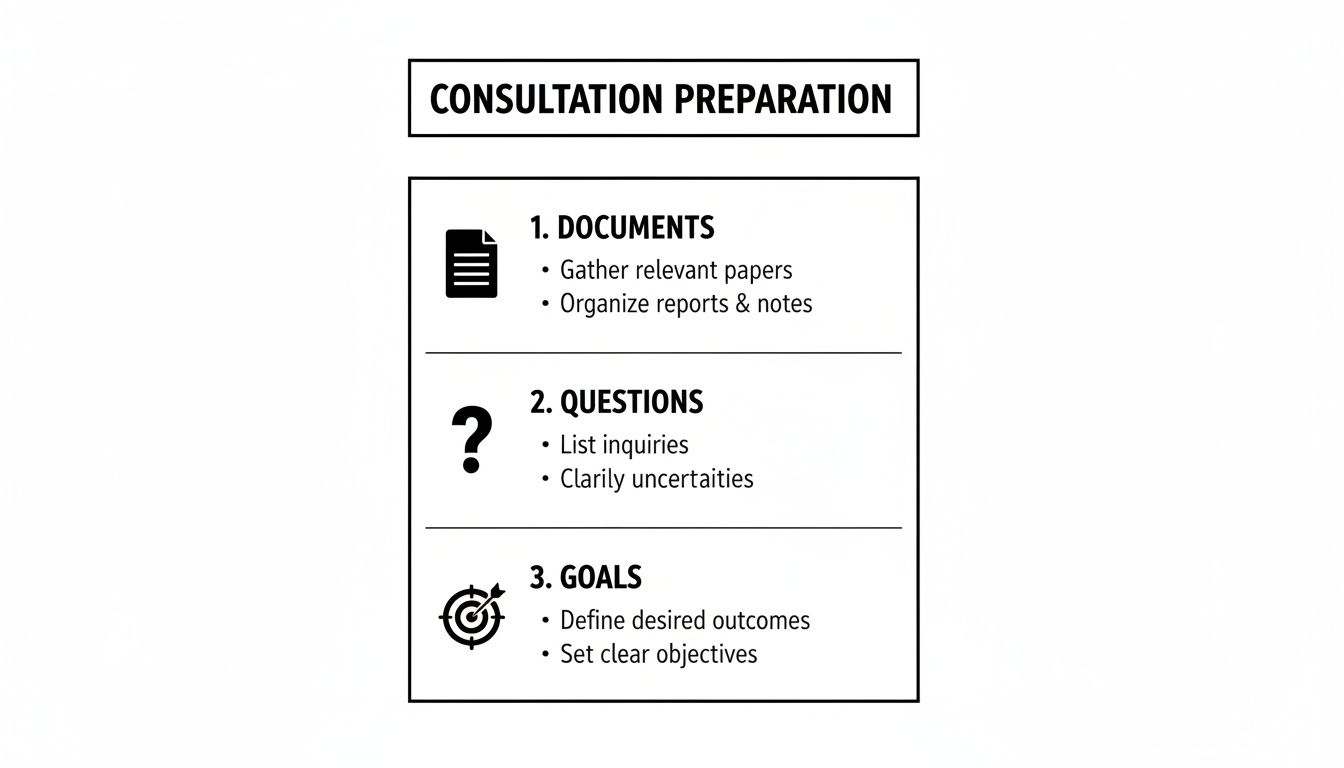
When you walk into a meeting organized, you can have a much more productive conversation about both your case and the costs. This kind of clarity helps you compare potential attorneys in areas like Roswell or Marietta based not just on price, but on the true value and peace of mind they can offer.
So, You've Hired a Lawyer. What Happens Now?
Once you've officially hired a criminal defense attorney, you’ll probably feel a huge weight lift off your shoulders. You’ve made a smart, decisive move. But what comes next? The process can feel like a complete maze, so let's walk through the roadmap of what you can generally expect. This will help you manage your expectations and stay grounded through the process.
The moment you sign that retainer agreement, the real work begins for your legal team. This isn't a passive process where you just sit back and wait; it's a partnership. Your lawyer is in the driver's seat, but your cooperation is absolutely essential.
The First Steps in Your Defense
The very first thing your attorney will do is formally notify the court and the prosecution that they're representing you. This is a crucial step. It immediately puts a stop to law enforcement and prosecutors contacting you directly—from this point forward, all communication has to go through your lawyer's office.
From there, your case will move into a few key phases:
- Discovery: This is where your lawyer formally demands all the evidence the prosecution has against you. This includes police reports, witness statements, any lab results, body cam footage, and audio recordings. They get everything.
- Case Analysis: Your attorney will then dig into every single piece of that evidence. They'll meticulously review it all, looking for weak spots in the state’s case, procedural mistakes by the police, or any violations of your constitutional rights.
- Strategy Meetings: You'll meet with your lawyer to go over everything they’ve found. This is where you provide your side of the story, point out things that are wrong in the police report, and help build a complete picture of what actually happened.
This initial groundwork is the absolute foundation of the entire defense strategy. The information gathered here shapes every single decision made down the road, from filing pre-trial motions to discussing potential plea bargains.
Making Sense of Court Appearances
Your case will involve several court dates, and each one has a specific job to do. While the exact order can shift a bit depending on whether your case is in Forsyth County, Cobb County, or another local jurisdiction, the main events are pretty standard.
The Arraignment is usually your first time in front of the judge. This is where you're formally told what the charges are, and you'll enter a plea. At this early stage, that plea is almost always "not guilty." Your attorney will handle all the talking and make sure everything is filed correctly.
After the arraignment, the case enters the pre-trial phase. This is where most of the heavy lifting gets done. Your attorney might file pre-trial motions, which are just formal requests made to the judge. For example, if there is a belief that the police illegally obtained evidence, a motion to suppress it may be filed. Winning these motions can be a game-changer, sometimes leading to charges being reduced or even dismissed entirely before a trial ever gets close.
The journey through the criminal justice system is a marathon, not a sprint. Each stage, from the initial investigation to the final court date, serves a distinct purpose. Understanding this flow helps you see the bigger picture and appreciate the strategy your legal team is building on your behalf.
Your Role in Your Own Defense
One of the most critical parts of this whole process is keeping an open and honest line of communication with your legal team. Your lawyer can only build the strongest possible defense with the information you give them. It is helpful to be an active participant.
That means you have a few responsibilities, too. Here’s how you can best help your own case:
- Be Responsive: When your lawyer's office calls or sends an email, get back to them as soon as you can. Time is often critical, especially when court deadlines are looming.
- Be Honest and Thorough: Don't hide anything. Don't leave details out, even if you think they’re embarrassing or don't matter. Your attorney needs the complete, unvarnished truth to anticipate what the prosecutor will do and build an effective counter-strategy.
- Stay Organized: Keep all your case documents together in one place. Your own notes, a timeline you've written out, and any new paperwork you get can all be incredibly valuable.
At the end of the day, your lawyer is your guide through this complicated system. They will explain your options at every turn, whether it's thinking over a plea offer from the state or getting ready for trial. By understanding these general stages and what your role is, you can work more effectively with your attorney and face what's ahead with a lot more confidence.
Common Questions When Finding a Lawyer
When you start searching for a "criminal defense lawyer near me," you're going to have a lot of questions. That’s completely normal. The whole process can feel confusing, and getting straight answers is the first step toward taking back some control. Let's break down a few of the most common things people ask.
Understanding the basics will help you make a much more informed decision as you move forward.
Private Attorney or Public Defender
Right off the bat, many people wonder if they should hire a private attorney or go with a public defender. Both are fully licensed lawyers who will represent you in a criminal case. The real difference is how you hire them and what their day-to-day work looks like.
A private attorney is someone you hire directly. You get to research, interview, and choose the lawyer you feel most comfortable with. Because you’re paying them, they can often be more selective about their caseload, which might mean they have more time to dedicate to your specific situation.
A public defender, on the other hand, is appointed by the court for people who can't afford to hire their own lawyer. They are state employees who are in court constantly, handling a huge volume of cases. This gives them an incredible amount of hands-on experience and a deep understanding of the local court system.
It's a myth that one is always "better" than the other. The right choice really comes down to your personal circumstances, how complex your case is, and your financial situation. Both private attorneys and public defenders are dedicated to defending their clients.
Making Sure a Lawyer Has the Right Experience
How can you be sure an attorney has the specific experience your case needs? Criminal law is a massive field. A lawyer who is a powerhouse in DUI defense in Forsyth County might not be the best fit for a complicated white-collar case in Marietta. You need to look for specific, proven experience.
Here’s what to look for:
- Case-Specific Focus: Check out the lawyer’s website. Do they have pages or blog posts dedicated to your type of charge, whether it's a DUI, drug offense, or theft in places like Cumming, Johns Creek, or Roswell?
- Local Court Familiarity: Do they regularly talk about the courts in Cobb County or East Cobb? An attorney who is a familiar face in your local courthouse knows the ins and outs of how things work there, which is a huge advantage.
- Track Record: While no lawyer can promise a specific outcome, they can talk about their approach and how they've handled similar cases. During your first meeting, ask them about their experience with situations like yours.
Finding the right match means digging deeper than a generic "criminal defense lawyer" title to find someone whose practice is truly aligned with what you're facing.
What If You Are Unhappy with Your Current Lawyer
Sometimes, even after doing your homework, the relationship with your attorney just doesn't click. Maybe you feel like you're not getting enough communication, or you disagree on the strategy. If you hit this point, you have options.
First, try to talk it out. Schedule a meeting to voice your concerns directly and honestly. A simple conversation can often clear up misunderstandings.
If that doesn't resolve the problem, you generally have the right to change lawyers. You can hire a new attorney, who will then file a motion with the court to take over your case. As long as it doesn’t create a major delay or mess up the proceedings, judges usually grant these requests.
Facing a criminal charge can be one of the most stressful experiences of your life, but you don't have to navigate it alone. With over 25 years of experience, including time as a former prosecutor, Brian Hansford Law is dedicated to protecting your rights and fighting for the best possible outcome. To discuss your case with an experienced criminal defense attorney, visit us at https://challengemycharge.com.
