
When you hear the term "criminal mischief," it might conjure up images of teenage pranks, but in Georgia, it's a specific misdemeanor charge with serious implications. Put simply, it’s the law’s way of saying a person can't intentionally damage someone else's property. The dividing line is the value of that damage—if it's less than $500, it is often classified as a misdemeanor charge.
This charge often pops up in the heat of the moment. Think of vandalism, arguments between neighbors that escalate, or a fit of anger that ends with a broken phone. It's the legal line in the sand that protects our belongings from deliberate harm.
Deconstructing the Criminal Mischief Charge in Georgia
So, what exactly does the state have to prove to make a criminal mischief charge stick? It's not just about something getting broken. The law lays out a specific recipe, and every ingredient must be present for the prosecution to have a case.
Let's break down the key elements that turn a simple act of property damage into a criminal offense in the eyes of the court.
To make it easier to see how these parts work together, here's a quick breakdown of what a prosecutor needs to prove.
Key Elements of a Criminal Mischief Misdemeanor in Georgia
| Component | Explanation | Example |
|---|---|---|
| Intentional Act | The damage wasn't an accident. The person had to knowingly and purposefully cause it. | Kicking a dent into a car door out of anger, not accidentally bumping it with a shopping cart. |
| Property of Another | The item damaged must belong to someone else. You can't be charged for breaking your own stuff. | Smashing a neighbor’s mailbox, not your own. |
| Actual Damage | The property was actually defaced, destroyed, or tampered with in a way that caused a loss. | Spray-painting graffiti on a building or cracking someone’s phone screen. |
| Damage Value | The cost to repair or replace the property is less than $500. This is the key that keeps it a misdemeanor. | A broken window that costs $350 to fix, not one that costs $1,000. |
Each of these components is a hurdle the prosecution must clear. If even one is missing, the charge can fall apart.
The Element of Intent
First and foremost, the act must be intentional. This is all about a person's state of mind. An accident just doesn't cut it.
If a person knocks over a lamp at a friend's house by mistake, that’s not criminal mischief. But if they get into an argument and deliberately throw that same lamp against the wall, they have now crossed the line into intentional action. The prosecutor has to prove they meant to cause the damage.
Property Damage and Ownership
The next piece is simple: actual damage must happen to property that belongs to someone else. This isn't limited to just smashing things.
- Defacing Property: Think spray-painting a wall, keying a car, or carving initials into a public bench.
- Destroying Property: This is when an item is rendered useless, like shattering a window or stomping on a laptop.
- Tampering with Property: This can be more subtle, like messing with someone's machinery in a way that causes a financial loss or creates a safety hazard.
The core idea here is that you can’t be charged with criminal mischief for destroying your own belongings. The law is there to protect other people's property rights.
The $500 Value Threshold
This is the big one. What separates a misdemeanor from a much more serious felony charge is the $500 threshold. If the cost to repair or replace the damaged property is $499.99 or less, the charge is criminal mischief as a misdemeanor. Once it hits $500, it becomes a felony.
This financial line is absolutely critical. It single-handedly determines the severity of the potential penalties, the court a person will likely face, and the long-term impact a conviction could have on their life. Misdemeanor property offenses like this are far more common than people think, making up a significant portion of arrests and clogging up local court dockets. To get a broader perspective, you can find more about misdemeanor data from the Jail Data Initiative.
How Georgia Splits Misdemeanor from Felony Charges
In Georgia, the world of criminal mischief is split in two. The line in the sand? A simple dollar amount: $500.
This threshold is the single most important factor that decides whether a property damage charge is a manageable misdemeanor or spirals into a life-altering felony. Think of it as a financial tripwire. Crossing it triggers a much more severe response from the courts.
Damaging property valued at $499 is handled very differently than damaging property valued at $501. The actions might be almost identical, but the legal fallout couldn't be more different. This is a common way for the justice system to classify the seriousness of property crimes—it’s not unique to Georgia.
What a Misdemeanor Conviction Really Means
When the damage adds up to less than $500, the charge is classified as criminal mischief misdemeanor. While that sounds less serious than a felony, it's far from a minor inconvenience. A conviction still carries real penalties designed to punish the offender, pay back the victim, and discourage anyone from doing it again.
A judge has a few tools they can use for sentencing, and they can absolutely combine them. That means a single conviction could lead to several consequences layered on top of each other. The stakes are real, and the impact can last long after a court date is over.
Here’s a breakdown of what a person could be facing in Georgia:
- Fines: The court can impose a fine of up to $1,000. This is a direct payment to the state.
- Jail Time: A conviction could lead to time in a county or local jail for up to 12 months.
- Probation: A judge might order up to one year of probation, either instead of or in addition to jail time. This means supervised release with very strict rules.
- Restitution: This one isn't optional in many cases. The court will order the person to pay the victim back for the full cost of repairing or replacing whatever was damaged.
Key Takeaway: The penalties for a criminal mischief misdemeanor are not a slap on the wrist. They involve serious financial costs, the potential loss of freedom, and a year of court-ordered supervision that can turn a person's life upside down.
Getting a Closer Look at Probation and Restitution
Fines and jail time are pretty straightforward, but probation and restitution bring their own ongoing headaches. These aren't one-and-done punishments; they are long-term responsibilities that can be tough to manage.
Probation means a person has to check in with a probation officer regularly, stay out of trouble, and often complete other tasks like community service or anger management classes. If they violate any condition of their probation—even in a small way—the judge can revoke it and send them to jail to serve out their original sentence.
Restitution is a straight-up debt owed to the victim. It has to be paid in full. Failing to pay it can also trigger a probation violation, landing a person in even more legal hot water. The system is designed to make the victim whole, but it also places a heavy financial weight on the defendant long after the case is officially closed.
Real-World Examples of Criminal Mischief
Legal definitions can be a bit abstract. It’s one thing to read the law, but it’s another to see how it plays out in real life here in North Georgia. Let’s move past the textbook language and look at some concrete scenarios that could easily lead to a criminal mischief misdemeanor charge in places like Alpharetta, Cumming, or Marietta.
The common thread in all these situations is the dollar amount. The cost to fix the damage is what separates a misdemeanor from a much more serious felony. As long as the repair or replacement value stays below the $500 felony threshold, the charge remains a misdemeanor. These examples show just how fast a bad decision can spiral into a legal headache.
Common Vandalism and Property Damage
Vandalism is probably what most people think of when they hear "criminal mischief." It’s the classic case of intentionally defacing or damaging someone else's property without their permission.
-
Spray-Painting Graffiti: Someone decides to spray-paint a tag on the wall of a small business in downtown Roswell. The owner gets a quote to have it professionally removed, and the bill comes to $350. Because the act was intentional and the damage is under $500, that’s a textbook criminal mischief misdemeanor.
-
Damaging Public Property: An angry individual kicks a park bench in Marietta, cracking one of the wooden slats. The city’s parks department estimates the repair will cost around $150. Even though it’s public property, it still belongs to "another" (in this case, the citizens of Marietta), so the charge sticks.
Disputes That Escalate
A lot of criminal mischief charges don't start out with a plan to break something. They're often the result of a heated argument where emotions boil over and someone acts impulsively.
A simple disagreement between neighbors or a tense encounter in a crowded parking lot can quickly get out of hand.
Scenario Spotlight: The Parking Lot Dispute
Two drivers get into a heated argument over a parking spot at a busy shopping center in Johns Creek. Frustrated and angry, one person takes their keys and drags them down the side of the other person's car, leaving a long, deep scratch. A local body shop quotes the paint repair at $450. This was a deliberate act of property damage, and since the value is under the felony limit, it’s a classic criminal mischief misdemeanor charge.
Actions During Personal Conflicts
It’s not just strangers. Conflicts between people who know each other—partners, roommates, family members—are a common source of these charges. An argument at home can easily end with a broken possession and a call to the police.
For instance, during a fight in a Milton apartment, one person grabs their partner's smartphone and smashes it against the wall, shattering the screen. If the cost to replace that screen is $275, the act fits the legal definition perfectly. The personal relationship doesn’t change the fact that one person intentionally destroyed property belonging to another. These everyday situations show just how easy it is to find yourself facing a criminal mischief accusation.
Your Guide to the Georgia Court Process
Getting charged with criminal mischief misdemeanor can throw a person into the court system, and that's a confusing place to be. If you've been arrested anywhere from Forsyth County to Cobb County, you're suddenly facing a process that can feel overwhelming and intimidating. Let's walk through it step-by-step so you know exactly what to expect, from the moment of arrest to the first day in court.
Think of it as a timeline. It all starts with the arrest and booking, then moves to an initial court appearance, and from there into a pre-trial phase where the real work on a case begins. Getting a handle on this flow is the first step to taking back some control.
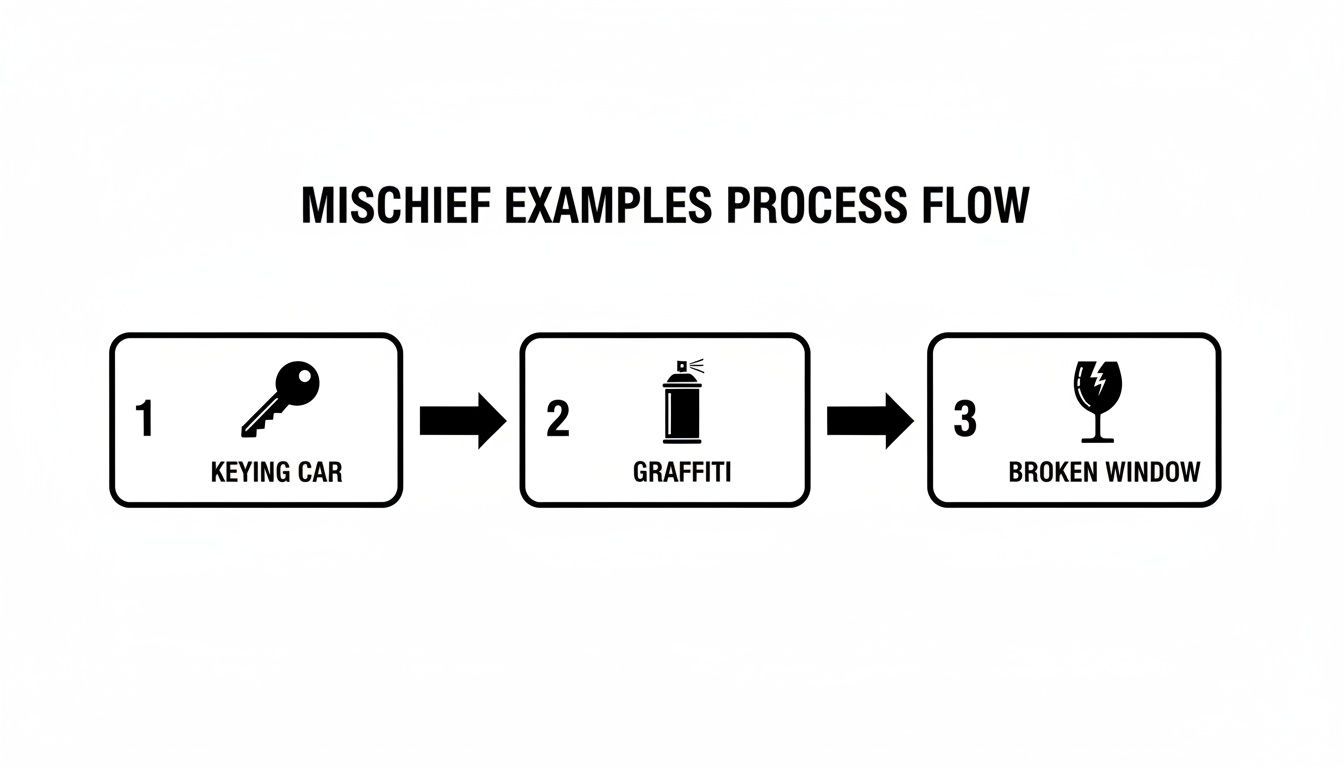
The image above shows a few classic examples—keying a car, spray-painting a wall, or breaking a window. These are exactly the kinds of property damage that, if valued under $500, land a person with a misdemeanor charge and kick off the legal process we're about to break down.
The First 24 Hours: Arrest and Booking
It all begins with the arrest. From there, the individual will be taken to a local jail for booking. This is an administrative process where they take your fingerprints, your photo (the mugshot), and record your personal information. It’s how the system creates an official record of the arrest.
Next up is bond. Bond is simply a financial promise to the court that a person will show up for future court dates. For a misdemeanor, the bond amount is often pre-set, but a judge can also set it at a first appearance hearing, which has to happen within 48-72 hours of an arrest. This can usually be paid directly or through a bail bondsman.
Municipal Court vs. State Court
Where a case will be heard is a big deal, and it all comes down to where the alleged offense happened.
- Municipal Courts: If the incident took place inside city limits—think Alpharetta, Roswell, or Marietta—the case will probably start in that city's municipal court. These courts mostly deal with traffic tickets, city ordinance violations, and some misdemeanors.
- State or Superior Courts: If it happened in an unincorporated area, like parts of Forsyth or Cobb County, the case goes to the county's State or Superior Court. These courts also handle misdemeanor cases if a jury trial is demanded, as well as all felony cases.
The procedures and even the prosecutors are different in these courts, so knowing which system you're in is critical.
Arraignment: Your First Formal Court Appearance
An arraignment is the first official date with the judge. This isn't the trial. At this hearing, the prosecutor will formally read the charges, and the judge will ask how the defendant pleads.
There are three basic options:
- Guilty: Admitting to the charge.
- Not Guilty: Denying the charge. This moves the case forward toward a potential trial.
- Nolo Contendere (No Contest): Accepting the conviction without formally admitting to the act.
Pleading "not guilty" at arraignment is standard practice. It doesn't mean a person is being difficult; it's a procedural step that provides time to get the evidence and figure out the best strategy. Once that plea is entered, the court will schedule future dates for hearings. To get a fuller picture of the entire journey, you can learn more about the complete steps in the criminal justice process.
The Path Forward: Discovery and Negotiations
After the arraignment, the case moves into what’s called the discovery phase. This is where the defense team formally requests every piece of evidence the prosecution has. We're talking police reports, witness statements, body cam footage, photos—everything related to the criminal mischief misdemeanor charge.
This is also when negotiations often start. Once the strength (or weakness) of the state’s evidence is clear, discussions can begin with the prosecutor about a potential resolution. This could lead to a plea deal for a lesser charge or a more favorable sentence, or it could confirm that the best option is to fight the charge at trial.
What Are My Options? Exploring Defenses and Case Outcomes
When a person is facing a criminal mischief charge, the specific details of what happened are everything. The journey from an accusation to a final outcome is never a straight line—every case has its own unique facts that open up different defense strategies and potential resolutions. It’s not always a black-and-white question of "guilty" or "not guilty"; the court system has several ways to resolve these kinds of cases.
The entire landscape of possibilities hinges on the specifics. Was the damage really intentional? Is there any doubt about who was actually responsible? And is the claimed dollar value of the damage accurate? These are the questions that form the bedrock of a solid defense and can dramatically change the final result.
Challenging the Core Elements of the Charge
A strong defense often starts by picking apart the fundamental building blocks of the prosecutor’s case. To make a criminal mischief charge stick, the State has to prove every single element beyond a reasonable doubt. If even one of those elements is shaky, the whole case can start to crumble.
Here are three common areas where a defense can be built:
- Lack of Intent: This is a big one. The law requires the damage to have been done knowingly and intentionally, not by accident. If someone trips and falls through a glass coffee table, that’s just bad luck—it’s an accident. It's missing that deliberate state of mind needed for a criminal mischief conviction.
- Mistaken Identity: The prosecutor has to prove it was that specific person who caused the damage. Maybe the incident happened at night, was captured on grainy, low-quality security footage, or depends entirely on a witness who isn't 100% sure. In these situations, there’s a strong argument to be made that they’ve simply got the wrong person.
- Disputing the Damage Value: That $500 threshold is what separates a misdemeanor from a much more serious felony. If the property owner claims a repair costs $550, but professional estimates can show it’s only $300, it changes the entire dynamic. While it might not get the charge thrown out completely, proving a much lower value can be a powerful tool during negotiations.
Beyond a "Guilty" or "Not Guilty" Verdict
The outcome of a criminal case isn't always some dramatic courtroom scene ending with a jury's verdict. In reality, most cases—especially misdemeanors—are resolved long before a trial ever begins. The justice system is built with several off-ramps and alternative routes.
These resolutions are designed to acknowledge the complexities of a situation and can offer a path forward that doesn’t leave a person with a permanent criminal record. Understanding these potential outcomes is key to seeing the full picture of what could happen.
Criminal mischief charges are often influenced by outside factors. Property offenses, for instance, show clear seasonal patterns, with incidents sometimes rising in warmer months or during periods of public unrest. This is a trend that impacts policing and cleanup costs for cities. You can discover more insights about these crime statistics and their financial impact.
Alternative Resolutions and Diversion Programs
Not every case is destined for a trial. Prosecutors and judges often have the flexibility to resolve a criminal mischief misdemeanor in ways that focus more on making things right and less on just punishment.
Here are a few of the most common alternative outcomes:
- Case Dismissal: This is the best-case scenario. A prosecutor might dismiss the case if the evidence is just too weak, a key witness disappears, or if constitutional rights were violated during the investigation. To learn more about this, check out our guide on how to get a case dismissed before trial.
- Pre-Trial Diversion Programs: These are often available for first-time offenders. Think of it as a deal with the prosecutor: The defendant agrees to complete certain conditions—like paying back the owner, attending classes, or doing community service—and once they're done, the charges are dropped completely.
- Negotiating for a Lesser Offense: Sometimes, the best strategy is to negotiate a plea to a less serious charge, like a simple city ordinance violation (think disorderly conduct). This can be a huge win, as it helps avoid a state-level misdemeanor conviction on a permanent record.
The Lasting Impact of a Misdemeanor Conviction

The fallout from a criminal mischief misdemeanor conviction doesn't just stop when a person walks out of the courtroom. Sure, the fines get paid and the probation period eventually runs its course. But the conviction itself? That creates a permanent public record that can follow a person around for years, casting a long shadow over their life.
This isn't some dusty file tucked away in a courthouse basement anymore. In our digital world, that record is incredibly easy for anyone to find with a routine background check. It means a single mistake can put up some serious and lasting roadblocks long after the case is technically over.
How a Criminal Record Affects Your Future
Think of that misdemeanor conviction as a permanent red flag on a personal history. The moment someone applies for a new job, tries to rent a decent apartment, or seeks a professional license, that flag is going to pop up. Employers and landlords run background checks as a standard part of their process—it’s just how things are done now.
Having a conviction for a property crime, even a misdemeanor, can make them nervous. It can lead directly to lost job opportunities, denied housing applications, and even trouble getting a loan or into certain college programs.
The ripple effects are very real. What starts as a simple property damage charge can easily morph into a major barrier to employment, housing, and professional growth, hitting a person's life in ways they never saw coming.
Can This Record Be Sealed in Georgia?
The good news is that a conviction doesn't automatically have to be a life sentence. Georgia law offers a way for some people to get their criminal records sealed from public view. The official term is record restriction, but most people just call it expungement.
It's not an automatic process, and it’s not an option for everyone. Eligibility will hinge on a few key things, like the specific charge, prior criminal history, and whether every part of the sentence was successfully completed.
For a criminal mischief misdemeanor, getting a record restriction can be a complete game-changer. It essentially hides the conviction from most background checks run by private employers, landlords, and the general public. This can reopen doors that were slammed shut, allowing a person to finally move forward without the weight of a past mistake. The rules are specific, but it's an option absolutely worth exploring. You can learn more about the specifics of the process by reading about how to expunge a misdemeanor in Georgia. Successfully navigating the system can give a person a true second chance, clearing the path for their future.
When you’re staring down a criminal mischief charge, a lot of questions pop up. It’s natural. Let’s tackle some of the most common ones we hear from folks in Georgia to clear things up.
Getting a handle on the financial penalties and exactly how certain actions get classified is half the battle. Here’s a straightforward breakdown.
What Is the Difference Between a Fine and Restitution?
This is a big one. Think of it like this: a fine is a penalty paid to the government—the court, the state—as punishment for the offense itself.
Restitution, on the other hand, is money that goes directly to the victim. Its sole purpose is to make them whole again by covering the actual, documented cost of the damage a person is accused of causing. In almost every criminal mischief case, the judge will order restitution on top of any fines, so the defendant could be on the hook for both.
Is Graffiti Considered Criminal Mischief in Georgia?
Absolutely. In fact, intentionally spray-painting or otherwise defacing someone else's property is a textbook example of criminal mischief.
The real question isn't if it's a crime, but how serious it is. The answer comes down to the price tag for cleaning it up or fixing the damage. If that cost is under $500, it is typically classified as a misdemeanor. But if the bill to repair the damage climbs over that $500 mark, the charge can jump to a much more serious felony.
One of the most important things to remember is that you have the right to remain silent. You can be polite and professional with law enforcement, but you are not obligated to answer questions that could incriminate you without an attorney present.
What Should I Do If Police Want to Question Me?
It’s a stressful situation, no doubt. The common approach is to stay calm and be polite, but firmly state that you will not be answering any questions until you’ve had a chance to speak with a lawyer.
Remember, anything said can and will be used against a person. It becomes part of the official record for the investigation. Protecting these rights from the very first interaction is one of the most critical steps a person can take.
If you are facing a criminal mischief charge in Alpharetta, Cumming, or anywhere in the surrounding North Georgia area, the details are everything. At Brian Hansford Law, we live and breathe the local court systems and are here to help you make sense of your situation. To talk about your case, visit us at challengemycharge.com.
